Disney Lorcana Keywords Explained: Rules and Card Counts
Lorcana has fourteen keywords through 15 October 2026 and a fifteenth, Adventurous, from 16 October. Ravensburger prints them wildly unevenly. Here is what each one does by rule number, how many cards actually carry it, and the ink-pair blind spot that no rulebook warns you about.
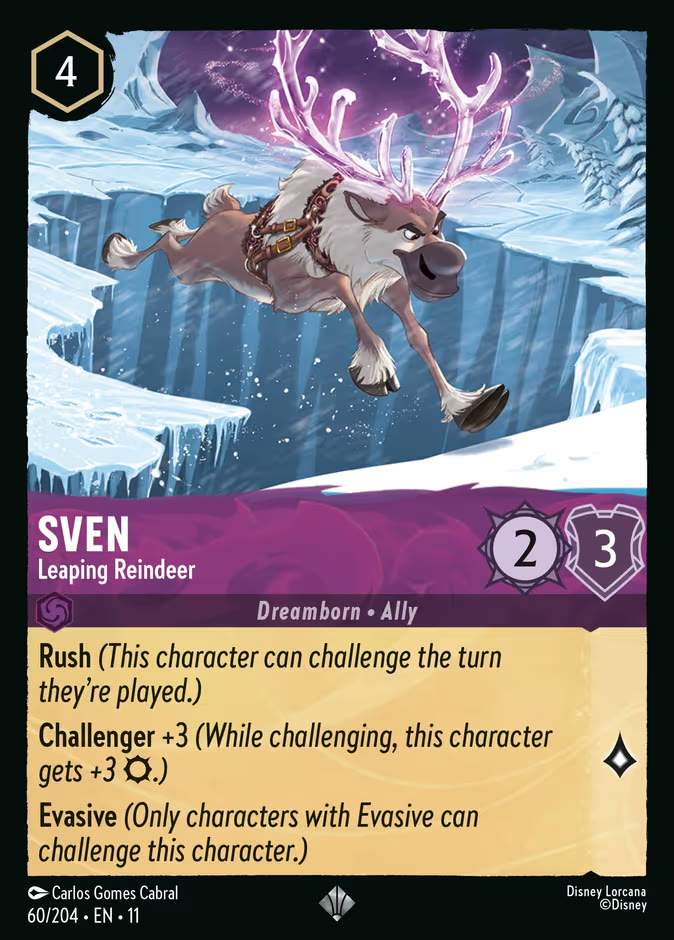
There is a Lorcana game state that ends more matches than any removal spell, and it looks like nothing. Your opponent has one 2-lore character on the table. You have four characters, all bigger, all ready. And you cannot touch it, because it has Evasive and not one of your four does.
That is not a skill gap. That happened in deckbuilding, weeks earlier, when you picked two inks without checking whether they could interact with the second-most-printed keyword in the game.
So I pulled the whole card pool from the Lorcast API and counted every printed keyword from the card text rather than trusting a metadata field (Lorcast's keyword field leaves Alert out entirely). The method: the 13 main sets from The First Chapter through Attack of the Vine!, promos excluded, 3,000 printings merged into 2,476 unique cards by full name (name plus version, ignoring apostrophe style and capitalisation), re-checked against Lorcast's 10 October 2026 export. Then I lined the counts up against the definitions in the Comprehensive Rules - version 2.2.0, in force from July 9 to October 15, 2026, and version 2.3.0, which takes over on 16 October 2026. What came out is not what the reminder text implies.
Keywords are where Lorcana keeps its strategy
Comprehensive Rules 2.2.0, in force until 15 October 2026, lists exactly fourteen in rule 8.1.1: Alert, Bodyguard, Boost, Challenger, Evasive, Reckless, Resist, Rush, Shift, Singer, Sing Together, Support, Vanish and Ward. Version 2.3.0, effective 16 October 2026 for Hyperia City, adds a fifteenth, Adventurous, as section 8.16 (covered below). Anything else in a text box is a named ability, not a keyword.
They are also rarer than they feel. Only 666 of the 2,476 unique cards carry a printed keyword at all - 26.9 percent. Stacking is rarer still: 593 cards have exactly one, 66 have two, and seven cards in the main-set pool have three. If you have ever felt like a card with two keywords was pushed, the maths agrees with you.
The next rule, 8.1.2, is the stacking rule. Keywords written with a plus-N stack; keywords without one do not. Resist +1 and Resist +2 on the same character is Resist +3. Under 2.2.0, a character that already has a non-stacking keyword simply does not get a second copy. Version 2.3.0 changes that from 16 October: when two copies meet, the one with the longer duration applies and the other ceases to exist. A printed Support plus a Support granted until the end of your turn is still just the printed Support under both versions - that is 2.3.0's own worked example - but a longer-lasting grant can now replace a shorter one.
If the turn structure is still new, start with how to play Disney Lorcana - everything below assumes you know what questing, challenging and drying mean.
Every keyword at a glance
Counts are unique cards carrying that keyword as printed text, through Attack of the Vine!. Dual-ink cards are counted once, and appear under both of their inks in the ink column.
| Keyword | Cards | Rule | Lives in |
|---|---|---|---|
| Shift | 199 | 8.10 | Everywhere - 36 to 45 per ink |
| Evasive | 134 | 8.6 | Amethyst 48, Emerald 47, Ruby 44 |
| Bodyguard | 59 | 8.3 | Amber 32, Steel 27 |
| Support | 56 | 8.13 | Sapphire 30, Amber 27 |
| Ward | 55 | 8.15 | Sapphire 28, Emerald 27 |
| Rush | 52 | 8.9 | Ruby 28, Amethyst 23 |
| Resist | 38 | 8.8 | Steel, all 38 |
| Challenger | 38 | 8.5 | Amethyst 22, Steel 16 |
| Boost | 32 | 8.4 | All six, 4 to 8 each |
| Singer | 29 | 8.11 | Amber 25, Ruby 4 |
| Reckless | 20 | 8.7 | Ruby, all 20 |
| Sing Together | 18 | 8.12 | All six, songs only |
| Alert | 9 | 8.2 | Steel 5, Sapphire 4 |
| Vanish | 7 | 8.14 | Amethyst 6, Steel 4 |
| Adventurous | - | 8.16 (from 16 Oct 2026) | New with Hyperia City |
Adventurous has no count because no card through Attack of the Vine! carries it on a keyword line; it arrives with Hyperia City.
Three of those rows are absolutes worth memorising. Every one of the 38 Resist cards is Steel or a Steel dual-ink card. Every one of the 20 Reckless cards is Ruby. Every one of the 38 Challenger cards is Amethyst or Steel. There are no exceptions, not one, across three years of printing. If your deck wants those effects, those inks are not a preference, they are a requirement.
Shift is the most-printed keyword in the game
199 cards, about eight percent of the 2,476 unique cards in the main-set pool. Shift is more common than Bodyguard, Support and Ward combined.
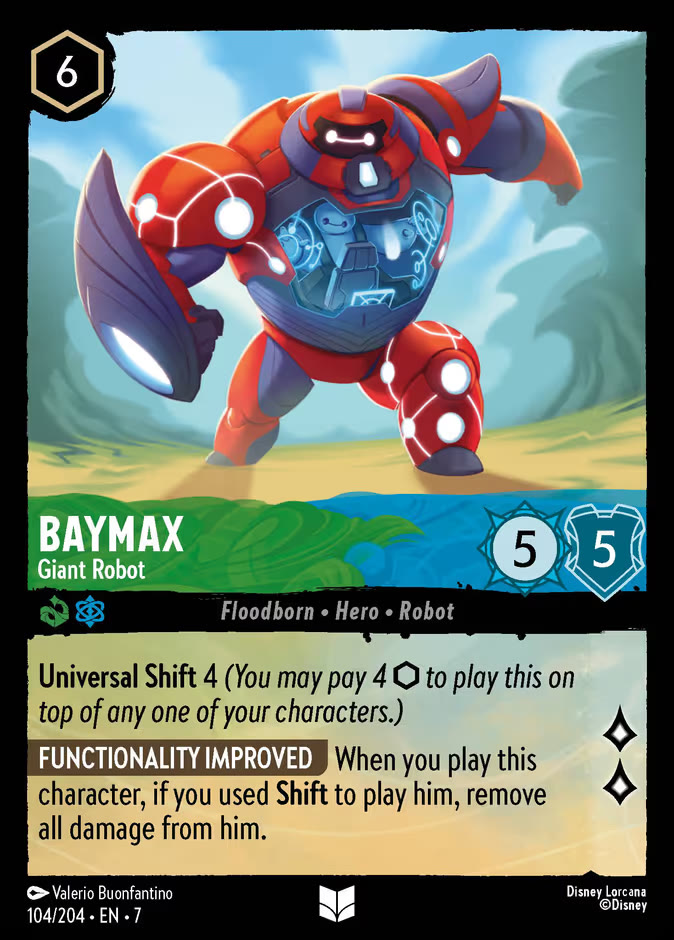
Rule 8.10.1 is the important half: if you have a character in play with the same name as the Shift card, you may pay the Shift cost instead of the ink cost and stack the new card on top. The value is a discount, and it is a big one. Across the 193 Shift cards with an ink cost, the most common price is 3 ink (58 cards), with 4 close behind (51) and the rest running 2 (21), 5 (42), 6 (13) and 7 (6), plus one card each at 0 (Mickey Mouse & Minnie Mouse - Adventuring Duo, a Duo Shift) and 1 (Nick Wilde - Sly Fox). Shifting a 7-cost body onto a 3-cost one for 5 ink is a turn of tempo you did not have.
The part that catches people is 8.10.4: a shifted character inherits its target's dry state. Stack onto a character that has been out since the start of your turn and the new one can quest immediately, ignoring the drying rule entirely. That is the actual engine behind Shift, and it is why Evasive and Shift appear together on 23 cards - the most common keyword pairing in the game by some distance.
Rule 8.10.8 lists six variants: Classification, Universal, Duo, Combo, Temporary and Potato Shift. Universal Shift stacks onto any character you control, and there is exactly one card with it in the game. Classification Shift stacks onto a character with a stated classification, and there are four: Thunderbolt - Wonder Dog (Puppy Shift, from Archazia's Island), The Madrigal Family - Every Generation (Madrigal Shift), The Vine - Towering Stalk (Floodborn Shift) and Sun Yee - Red Panda Spirit (Temporary Red Panda Shift, which combines two variants). Six more cards replace the ink cost with a discard instead, all of them from Ursula's Return. Attack of the Vine! is where the variants piled up: it printed three of those four Classification Shifts, and 10 of the 12 cards that carry any named Shift variant.
Evasive and the three ink pairs with zero printed copies
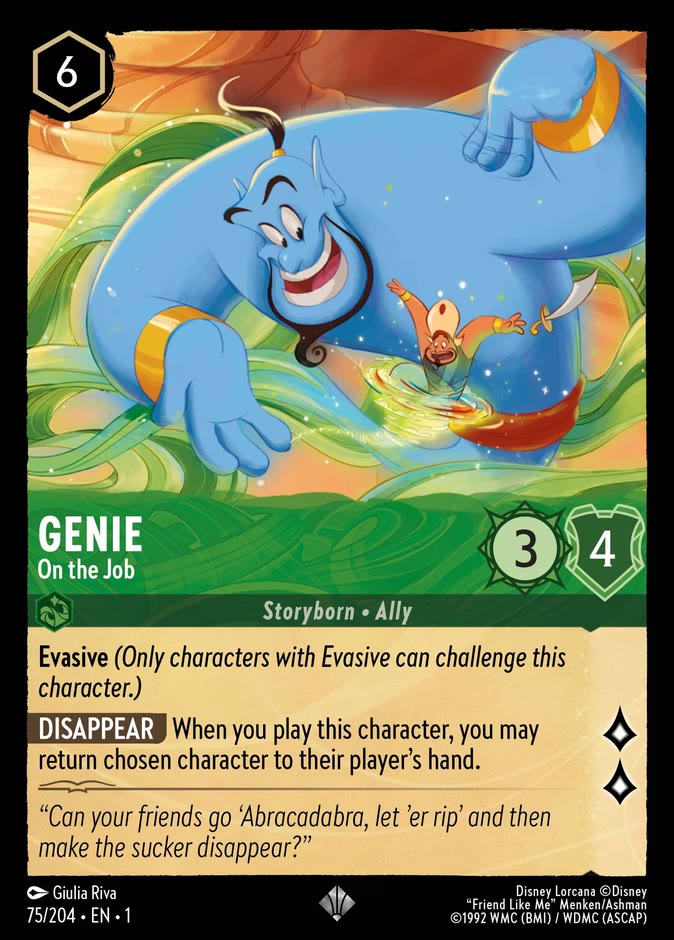
Rule 8.6.1 is one sentence: an Evasive character cannot be challenged except by a character with Evasive. It is the second-most-printed keyword at 134 cards, and it is stacked almost entirely into three inks - Amethyst 48, Emerald 47, Ruby 44.
The other three inks look like they have a handful. Amber 5, Steel 5, Sapphire 4. Look closer: every single one of those 14 cards is a dual-ink card whose other half is Amethyst, Emerald or Ruby. There is not one mono-Amber, mono-Sapphire or mono-Steel card in the main-set pool with Evasive as a printed keyword.
Run that through the two-ink deckbuilding limit and you get a result that should be printed on the box:
| Your inks | Printed Evasive cards available |
|---|---|
| Amber + Sapphire | 0 |
| Amber + Steel | 0 |
| Sapphire + Steel | 0 |
| Any pair with Amethyst, Emerald or Ruby | 39 to 81 |
Zero. Not "few" - none. If your two inks are drawn from Amber, Sapphire and Steel, there is no legal 60-card deck that can challenge an Evasive character with a printed Evasive body. And Amber plus Steel is the beginner pairing our own ink guide recommends, because it is otherwise the most forgiving shell in the game.
That is not a reason to avoid it. It is a reason to know that your answer to an Evasive quester has to come from somewhere else: damage effects that do not require a challenge, bounce, or the cards in the next section.
Alert is the patch, and it went exactly where the hole was
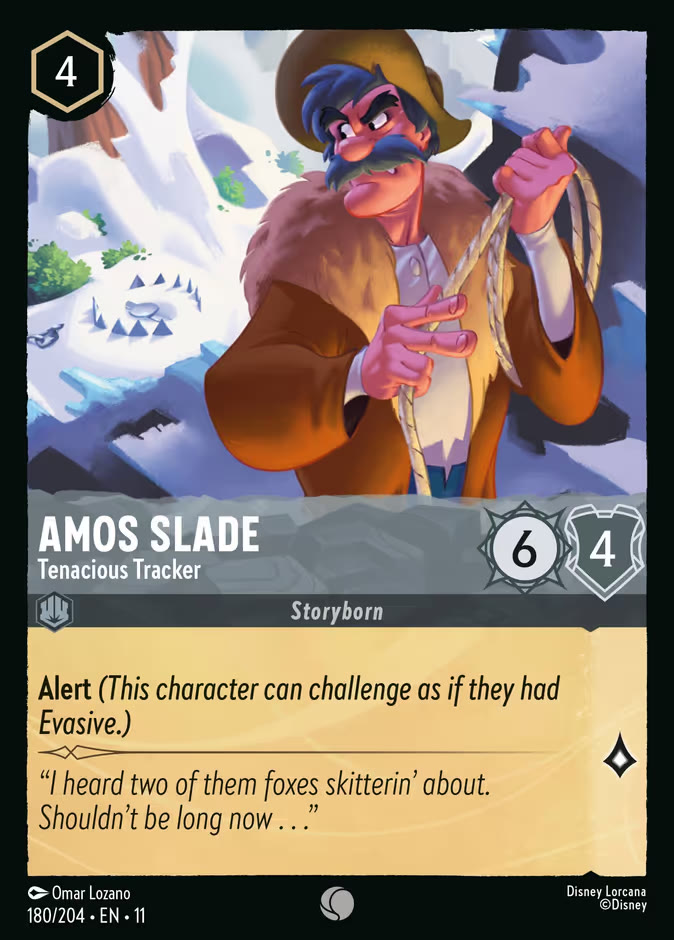
Rule 8.2.1: a character with Alert ignores the challenging limiters of Evasive. Rule 8.2.2 adds the fiddly bit - it does not gain Evasive, so it can still be challenged by anything.
Nine cards have it. Five are Steel, four are Sapphire, none are dual-ink, and none are Amber, Amethyst, Emerald or Ruby.
Read that against the previous section. The three inks with no printed Evasive of their own are Amber, Sapphire and Steel, and Alert was printed into two of them. It started in Whispers in the Well, the same set that introduced Boost, with more in Winterspell, Wilds Unknown and Attack of the Vine! - four consecutive sets.
Counting Alert alone, Sapphire plus Steel has 9 cards that can challenge an Evasive character, Amber plus Steel has 5 and Amber plus Sapphire has 4. Alert is not the only route, though. Sapphire and Steel have printed the same answer long-hand since The First Chapter: 21 mono-ink characters in the main sets - 13 Steel and 8 Sapphire, Simba - Returned King and Robin Hood - Unrivaled Archer among them - gain Evasive during your turn (two of them only under a condition), which lets them challenge an Evasive character. Another 12 Sapphire and Steel cards - characters, actions and items - hand out Evasive or Alert. If you are on one of these pairings, those are the card names to know.
Amber is the ink left out. It has no Evasive of its own, no Alert, and no card that hands either out.
Bodyguard and Resist: how Lorcana builds a wall
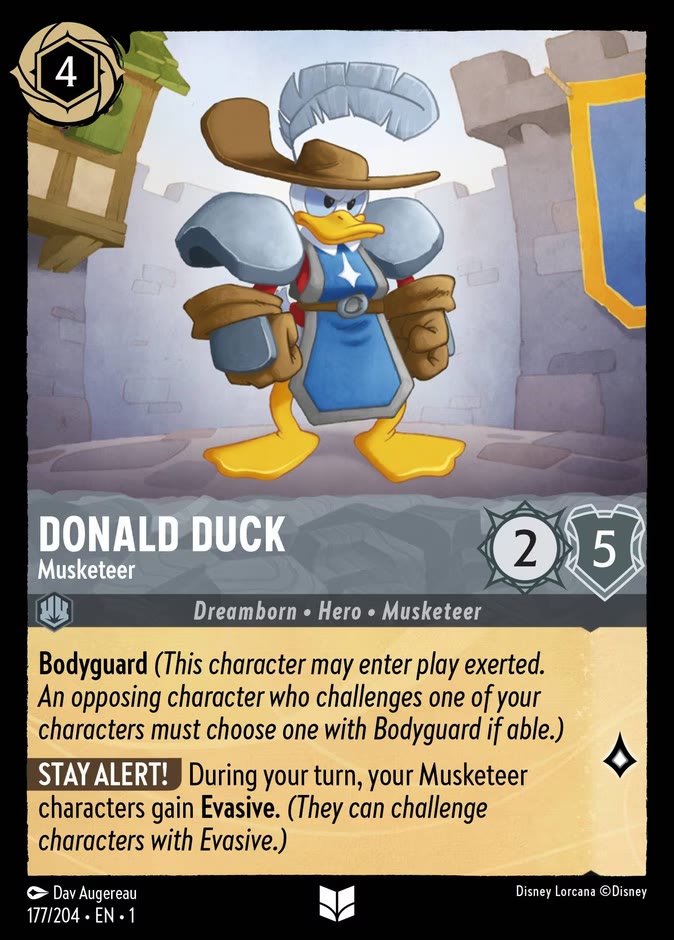
Bodyguard is two abilities wearing one word, which is why it confuses people. Rule 8.3.2 lets the character enter play exerted - optional, your choice, and the reason a Bodyguard can eat a challenge the turn it lands. Rule 8.3.3 is the redirect: if an opponent challenges any of your characters, they must choose one with Bodyguard if able.
Note "if able." A Bodyguard that is ready cannot be challenged at all, since you may only challenge exerted characters. That is why Bodyguards enter exerted on purpose - a ready Bodyguard protects nothing.
Fifty-nine cards, and it is an Amber and Steel keyword by a mile: Amber 32, Steel 27. Play Amber plus Steel and you have 54 Bodyguard cards to choose from, the deepest Bodyguard pool any pairing gets.
Resist is the other half of that wall and it is the purest ink lock in the game. All 38 cards are Steel or Steel dual-ink. Rule 8.8.1 reduces damage that would be dealt, and 8.8.2 clarifies that damage reduced to zero counts as no damage at all - which turns off "whenever this character is damaged" triggers entirely. Rule 8.8.3 is the trap: damage put or moved onto the character is not reduced. Resist stops challenges and damage effects, not the cards that shuffle existing damage around.
The values are small on purpose. Resist +1 on 28 cards, +2 on 9, and exactly one Resist +3 in the whole game - Namaari, Resolute Daughter, a 9-ink Steel card from Shimmering Skies.
Challenger, Rush and Reckless: the combat trio
Challenger +N gives bonus Strength while challenging, and only while challenging (rule 8.5.2 - you get nothing on defence). Thirty-eight cards, every one of them Amethyst or Steel. The spread is +2 on 21 cards and +3 on 10, so anything above that is a build-around: three cards at +4, one at +5, and a single Challenger +7 on Jafar, Tyrannical Hypnotist, a 6-ink Steel card from Shimmering Skies.
Rush (8.9) lets a character challenge the turn it is played by treating it as though it had been in play since the start of your turn. Fifty-two cards, Ruby 28 and Amethyst 23. Amethyst plus Ruby gets 50 of them - the reason that pairing plays as fast as it does.
Reckless (8.7) is the one people misread. It is not "must attack." It is two abilities: the character cannot quest, and you may not declare the end of your turn while it is ready and able to challenge. All 20 cards are Ruby. Rule 8.7.4 is the useful escape hatch - you can still exert a Reckless character to pay ability costs or sing a song, which is a legal way to spend it on a turn where challenging would be a disaster.
Ward and Support are the keywords Sapphire actually owns
Ward (8.15.1) means your opponents cannot choose this card when resolving an effect. Not "cannot target it with removal" - cannot choose it, full stop. Rule 8.15.2 is the important limit: effects that do not require a choice still work. A board wipe that hits every character does not care about Ward. A spell that says "chosen character" does.
Fifty-five cards, split Sapphire 28 and Emerald 27. Emerald plus Sapphire gives you 50 of them, and that is the entire pitch for that pairing - two inks whose best bodies are simply not interactable by most removal.
Support (8.13.1) is a triggered ability: whenever this character quests, you may add its Strength to another chosen character's Strength this turn. Fifty-six cards, Sapphire 30 and Amber 27. Amber plus Sapphire reaches 51. It reads like a combat trick and plays like one, because the bonus lasts the turn - quest with the Support character first, then challenge with the character you pumped.
Singer and Sing Together: the song engine
Singer N (8.11.1) lets a character exert to sing a song as though it cost N. Twenty-nine cards, and 25 of them are Amber - two of those dual-ink, Mirabel Madrigal - Hopeful Dreamer with Amethyst and The Troubadour - Musical Narrator with Steel. The four exceptions are all Ruby and all rock stars - Max Goof, King Louie, and both Powerline cards - which is the kind of flavour discipline I will always take. Values run 3 to 9, clustering at Singer 5 (11 cards).
Rule 8.11.2 is the line that wins arguments: the character counts as cost N only for singing, and only during the process of playing the card. Its ink cost never changes, so it is still whatever it was for every other effect in the game.
Sing Together N (8.12) is the group version - exert any number of your characters whose total ink cost meets or exceeds N and play the song for free. Eighteen cards, all of them songs, spread across all six inks, with N running 5 to 10. It debuted in Ursula's Return. Rule 8.12.3 is the one to exploit: every character that helps sing counts as having sung, so "whenever this character sings a song" triggers fire for all of them at once.
Boost and Vanish: a stockpile and a tax
Boost (8.4.1) is something you choose to use, not a static ability: once during your turn, at any point you could use an activated ability, you may pay N ink to put the top card of your deck facedown under this card. Thirty-two cards so far, 18 from Whispers in the Well and 14 from Winterspell, and unlike almost every other keyword it is spread across all six inks - Ruby 8, Sapphire 7, Amethyst 5, and 4 each in Amber, Emerald and Steel. Costs are Boost 1 (10 cards), Boost 2 (18) and Boost 3 (4). One of them is a Location rather than a character.
Two rules make it work. Nobody may look at the face of a boosted card, ever, including you (8.4.2). And a card under another card is not in play, so boosting it is not playing it (8.4.3). The cards under a character are a stockpile you paid ink to build, and the payoff text on each card decides what that stockpile is worth. (They are not "counters" in the rules sense: from 16 October, rule 1.13 reserves that word for damage counters and ink drops, and 1.13.3.3 bars standard cards from being used as counters.)
Vanish (8.14.1) is the smallest of the fourteen printed keywords at seven cards, all Amethyst or Steel, all from Archazia's Island and Reign of Jafar, and all Illusion-flavoured. When an opponent chooses this character as part of resolving an action, banish it. It is a punish, not a protection - the opponent still gets the effect, and 8.14.2 confirms Vanish resolves afterwards. Vanish makes your opponent's targeted removal cost them a card of tempo, which against a control deck is exactly the tax you want.
Adventurous arrives with Hyperia City on 16 October
Comprehensive Rules 2.3.0, written to prepare for Hyperia City, takes effect on 16 October 2026, the day of the Hyperia City prerelease (the set goes on sale everywhere on 23 October, per Ravensburger's product page), and adds the fifteenth keyword as section 8.16. Adventurous is two static abilities: the character can't challenge (8.16.2), and you can't declare the end of your turn while it is ready and can quest (8.16.3). Rule 8.16.4 keeps the escape hatch Reckless has - you can still exert it to use abilities or sing songs.
Ravensburger's Hyperia City release notes frame it as the mirror of Reckless: one forces a challenge, the other forces a quest. The same notes update five older Amber cards whose long-hand text already said a chosen opposing character "can't challenge and must quest" - Gaston - Frightful Bully, Cobra Bubbles - Dedicated Official, Ariel - Curious Traveler, This Growing Pressure and Woody - Town Sheriff - to reflect that what they hand out is now Adventurous.
One housekeeping note if you read the PDF yourself: the English 2.3.0 rule 8.1.1 summary still lists only the original fourteen names, even though section 8 now runs to 8.16. The rest of the 2.3 update, including ink drops, is in Hyperia City rules changes.
What the numbers should change about your deck
Three things, in order of how much they will cost you.
Check your Evasive answer before you pick inks. If your pair is drawn from Amber, Sapphire and Steel, none of your cards has Evasive as a printed keyword. Your ways to challenge an Evasive character are the Alert characters (four to nine, depending on the pair), the Sapphire and Steel characters that gain Evasive during your turn, and the cards that hand out Evasive or Alert - and an Amber pairing gets only its partner ink's share, because Amber has none of them. Build the answer in deliberately - those bodies if you are in Sapphire or Steel, or damage effects that never mention challenging.
Stop treating Shift as a rare-card tax. 199 cards carry it, the most common Shift cost is 3, and stacking onto a dry character skips drying entirely. If you are playing four copies of a character and never running the Shift version, you are declining the cheapest tempo swing in the format.
Read the keyword, not the reminder text. Resist does not stop moved damage. Ward loses to effects that do not choose. Bodyguard only works exerted. Alert does not grant Evasive. Every one of those is a rule that costs a game the first time it comes up, and all four are one line each in section 8.
If keyword design is the part of card games you like, the same exercise on other games is illuminating: MTG keywords explained covers a pool where evergreen keywords are a deliberate rotating list, and Braverse keywords explained covers a much younger game still deciding what its evergreens are. Lorcana sits between them - fourteen keywords (fifteen from 16 October), three years, and a pool with clear enough patterns that you can read a card's ink off its keyword line most of the time.
Card counts here cover the 13 main sets through Attack of the Vine!, re-checked against Lorcast's 10 October 2026 export; Hyperia City is not in them. Rule numbers are from Comprehensive Rules 2.2.0 and carry over unchanged into 2.3.0, whose update summary lists two section-8 changes: the rewritten 8.1.2 and the new 8.16. The card counts will drift with every set; the section-8 definitions rarely do.
Frequently Asked Questions
How many keywords are in Disney Lorcana?
What is the most common keyword in Disney Lorcana?
What does Evasive do in Lorcana?
Which Lorcana inks have no Evasive characters?
What does Alert do in Disney Lorcana?
Which ink has Resist in Lorcana?
Do Lorcana keywords stack?
How does Bodyguard work in Lorcana?
What does Boost do in Disney Lorcana?
Keep Reading
- Disney Lorcana Comprehensive Rules 2.2.0, effective July 9, 2026 (Ravensburger)
- Disney Lorcana Comprehensive Rules 2.3.0, effective October 16, 2026 (Ravensburger)
- Disney Lorcana TCG Set Release Notes: Hyperia City - Adventurous and keyword stacking (Ravensburger, 8 October 2026)
- Hyperia City product page - prerelease 16 October 2026, on sale everywhere 23 October 2026 (Ravensburger)
- Lorcast - Disney Lorcana card database and search API
- Disney Lorcana TCG Resources (Ravensburger)
- Keyword - Disney Lorcana Wiki
Related Guides
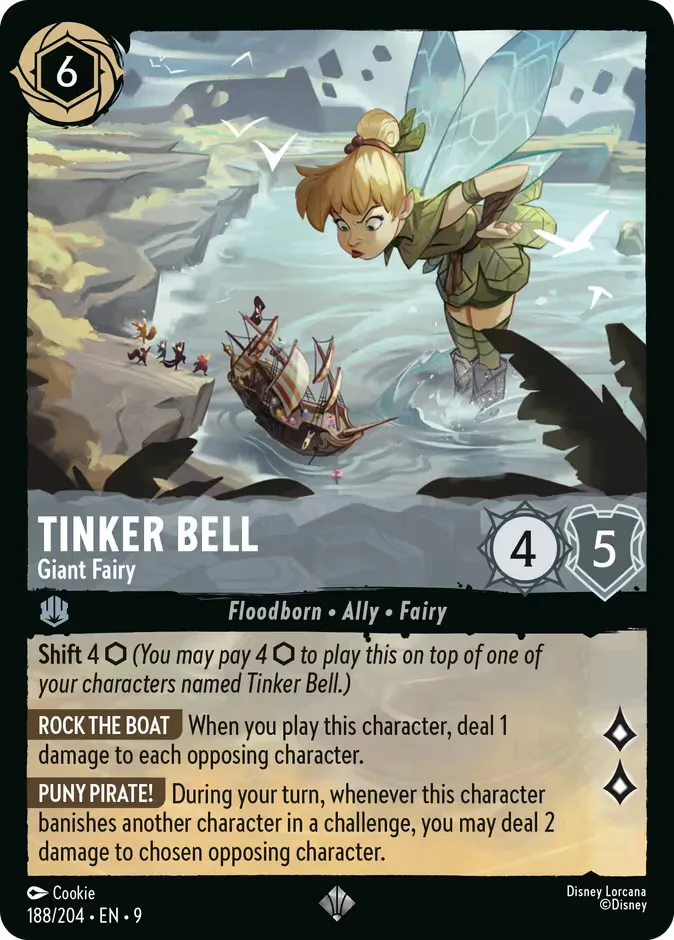
Lorcana Shift Explained: Stacks, Damage and All 6 Variants
Shift is 199 cards across the 13 main sets before Hyperia City and a full page of rules, and most of that page is about the card underneath. Here is what a shifted character inherits, why 63 Core-legal cards care about the stack, where every card goes when the top one leaves play, and what each of the six variants actually lets you shift onto.
Lorcana Hyperia City Rules Changes: What CR 2.3 Changed
Ravensburger's Hyperia City release notes do more than explain the new set. Five Core cards gain a keyword, ink drops finally get a rule, keywords stop cancelling each other the old way, and an old Black Cauldron trick gets a written answer. Here is each change, the old wording next to the new, and the rulings that teach a general rule.
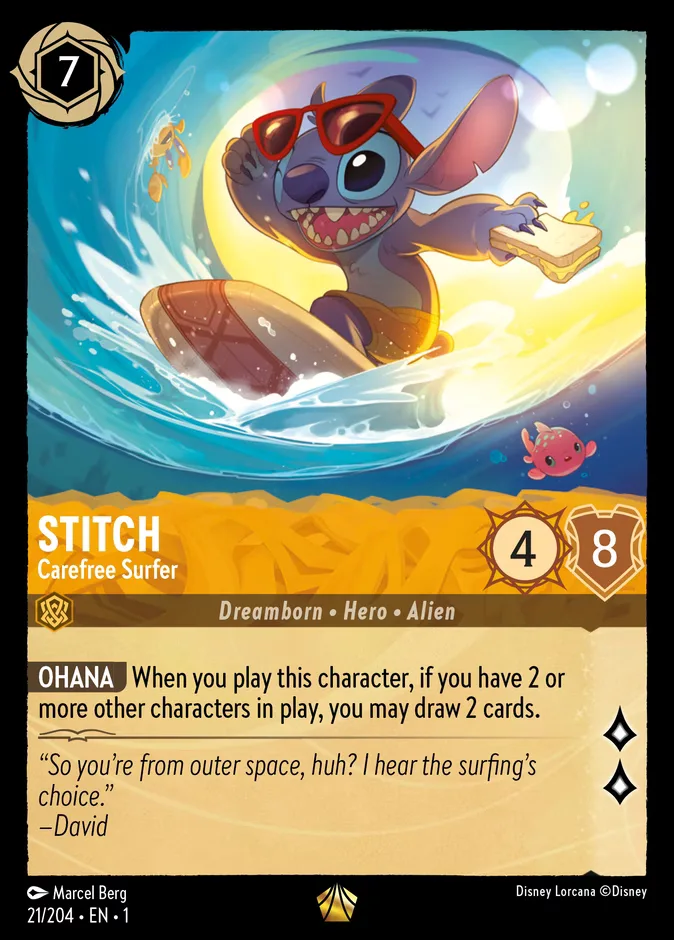
Disney Lorcana's Bag Explained: How Trigger Order Works
Six other posts on this site mention "the bag" in passing and none of them explain it. Here is the actual rule: what goes in, what never does, the exact order it resolves in when two abilities fire at once, and the two different ways a Lorcana card can make something happen later.
Disney Lorcana Uninkable Cards: All 585, and How to Ink One
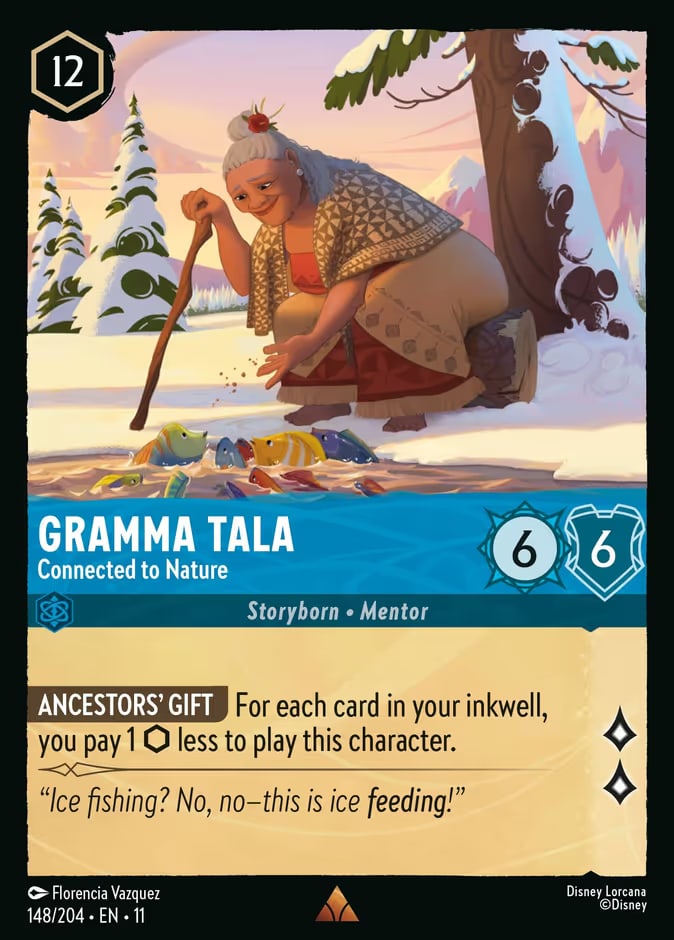
The inkwell symbol is the first rule Lorcana teaches and the last one anybody puts a number on. Here is the whole uninkable pool counted off the live card data - 585 of 2,476 cards - cut by rarity, cost, type and ink, plus the Comprehensive Rules clause that lets five specific cards put an uninkable card into your inkwell anyway.
How to Play Disney Lorcana - Rules, Turn Structure, and the Race to 20 Lore
Lorcana is the rare TCG where you never attack your opponent directly. You race them to 20 lore. This is the full rules walkthrough - inkwell, turn phases, questing, challenging, drying, card types, and deck limits.
Disney Lorcana Format Coconut Explained: All 18 Beta Cards
Ravensburger put a new multiplayer format into open beta and then did not print a single card for it. The 18 Coconut cards live in the Companion app, the rules fit on one page, and the deckbuilding restrictions are stranger than the summary makes them sound. Here is the whole thing, with the card pool behind each Coconut counted.