Gundam Card Game Multiplayer Rules - 2v2 and Battle Royale
On 25 September 2026 a store release event opened with a Battle Royale option and Bandai posted four decklist pairs built for 2v2 Team Battle. Most of the 1v1 game carries over, but a handful of rules change who gets EX Resources, whose hand a Shield lands in and what "friendly" means once your partner sits next to you - and Bandai's own two rules documents disagree on one of them. Here is every change, the 11 multiplayer rulings I found in Bandai's FAQ, the 35 cards whose text reads the size of the table, and what Bandai's 14 team decklists do differently.
Two things went live on 25 September 2026 that make multiplayer Gundam worth learning properly. Bandai's ST11-ST14 Starter Release Event opened at stores, running to 8 October, and its event page lets a store run it as a single round of Battle Royale in which the last player standing at each table takes an extra pack. The same day, Bandai's DECKS page added four pairs of 50-card lists built for two-on-two Team Battle, one of them introduced as "Designed for two-on-two team battles."
Most of the 1v1 game carries straight over. The Comprehensive Rules give multiplayer one section, section 12, and say deck construction and game progression are "generally the same" as in a two-player game. The exceptions are few and specific, and they are exactly the ones that decide a pod: whose hand a Shield lands in, who gets an EX Resource, and what the word "friendly" means once your partner is sitting next to you. Here is every one of them, plus the 35 cards whose text changes with the size of the table.
How I checked
Rules text is Comprehensive Rules Ver. 1.9.0, dated 11 September 2026, whose section 12 is Multiplayer Battle. I read it against Bandai's two standalone pages, Team Battle Rules (updated 6 February 2026) and Battle Royale Rules. The official FAQ has no multiplayer category, so I searched it for "team", "teammate", "multiplayer", "battle royale" and "enemy player" and kept every answer that turns on the number of players.
Card counts come from a freeword search of the English card database for "player" on 28 September 2026, with every result's detail page read in full. Deck numbers come from all 53 lists on Bandai's DECKS page the same day. As a check on that parse, it reproduces the tallies the Commands guide and Bases guide published for the first 41 lists exactly: 284 Command copies, 120 of them with Action timing, and 30 lists at four Bases.
What changes, side by side
The 1v1 rules walkthrough is the baseline. This is what moves:
| 1v1 | Battle Royale | Team Battle | |
|---|---|---|---|
| Players | 2 | 3 or more | 4, as two teams of two |
| Shields at the start | 6 each | 6 each | 8 per team - 4 from each player - in one shared shield area |
| EX Base | 1 each | 1 each | 1 per team |
| EX Resource | Player Two only | Every player except Player One | Team Two (the two rules documents disagree on how many - see below) |
| Bases in play | 1 each | 1 each | 1 per team |
| Unit cap | 6 each | 6 each | 6 per team |
| Legal attack targets | The opponent, or their rested Units | Any other player, or any other player's rested Units | The opposing team, or its rested Units |
| "Enemy" in card text | The other player | Every other player | Both players on the other team |
| Turn order | Alternating | Clockwise or counterclockwise, Player One's choice | Teams alternate; both teammates play the turn together |
| Deck runs out | You lose | You are removed from the game | Your whole team loses |
Deck construction does not move at all. Each player still brings their own 50-card, one-or-two-colour deck and 10-card resource deck, which means a Team Battle team can field four colours between them. That matters later.
Battle Royale: everyone against everyone
Setup, from rules 12-2-1 to 12-2-3: everyone plays rock-paper-scissors, the winner becomes Player One and picks clockwise or counterclockwise, everyone draws five, and redraws go around the table starting with Player One. Each player sets out six Shields and an EX Base as normal, and every player except Player One places an EX Resource (12-2-2). In a four-player pod that is three players holding an EX Resource and one holding the first turn.
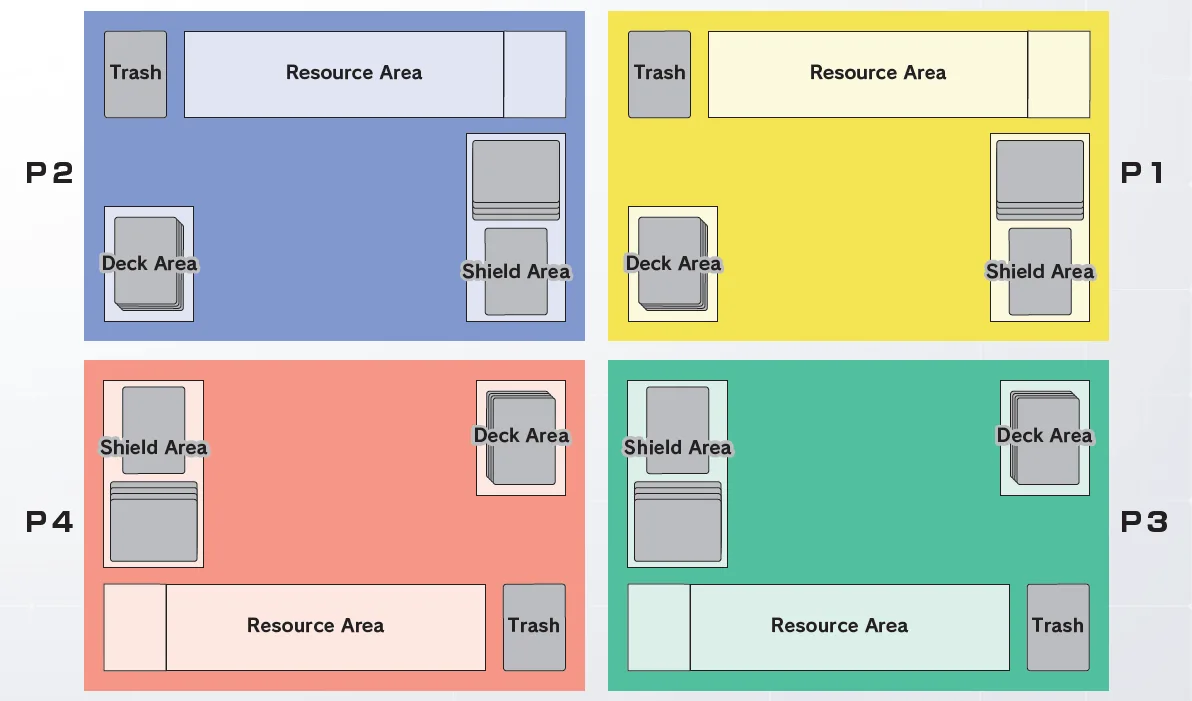
During play, three rules replace their 1v1 versions:
- Targets. You may attack any other player, or any other player's rested Unit (12-2-7), and Bandai's page lets you choose freely which opponent an effect targets. "Enemy" and "opponent" in card text mean every other player (12-2-6).
- Action steps start with the player after the active player and go around in turn order until everyone has passed (12-2-8) - the multiplayer version of 1v1's rule that the standby player acts first (9-2).
- Simultaneous actions resolve active player first, then around the table one player at a time (12-2-4). Rulings Q314 and Q330 apply that to "All enemy players each choose 1 of their active Units" on EB01-009 Gundam Full Armor (Thunderbolt) (EX) and EB01-074 Eternal Road: the enemies choose in turn order, and the effect is still treated as simultaneous.
Then the part you must agree before shuffling, because there are two ways to win (12-2-5):
- Winner takes all. The first knockout ends the game, and only the player who dealt that battle damage wins (12-2-5-1). A player who runs out of deck is removed from the game with all their cards and effects, and play continues.
- Last player standing. Anyone who takes battle damage with an empty shield area, or runs out of deck, is removed along with all their cards and effects; the last player left wins (12-2-5-2). This is the mode Bandai's event page names for the ST11-ST14 release event.
One wording trap. Bandai's Battle Royale page summarises the winning hit as defeating "a player with no Shields". The Comprehensive Rules say a player with no cards in their shield area - so, exactly as in 1v1, a Base still standing there keeps you alive with every Shield gone.
Winner-takes-all also has an edge the rules imply without spelling out: breaking an opponent down to an empty shield area without finishing them hands the win to whoever next lands battle damage on them. And a single Unit can travel. Ruling Q302 covers ST10-001 Zeta Gundam (EX), which sets itself active after destroying a shield area card: in a four-player game it can then attack Player B or Player C, because its own text only stops it choosing the same enemy player or enemy team again that turn.
Team Battle: one shield wall, two players
Setup, from rules 12-3-2 to 12-3-7 and Bandai's Team Battle page:
- Teammates sit side by side. The player on the right is team leader, and the two leaders decide which team goes first.
- Everyone draws five; mulligans start with the first team.
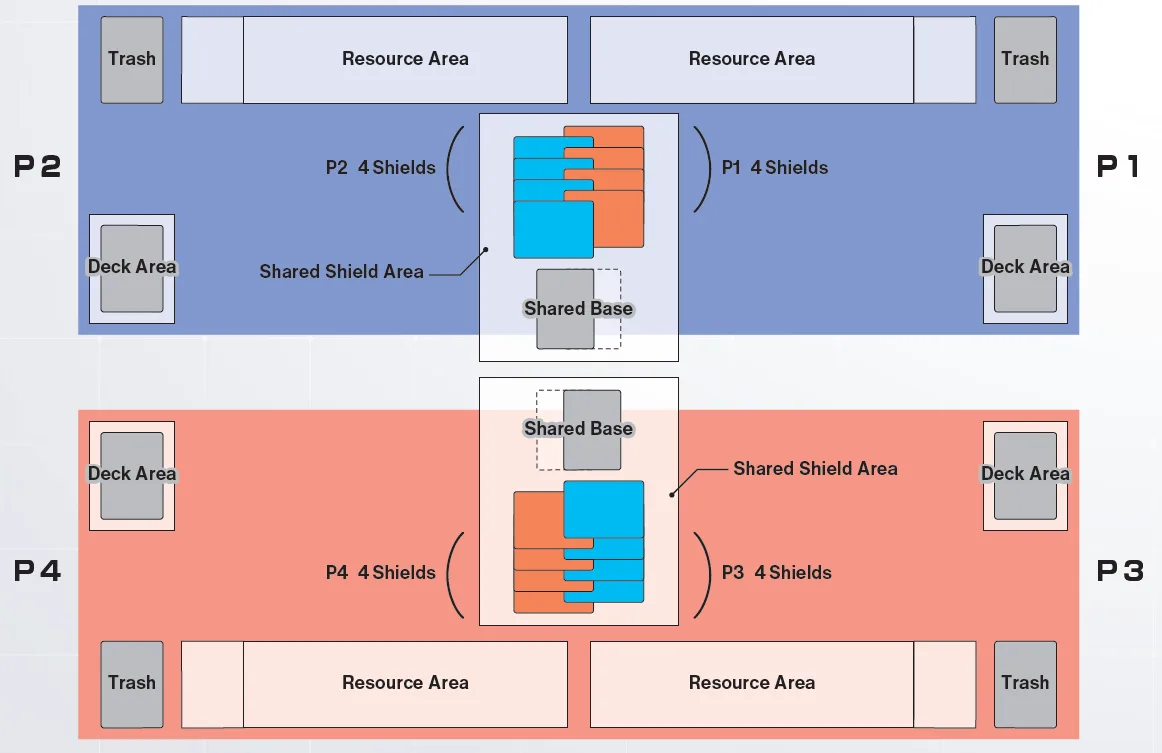
- Each player places the top four cards of their deck into the team's shared shield area, alternating and overlapping, starting nearest the players. Bandai's page adds that the left player's card takes the nearest bottom spot. That is eight Shields per team.
- Each team places one EX Base. The team has one base section, and it holds one Base at a time (12-3-7).
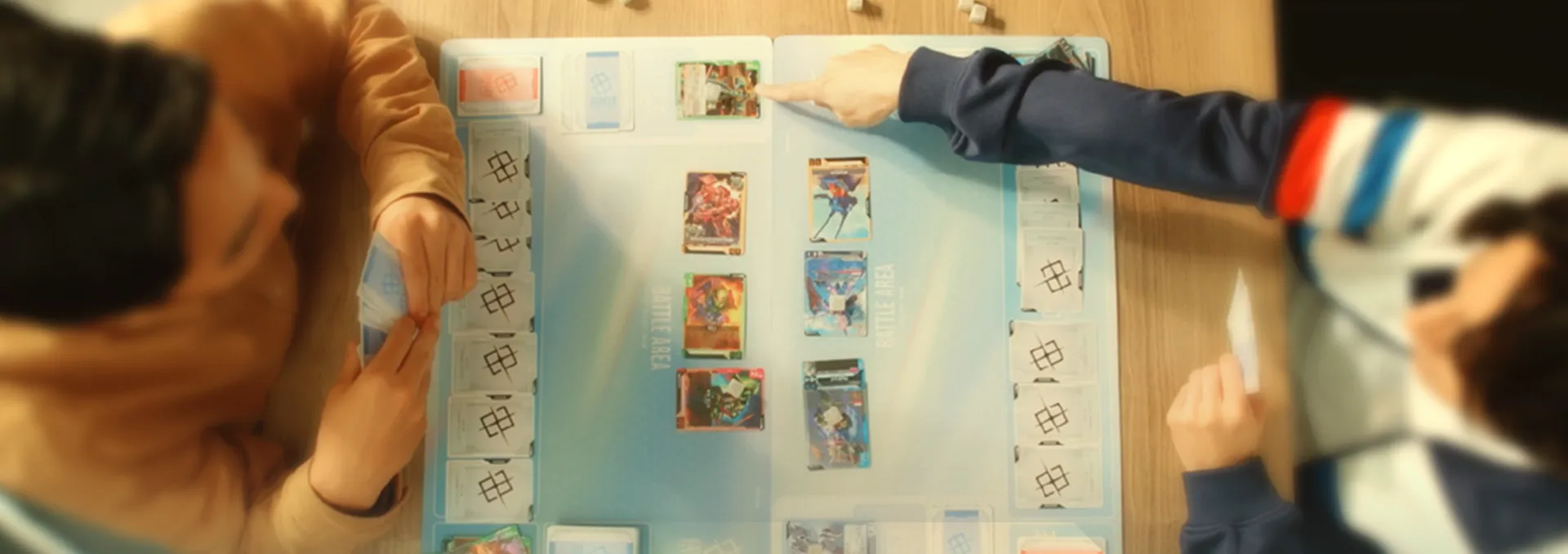
The image at the top of this page is Bandai's own layout diagram: two sets of four Shields interleaved into one stack, one Base slot, and everything else - deck, trash, resource area - still personal.
Once the game starts:
- The turn is shared. Each team goes through every phase together, attacks and action steps included (12-3-1).
- Nothing else is. Hands, Resources and cards on the field stay separate. You cannot lend a card, pay your teammate's cost, or use their Level to play a card (12-3-3). You can talk strategy freely; if you disagree, the leader decides (12-3-4).
- Six Units per team, not per player (12-3-14). If the team's battle area is full when a Unit arrives, you choose one of the team's Units and it goes to its owner's trash (12-3-14-1) - the rule does not limit that choice to your own Units.
- Attacks go at the opposing team itself, meaning their shared shield area, or at one of their rested Units (12-3-12). Your <Blocker> can intercept an attack on your teammate's Unit (12-3-13).
- Pilots pair only with your own Units (12-3-15).
- Losing is team-wide. If any player takes battle damage with no cards in the team's shield area, the team loses; if any one player runs out of deck, the team loses (12-3-9).
Rule 12-3-8 touches every Base in the game. When a Shield takes damage or is added to a hand, it is always the top Shield of the shared stack, and it goes to the trash or hand of that card's owner - not the player whose effect moved it. All 72 Base cards in the English database on 28 September 2026 carry a 【Deploy】 that begins "Add 1 of your Shields to your hand," the template the Bases guide counted on the first 68. In Team Battle, that card goes to whichever teammate owns the top Shield. Bandai's own Triple Ship Alliance x AGE 2 notes turn it into a tip: deploy a Base while your ally's card is on top, and you refill their hand.
The EX Resource line Bandai's two documents disagree on
Here is where the paperwork splits. Comprehensive Rules 12-3-6 says "each player on Team Two places one card." That is two EX Resources for the team going second.
Step 5 of Bandai's Team Battle page says each team places one EX Base, and "The second team also places 1 EX Resource." Read plainly, that is one.
Of the two, the Comprehensive Rules are the newer document - 11 September 2026 against the page's 6 February 2026 - and they spell out which players place the card, where the page names only the team. They also match the pattern of the other two modes, in which every player who does not take the first turn gets one EX Resource. But the page has not been corrected, so settle it before you shuffle. It is a whole extra Resource on turn one.
Friendly means your teammate too, your means only you
Rule 12-3-10: "friendly" means your cards and your teammate's. Rule 12-3-11: "you" and "your" mean only the card's owner. Ruling Q84 puts it in one line: in 1v1 there is no difference between "1 of your Units" and "1 friendly Unit", but in Team Battle "1 friendly Unit" can be your teammate's.
That is not a corner case. A freeword search of the English card database returns 145 distinct card numbers containing the word "friendly", and in Team Battle every one of those references covers your partner's cards too. Bandai's own team lists lean on both halves of the distinction:
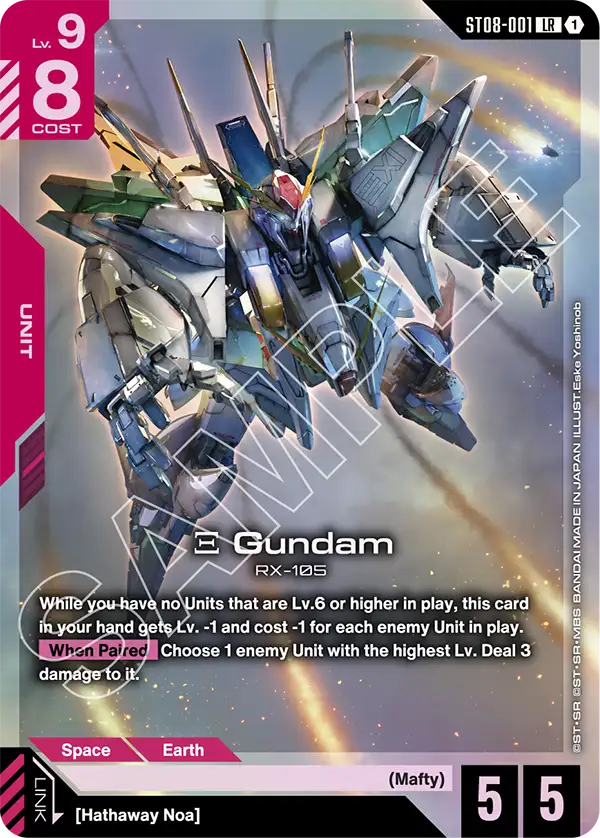
- ST08-001 Ξ Gundam gets Lv. -1 and cost -1 in your hand for each enemy Unit in play, but only while you have no Units that are Lv. 6 or higher. "You" is only you, so your teammate's Lv. 6 finisher does not switch the discount off - and "each enemy Unit" now counts two opponents' boards. Bandai's Ξ Gundam x Qubeley notes call that a combo "only possible in team battle".
- GD05-049 Sazabi destroys one of your Units to make every enemy player destroy one of theirs. Your partner's Units are off the menu - Bandai's Nu Gundam × Sazabi notes say so - but both opponents lose a Unit.
- ST08-012 Words for Hathaway gives a friendly Link Unit <Breach 1>. In Bandai's Banshee Norn × Ξ Gundam pairing it sits in the Green-Red deck and is aimed at the Blue-White deck's Banshee Norn.
- GD01-027 Big Zam's 【Deploy】, once you have 10 or more (Zeon)/(Neo Zeon) Unit cards in your trash, deals 4 damage to all Units with <Blocker> - your teammate's included; Bandai's Big Zam × Psycho Haro notes tell you to agree its timing with your partner first.
35 cards read the size of the table
The same freeword search for "player" returns 54 deck-legal card numbers. Nineteen of them only use the word in heads-up attack wording - "can't choose the enemy player as its attack target", "if you are attacking the enemy player" - which neither counts players nor picks between them. The other 35 behave differently depending on how many opponents are sitting across from you:
| What the text does | Cards | Which |
|---|---|---|
| Only works with 2 or more enemy players | 4 | EB01-040 Gundam Epyon, EB01-044 Justice Gundam (EX), EB01-055 Dom Gross Beil, EB01-058 Extreme Gundam |
| Scales with the number of enemy players | 3 | ST10-008 Gundam Barbatos 1st Form, ST14-006 Full Armor Unicorn Gundam (Destroy Mode), ST14-015 Battlefield Emotions |
| Hits each enemy player once | 8 | EB01-002 Hi-Nu Gundam (EX), EB01-009 Gundam Full Armor (Thunderbolt) (EX), EB01-041 Strike Freedom Gundam (EX), EB01-074 Eternal Road, EB01-082 Warship Cruise, EB01-090 Tiffa Adill & Freeden, GD05-049 Sazabi, ST14-001 The-O |
| Picks one enemy player | 6 | EB01-062 Jona Basta, GD05-046 Abyss Gundam (MA Mode), GD05-107 Interwoven Blessings, ST12-013 The Final Victor, ST13-009 Gundam Pharact, ST14-003 Palace Athene |
| Checks whether any enemy player meets a condition | 3 | EB01-013 Red Gundam(0085), GD05-037 Destroy Gundam, GD05-091 Sting Oakley |
| Shares its effect with other players | 6 | EB01-017 Haro, EB01-023 Le Cygne (EX), EB01-025 Tallgeese Ⅱ, EB01-059 Psycho Zaku, EB01-078 Premium Unit Assembly, GD04-128 Armory One |
| Refers to another player, "a player", or an enemy team | 4 | EB01-005 Zeta Gundam Ⅲ P2 Type, ST10-001 Zeta Gundam (EX), ST12-009 Unicorn Gundam 02 Banshee (Unicorn Mode), ST12-012 Ple-Twelve |
| Lets "that enemy player" respond | 1 | GD05-034 Gaia Gundam |
Eighteen of the 35 come from Eternal Nexus [EB01], the G Generation collaboration booster whose product page says it contains "numerous cards designed for multiplayer modes"; its partner starter, Generation Pulse [ST10], carries the same line and adds two more. The ST11-ST14 card list piece walks through six of the September wave's entries in detail.
The "each enemy player" row is where the swing lives. EB01-082 Warship Cruise costs 1 and returns a Lv. 3 or lower Unit belonging to each enemy player - one card in 1v1, two in Team Battle, three in a four-player royale. Bandai's Strike Freedom × Destiny notes point out the two-for-one in team battles.
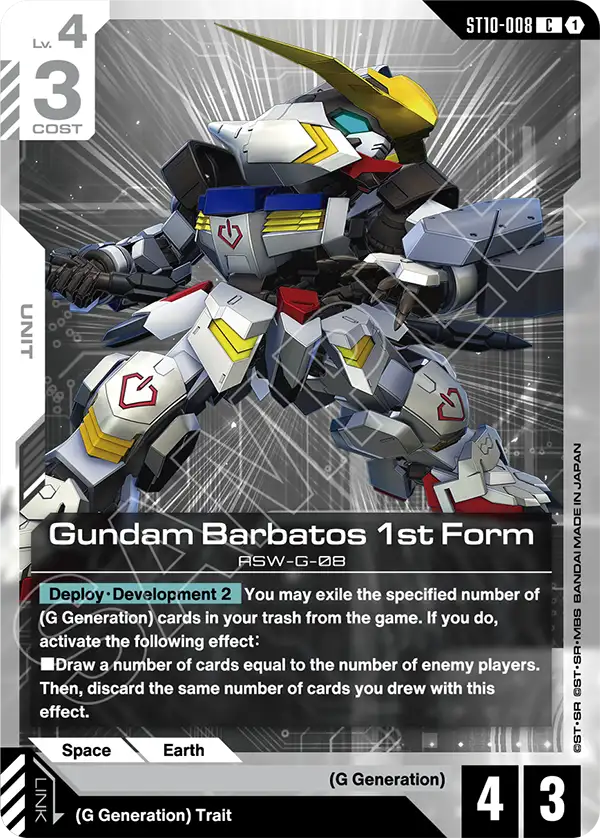
Bandai has ruled on the scaling row directly. ST10-008 Gundam Barbatos 1st Form draws cards equal to the number of enemy players and then discards the same number: ruling Q305 confirms two and two in Team Battle, and Q306 confirms three and three in a Battle Royale "if there are still three enemy players".
Four cards that do nothing extra in 1v1
The first row of that table deserves its own look, because in a two-player game those four abilities never turn on. Each one is conditioned on there being 2 or more enemy players, and a 1v1 game has one.
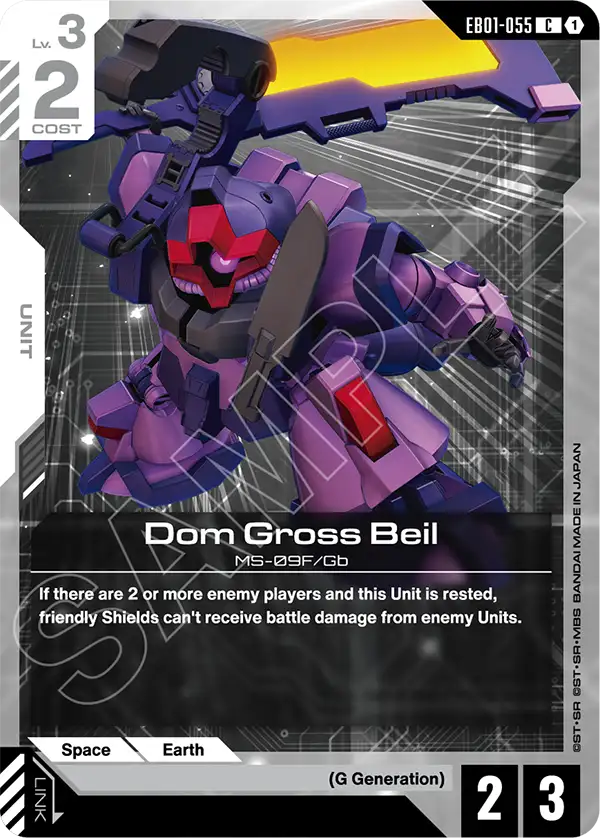
| Card | Lv. / cost | AP / HP | What switches on with 2+ enemy players |
|---|---|---|---|
| EB01-055 Dom Gross Beil | 3 / 2 | 2 / 3 | While it is rested, friendly Shields can't receive battle damage from enemy Units |
| EB01-058 Extreme Gundam | 4 / 2 | 3 / 4 | Gains <Blocker> |
| EB01-044 Justice Gundam (EX) | 6 / 5 | 5 / 4 | 【Deploy】 returns a Unit belonging to the enemy player with the most Units (its <Blocker> works in any game) |
| EB01-040 Gundam Epyon | 8 / 7 | 6 / 6 | 【Deploy】 gives 1 to 3 friendly Units <Breach 3> for the turn |
Dom Gross Beil is the standout. In 1v1 it is a 2/3 whose only text never activates. In Team Battle, where friendly Shields are the one shared stack, a rested Dom Gross Beil stops battle damage from enemy Units to both players' Shields - and the Blue-White halves of Bandai's Strike Freedom × Destiny and Big Zam × Psycho Haro pairings each run four copies. Epyon's <Breach 3> is wider in Team Battle for the same reason: "friendly Units" includes your partner's board.
What Bandai's own team decks look like
Bandai has published 14 lists built for Team Battle: four single lists on 13 February 2026 tagged "(Team Battle Version)", one pair on 26 June 2026 (the Blue-Green Support and Blue-White Thunderbolt page, which describes itself as a deck combo for 2 on 2 battles), and the four pairs of 25 September. Set against the other 38 one-on-one constructed lists on the same page:
| Average per 50-card list | 38 one-on-one lists | 14 Team Battle lists |
|---|---|---|
| Units | 30.5 | 27.0 |
| Pilots | 8.8 | 8.4 |
| Commands | 6.4 | 11.4 |
| Action-timing Command copies | 2.1 | 6.1 |
| Lists with no Action-timing Command | 17 of 38 | 2 of 14 |
| Bases | 4.3 | 3.2 |
| Lists with fewer than four Bases | 0 of 38 | 8 of 14 |
| Distinct card numbers | 15.0 | 14.5 |
The one Battle Royale list on the page, Green-White Psycho Haro, is left out of both columns.
Commands and Bases move furthest; Units drop by 3.5 a list, while Pilots and card variety barely change. Commands nearly double - 12 of the 14 team lists run eight or more, against 15 of the 38 one-on-one lists - and Action-timing copies roughly triple. Bandai's GD03 Jupitris notes tell you to play Commands in action steps whenever possible, and the lists are built to match. The one team list that goes hard the other way is the Green-Purple Big Zam half of Big Zam × Psycho Haro, at 38 Units and no Commands at all.
Bases drop, which lines up with a team having one base section between two players. No one-on-one list runs fewer than four; eight of the fourteen team lists do. Across Bandai's five pairs, the two halves together run 6, 6, 6 and 7 Bases in the four September pairs and 8 in the June pair, where two separate 1v1 decks at the usual four apiece would bring eight every time.
The September pairs also do something with colour that 1v1 cannot. Each teammate's deck is still two colours, but in all four pairs the two halves share no colour at all, so each team covers four of the five. White is in every one of those pairs, and each pair leaves out a different colour: green, blue, purple and red in turn. The June pair is the exception, with blue on both sides. The colour breakdown covers what each of those colours brings.
Every multiplayer ruling I could find
Bandai's FAQ has no multiplayer category, so these are scattered across card pages and one general entry. Searching for team, teammate, multiplayer, battle royale and enemy player turns up these eleven:
| Ruling | Card | What it settles |
|---|---|---|
| Q84 | General (Unit category) | "1 friendly Unit" and "1 of your Units" differ only in team battle, where "1 friendly Unit" can be a teammate's |
| Q302 | ST10-001 Zeta Gundam (EX) | In a four-player royale it can attack a second player after destroying one player's shield card |
| Q305 | ST10-008 Gundam Barbatos 1st Form | Team Battle has two enemy players, so it draws 2 and discards 2 |
| Q306 | ST10-008 Gundam Barbatos 1st Form | A royale with three enemy players left draws 3 and discards 3 |
| Q312 | EB01-005 Zeta Gundam Ⅲ P2 Type | It can choose a teammate's rested Unit in Team Battle |
| Q313, Q329 | EB01-009, EB01-074 | Each enemy player chooses one of their own Units |
| Q314, Q330 | EB01-009, EB01-074 | Enemy players choose in turn order starting from the active player, treated as simultaneous |
| Q464 | ST14-001 The-O | Its untap lock applies to each opponent's field |
| Q486 | GD05-034 Gaia Gundam | Both enemy teammates decide whether to discard; the follow-up deploy happens only if neither does |
For how the FAQ layers over the rulebook in general, see the rulings guide.
What this does not settle
- Whether a knocked-out player still counts. The four "2 or more enemy players" cards and the three scaling cards all read the number of opponents, and in last-player-standing that number falls as players are removed. Bandai has not ruled on it directly; Q306's own wording, "if there are still three enemy players", reads as a count of players still in the game.
- How many EX Resources Team Two gets. Covered above; the two documents still disagree as of 28 September 2026.
- A table-size ceiling. The rules say Battle Royale is for three or more players and set no maximum. The Eternal Nexus and Generation Pulse product pages describe battle royale modes "for up to four players", which reads as what those cards were designed around rather than a rule.
- Anything competitive. Bandai's Battle Royale page pitches the mode as a way to play casually, and its decklists are showcase builds, not tournament results. Nothing here says which multiplayer deck wins. For what a judge enforces at a sanctioned 1v1 event, the tournament rules guide is the one to read.
- Anything after 28 September 2026. Card counts are the English database on that date. Stardust Trails [GD06] releases 30 October 2026 and is not in it; any multiplayer text it prints will move the 35.
If you also play Riftbound, its 2v2 rules are worth reading side by side with this one.
Frequently Asked Questions
How does Team Battle work in the Gundam Card Game?
How does Battle Royale work in the Gundam Card Game?
Who gets the EX Resource in Gundam Card Game multiplayer?
Does "friendly" include my teammate's cards in Gundam Card Game Team Battle?
What happens when a Base adds a Shield to your hand in Gundam Card Game Team Battle?
Which Gundam Card Game cards get better in multiplayer?
How are Bandai's Gundam Card Game Team Battle decklists different from 1v1 decklists?
Keep Reading
- Gundam Card Game Comprehensive Rules Ver. 1.9.0, updated 11 September 2026 (Bandai, PDF) - section 12 Multiplayer Battle, rules 12-1 to 12-3-15
- Team Battle Rules - GUNDAM CARD GAME Official Website (updated 6 February 2026)
- Battle Royale Rules - GUNDAM CARD GAME Official Website
- GUNDAM CARD GAME Official FAQ, freeword searches for "team", "teammate", "multiplayer", "battle royale" and "enemy player" - Q84, Q302, Q305, Q306, Q312, Q313, Q314, Q329, Q330, Q464 and Q486 on multiplayer play
- GUNDAM CARD GAME Official Card Database (freeword searches for "player" and "friendly", every result read 28 September 2026)
- GUNDAM CARD GAME Official DECKS page - all 53 lists read 28 September 2026, incl. the Team Battle lists deck-022 to deck-025, deck-035 and deck-041 to deck-044
- Banshee Norn × Ξ Gundam - official 2v2 Team Battle decklist pair (Bandai, 25 September 2026)
- GUNDAM CARD GAME ST11-ST14 Starter Release Event, 25 September to 8 October 2026 - Standard 1on1 or single-round Battle Royale format
- Eternal Nexus [EB01] product page - "numerous cards designed for multiplayer modes"
Related Guides
Gundam Card Game Errata and Comprehensive Rules Updates
Bandai has corrected the text of three Gundam Card Game cards, and on 30 September 2026 its own card database still shows the uncorrected wording on all three. Here is each errata and what it changes at the table, plus a version-by-version account of the Comprehensive Rules from 1.0 to 1.9.0, built by comparing every archived English PDF against the next - including three rules the official changelog never lists.
Gundam Card Game Timing Keywords: All 13 and When They Fire
Section 13-2 of the Gundam Card Game Comprehensive Rules defines 13 timing keywords, and 715 of the 956 main-deck cards open an effect with at least one. Here is what each one is, when it fires, how many cards print it, the colour it wears on the printed card, and the rulings that separate When Paired, During Pair, When Linked and During Link.
Gundam Card Game Rulings - Bandai Has Answered 425 Questions, and These Are the Ones That Change How You Play
Pair Char Aznable with a Unit that demands Amuro Ray and you have not wasted a card - Bandai says so in writing. That ruling is one of 425 the company publishes in an official FAQ database sitting one click off the rules page, and it is where the fine print of this game actually lives. I read all 425 of them, cross-checked every principle against Comprehensive Rules Ver. 1.8.0, and pulled out the resolution order, the priority exceptions, and the fifth zone that is not the trash.
Gundam Card Game ST11-ST14 Decklists Are Not the Box
Two weeks ago, the closest thing to an ST11-ST14 decklist was a guess. On 25 September 2026 - the day the boxes actually reach shelves - Bandai posted all four, and none of them is the starter deck you can buy. Raging Onslaught keeps nine of its own sixteen cards; Silent Barrage keeps eight. I read all four lists against the card database, checked what got cut, what got imported, and the banned-list update Bandai posted the same day quietly targeting two of the new starters' own vanilla Units.
How to Play the Gundam Card Game - Resources, Shields, Pilots, and the Six-Card Life Total
Your entire life total in the Gundam Card Game is six face-down cards with 1 HP each, plus a token base with 3 HP. This is the complete rules walkthrough - the separate resource deck, the Level and Cost split, setup, the five card types, pairing Pilots into Link Units, the five phases, and combat - checked line by line against Bandai's Comprehensive Rules Ver. 1.8.0.
![Official Bandai key visual for the Gundam Card Game starter deck Raging Onslaught [ST12], showing the crimson and black Gundam Epyon in its mobile suit form, wings spread and heat rod in hand, against a blue starfield.](/images/blog/gundam-tcg/gundam-card-game-st11-st14-card-lists/gundam-st12-raging-onslaught-key-visual.webp)
Gundam Card Game ST11-ST14 Card Lists - All 64 Cards
On 11 September 2026 Bandai put the ST11 through ST14 card lists into the official card database, two weeks before the decks reach shelves. That is 64 distinct cards, 2 Legend Rare and 14 Common per deck, all of them Block 2. It also shipped 62 new rulings and Comprehensive Rules Ver. 1.9.0 the same day. Here is every card, what the four decks are actually built to do, the ruling that changes cards you already own, and the one card whose database entry already disagrees with Bandai's own errata.