Half-Life 2 Developer Commentary: 282 Nodes, 44 Speakers
For twenty years the base game had no commentary track — only the Episodes and Lost Coast did. Then Valve put the original team back in a booth. Here is how big the result actually is, who is in it, and the one thing turning it on takes away from you.

Half-Life 2 shipped in November 2004 with no developer commentary. Lost Coast invented the feature a year later, Episode One and Episode Two both shipped with tracks of their own, and the game those three orbit sat there without one for two decades.
Valve fixed that on November 15, 2024. The 20th Anniversary Update's announcement put it plainly: the Episodes always had commentary tracks, and the base game "never did... until now." Valve got the original team back into a booth and recorded three and a half hours of new commentary for Half-Life 2.
That is a genuinely large piece of content bolted onto a twenty-year-old game, and the size of it is not obvious from inside a playthrough. So here is the shape of it, counted off Combine OverWiki's full transcript.
The base game went twenty years without one
Worth being precise about what was added, because the anniversary update did several things at once.
Valve's own announcement lists the additions: Episode One and Episode Two folded into the base game, in-game Steam Workshop support under the Extras menu, a pass of bug fixes and new graphics options, a documentary made by Secret Tape, and the commentary. If you already knew about the cut content and the documentary, the commentary is the part of that update that is still sitting unplayed in your library.
The feature also needed servicing almost immediately. Eleven days after launch, the November 26, 2024 update listed a fix "with overlapping commentary tracks if a commentary track was playing between level loads" — Valve's note does not say which campaign the bug showed up in, and that same update carries several fixes for switching between the episodes.
Turning it on is a New Game decision
Valve's 20th Anniversary Update change notes put it in one line: "Commentary mode can now be enabled on the New Game screen." That is the practical thing to know — the switch sits where you start a campaign, so decide before you press New Game. (Combine OverWiki's general article on the feature describes enabling commentary from the options dialog instead; the two sources disagree, so treat the New Game screen as the route Valve documents and not as the only one.)
Once you are in, the interaction is the same one Valve has shipped since Lost Coast. Per Combine OverWiki's developer commentary article:
- Aim at a floating node and press your USE key to start playback. Press it again to stop.
- Distance does not matter. A node can be triggered from any range as long as you can see it.
- Nodes that have already played change to a grey model, so you can tell at a glance what you have heard.
- Some nodes take control of your camera to show you something — a comparison shot, a piece of level geometry, a technique.
- Music and ambient sound keep playing underneath a node.

One nice piece of continuity: OverWiki notes that in Valve games the introductory node — the one explaining how the controls work — is recorded by Gabe Newell. In Half-Life 2's transcript that is the file cn_118_welcome, and it is the only entry in all 282 with his name on it.
What it takes away: achievements
This is the thing to decide before you start.
Combine OverWiki's developer commentary article records that achievements cannot be earned while commentary mode is running, naming Portal 2's singleplayer and Half-Life: Alyx as the exceptions to that rule. The reasoning given is that commentary mode makes the game easier — activating a node triggers side effects depending on the title, disabling the AI in Lost Coast and making the player invulnerable in the Episodes.
So a commentary run is not an achievement run. If you are working through the achievements guide, that is a separate playthrough. Plan two, or accept that one of them is for listening.
How big the four tracks actually are
Combine OverWiki maintains a full transcript page for each commentary track in the Half-Life 2 family. Counting the entries on each gives you the real scale of what the anniversary update added:
| Game | Commentary nodes | Track shipped with the game? |
|---|---|---|
| Half-Life 2 | 282 | No — added November 15, 2024 |
| Half-Life 2: Episode Two | 157 | Yes (2007) |
| Half-Life 2: Episode One | 115 | Yes (2006) |
| Half-Life 2: Lost Coast | 16 | Yes (2005) |
| Total across the four | 570 |
The base game's track is larger than both Episodes combined, and roughly eighteen times the size of the Lost Coast track that started the whole idea. If you have only ever heard the sixteen Lost Coast nodes, you have heard about 3% of what Valve has recorded for this game.
Divide Valve's three and a half hours by 282 and you get an average of roughly 45 seconds per node. Some are far longer — the transcript entries for Ken Birdwell's nodes on character lighting and facial technology are among the longest on the page — but 45 seconds is the number to hold in your head when you are deciding whether to stop for one.
The file numbers are recording order, not play order
Here is the part that will save you an afternoon if you try to use the transcript as a checklist.
The nodes are named cn_001 through cn_287, and it is tempting to read that as the order you meet them. It is not. cn_032_coast comes before cn_046_buggy_introduction, and you cannot reach the coast without the buggy. The numbering is not a route.
Sort the transcript by file number and the reason becomes obvious: the speakers run in alphabetical passes. Nodes 25 through 69 are 45 consecutive files running cleanly from Adrian Finol to Ted Backman by first name, then the alphabet restarts. Doing that check across the whole list turns up 51 of these runs. The file numbers record which batch a line was recorded in and who said it — not where it sits in City 17.
Two consequences:
- The transcript will not tell you where a node is. OverWiki's Lost Coast page has a Location column for all 16 of its nodes; the Half-Life 2 page does not carry one. Filenames like
cn_212_we_dont_go_to_ravenholmnarrow it to a chapter and no further. You find them by looking around. - Five numbers have no entry. The sequence runs 1 to 287 but carries 282 files — 74, 86, 99, 171 and 221 are absent. Whether Valve skipped those numbers internally or the transcript is simply incomplete, the wiki does not say. Do not assume you are missing five nodes in-game.
Where the 282 nodes cluster
Grouping the filenames by their numbered blocks gives a usable picture of what the track spends its time on. This is grouped by what the files are named, not by verified in-game placement. Some blocks sit cleanly on one chapter and some cover two or none at all, so read the right-hand column rather than the block boundaries.
| File numbers | Nodes | What the filenames cover |
|---|---|---|
| cn_001–011 | 11 | Physics audio: collision sound, buggy engine design, soundscapes, dynamic mixing |
| cn_012–024 | 13 | Opening chapters and general design — the metrocop scene, Eli's lab, Overwatch |
| cn_025–069 | 45 | Highway 17 and Sandtraps — snipers, thumpers, the antlion guard, the buggy |
| cn_070–114 | 42 | Route Kanal and Water Hazard — the airboat, barnacles, the attack helicopter |
| cn_115–162 | 48 | Point Insertion, then characters: writing, choreography, faceposer, voice actors |
| cn_163–182 | 19 | The coast tail end and the Citadel — super gravity gun origins, Breen's monologue |
| cn_183–211 | 29 | Nova Prospekt — turrets, allied antlions, Mossman's betrayal, autosave design |
| cn_212–238 | 26 | Ravenholm — traps, poison zombies, Grigori's plaza, playtester archetypes |
| cn_239–257 | 19 | The City 17 uprising — sniper streets, citizen squads, Striders |
| cn_258–287 | 30 | Engine internals — displacements, shaders, cubemaps, gamma, ropes, VMPI |
| Total | 282 |
Two things jump out of that table.
Nova Prospekt and Ravenholm are the two blocks that map onto a single chapter each — 29 nodes and 26 nodes. The bigger blocks above them in the table are not chapter blocks: cn_025–069 spans Highway 17 and Sandtraps, cn_070–114 spans Route Kanal and Water Hazard, and cn_115–162 leaves the opening chapters after a dozen files and turns into a writing-and-choreography section. Four consecutive Dario Casali files open the Ravenholm block, and Tom Leonard closes it with nodes on how the chapter was developed and how playtesters behaved in it. If you are picking one stretch to run with commentary on, Ravenholm packs 26 of them into a single chapter.
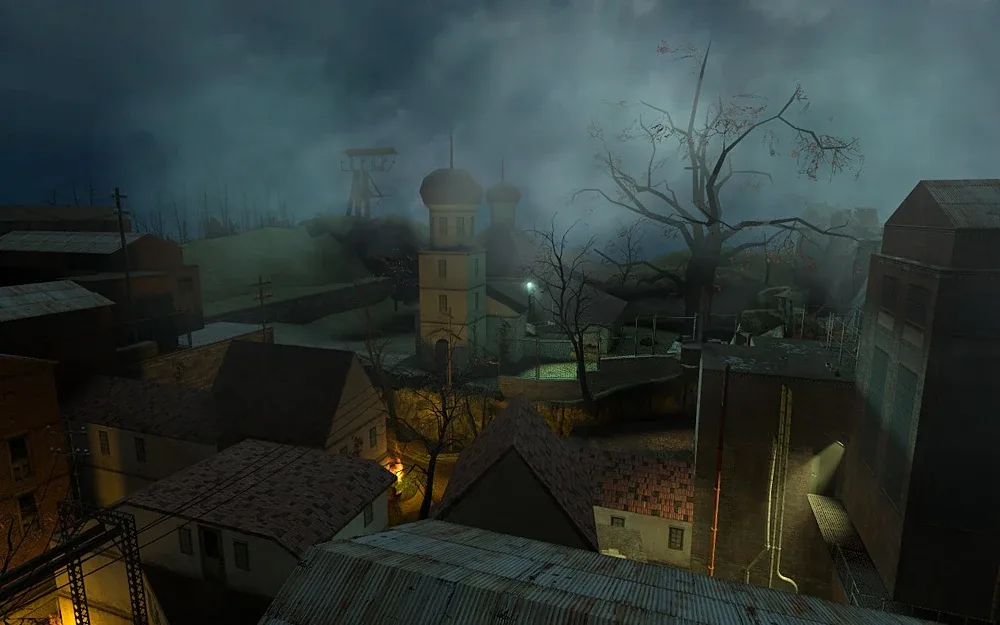
The last 30 nodes are mostly not about playing Half-Life 2 at all. Files 258 to 287 are largely a graphics-programming lecture: occlusion, detail objects, three consecutive nodes on displacements, particles, cubemaps, the water shader, normal maps, dynamic shadows, a node literally named cn_269_combinatorial_shader_explosion, gamma correction, the eye shader, facial technology, rope rendering and Valve's distributed compile system. A handful in that block still point at the game itself — cn_279_combine_gunship, cn_285_reference_maps, cn_286_response_rules — but the tech material is why this track is worth playing even if you have finished the game six times.
Who actually talks
Forty-four people speak across the 282 nodes. There is no dominant narrator — the largest share any one person has is eleven files, under 4% of the track.
| Speaker | Nodes |
|---|---|
| Brian Jacobson | 11 |
| Jeff Lane | 11 |
| Ken Birdwell | 11 |
| Mike Dussault | 11 |
| Eric Smith | 10 |
| Marc Laidlaw | 10 |
| Dave Riller | 9 |
| Eric Kirchmer | 9 |
| Jay Stelly | 9 |
| Josh Weier | 9 |
| Kerry Davis | 9 |
| The remaining 33 speakers | 173 |
| Total | 282 |
The names worth watching for, if you are listening selectively:
- Marc Laidlaw, the game's writer, has 10 files — including
cn_177_breen_monologue,cn_201_mossmans_betrayalandcn_159_writing. If you came here from the story and lore guide, those are your nodes. - Ken Birdwell carries the character-technology material: facial animation, the eye shader, character lighting.
- Kelly Bailey, who wrote the soundtrack, has 8 files and they are front-loaded —
cn_004throughcn_011, all audio. - Gabe Newell appears exactly once, on the welcome node.
The warp shortcut Valve built for debugging
Combine OverWiki documents a hidden function Valve built for debugging node placement, which shipped enabled in several Source titles.
Trigger lastinv, +attack2 and +use simultaneously — on default bindings that is Q, right mouse button and E together. Your screen fades to black and you are placed at the map coordinates of the next node on that map you have not yet played. Do it again and you move to the one after that.
Read the game list before you go hunting for it in Half-Life 2, though. OverWiki enumerates where the shortcut is enabled by default: Lost Coast, Episode One, Episode Two, Portal, Team Fortress 2, Left 4 Dead and Left 4 Dead 2. Half-Life 2 is not on that list, which is unsurprising — the base game had no nodes at all until 2024, and the wiki has not said either way whether the 20th Anniversary track inherited the shortcut. So treat this as a documented Source-engine trick that works in the Episodes and Lost Coast, and as untested in Half-Life 2 itself.
Two caveats where it does work, both from the same source. It was built as a debug tool, not a feature, so it can drop you inside geometry or inside a model. And it only moves you between nodes on the map you are currently in — it is not a fast-travel system for the campaign. If you want it bound to something less awkward, the console commands guide covers getting the developer console open in the first place.
Quick Action Checklist
- Commentary can be switched on from the New Game screen, per Valve's own anniversary change notes. Decide before you start a campaign.
- Combine OverWiki records that achievements do not unlock in commentary mode. Keep your achievement run and your commentary run separate.
- 282 nodes, three and a half hours, about 45 seconds each on average.
- Aim at a node and press USE. Range does not matter as long as you can see it. Played nodes turn grey.
- The file numbers are recording batches, not a route. Do not use them as a checklist.
- Ravenholm (26 nodes) and Nova Prospekt (29 nodes) are the densest single chapters.
- Files 258–287 are mostly engine tech — the reason to run this even on a replay.
- The Q + right mouse + E node-warp trick is documented for Lost Coast and the Episodes, not for Half-Life 2. Do not count on it in the base game.
Frequently Asked Questions
How do you turn on developer commentary in Half-Life 2?
How many developer commentary nodes does Half-Life 2 have?
Did Half-Life 2 always have developer commentary?
Do achievements unlock in Half-Life 2 commentary mode?
Which Half-Life 2 chapters have the most commentary?
Keep Reading
- Valve — Half-Life 2 20th Anniversary Update page: 3.5 hours of developer commentary, activated on the New Game screen, recorded by the reassembled original HL2 team, plus Workshop, Episodes and Steam Deck changes
- Valve — Half-Life 2 20th Anniversary Update announcement, November 15 2024: the Episodes always had commentary tracks and the base game never did until Valve re-recorded the team for three and a half hours
- Valve — Half-Life 2 Steam update feed: the November 26 2024 update fixing overlapping commentary tracks across level loads, and the July 23 2025 update, the most recent as of September 12 2026
- Combine OverWiki — full Half-Life 2 commentary transcript: 282 node filenames numbered cn_001 to cn_287 with five numbers absent, speaker per node, and a list of all 44 speakers
- Combine OverWiki — how commentary nodes work: USE key activation regardless of distance, grey model once played, camera takeover, achievements disabled in commentary mode, Gabe Newell on the intro node, and the lastinv + +attack2 + +use node warp shortcut
- Combine OverWiki — Half-Life 2: Episode One commentary transcript, 115 nodes
- Combine OverWiki — Half-Life 2: Episode Two commentary transcript, 157 nodes numbered EP2-Comment001 to EP2-Comment254
- Combine OverWiki — Half-Life 2: Lost Coast commentary transcript, 16 nodes with a location column the Half-Life 2 page does not have
- Half-Life Wiki — developer commentary node models, active and played-grey states
Related Guides
Half-Life 2 Episode Three: What Was Built and Why It Died
Valve promised the Half-Life 2 trilogy would end by Christmas 2007. Episode Three never shipped, and neither did the two Ravenholm projects Junction Point and Arkane built for Valve. Here is what each project contained, the code Valve still publishes, and the reasons the developers have given on the record, up to an August 2026 interview.
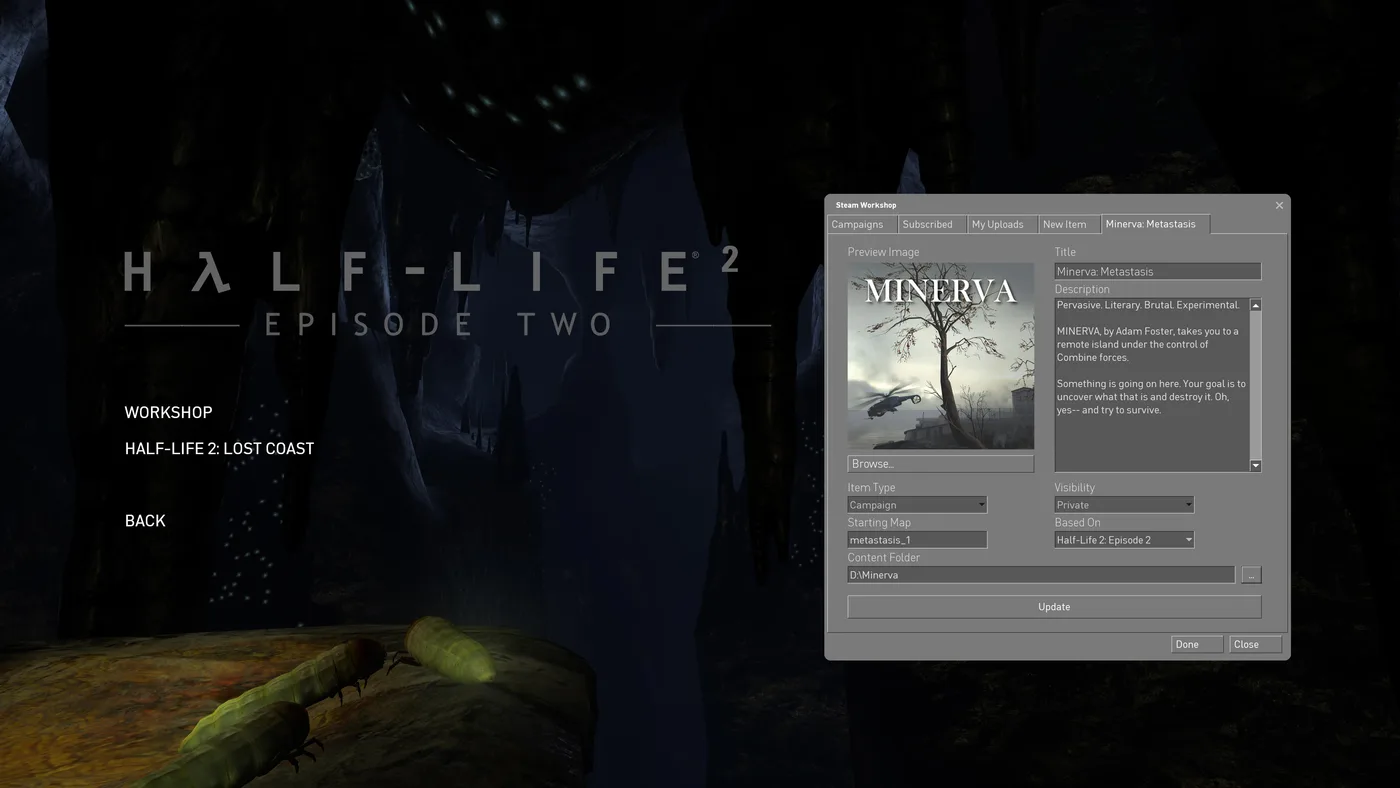
Half-Life 2 Steam Workshop: Campaigns, Addons, Known Bugs
Half-Life 2 has had a Steam Workshop in its Extras menu since November 2024, and it held 12,469 items on October 11, 2026. Here is how Campaign and Content items load differently, how to start a Workshop campaign, what people actually subscribe to, and the bugs still open on Valve's tracker.
Half-Life 2 Episode Achievements: All 36, and the Hard Ones
Half-Life 2's Steam page now lists 69 achievements, not 33. The 20th Anniversary Update brought in the Episodes' 36. Here is every one of them, which game each actually counts in, which ones a reload can rescue, and the runs that need planning.
Half-Life 2 G-Man Sightings: Where to Spot Him, Map by Map
Between the opening monologue and the ending, the G-Man turns up twelve more times in Half-Life 2, mostly at a distance or on a screen. Here is where each one is, by chapter and map, plus the three in Episode Two and the ones Valve cut.
Half-Life 2 Beginner's Guide: Start Strong in City 17
Half-Life 2 never stops to explain itself, which is why new players stall in Ravenholm with no shotgun ammo and no idea the gravity gun was the answer. Here is the chapter map, the systems the game hides, and the mistakes that waste your first playthrough.
Half-Life 2 on Console, Mac and Steam Deck: Every Version
Half-Life 2 has shipped on seven platforms and one arcade cabinet, and only one of those versions still gets patches from Valve. Here is every official port, what each one is missing, and the right way to play it on whatever you own.