Half-Life 2 Cut Content: The Beta Game Valve Was Right to Kill
The 2003 leak handed the internet an entire second Half-Life 2 — cut chapters, cut monsters, a different villain, and a gravity gun that had not been invented yet. Twenty years of "imagine if they had kept it" later, the honest read is that almost every cut was correct, and the reasons why are a masterclass in how Valve built the thing.
There is a jar in Black Mesa East that most players walk straight past. It sits in Eli Vance's lab holding something grey and lumpy in formaldehyde, and if you actually ask him about it he shrugs: "We're still not sure what that does. Alyx brings in the strangest things." That is the severed head of a Cremator, a Combine unit that spent years in development, got a full model, a voice, an animation set, and its own signature weapon, and then never appeared in the game you bought. Valve pickled it and put it on a shelf as a joke.
Half-Life 2 is full of that. Not "unused texture" full — entire chapters, entire enemy classes, a different main villain full. And because of one very bad October in 2003, we can see almost all of it. Two decades of forum posts have treated that as a tragedy. Play the beta material for an afternoon and the opposite becomes obvious: the cuts are the reason the retail game holds up. Here is what was in there, and, more usefully, why each thing had to go.
What the 2003 leak actually put on the internet
Quick history, because the details matter for judging what survives. In early October 2003, German hacker Axel Gembe broke into Valve's network. The Combine OverWiki dates the source-code theft to October 4 and a playable build — which Gembe called "Chosen 9" — to October 7. Valve has always called this theft rather than a leak, and that is the correct word for it.
The haul was enormous: the Source engine source code, roughly 1,300 VMF map files, a playable build, an early Half-Life port to Source, a prototype Counter-Strike: Source, and two Team Fortress 2 player models. What the modding scene now calls the "WC map pack" — WC for Worldcraft, the old name for Hammer — is about 3 GB spread across roughly 60 folders named after individual Valve developers, most of it dated 2001 to 2002.
Two things follow from that. First, these are not polished cut levels; they are working files. Most need texture fixes and a BSP compile before they will even run. Second, most of them predate the last two years of development, so "the beta" is not one alternate game. It is a snapshot of several different versions of Half-Life 2 stacked on top of each other, several of which contradict the others.
The Hydra: six months of AI nobody could see
If one cut enemy has a cult, it is the Hydra. A colonial organism with three neon-blue tentacles growing out of transparent, gelatinous flesh with the organs visible inside, each tentacle capped with a different specialized head: a pointed one for impaling, a "seer" covered in finger-like sensors, and a "smacker" for hitting things. It was inspired by the Tentacle from the first Half-Life and by the Lernaean Hydra, and it looked genuinely alien in a way nothing in the retail game quite matches.
It also stole the show twice. It appeared in the E3 2002 "Strider" demo, impaling a Combine Soldier in a sewer, and again in the E3 2003 "Tunnels" demo with updated models.
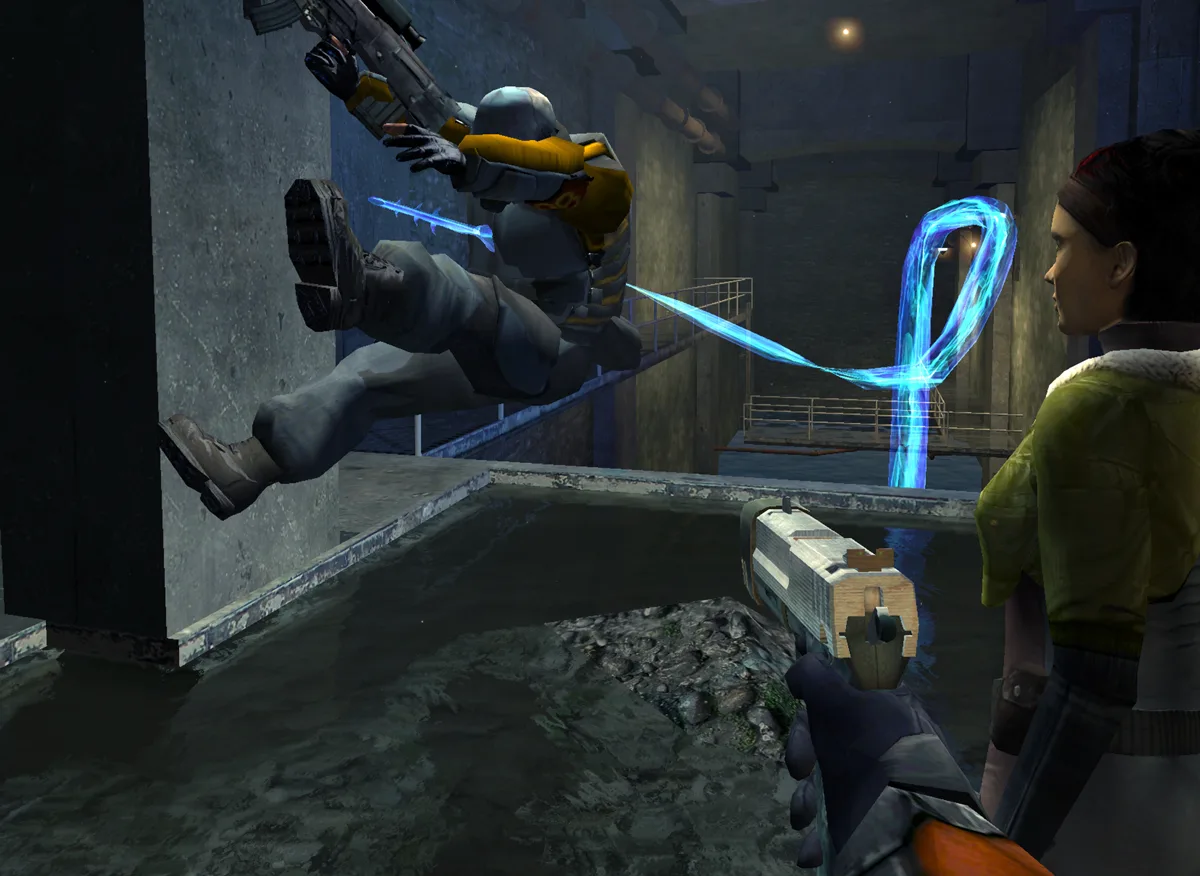
Ken Birdwell reportedly spent six months on its AI and physics. And then Valve cut it, for a reason worth writing on a wall: while the great big glowing worm looked good fighting other NPCs, in first person it read as a nondescript blob doing something vague, and then you were dead without ever really seeing what killed you.
That is the entire problem with spectacle enemies in a first-person game, stated plainly. The Hydra was a fantastic thing to watch and an incoherent thing to fight. Compare it to what shipped: every enemy in the Half-Life 2 bestiary telegraphs, from the antlion guard's charge windup to the gunship's tracking flare. Six months of work went in the bin because the player could not read it. Valve was right.
How the gravity gun got invented
The single best thing in Half-Life 2 was not designed in one go. It is the survivor of three separate cut experiments, and you can watch the idea converge.
The Brickbat
The Brickbat was an unfinished test weapon that let you pick up and throw specific objects, with damage scaling off the velocity at impact. The throwable list is a wonderful little time capsule: four rock models, beer bottles in two variants, live fast headcrabs (a direct descendant of the Snark), and Cremator heads.
It works, conceptually. It is also a whitelist. Someone at Valve had to author every throwable individually, which means the physics fantasy stops the second you look at an object nobody scheduled.
The Physgun
The Physgun went the other way — full generality, zero restraint. Primary fire threw a blue beam that grabbed physics props at considerably longer range than the retail gravity gun manages, with the mouse wheel pulling objects nearer or pushing them away. Secondary fire fired sticky welding balls that bonded props together so you could build contraptions.
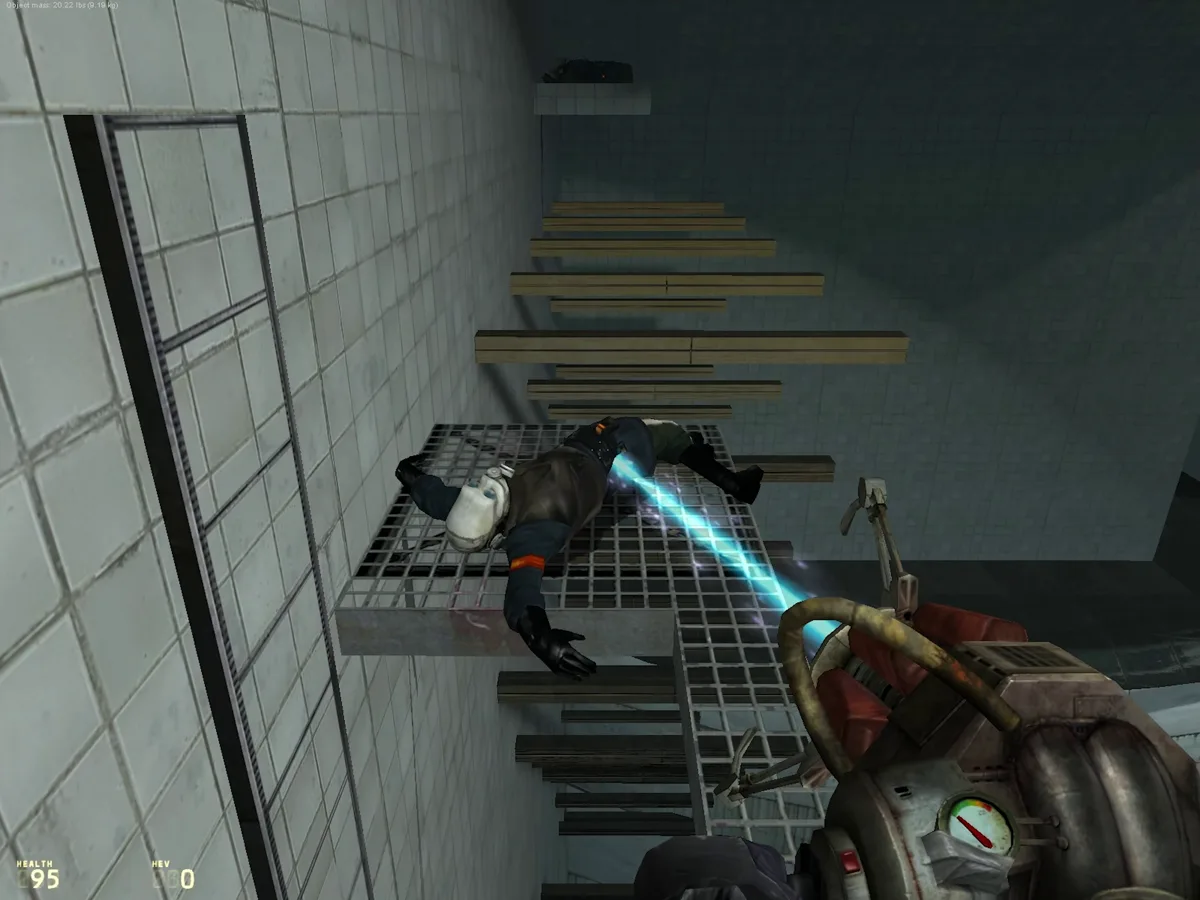
It looked close to the final weapon but wrong in the details: a red rotating wheel instead of the orange-and-blue glow, a beige pipe over the top, simpler pincers, and no worldmodel at all. It was also, by every account, extremely difficult to use well. If that description sounds familiar, it should — Garry's Mod is essentially the Physgun given the life it deserved, complete with rotation and mid-air freezing. Valve's David Speyrer has described the retail gravity gun as the end point of iterating on this thing.
The lesson is the range. Cutting the Physgun's reach down to a few metres is what turns a sandbox tool into a combat weapon, because now you have to walk toward the saw blade, which puts you in the fight. Every trick in the gravity gun guide exists inside that constraint.
The Cremator and the head in the jar
Which brings us back to the jar. The Cremator, designed by Dhabih Eng, was a Combine janitor: it patrolled City 17 clearing corpses off the streets and scrubbed wildlife off Wasteland trains, occasionally picking a fight with you. Its weapon was the Immolator, a large cannon that sprayed a green plasma beam which disintegrated organic matter, fed by a hose from a sphere on its abdomen. Sound files show it noticing the player, and it could be killed by Gordon or by rebels — after which you could take its gun, and its head, as Brickbat ammo.
Valve liked it enough to consider it again for Half-Life: Alyx early in that project, before Combine Hazmat Workers took the slot. What survives in retail is the pickled head in Black Mesa East, plus a computer scan of it in the same scene and in the Deathmatch map Steam Lab.
The Combine Guard became the Hunter three years later
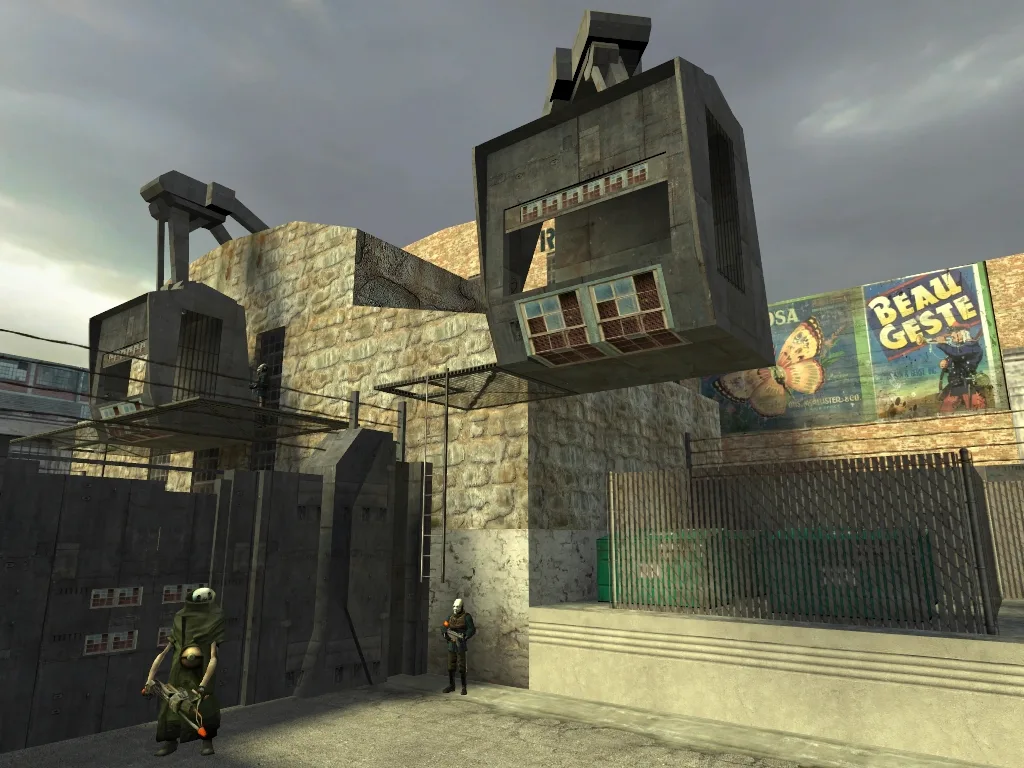
The Combine Guard was the beta's heavy Synth, and it is the most quietly horrifying design Valve ever produced: a human face mounted on a robotic body, with development notes stating the camera attachment is the soldier's real head — meaning the human inside had its eyes removed. It carried a small extendable shield on the left forearm and a breather in the mouth, and it kicked at close range.
Its Combine Guard Gun fired a heavy disintegration beam. That beam was not wasted; it got recycled onto the Strider, which is why the Strider's warp cannon feels like it came from a different weapon class than everything else the Combine field.
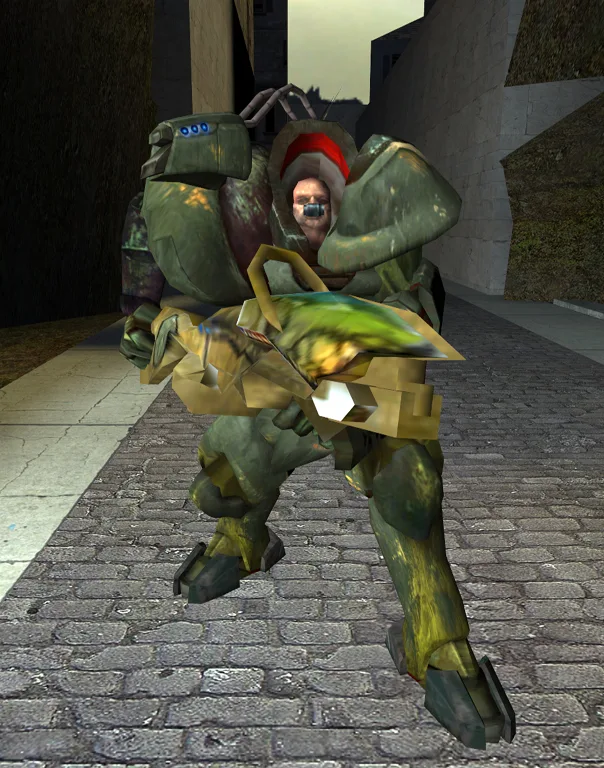
The Guard's showcase was the E3 2002 "Terminal" demo, marching with Combine Soldiers and Scanners before the rebels jumped them. The famous beat has a Guard punch through a door window, peer through the hole with its camera, then knock the door flat. Genuinely great staging.
So why cut it? Because the role it was built for — a big, specialized Combine unit you beat with physics rather than bullets — is hard to tune, and Valve did not land it until the Hunter in Episode Two, three years later. If you have played Episode Two, you have fought the Combine Guard. It just took an extra development cycle and a much better readable silhouette to work.
The Air Exchange: a whole chapter folded into Nova Prospekt
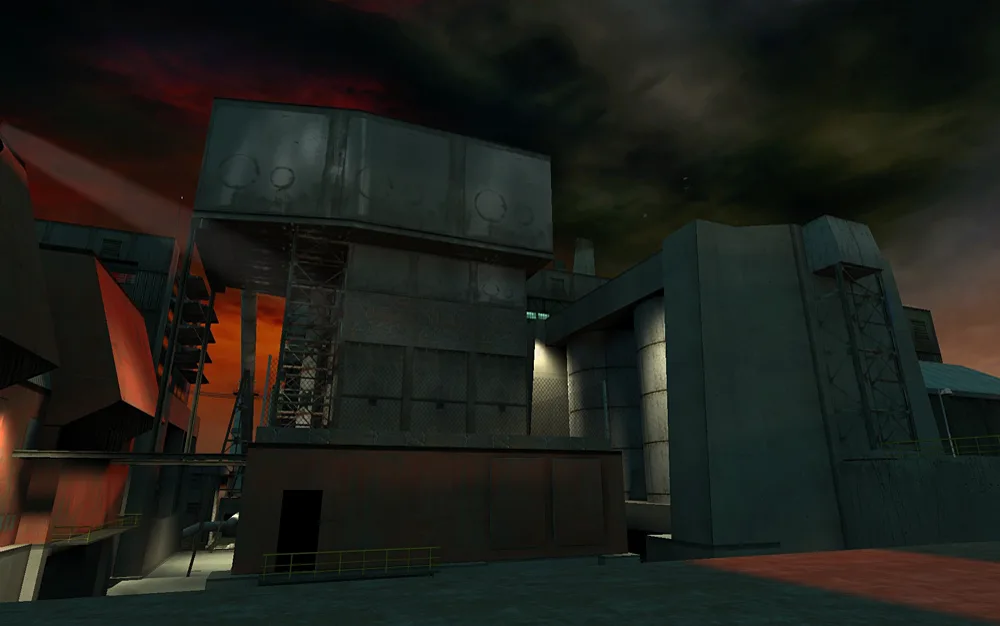
The Air Exchange, or AirEx, was a fortified Combine industrial complex on the Coast, sitting between the Depot and the Borealis in the original route. It was prototyped with all its maps built before it was cut, so it exists in the map pack as a real place.
The premise was strong. The facility was terraforming the region's atmosphere into something breathable for the Advisors and poisonous for people, which is why beta citizens wore respirators. Gordon arrives by train, meets Alyx and her pet alien Skitch, infiltrates the complex, climbs the industrial tower, and sabotages the reactor core — and that is the act that kicks off the uprising in City 17. Captain Vance, head of AirEx security and leader of the Conscripts, was in a compromised position guarding the place.
Valve cut it to concentrate on areas more fruitful for gameplay, and the structural idea survived: destroy a critical Combine installation, trigger the uprising. That is exactly what the Depot and Nova Prospekt do in the shipped game, with a teleporter accident doing the scene transition instead of a train.
Notice what else got merged. Captain Vance was originally Alyx's father — a separate white character from Eli Vance, who at that point was an unrelated eccentric old man running a scrapyard lab, and who lost his leg examining a Particle Storm rather than to anything Combine. Collapsing two characters into one Eli is why the retail game can afford to spend real screen time on him. Cut chapters bought character development.
Weather Control and the Arctic game that never got built
Weather Control is the deep cut. It was an Arctic facility — a colossal dome bristling with antennae and radar dishes, sitting in a canyon northwest of City 17, built by the Combine to drain Earth's oxygen. In the original four-day story structure it sat between Kraken Base and the Skyscraper chapter. Gordon would arrive with Captain Vance and rebelled Conscripts to retrieve data chips, fight airships and deployed mechs, and watch Alyx get knocked cold by an energy blast before Conscripts destroyed the mech with guns buried in the ice.
Almost none of that exists as playable material. It is the only cut chapter with no known maps and no scripted content at all: what we have is a design vignette Marc Laidlaw wrote for the Half-Life 2: Raising the Bar book, plus early geography maps placing it in the Arctic.
Which tells you something about how the game was actually made. Beside it, Kraken Base was the Arctic base Judith Mossman transmitted from, and the Borealis was a ship chapter where you fought alongside a character named Odell. All three are Arctic. All three were cut. The pivot away from snow toward a scorched Eastern European coast is the single largest change between beta and retail, and the buggy and airboat chapters are what grew in the hole it left.
The Consul is the reason Wallace Breen works
Before Dr. Wallace Breen, the collaborator-in-chief was called the Consul. Same job, very different execution. The Consul was Big Brother by way of 1984: an austere, owl-eyed face plastered across propaganda posters in the City 17 train station with slogans like "The Consul says... relax" and "The Consul says... report." Beta dialogue explains him coldly — they call him the Consul now, he speaks for the Combine, he shares in their power. The plan had him revealed as having traded away large portions of his own body for immortality on Combine life support.
That is a good villain for a different game. It is also a poster, not a person. Retail Breen is scarier precisely because he is not a grotesque — he is a plausible, articulate, self-justifying administrator who thinks he saved the species and would like you to understand his reasoning. The Breencasts work because you keep almost agreeing with him.
Traces survive: sound clips for early Breencast broadcasts, a cut confrontation where Alyx tells him he is just another cog in the Combine machinery, plus a prototype Citadel office map by Viktor Antonov and the poster art. Worth noting the Consul was also the one who approved non-standard weapons for the Metrocops — a small detail that shows how much more directly hands-on this version of the character was.
The Ice Axe and the AR2 that was actually an OICW
Two cut weapons are worth your attention because both leave fingerprints in files you already own.
The Ice Axe was a melee weapon with two fire modes, a fast swing and a slow swing, both dealing 10 damage. It was almost certainly built for the Arctic chapters, and it died for two reasons: those chapters died, and it was too close to the crowbar to justify a slot. Its ghost is beautiful, though. Go look at Half-Life 2's sound files: the crowbar's swing sound is still named iceaxe_swing1.wav. Twenty years later, every time you smash a crate, you are playing an ice axe sample.
The AR2 in the beta was not the Pulse Rifle. It was a model of the real-world XM29 OICW, and it behaved like one: fully automatic from the hip, semi-automatic when scoped, 8 damage a bullet and 16 scoped, a 30-round magazine, plus an underslung 40mm grenade launcher holding one grenade with three in reserve. The launcher is present but disabled in the leak build, though promo videos show it firing. It appeared in the E3 2003 "Bugbait" demo in the Nova Prospekt laundry room.
Cutting it was a worldbuilding decision as much as a balance one. A Heckler & Koch prototype in a Combine soldier's hands says "near-future military shooter." The Overwatch Standard Issue Pulse Rifle that replaced it says "these things are not from here," and its alt-fire energy ball is one of the most distinctive weapons in the entire arsenal. Early textures for the obsolete guns still ship in materials/models/weapons/obsolete.
The pattern: Valve cut everything the player could not read
Line the cuts up and one criterion does most of the work. It is not scope, and it is not technical difficulty. It is legibility.
The Hydra went because you could not tell what was killing you. The Physgun went because a tool with unlimited range gives you no reason to move. The Brickbat went because a curated throwable list breaks the moment you test it against an unlisted object. The Combine Guard went because a physics-weakness enemy needs a silhouette that advertises the weakness, and it took the Hunter to find one. The OICW went because a real-world rifle reads as the wrong genre. The Consul went because an abstraction cannot argue with you. Friendly fire, incidentally, went for the flattest reason of all: playtesters kept killing their own teammates.
Even the art direction reversal fits. Early Half-Life 2 was American East Coast skyscrapers, a dark Blade Runner register, with the Combine looking obviously alien. Retail is a bright, small-scale, post-Soviet Eastern European city where the Combine builds out of recycled human material — ceramic tile inside the Citadel, repurposed rail infrastructure outside. That switch is not about looking cooler. It is about you being able to tell, at a glance, that this place used to belong to people. Everything the story and lore does emotionally rides on that read.
So the next time somebody posts the Hydra footage with "we were robbed" under it: we were not. We got the version where you can see what is happening.
Where to see the cut content yourself
You do not need a sketchy download to touch most of this.
- Play the retail Easter eggs. The Cremator head is in Eli's lab in Black Mesa East — ask him about it. The computer scan of it is right there in the same scene.
- Read the file names. Open Half-Life 2's sound files and find
iceaxe_swing1.wavdriving the crowbar. Obsolete weapon textures sit inmaterials/models/weapons/obsolete. - Run the developer commentary. The 20th Anniversary Update, shipped November 15, 2024, added roughly 3.5 hours of brand-new commentary across the whole game — the original release had none — alongside Episode One and Episode Two bundled into the base game, Steam Workshop support in-game, HDR and lightmap improvements, and gamepad and Steam Deck handling. The same anniversary brought a documentary in which the team walks through the development mess directly.
- Watch the E3 demos. The 2002 "Strider" and "Terminal" demos and the 2003 "Tunnels" and "Bugbait" demos are the cleanest look at the Hydra, the Combine Guard, and the OICW in motion.
- Install a restoration mod. Several community projects rebuild beta maps and NPCs on modern Source; the Half-Life 2 mods guide covers what is actually worth installing versus what is a broken map dump.
Quick Action Checklist
- Treat the WC map pack as working files from 2001 to 2002, not a finished alternate game — several beta versions contradict each other.
- Ask Eli about the jar in Black Mesa East to see the only Cremator in retail Half-Life 2.
- Remember the Hydra's lesson: an enemy that is fun to watch can still be unreadable in first person.
- The gravity gun's short range is the design, not a limitation — it forces you into the fight.
- The Hunter in Episode Two is the Combine Guard's role, finally tuned.
- The Air Exchange's "sabotage a facility to start the uprising" beat lives on in the Depot and Nova Prospekt.
- Weather Control, Kraken Base, and the Borealis were all Arctic — the Coast chapters exist because Valve dropped the snow.
- Listen for
iceaxe_swing1.wavevery time you swing the crowbar. - Run the 20th Anniversary Update's 3.5 hours of developer commentary before you go hunting for beta builds.
- When you evaluate any cut feature, ask the Valve question first: could the player tell what was happening?
Frequently Asked Questions
What is the Half-Life 2 beta?
Why was the Hydra cut from Half-Life 2?
What was the Cremator in Half-Life 2?
Was the gravity gun in the Half-Life 2 beta?
What chapters were cut from Half-Life 2?
Who was the Consul in Half-Life 2?
What cut weapons are still referenced in retail Half-Life 2 files?
Did the Half-Life 2 20th Anniversary Update add cut content?
Keep Reading
- Combine OverWiki — Development of Half-Life 2, the 2003 theft, and the WC map pack
- Combine OverWiki — the Hydra, its E3 demos, and why it was cut
- Combine OverWiki — the Cremator, the Immolator, and the Black Mesa East Easter egg
- Combine OverWiki — the Physgun and its relationship to the retail gravity gun
- Combine OverWiki — the Air Exchange cut chapter and Captain Vance
- Combine OverWiki — the Consul, the early version of Wallace Breen
- Valve — Half-Life 2 20th Anniversary Update features and documentary
Related Guides
Half-Life 2 Episode Three: What Was Built and Why It Died
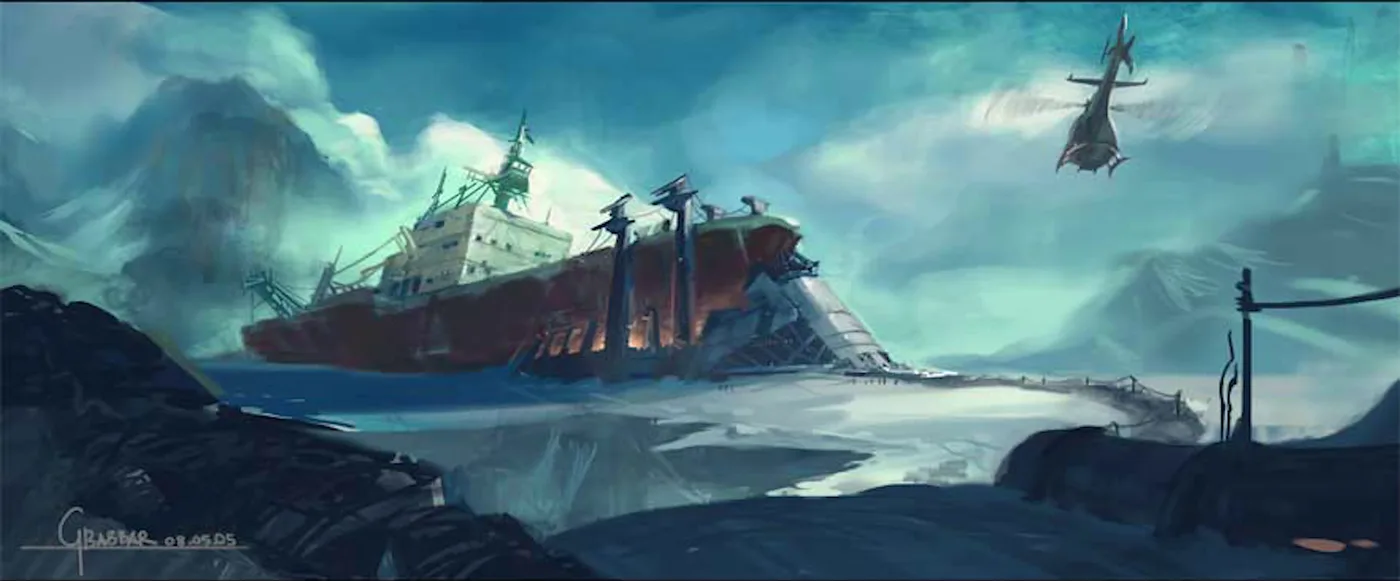
Valve promised the Half-Life 2 trilogy would end by Christmas 2007. Episode Three never shipped, and neither did the two Ravenholm projects Junction Point and Arkane built for Valve. Here is what each project contained, the code Valve still publishes, and the reasons the developers have given on the record, up to an August 2026 interview.
Half-Life 2 Steam Workshop: Campaigns, Addons, Known Bugs
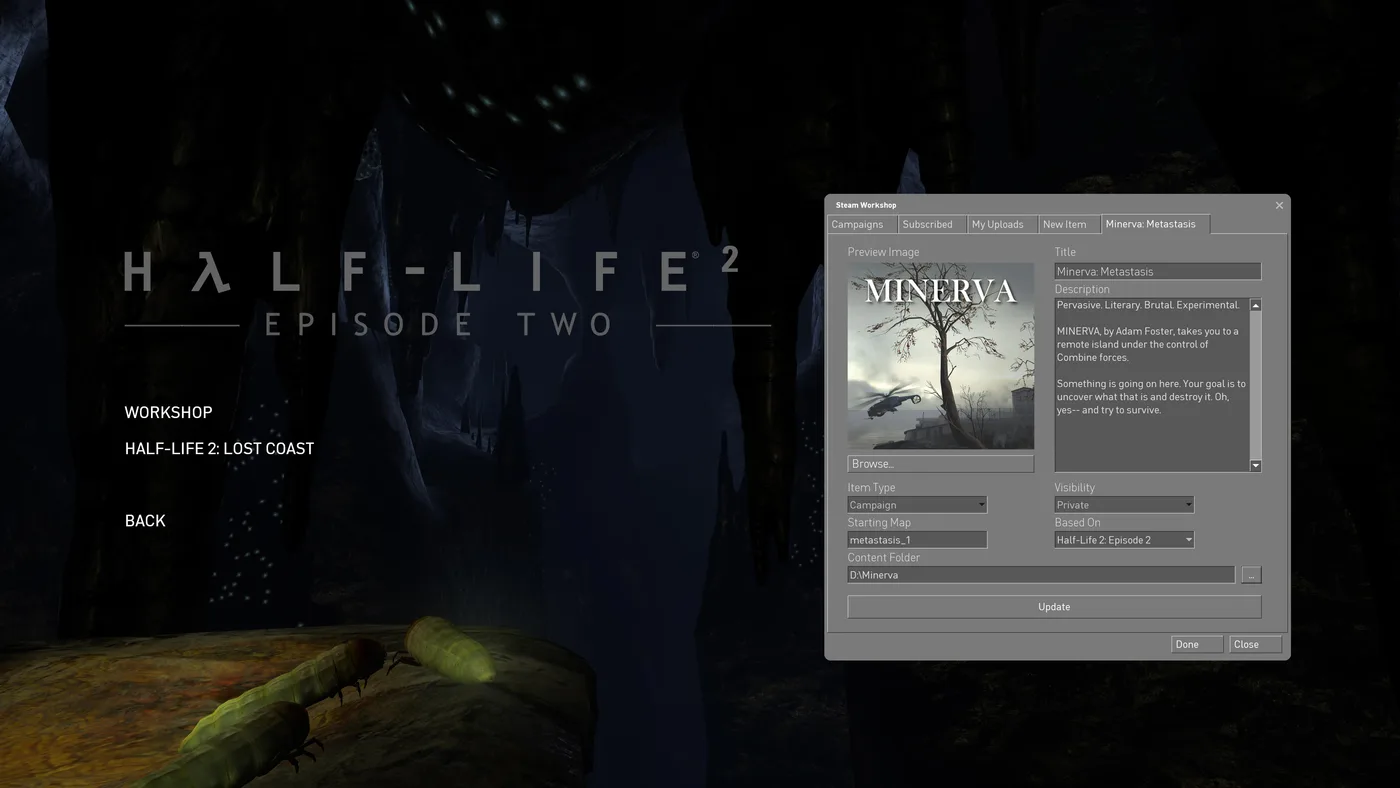
Half-Life 2 has had a Steam Workshop in its Extras menu since November 2024, and it held 12,469 items on October 11, 2026. Here is how Campaign and Content items load differently, how to start a Workshop campaign, what people actually subscribe to, and the bugs still open on Valve's tracker.
Half-Life 2 Episode Achievements: All 36, and the Hard Ones
Half-Life 2's Steam page now lists 69 achievements, not 33. The 20th Anniversary Update brought in the Episodes' 36. Here is every one of them, which game each actually counts in, which ones a reload can rescue, and the runs that need planning.
Half-Life 2 G-Man Sightings: Where to Spot Him, Map by Map
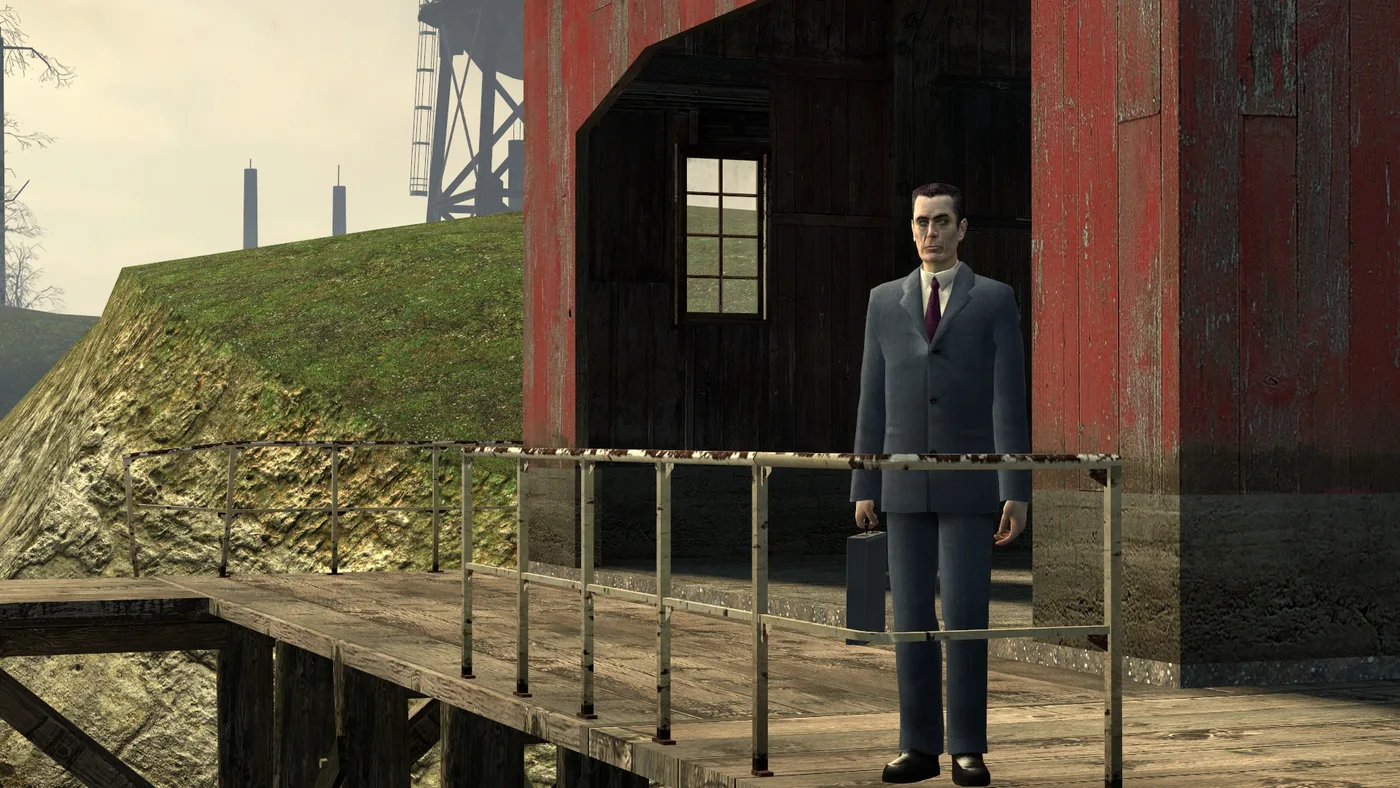
Between the opening monologue and the ending, the G-Man turns up twelve more times in Half-Life 2, mostly at a distance or on a screen. Here is where each one is, by chapter and map, plus the three in Episode Two and the ones Valve cut.
Half-Life 2 Beginner's Guide: Start Strong in City 17
Half-Life 2 never stops to explain itself, which is why new players stall in Ravenholm with no shotgun ammo and no idea the gravity gun was the answer. Here is the chapter map, the systems the game hides, and the mistakes that waste your first playthrough.
Half-Life 2 on Console, Mac and Steam Deck: Every Version
Half-Life 2 has shipped on seven platforms and one arcade cabinet, and only one of those versions still gets patches from Valve. Here is every official port, what each one is missing, and the right way to play it on whatever you own.