Minecraft Firework Guide: Rockets, Elytra Boosts, and Stars
Firework rockets are three things at once in Minecraft: your elytra engine, a surprisingly nasty crossbow shell, and a light show. Here is how flight duration, stars, and shapes actually work, with the real numbers.
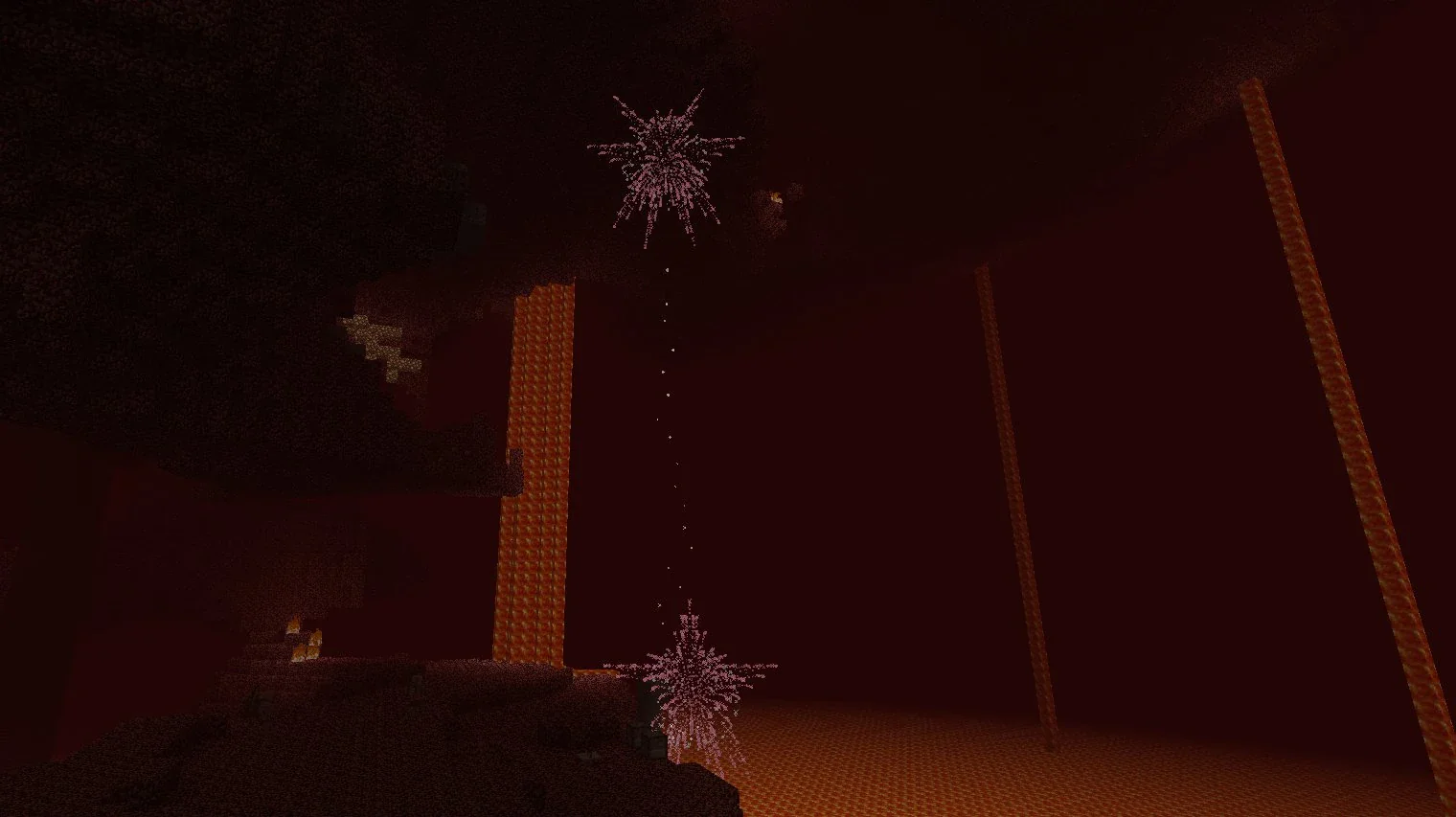
Most players meet firework rockets exactly once — the first time they strap on an elytra, run off a cliff, and realize they have no idea how to actually go anywhere. Fireworks are the answer, and they are quietly one of the most versatile items in the game. The same rocket that launches a light show over your base is the engine that lets you cross a thousand blocks in a minute, and, loaded into a crossbow, a shell that hits harder than a diamond sword. Almost nobody uses all three.
This guide breaks the whole system down: what goes into a rocket, how flight duration actually scales, the firework-star recipe with every shape and effect, and the three real jobs a rocket does — elytra fuel, crossbow ammo, and decoration. Every number here is checked against the Minecraft Wiki, because "just add more gunpowder" is the extent of most firework advice online, and it leaves out the parts that matter.
What a firework rocket is made of
A firework rocket has a dead-simple base recipe:
- 1 paper + 1 to 3 gunpowder, crafted anywhere in the grid, yields 3 firework rockets.
That plain rocket has no explosion — it launches, flies, and fizzles out with no burst. It is the version you want for flying, and the version that comes out cheapest. Paper comes from sugar cane; gunpowder drops from creepers, witches, and ghasts, and hides in desert temple and dungeon chests. If gunpowder is your bottleneck, a creeper-focused mob farm is the fix — the hostile mobs guide covers what spawns where.
To make a rocket that actually explodes, you add firework stars:
- 1 paper + 1 to 3 gunpowder + 1 to 7 firework stars yields 3 firework rockets that burst with effects.
Each star you pack in becomes one explosion in the sky, so a single rocket can throw up to seven separate bursts at once. Stars are also what turn a rocket into a weapon — more on that below. The gunpowder count still controls flight duration exactly as it does for a plain rocket; the stars just ride along.
Flight duration: what the gunpowder does
The single most important number on a rocket is its flight duration, and it is set entirely by how much gunpowder you used: 1, 2, or 3. That is the whole dial. More gunpowder means the rocket flies longer and higher before it detonates.
Roughly how high a rocket climbs when launched from the ground:
| Gunpowder | Flight duration | Rise height |
|---|---|---|
| 1 | Duration 1 | 8 to 20 blocks |
| 2 | Duration 2 | 18 to 34 blocks |
| 3 | Duration 3 | 32 to 52 blocks |
Under the hood, the rocket's lifetime in ticks is 10 x (gunpowder + 1) + a random 0 to 5 + a random 0 to 6. So a duration-3 rocket lives around 40 to 51 game ticks (roughly 2 to 2.5 seconds), while a duration-1 rocket burns out in about 1 second. That randomness is why a stack of identical rockets does not all pop at exactly the same height — handy for a natural-looking show, less handy when you want precise timing.
For flying, the takeaway is simple: duration 3 (three gunpowder) is the flight rocket. It gives the longest sustained push per rocket, which means fewer rockets burned per trip and less inventory churn.
Crafting firework stars: colors and shapes
The firework star is where the customization lives. The base recipe is one gunpowder plus at least one dye, which produces a single firework star in that color. Add more dyes in the same craft — up to eight — and the burst comes out as a blended mix of all of them.
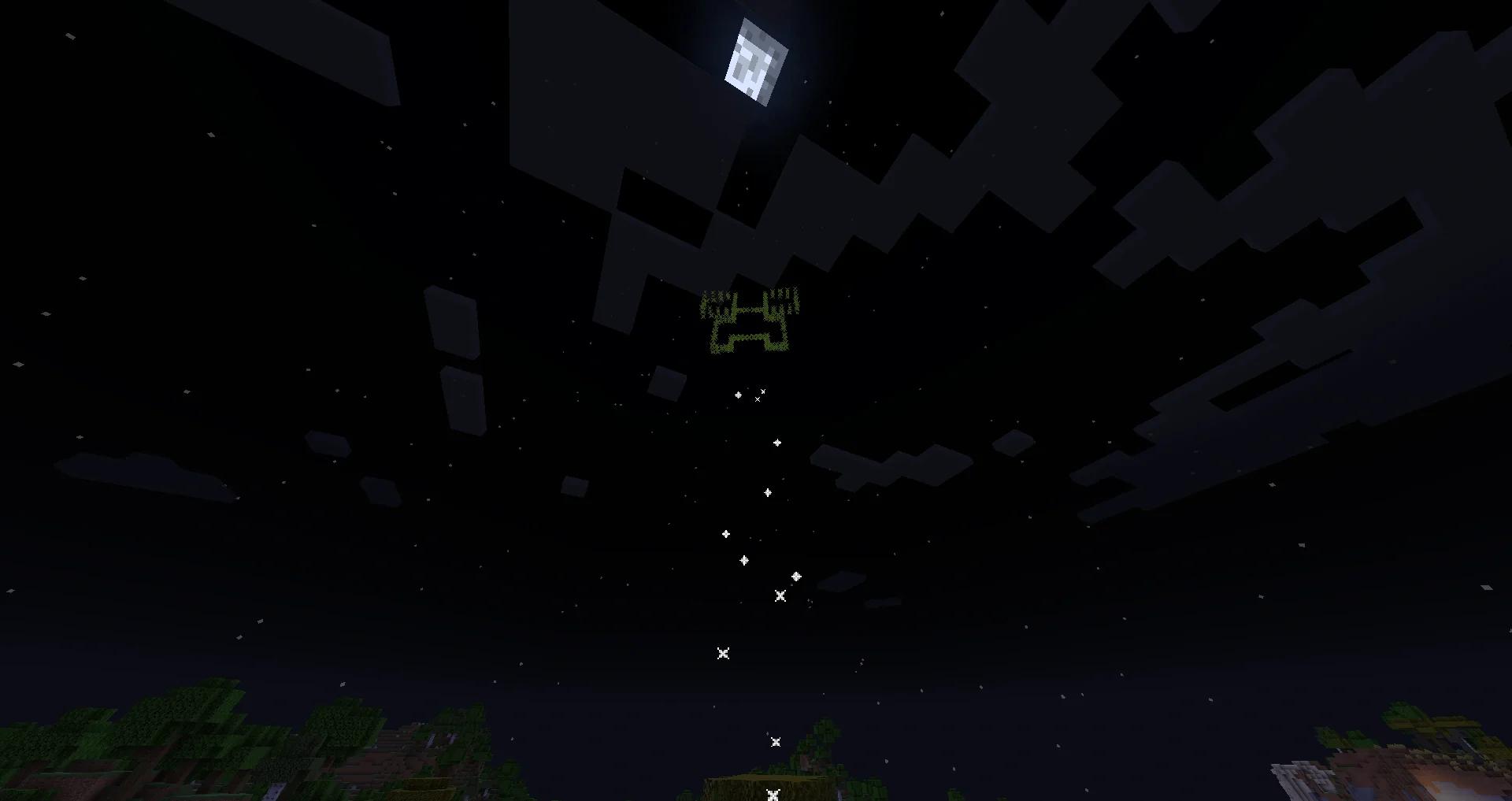
On top of color, one shape modifier and any number of effect modifiers can go into the same star. That is a lot of combinations from one crafting slot.
Shape modifiers
Add one of these to the star recipe to change the explosion shape (you can only use one shape per star):
- Nothing — a small ball, the default.
- Fire charge — a large ball.
- Gold nugget — a star shape.
- Feather — a burst (the willow, drooping shape).
- Any mob head — a creeper-shaped explosion, like the one above.
Twinkle, trail, and fade effects
These stack freely — you can add both to one star:
- Glowstone dust — adds the twinkle (crackle/flicker) effect, so the burst pops and sparkles at the end.
- Diamond — adds a trail, leaving a comet-like streak behind each particle.
There is also a fade: take a finished firework star, craft it together with one or more dyes, and the explosion will fade from its original color to the new one as it dies. Combine shape, mixed base colors, a fade, twinkle, and a trail, and you can build a genuinely custom burst — then pack up to seven of those into one rocket for a layered explosion. It is the closest Minecraft gets to a crafting toy with no wrong answers.
Boosting your elytra with rockets
This is the job most players actually care about. While you are gliding on an elytra, using a firework rocket lights it as a booster: it shoves you forward in the direction you are looking at a speed of roughly 33.5 blocks per second for as long as the boost lasts. Chain rockets one after another and you cruise indefinitely, turning the elytra from a slow glide into real fast travel.
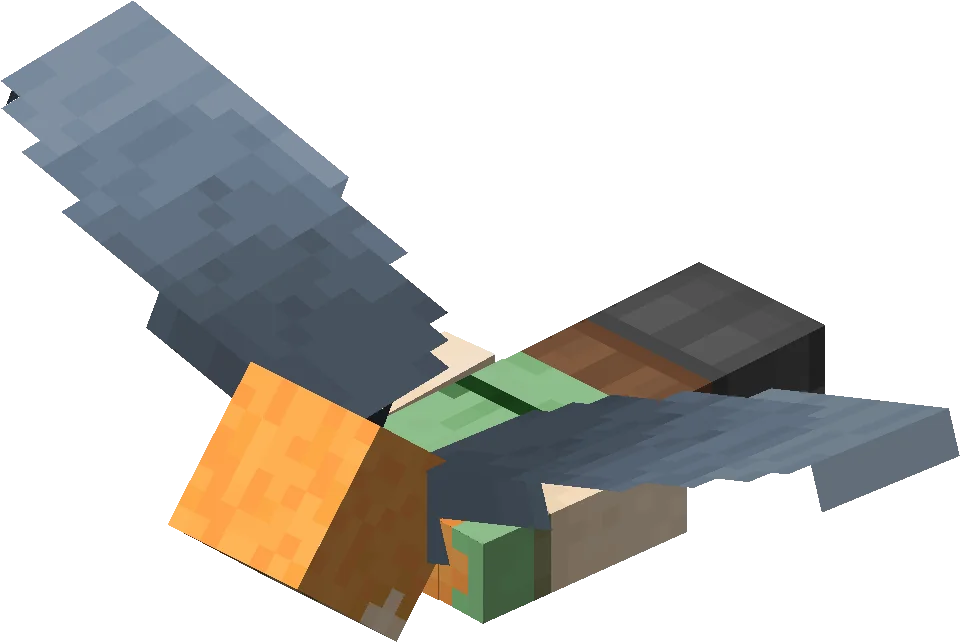
Two things to get right:
- Use plain, star-less rockets for flying. A rocket with firework stars explodes when you use it mid-glide and damages you — the same explosion that makes it a weapon will chew through your health if you boost with it. Flight rockets should be pure paper-and-gunpowder, no stars.
- Flight duration controls the push. A duration-3 rocket boosts longest (about 50 ticks of thrust), so three-gunpowder rockets are the standard flight fuel: fewer rockets per journey, less time spent re-igniting.
If you are still hunting for the wings themselves, they only come from End cities — the elytra guide and the End cities guide cover the trip. Once you have both wings and a rocket stack, fireworks quietly become the best transportation in the game, as the transportation guide lays out against boats and rails.
Fireworks as a crossbow weapon
Here is the trick most people never try: a firework rocket loads into a crossbow as ammunition. Only rockets with firework stars deal damage (a plain rocket just flies out and fizzles), but a loaded star-rocket turns a crossbow into a small artillery piece.
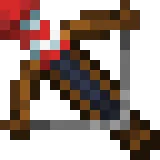
How the damage works:
- The explosion deals about 7 HP (3.5 hearts) with a single star, and each additional star adds roughly 2 more HP, up to about 19 HP (9.5 hearts) at point blank with the maximum seven stars.
- Damage falls off with distance across a blast radius of about 5 blocks, so a direct hit hurts far more than a near miss.
- More gunpowder gives the shot longer range; more stars give it more damage. A three-gunpowder, seven-star rocket is the heavy shell.
Two crossbow enchantments make this nasty: Quick Charge slashes the reload time so you can fire rockets in quick succession, and Multishot launches three rockets in a spread from a single shot. The best enchantments guide covers both. Crossbows themselves drop from pillagers, so a raid can arm you before you even craft one — the raids and pillagers guide has the details.
Building a firework show with dispensers
Fireworks are also just fun to set off, and a dispenser launches them for you. Load a dispenser with firework rockets, wire it to redstone, and every pulse fires one into the sky — the backbone of any automated fireworks display.
A few show-building notes:
- Aim the dispenser upward (they fire in the direction they face) so rockets climb instead of skittering along the ground.
- Vary the flight durations across different dispensers so bursts pop at different heights instead of a flat line.
- A repeater clock or an observer loop paces the launches; if timed circuits are new to you, start with the redstone basics guide before wiring a big finale.
Because a single rocket can carry seven stars, and each star can have its own color, shape, twinkle, trail, and fade, even a small dispenser array can throw up a genuinely varied show. It is the one place in Minecraft where over-engineering a build has zero downside.
Java vs Bedrock differences
The core system is identical across editions, but the crossbow behavior differs in a way that matters if you are aiming at mobs:
- In Java Edition, a firework rocket fired from a crossbow explodes instantly the moment it hits an entity — point, click, boom.
- In Bedrock Edition, the rocket can pass through the entity instead of detonating on contact, so you have to lead your shots and rely on the timed detonation rather than an impact trigger.
Everything else — the recipes, flight duration, star effects, and elytra boosting — works the same way in both. The gunpowder-to-flight-duration relationship and the star damage scaling are shared across editions, so the flight rocket you build on Java is the same one you build on Bedrock.
Firework tips most players miss
- Keep two rocket types on hand. Star-less duration-3 rockets for flying, and a few loaded star-rockets for the crossbow. Never fly with star-rockets — they hurt.
- Batch your flight fuel. One craft makes three rockets, so a full inventory of gunpowder and paper produces stacks fast. Fly far more than you think you will, and top up before long trips.
- Multishot triples your firepower. A Multishot crossbow fires three star-rockets in one pull — brutal against groups, and a fast way to burn through a stack of shells.
- Seven stars, seven bursts. For a show, pack a rocket with several differently-designed stars; they all detonate together in one layered explosion.
- Fireworks can slow your fall. Using a rocket while gliding low can bail you out of a bad landing, since the boost redirects your momentum — an emergency trick worth remembering.
- Gunpowder is the real cost. Everything firework-related eats gunpowder. A creeper farm is what unlocks unlimited flying and unlimited shows.
Quick Action Checklist
- Craft flight rockets: 1 paper + 3 gunpowder (no stars) for the longest elytra boost
- Craft firework stars: 1 gunpowder + dye, adding a shape modifier and twinkle/trail as desired
- Combine up to 7 stars into one rocket for a multi-burst explosion
- Fly by gliding on an elytra and using star-less rockets to boost forward (about 33.5 blocks per second)
- Never boost mid-glide with a star-rocket — the explosion damages you
- Load star-rockets into a crossbow for 7 to 19 HP explosive shots; add Quick Charge and Multishot
- Build a dispenser show with varied flight durations for bursts at different heights
- Set up a creeper farm so gunpowder never limits your flying or your fireworks
Frequently Asked Questions
How do you make a firework rocket in Minecraft?
What is the best firework rocket for flying with an elytra?
How do you change the color and shape of a firework?
How much damage does a firework rocket do from a crossbow?
Where do you get gunpowder for fireworks?
Keep Reading
Related Guides
Minecraft Wandering Trader Guide: Trades, Spawns and Llamas
Every wandering trader shows 9 offers drawn from a pool of 100 that is the same on Java 26.3 and Bedrock 26.50. Here is the full price list from the game's own trade files, the odds of seeing the offer you want, what the trader buys from you, how long one takes to spawn, and why a name tag will not keep it.
Minecraft on Switch 2: Free Upgrade, Price and Minecoins
Digital owners of Minecraft for Nintendo Switch get the native Switch 2 version free in most regions until January 31, 2027. Cartridge owners have been offered nothing so far. Here are the editions, the US prices, what the native version changes, and the Minecoins change that lands on the same day.
Minecraft Spear Guide: Jab, Charge Damage, and Lunge
A diamond spear jabs for 4 damage. Held low on an elytra at rocket speed, the same spear charges for 37. The spear's charge takes its damage from how fast you are moving, and the weapon breaks several rules the rest of Minecraft combat runs on. Here are the real numbers for every tier, both attacks, and Lunge.
Minecraft Game Rules List: Every Rule and Its New Name
Java 1.21.11 renamed every game rule: keepInventory is keep_inventory now, doDaylightCycle is advance_time, and doFireTick is gone entirely. Here is the full list for Java 26.3 and Bedrock 26.50, with old names, new IDs, menu labels, defaults, and the 19 Bedrock rules that switch your achievements off for good.
Minecraft Survival Guide for Beginners: Your First Days
You have about ten minutes of daylight before the sun sets and the world tries to kill you. Here is exactly what to do with them — punch a tree, build a tool chain, and get a roof over your head before the zombies arrive.
Best Minecraft Enchantments, Ranked — The Ones Worth Your XP
Mending is the enchantment that ends the grind — gear that repairs itself forever. Everything else is a fight over your XP and anvil uses. Here is what actually earns a slot, ranked, with the real max levels.