Minecraft Happy Ghast Guide: Dried Ghasts, Harnesses, Flight
The happy ghast is the first flying mount in Minecraft that carries passengers, hauls a horse on a lead, and doubles as a solid block you can build off. Here is the whole pipeline, with the Java and Bedrock numbers that actually differ.

Elytra flight is a solo sport. You get one player, one set of wings, a stack of rockets, and a strong chance of eating a mountain at 40 m/s. The happy ghast does something the elytra has never done in ten years: it carries four people at once, hovers exactly where you left it, and turns into a solid block you can stand on 200 blocks off the ground.
It is also the only mount in the game you obtain by finding a dehydrated block-shaped animal in the Nether and soaking it in a puddle. Mojang added it in Java Edition 1.21.6 and Bedrock Edition 1.21.80 as part of Chase the Skies, and almost every guide out there gets the growth timings wrong because Java and Bedrock handle snowball feeding on completely different math.
Here is the entire pipeline — fossil to flight — with every number checked against the wiki.
The mount that finally beats the elytra at something
A happy ghast is a passive Overworld mob with 20 HP and a hitbox 4.0 blocks tall and 4.0 blocks wide. That size matters more than it sounds: it is a floating four-by-four cube, so it will not squeeze through a two-wide canyon and it absolutely will not fit down your mineshaft. Plan your launch pads accordingly.
It cannot shoot fireballs, it is passive to everything, and it does not panic when damaged. It is also, importantly, not immune to fire and lava like its Nether cousin. A happy ghast taken into the Nether is a 4x4 target floating over a lava ocean with no fire resistance. Do not do it casually.
You can also stop asking whether you can breed them. You cannot. Happy ghasts have no breeding recipe at all, which means every single one in your world traces back to its own dried ghast block. Want a four-ghast hangar? That is four dried ghasts.
Where dried ghasts actually come from
Nether fossils in soul sand valleys
Dried ghasts generate as part of nether fossils, and nether fossils only generate in soul sand valleys. Each fossil is a bone-block skeleton somewhere between 5 and 27 blocks in size across 14 structural variants, and each one has a 1 in 3 (~33.3%) chance of generating a dried ghast adjacent to it.
So the loop is: find a soul sand valley, sweep it for bone-block fossils, check the blocks around each one, and expect roughly one dried ghast per three fossils. Soul sand valleys are wide open with terrible sightlines and are lousy with skeletons, so bring a bow and a fire resistance potion before you start sightseeing.
Here is the first real Java/Bedrock split, and it is a big one for anyone hunting: in Java Edition, nether fossils are a registered structure, so /locate structure minecraft:nether_fossil works. In Bedrock Edition, nether fossils are not a structure at all — there is nothing for a locate command to find. Bedrock players are doing it the honest way, on foot, with a soul speed pickaxe and patience.
Mining the block is trivial. A dried ghast has 0 hardness and 0 blast resistance, so it breaks instantly with any tool or your bare hand, and it always drops itself. Pocket it and hydrate it at home.
The craftable shortcut
If you have already farmed the Nether raw, you can skip the fossil hunt entirely. The recipe is 8 ghast tears surrounding 1 soul sand in a crafting table — a full ring of tears around a single soul sand center. Mojang added the recipe in snapshot 25w18a, partway through 1.21.6 development, presumably after realizing "go find 12 fossils" was a rough ask.
Eight ghast tears is not cheap, but it is renewable, and it means a ghast tear farm quietly doubles as a happy ghast factory.
Hydrating a dried ghast and the random-tick tax
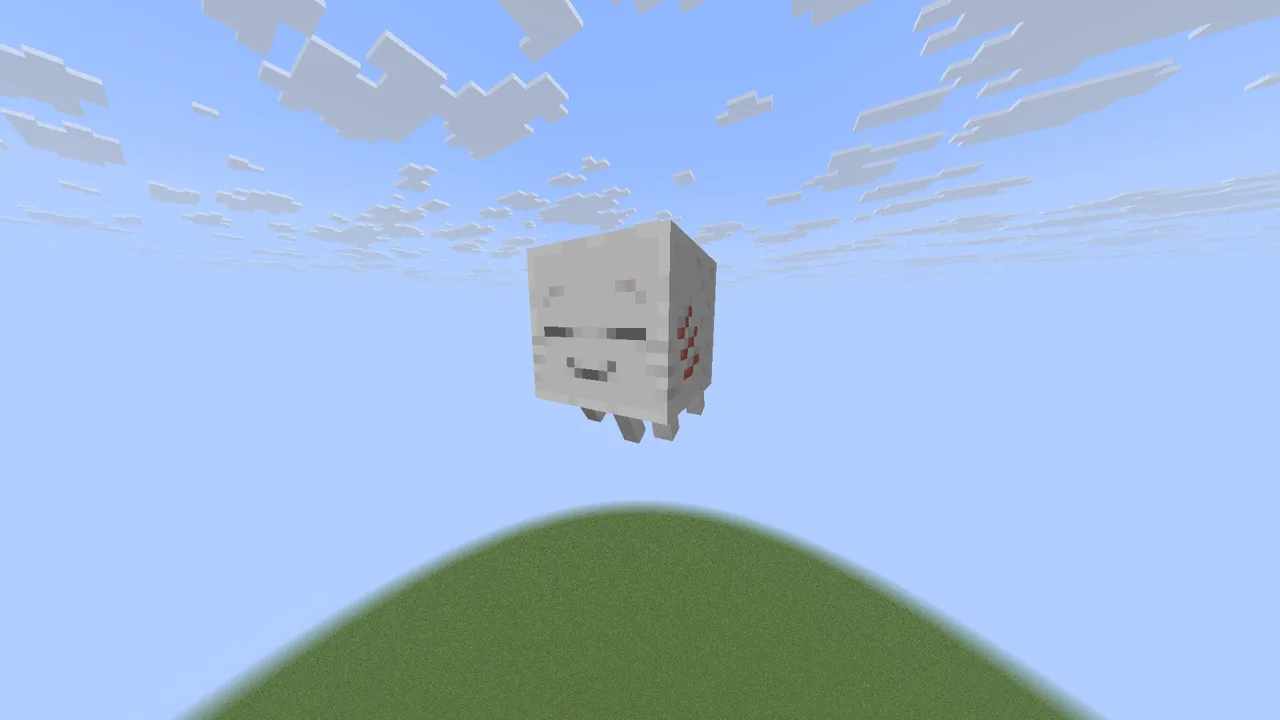
Place the dried ghast, waterlog it, and wait. That is the whole ritual — a bucket of water on the block does it.
The block has four hydration stages, and this is where people start panicking that theirs is broken. Each stage requires a 5,000-tick (250-second) delay to run out. But that delay does not start automatically. It only begins when the block receives a random tick, which on average takes about 68 seconds. Total, that is roughly 5.3 minutes per stage on average, and about 20 minutes from bone-dry to a live ghastling.
Random ticks are random, so your run will not be exactly 20 minutes. Some go faster. Some sit there smugly for six minutes on stage two while you refresh the wiki. It is working. Leave it alone.
Two things that will ruin your day:
- Pull the water and it reverses. If the water is removed mid-process, the block dehydrates back toward dry at the same rate it hydrated. It does not pause. It walks backward.
- Breaking it resets everything. Mine a partially hydrated dried ghast and it drops as a plain dried ghast, hydration progress gone. If you need to relocate it, do it before you start, not at stage three.
Also worth knowing: the block is not luminous and is not flammable, so you can safely park it anywhere, including inside a base.
Ghastling to adult: the snowball split
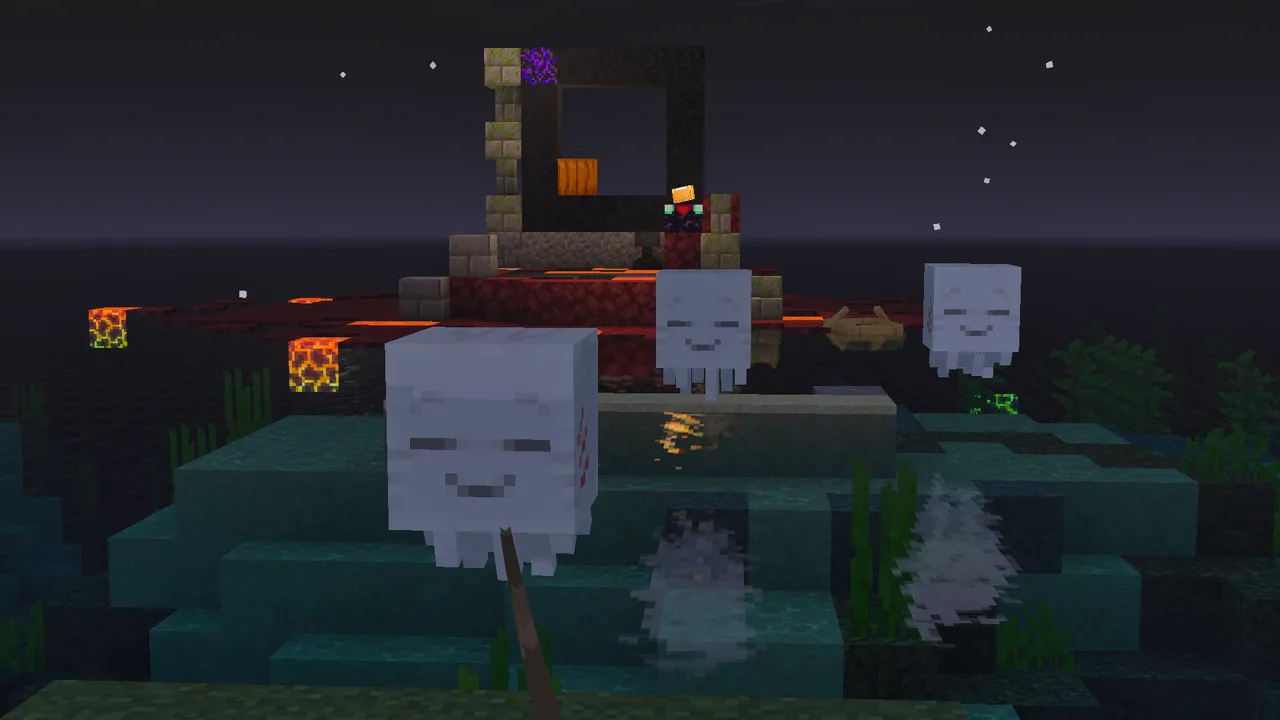
When hydration completes, the block becomes a ghastling — a 0.95-block baby that grows into a 4.0-block adult, a size jump of over 4.2x. It is genuinely one of the biggest baby-to-adult transitions in the game.
Left alone, a ghastling takes 20 minutes (24,000 ticks) to grow up. You speed that up with snowballs, and this is the number nearly every video gets wrong:
- Java Edition: each snowball reduces the ghastling's remaining growth time by 10%. That is the standard Java baby-growth formula. Ten snowballs does not finish the job — it takes about 35% off the total, because each one only shaves a tenth of what is left.
- Bedrock Edition: 10 snowballs takes a newly spawned ghastling straight to adult. Flat rate, no diminishing returns.
So Bedrock players should show up with exactly ten snowballs. Java players should show up with a stack and accept that the last few minutes are stubborn. Either way, snowballs are free: a snow golem in a snow-layer collector produces them endlessly, or you can shovel a snowy biome by hand.
Ghastlings have a few quirks worth using. They occasionally follow nearby players or specific mobs within a 16-block range, moving at a 1.1x speed boost and stopping about 5 blocks away — so a ghastling will trail you home if you stay close. They also do not drown underwater, unlike adults, which makes an early flooded pen a genuinely safe nursery.
Golden dandelions: the pause button
Newer addition, and a good one if you decided the baby is the best part. The golden dandelion — added in Java Edition 26.1 and Bedrock Edition 26.10, crafted from 8 gold nuggets around 1 dandelion — resets and locks a baby mob's aging timer. Use it on a ghastling and the 24,000-tick clock stops dead. Use it again on the same mob and aging resumes. Downward-drifting particles mean locked; upward particles mean running again.
It works on baby mobs generally (48,000 ticks for snifflets), and it has a few side gigs: it crafts into yellow dye, it makes a Saturation suspicious stew, and it distracts piglins, who inspect it for 6 seconds in Java and 8 seconds in Bedrock. Wandering traders sell it too.
Crafting the harness
No harness, no riding. Only adult happy ghasts can wear one, and the recipe is:
- Top row: leather, leather, leather
- Middle row: glass, wool of your chosen color, glass
That is 3 leather, 2 glass, 1 wool per harness, and there are all 16 dye colors. Already have one in the wrong color? Combine it shapeless with a matching dye to recolor it — no need to burn more leather.
To equip it, just use it on the ghast. As of Java 25w17a you can also fire one from a dispenser, which is delightfully unnecessary and exactly the kind of thing a redstone build should abuse. To remove it, use shears on the ghast; the harness drops as an item.
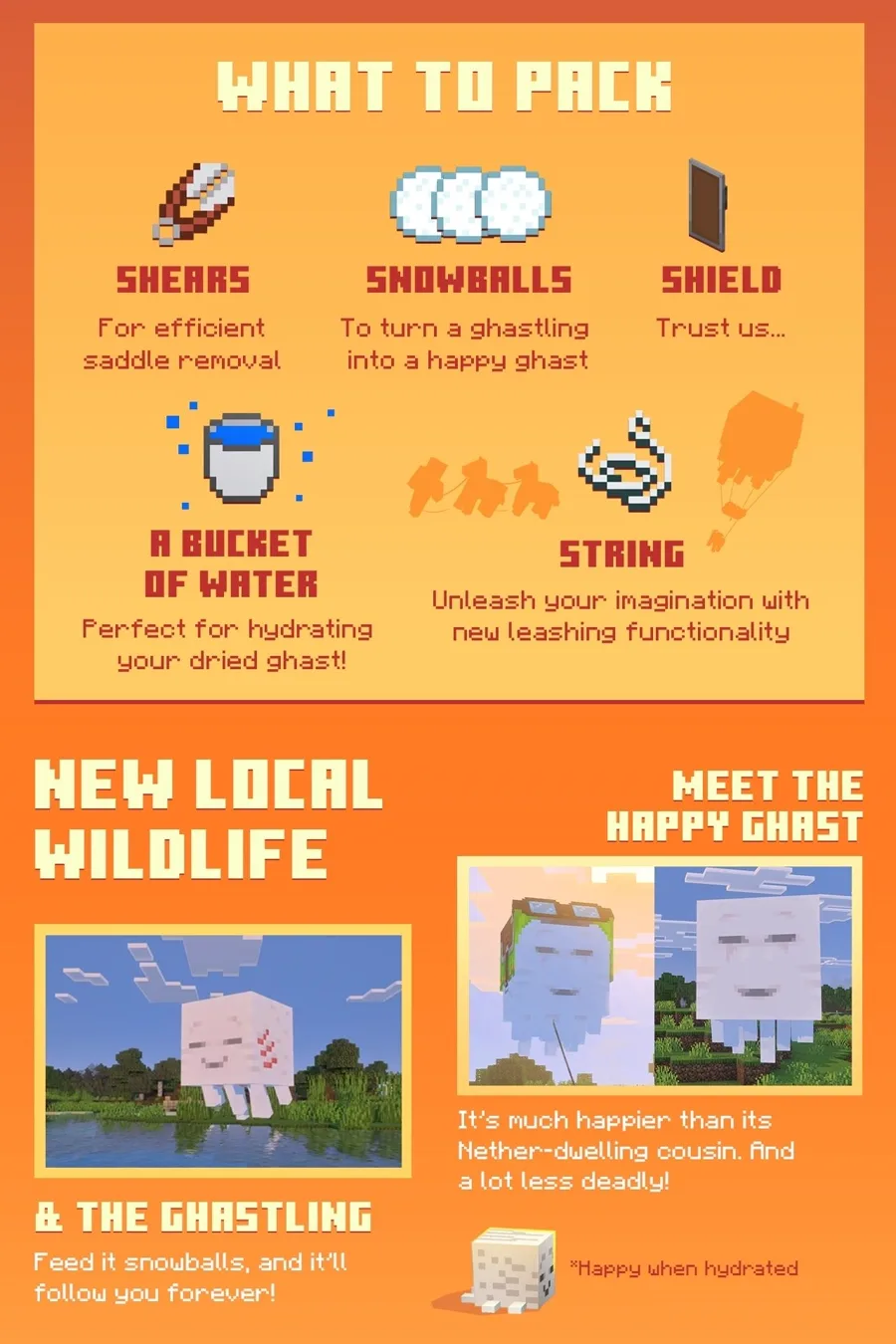
The harness is the big aviator goggles, and they are a status indicator, not decoration: goggles are up when the ghast is unridden and lower over its eyes when someone is piloting. On a server, you can tell at a glance across the sky whether a parked ghast is occupied.
Flying it: controls, speed, and the four-seat rotation
Up to four players ride one happy ghast. The first player to mount becomes the pilot and sits at the front, just above its face. Everyone after that fills the remaining sides going clockwise from the pilot. When somebody dismounts, the remaining riders rotate counter-clockwise to fill the gap — so the pilot's seat can change hands mid-flight if the pilot hops off.
Controls are deliberately simple and slightly awkward:
- Forward moves the ghast in whatever direction you are looking, including up and down.
- Jump moves it straight up.
- There is no dedicated descend key. To go down: look down and press forward, or look up and press backward.
- To hold a flat altitude, strafe left or right, or pin your camera pitch to exactly 0 using the debug screen.
Cruising speed is about 3.6 m/s in the direction the pilot is looking. That is slow. An elytra with rockets laughs at it. But it hovers, it carries a crew, and it never runs out of firework rockets, which is the whole trade.
Two riding perks that do not get enough attention:
- Extended item pickup. While riding, your vertical pickup range for dropped items below you increases to roughly the entire perimeter near the bottom of the ghast's body. You can hoover up drops from the air without landing — a genuinely great tree-farm or mob-drop cleanup tool.
- Pulled-back camera. Third-person view sits about 8 blocks from you instead of the usual 4, so you can actually see the thing you are riding.
Also: happy ghasts are unaffected by the Speed effect, so do not waste a potion trying to make one fast. And they make no footstep sounds, which is unnerving the first time one drifts up behind you.
The solid-block trick every builder should steal
This is the feature that turns a novelty mount into infrastructure.
Players can stand on top of a happy ghast — harnessed or not — as if it were a solid block. And while any player is standing on it, the ghast becomes stationary and snaps its alignment to one of the cardinal directions. It stops drifting. It becomes a 4x4 platform hanging in the air exactly where you left it.
Dismounting places you on top of it automatically, so the flow is: fly to your build height, dismount, and you are now standing on a stable platform, no scaffolding, no dirt tower. Other entities can stand on it too, and mobs make little to no attempt to pathfind while up there. Because it behaves like a solid surface, you can even ender pearl onto one.
The catch, and it is a real one: the moment no players are standing on it, the ghast becomes mobile again and loses that collision. Anything left on top gets flung off. Park a mob up there, walk away, and the game will happily drop it to its death. Reloading chunks also makes the ghast realign to face south, so a precisely oriented build platform will rotate on you after a relog.
Hauling horses, boats, and camels on one lead
The leashing rework that shipped alongside the happy ghast is quietly the best part of the update. A happy ghast can suspend large entities beneath it on a lead: boats, boats with chests, horses, donkeys, mules, skeleton horses, zombie horses, camels, camel husks, and sniffers.
You only need one lead to hang an entity, though the game renders it as four ropes for the visual — and if the ghast is harnessed, it gets a unique rope rigging design to match. Multiple entities can hang at once.
Happy ghast leads also stretch further than everything else in the game: 16 blocks maximum, versus 12 for other mobs. That extra clearance is the difference between your dangling horse clipping a cliff face and not.
For anyone who has ever tried to move a camel across an ocean, or relocate a sniffer without a boat and a prayer, this alone justifies the whole pipeline.
Keeping it alive
Twenty hit points is not much for something that size, and it does not regenerate quickly by default: 1 HP every 30 seconds.
But there are two conditions that crank that to 1 HP per second — a 30x improvement:
- The ghast is between Y 187 and Y 196 in the Overworld, which is the cloud layer, or
- It is raining or snowing.
That is a lovely piece of design, and it is exploitable. If your ghast takes a beating, climb to cloud level and let it sit for twenty seconds instead of hovering at build height for ten minutes.
Roaming behavior matters too. An unharnessed happy ghast wanders within a 64-block radius of its home point. A harnessed one — and any ghastling — sticks to a 32-block radius. That home point re-anchors whenever the harness is put on or taken off, a lead is detached, a rider dismounts, or you stop tempting it with a snowball. In practice: harness it and dismount where you want it to live, and it will stay in a much tighter orbit.
If you kill one, it drops its equipped harness plus 1–3 XP orbs when killed by a player or a tamed wolf. Ghastlings drop no experience at all. There is no reason to kill one, but now you know.
Java vs Bedrock: the delta list
The two editions have converged since launch, but not completely. Everything below is confirmed in the version histories:
| Thing | Java Edition | Bedrock Edition |
|---|---|---|
| Version added | 1.21.6 (snapshot 25w15a) | 1.21.80 (Preview 1.21.80.25, Drop 2 2025 experiment) |
| Snowball feeding | Each snowball cuts 10% off remaining growth time | 10 snowballs flat, ghastling to adult |
| Finding nether fossils | Registered structure — locate command works | Not a structure — no locate support |
| Health at launch | 20 HP from the start | Shipped at 40 HP, reduced to 20 in Preview 1.21.80.27 |
| Golden dandelion added | 26.1 | 26.10 |
| Spawn egg | Standard | 5% chance to spawn a ghastling |
A few later tweaks worth knowing: Java 1.21.9 (25w31a) made happy ghasts audible from 64 blocks away and raised the riding sound volume. Bedrock's Preview 1.21.100.22 added the 1–3 XP drop, raised its own ride sound volume, and let ghastlings follow wolves. Bedrock's experimental toggle went away entirely in 1.21.90, so the whole feature set is standard there now.
Quick Action Checklist
- Go to a soul sand valley in the Nether and sweep it for bone-block fossils. Roughly 1 in 3 has a dried ghast next to it. Java players can locate the structure directly; Bedrock players search on foot.
- Or craft one: 8 ghast tears around 1 soul sand.
- Break it with anything (0 hardness), bring it home, place it, and waterlog it. Do not remove the water — it reverses — and do not mine it mid-hydration, which resets progress.
- Wait roughly 20 minutes through four hydration stages (~5.3 min each on average, gated by random ticks).
- Feed the resulting ghastling snowballs: exactly 10 on Bedrock, a stack-ish on Java where each one only takes 10% off the remaining time. Or leave it 20 minutes.
- Want to keep it a baby? Use a golden dandelion (8 gold nuggets + 1 dandelion) to lock its age.
- Craft a harness: 3 leather across the top, glass-wool-glass beneath. Any of 16 colors, recolorable with dye. Use it on the adult ghast; shears take it back off.
- Fly with forward to go where you look and jump to climb. No descend key — look down and press forward. Cruise is 3.6 m/s.
- Dismount to stand on it. While a player stands on it, it locks in place as a solid 4x4 platform. Never leave mobs on it — they get flung off when the last player steps away.
- Hang boats, horses, camels, and sniffers underneath on a single lead, with 16 blocks of stretch.
- Damaged? Climb to Y 187–196 or wait out a rainstorm for 1 HP per second instead of 1 per 30 seconds.
- Never take it to the Nether casually. It is not fire or lava immune, and you cannot breed a replacement.
Frequently Asked Questions
How do you get a happy ghast in Minecraft?
How many snowballs does it take to grow a ghastling?
What is the harness recipe in Minecraft?
How many players can ride a happy ghast?
Can happy ghasts be bred?
Why does my happy ghast keep drifting away?
Keep Reading
- Minecraft Wiki — happy ghast stats, riding, roaming, and version history
- Minecraft Wiki — dried ghast generation, hydration timings, and crafting
- Minecraft Wiki — harness recipe, colors, and equipping
- Minecraft Wiki — nether fossil generation and dried ghast chance
- Minecraft Wiki — golden dandelion crafting and baby-age locking
Related Guides
Minecraft Name Tags Guide: How to Get, Use & Secret Names
A name tag is the cheapest insurance policy in Minecraft: name almost any mob and it will never despawn, no matter how far you roam. The exceptions are wandering traders, which still leave, and most hostile mobs on Peaceful. Since Java 26.1 and Bedrock 26.10 you can craft one from a scrap of paper and a metal nugget, so there's no excuse for losing a zombie villager before you can cure it anymore. This guide covers every way to get one, the anvil step you can't skip, and the hidden names that flip mobs upside down.
Minecraft Sniffer Guide: Eggs, Digging, and Ancient Seeds
The sniffer won the 2022 mob vote and then quietly became the only source of two plants in the game. Here is how to find its egg, hatch it fast, and actually get seeds out of the big lug.
Minecraft Wandering Trader Guide: Trades, Spawns and Llamas
Every wandering trader shows 9 offers drawn from a pool of 100 that is the same on Java 26.3 and Bedrock 26.50. Here is the full price list from the game's own trade files, the odds of seeing the offer you want, what the trader buys from you, how long one takes to spawn, and why a name tag will not keep it.

Minecraft on Switch 2: Free Upgrade, Price and Minecoins
Digital owners of Minecraft for Nintendo Switch get the native Switch 2 version free in most regions until January 31, 2027. Cartridge owners have been offered nothing so far. Here are the editions, the US prices, what the native version changes, and the Minecoins change that lands on the same day.
Minecraft Survival Guide for Beginners: Your First Days
You have about ten minutes of daylight before the sun sets and the world tries to kill you. Here is exactly what to do with them — punch a tree, build a tool chain, and get a roof over your head before the zombies arrive.
Best Minecraft Enchantments, Ranked — The Ones Worth Your XP
Mending is the enchantment that ends the grind — gear that repairs itself forever. Everything else is a fight over your XP and anvil uses. Here is what actually earns a slot, ranked, with the real max levels.