Minecraft Spawner Guide: Mechanics, XP Farms, and Real Rates
A monster spawner is not a magic mob faucet. It is a timer with a hard mob cap, a spherical activation radius, and a spawn volume that is shaped differently in Java and Bedrock. Learn the actual numbers and you stop building farms that quietly run at half rate.
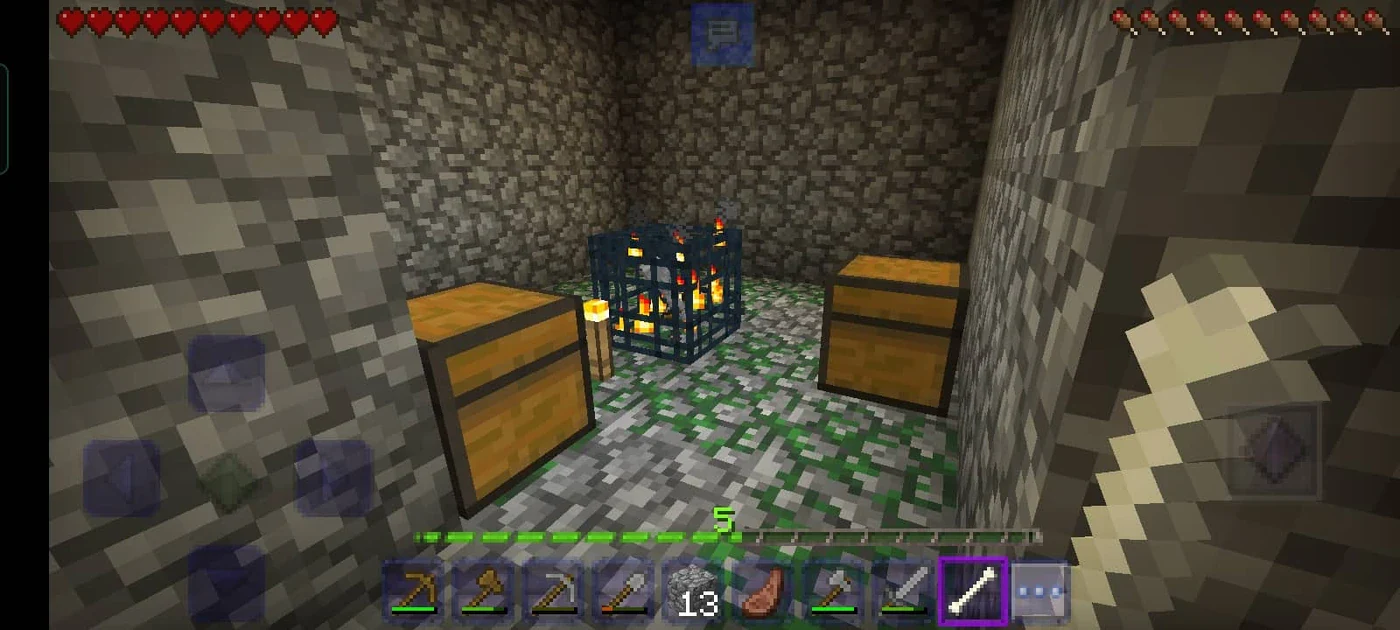
A monster spawner attempts to spawn four mobs, then goes quiet for anywhere between 200 and 799 game ticks — 10 to 39.95 seconds — before it tries again. That single number is why two players can build what looks like the same zombie farm off the same dungeon and get wildly different rates. One of them accidentally throttled the cycle. The other did not.
Spawners get treated like free mobs. They are not. They are a tightly specified block with an activation radius, a spawn volume, a hard local mob cap, and a set of relaxed spawning rules that still have teeth. Understand the system and a dungeon spawner becomes the fastest early-game XP you will find. Ignore it and you build a beautiful stone box that produces three zombies a minute.
Where spawners actually generate
There are exactly five places a spawner shows up in a normal world, and each one has a fixed mob:
- Monster rooms (the classic mossy dungeon) — one spawner in the center, rolling zombie 50%, skeleton 25%, or spider 25%.
- Mineshafts — any number of cave spider spawners, buried in cobwebs.
- Woodland mansions — optionally one spider spawner in a rare secret room on the second or third floor, packed in cobwebs. You can sometimes spot it through the windows from outside.
- Strongholds — one silverfish spawner in the end portal room. Always.
- Nether fortresses — usually two blaze spawners on fenced platforms. Sometimes only one.
- Bastion remnants — one magma cube spawner hanging from a chain under a bridge in the treasure room.
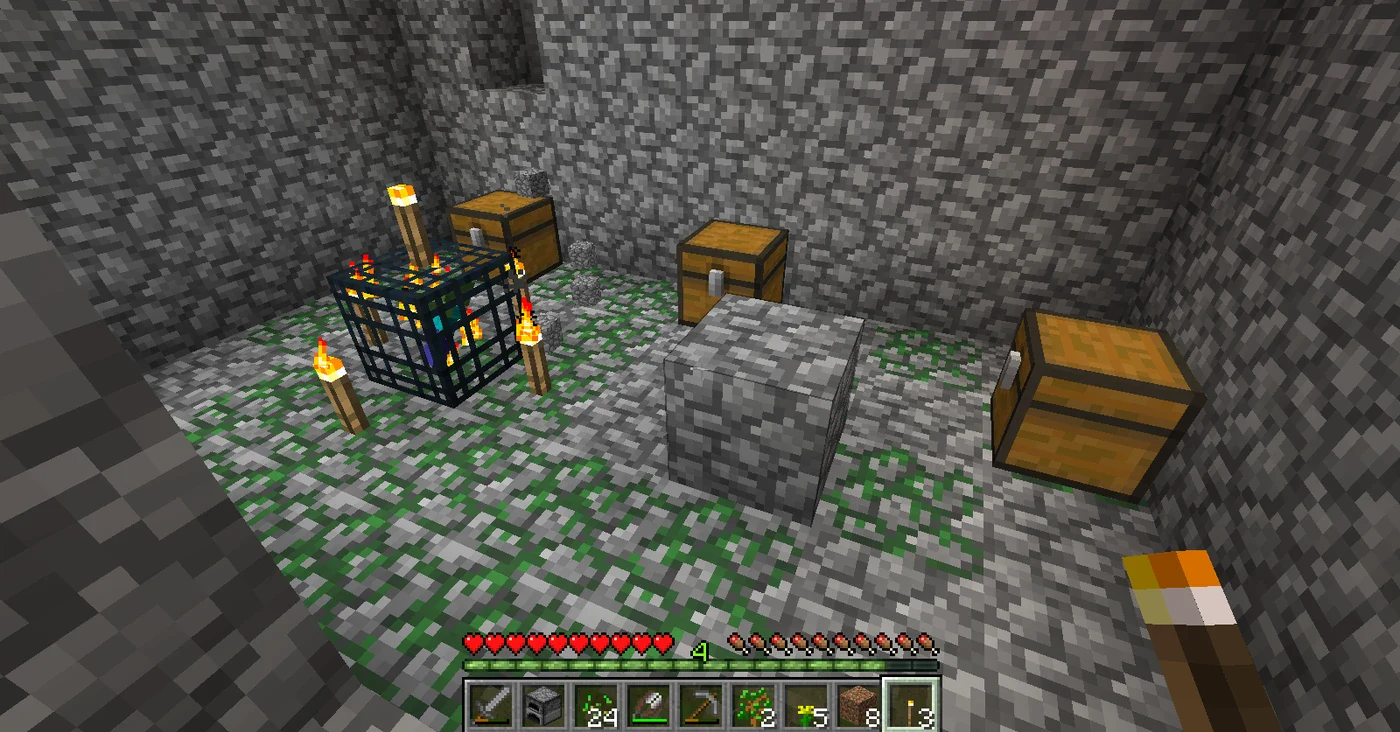
That is the whole list. Want a mob that is not on it? You are building a normal dark-room farm instead — a different engineering problem, covered in the best Minecraft farms roundup. Monster rooms are worth finding for the chest loot alone, which pairs naturally with a proper mining strategy.
The 16-block activation rule
A spawner turns on when a player who is not in Spectator mode comes within a spherical radius of 16 blocks measured from the center point of the block — so 15.5 blocks from the block face. Sphere, not cylinder. That distinction matters constantly when you build a farm with an AFK spot above or below the spawner: vertical distance counts exactly as much as horizontal distance.
If your AFK platform sits 14 blocks straight up and 8 blocks sideways, you are 16.1 blocks away and the spawner is simply off. This is the single most common reason a "finished" spawner farm produces nothing. Measure the diagonal, not the footprint.
Inside the spawn cycle
When active, the spawner picks 4 random points inside its spawn volume and tries to place a mob at each. Every ordinary spawning requirement still applies except the solid-block-underneath rule — the mob still needs room for its hitbox, still needs the right light level, still cannot spawn inside a block. So a "4 mob" attempt very often produces one or two.
When it succeeds it puffs smoke, throws extra flame particles, and starts the 200-to-799-tick wait. The mob model inside the cage spins faster as the timer runs down, which is a genuinely useful visual cue when you are debugging a farm.
Here is the part people miss: if the spawner picks four unsuitable locations and spawns nothing at all, it does not start the wait timer. It retries every single tick until at least one mob appears. The cooldown only begins after a successful spawn. A well-built farm therefore runs almost purely on the 10-to-39.95-second cycle, and a badly built one wastes its attempts but never actually stalls.
The six-mob cap that quietly kills your rates
This is the rate killer. Before each of the four spawn attempts, the game counts mobs of the spawner type whose hitbox intersects a volume around the spawner:
- Java Edition: a 9x9x9 volume centered on the spawner block.
- Bedrock Edition: a 16x10x16 volume centered on the lower northwest corner of the spawner block.
If 6 or more are already in there, the spawner poofs without spawning anything and waits for the next cycle. Not a reduced spawn. Zero.
This is why every good spawner farm moves mobs away fast. If your kill chamber is directly under the spawner and mobs pile up while you swing at them, you are permanently sitting at the cap and running at a fraction of the possible rate. Bedrock players get punished harder here — that 16x10x16 box is enormous compared to Java, so your holding area needs to be genuinely far away.
Java and Bedrock spawn in different shapes
Java uses a 9x3x9 volume: four blocks horizontally in each direction, one block vertically above and below the spawner. Simple box.
Bedrock uses 4 blocks of taxicab distance horizontally from the sides of the spawner, which makes the horizontal cross-section a diamond, not a square. If you are digging out a Bedrock spawner room and you carve a clean square, you have excavated corners that will never spawn anything. Mobs are also more likely to spawn closer to the spawner than farther from it in both editions, so the far edges contribute less than you would expect either way.
Mobs spawn at fractional X and Z coordinates but at integer Y — their legs land on the spawner layer, one above, or one below. That is why the vertical range is genuinely only three layers, and why tall mobs like zombies and skeletons need the layer above the top spawn layer to be transparent or they simply cannot spawn there.
Silk Touch does not work and never has
Let us kill this one permanently. Monster spawners cannot be obtained in Survival, even with Silk Touch. There is no enchantment, no tool, no trick. Break one with a pickaxe and it drops 15 to 43 experience and nothing else. Break it with anything other than a pickaxe and it drops nothing at all.
They also cannot be moved by pistons — not pushed, not pulled by sticky pistons. The block is anchored where the world generator put it, forever. You get spawners in Creative from the inventory, from a give command, or via setblock, clone, and fill, and a placed one is inert until you use a spawn egg on it.
So plan around the location. A spawner is a fixed piece of terrain, like a lava lake. Build the farm where the spawner is, not where you want it.
Building an XP farm off a dungeon spawner
The zombie or skeleton dungeon farm is the best XP-per-hour-of-setup in the early game, and it needs no redstone at all. If you want to understand what you are converting that XP into, the XP mechanics guide and the enchantment rankings are the natural follow-ups.
Step one: light the room, not the spawner
Torch the surrounding cave and every surface outside the 9x3x9 spawn volume first. You want the spawner to be the only thing producing mobs in the area.
Do not torch the spawner itself yet — for dark-spawning mobs a single torch on any side or the top disables the whole spawn volume, which makes a great construction safety switch you remove last.
Step two: carve the spawn volume
Dig out the full spawn volume plus one layer above it. For Java that is a 9x3x9 box with headroom on top so tall mobs fit. For Bedrock, remember the diamond and skip the corners. Then leave a 1-block gap at one edge of the floor for mobs to fall into.
Step three: the drop and the kill chamber
The classic approach is a water stream across the spawn floor pushing mobs into a drop shaft. The critical measurement is fall distance: you want mobs at half a heart so a single unenchanted punch finishes them and you get full XP.
- Zombies and skeletons (20 health): a fall of 23 blocks leaves them at roughly one heart. 24 blocks puts most of them at half a heart. Fall damage is 1 half-heart per block past the first three, so tune it by one block at a time and test.
- Keep the kill chamber well outside the 9x9x9 (Java) or 16x10x16 (Bedrock) counting box, or the six-mob cap will throttle you while you stand there.
That last bullet is the whole difference between a farm that feels great and one that feels broken. Push mobs away from the spawner, always.
Blaze spawners are a different animal
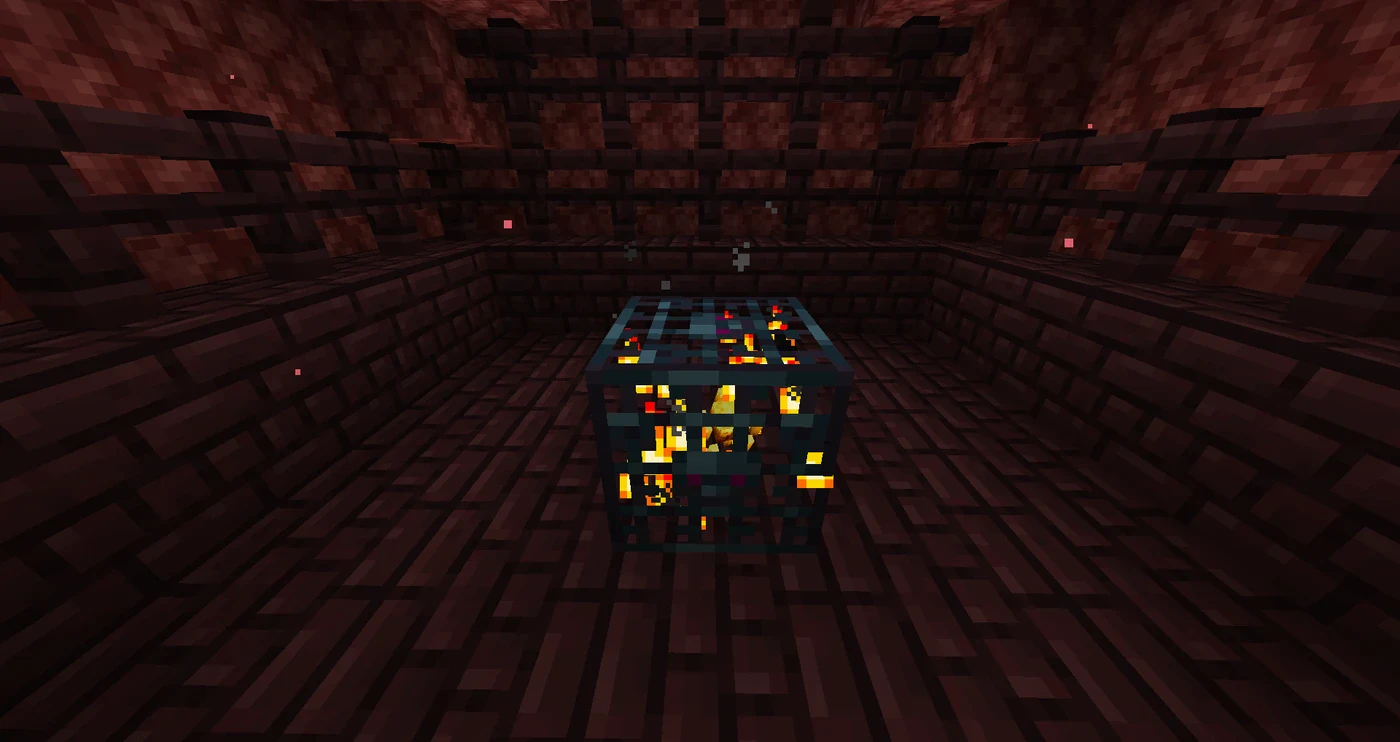
Blaze spawners are the most valuable spawner in the game because blaze rods are the only source of blaze powder, which gates both the brewing stand and every potion and the eyes of ender you need to reach the End.
Two things make them harder than a dungeon:
- They need light level 12 to disable, not 0. A single torch does nothing. During construction that means blazes keep spawning while you work, so bring fire resistance or a lot of patience.
- Blazes fly and shoot. A simple fall-damage farm does not work cleanly. Most designs push blazes into a confined chamber with a trapdoor ceiling and kill them manually, or drown-drop them a long way.
Blaze spawn volume is 3.8 blocks high — one block under the spawner and 1.8 above it — because blazes are taller than a block. Clear that headroom or you lose spawn slots.
If you are in a fortress for the spawner anyway, read the nether fortress and bastion guide before you go. Getting there safely is most of the difficulty.
Cave spider spawners and the cobweb problem
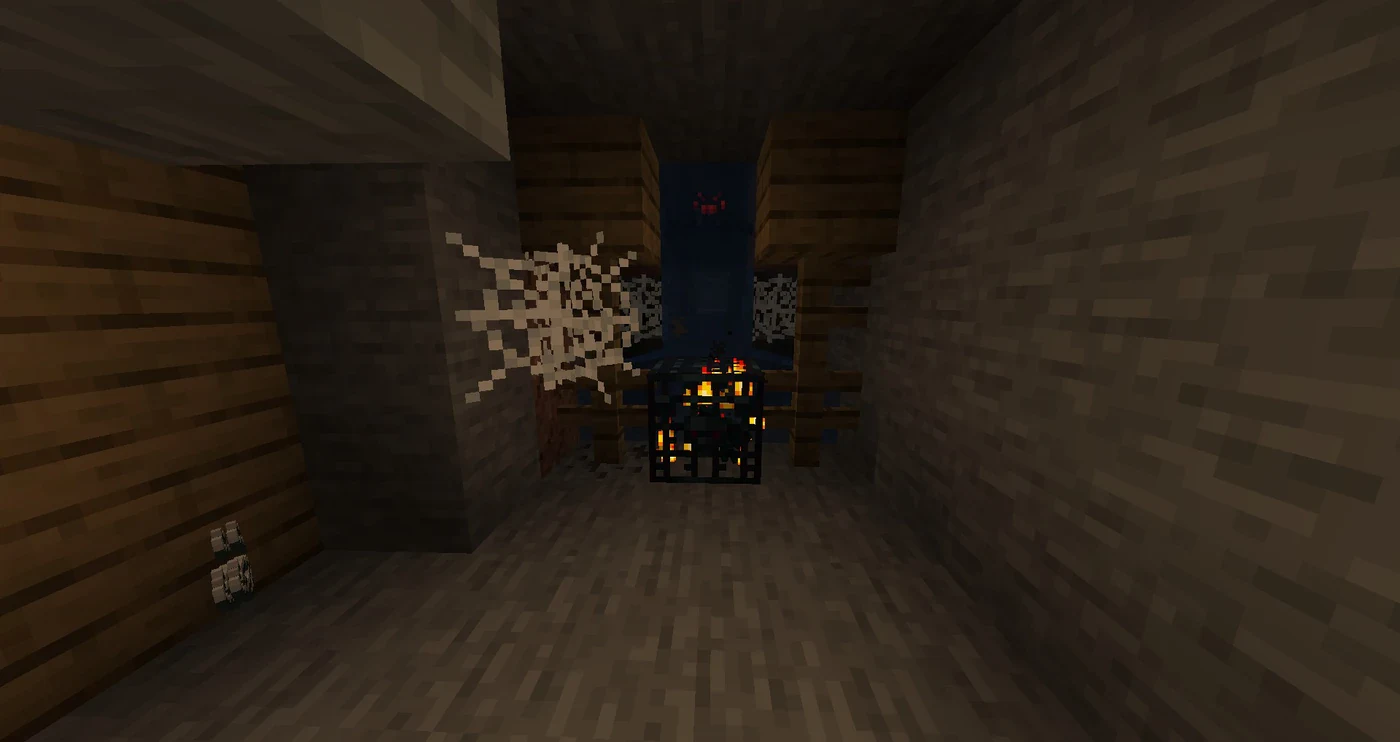
Cave spider spawners generate in mineshafts densely wrapped in cobwebs, and they are the most dangerous spawner to approach carelessly. Cave spiders are small enough to fit through a 1x1 gap, they inflict poison on Normal and Hard difficulty, and the cobwebs slow you to a crawl while they do it.
They make good string and XP farms, but the build order matters: clear cobwebs from the outside in, place a torch on the spawner the moment you can reach it, and only then carve the room. Bring milk. A bucket of milk clears poison instantly and it is the single most useful item to have on your hotbar down there.
Spiders also cannot spawn in a 1-block-tall gap, so a spider or cave spider farm can be shut off simply by lowering the ceiling — a trick that does not work on any other spawner type.
Silverfish and magma cube spawners

The stronghold silverfish spawner in the end portal room is the one almost everybody destroys on sight, and that is usually the correct call. Break it with a pickaxe for the 15 to 43 XP and move on. Like blazes, silverfish need light level 12 to suppress, so a torch will not save you.
Magma cube spawners in bastion treasure rooms are the strangest of the set, because magma cubes spawn at any light level. Light does nothing. The only fix is filling the spawn volume with solid blocks — and because every magma cube needs room for the large variant, as few as 9 solid blocks one layer above the spawner shuts the whole thing down.
Turning a spawner off for good
Sorted by mob behavior, since that is what actually determines the answer:
- Dark-only mobs (zombie, skeleton, spider, cave spider): one torch on any side or the top of the spawner kills the entire 9x3x9 volume.
- Blaze and silverfish: you need light level 12 throughout. Options include nine luminance-15 blocks laid in the standard pattern, six lava sources above the spawner, or a dense 7x7 grid of torches on the spawner Y level. In Bedrock, a light-15 source on four surfaces works.
- Magma cubes: light is irrelevant. Fill the volume with solid blocks, or use the 9-block trick above.
- Anything, permanently: mine it with a pickaxe. You lose it forever, but you get 15 to 43 XP on the way out.
One last thing worth knowing: spawn conditions mostly ignore biome. Spawners in mushroom fields, the deep dark, or the Void biome all function normally even though hostile mobs never spawn naturally there — a working mob source in places the game otherwise leaves empty.
Quick Action Checklist
- Measure your AFK spot as a sphere: 16 blocks from the spawner center, diagonal included. Vertical distance counts.
- Expect 4 spawn attempts per cycle and a 10 to 39.95 second wait between cycles. That is the ceiling. Nothing makes it faster.
- Keep fewer than 6 mobs of the spawner type inside the 9x9x9 (Java) or 16x10x16 (Bedrock) counting box or the spawner poofs and skips.
- Put your kill chamber outside that counting box. This is the number one rate fix.
- Carve 9x3x9 in Java. In Bedrock, carve the diamond — the square corners never spawn anything, and leave the top layer transparent so tall mobs fit.
- Stop looking for a Silk Touch spawner. It does not exist. Pickaxe gives 15 to 43 XP and nothing else.
- Tune the drop to about 24 blocks for zombies and skeletons so one punch finishes them.
- Use a torch on the spawner as a construction safety switch for dark-spawning mobs, and take it off last.
- For blaze and silverfish, plan for light level 12 — a single torch does nothing. For magma cubes, forget light and use 9 solid blocks one layer above.
- Bring milk to a cave spider spawner. Poison plus cobwebs is how people lose inventories.
Frequently Asked Questions
Can you get a spawner with Silk Touch in Minecraft?
How far away does a Minecraft spawner stop working?
Why is my Minecraft spawner farm so slow?
How do you disable a blaze spawner in Minecraft?
What mobs can naturally generate in spawners?
Keep Reading
Related Guides
Minecraft Automatic Farms: Observer and Piston Designs
Observer-and-piston farms look identical in every tutorial and perform nothing alike. The difference is growth math, edition-specific observer timing, and whether the chunk is even loaded. Here are the numbers behind the builds.

Minecraft Slime Farm Guide: Slime Chunks, Swamps, Slimeballs
Slimeballs are the one item you can't mine, trade, or craft your way around — sticky pistons, leads, and slime blocks all dead-end at them. Here's how to build a slime farm that buries you in the stuff, whether you go slime-chunk or swamp.
Minecraft Iron Farm Guide: Build an Iron Golem Farm
An iron golem drops 3 to 5 iron ingots every single time it dies, guaranteed, and your villagers will manufacture them for free if you set the scene right. Here is how to weaponize the panic mechanic into a farm that buries you in iron.
Minecraft Music Discs: Every Disc and How to Get It
Twelve of the 22 music discs come from a creeper killed by a skeleton or one of its variants. The other ten come from ten different places, and eight of those are a structure. Here is every disc, its composer, its length, its odds, and the comparator value it puts out — including the seven signal levels that two different discs now share.

Minecraft Survival Guide for Beginners: Your First Days
You have about ten minutes of daylight before the sun sets and the world tries to kill you. Here is exactly what to do with them — punch a tree, build a tool chain, and get a roof over your head before the zombies arrive.

Best Minecraft Enchantments, Ranked — The Ones Worth Your XP
Mending is the enchantment that ends the grind — gear that repairs itself forever. Everything else is a fight over your XP and anvil uses. Here is what actually earns a slot, ranked, with the real max levels.