Palworld TCG Rulings - All 97 and the Most-Ruled Cards
The Palworld TCG shipped with an official Q&A of 97 entries and has not added or revised one since. Pulling the whole database and sorting it by card shows where the game is genuinely hard: 45 of the 97 are wording rules that apply to cards nobody has printed yet, only 26 of the 166 cards ever earned a card-specific answer, and four cards account for 16 of the 32 that exist.
Bushiroad shipped the Palworld TCG on 30 July 2026 with an official Q&A attached, and then left it alone. Every one of the 97 entries carries a registration date of 30 July 2026, every one has a null update date, and not one is flagged as reflecting a rules revision. Thirty-one days on, the rulings you can read today are the rulings that were there on launch morning.
So I pulled all 97 and sorted them by what they actually point at. The shape is not what the entry count suggests. Only 32 of the 97 answer a question about a specific card, and those 32 land on just 26 of the 166 cards in the pool. Four cards hold 16 of the 32 between them. Their individual counts add up to 18, but entries #83 and #84 each name two of the four, so the distinct total is 16.
The other 45 in the largest category are not about any one card. They are wording rules — what "Choose up to X" means, what "Choose all" forbids, when an automatic ability is mandatory — filed against every card that happens to use the phrase. They will still be the answer when Booster Pack "Legends Awaken" arrives on 30 October with another 100 card types nobody has read yet.
What the official Q&A actually is
Five categories, 97 entries, numbered 1 to 97 with no gaps.
| Category | Entries | What lives there |
|---|---|---|
| Card Abilities | 45 | Generic wording and timing rules, tagged onto every card they touch |
| Q&A about Cards | 32 | One named card, one specific interaction |
| Flow of the Game | 12 | Phases, zones, limits, resolution order |
| Game Preparation | 7 | Deck legality, mulligan, sleeves, playmats |
| Tournaments/Events | 1 | Time limits |
Twenty-three of the 97 reference no card number at all — they are pure rules questions. The remaining 74 are tagged to at least one card.
That single Tournaments/Events entry is #7, and it says only that a time limit is set per event and you should read that event's floor rules. Everything competitive lives in the Bushiroad floor rules document instead, which the promo card and organized play guide goes through.
Only 26 cards ever got a card-specific answer
Run every card number in the Q&A back against Bushiroad's own card database and 114 of the 166 base cards are tagged by at least one entry. But most of those tags come from the generic wording rules, which get attached to dozens of cards at once. Narrow it to the 32 card-specific entries and the field collapses to 26 cards.
By card type, the hit rate is lopsided:
| Card type | Cards in pool | Tagged by any ruling |
|---|---|---|
| Structure | 26 | 24 |
| Pal | 100 | 66 |
| Event | 17 | 13 |
| Gear | 14 | 11 |
| Soul | 9 | 0 |
Structures are the type most likely to be caught up in a ruling — 24 of 26 — which follows from what they do: they sit in the base indefinitely, 21 of the 26 carry a [Once Per Turn] clause, and they take Pal assignments. Souls are the opposite. Not one of the nine Soul cards appears in a single entry, and only one of the nine carries any text at all: the trial deck Soul's parenthetical reminder that you may rest 3 souls once per main phase to draw a card. The other eight are blank.
Here are the cards with more than one card-specific ruling, with their total tag count alongside for contrast.
| Card | Number | Type | Colour | Card-specific | All tags |
|---|---|---|---|---|---|
| Antique Dresser | EBP01-040 | Structure | Blue | 5 | 9 |
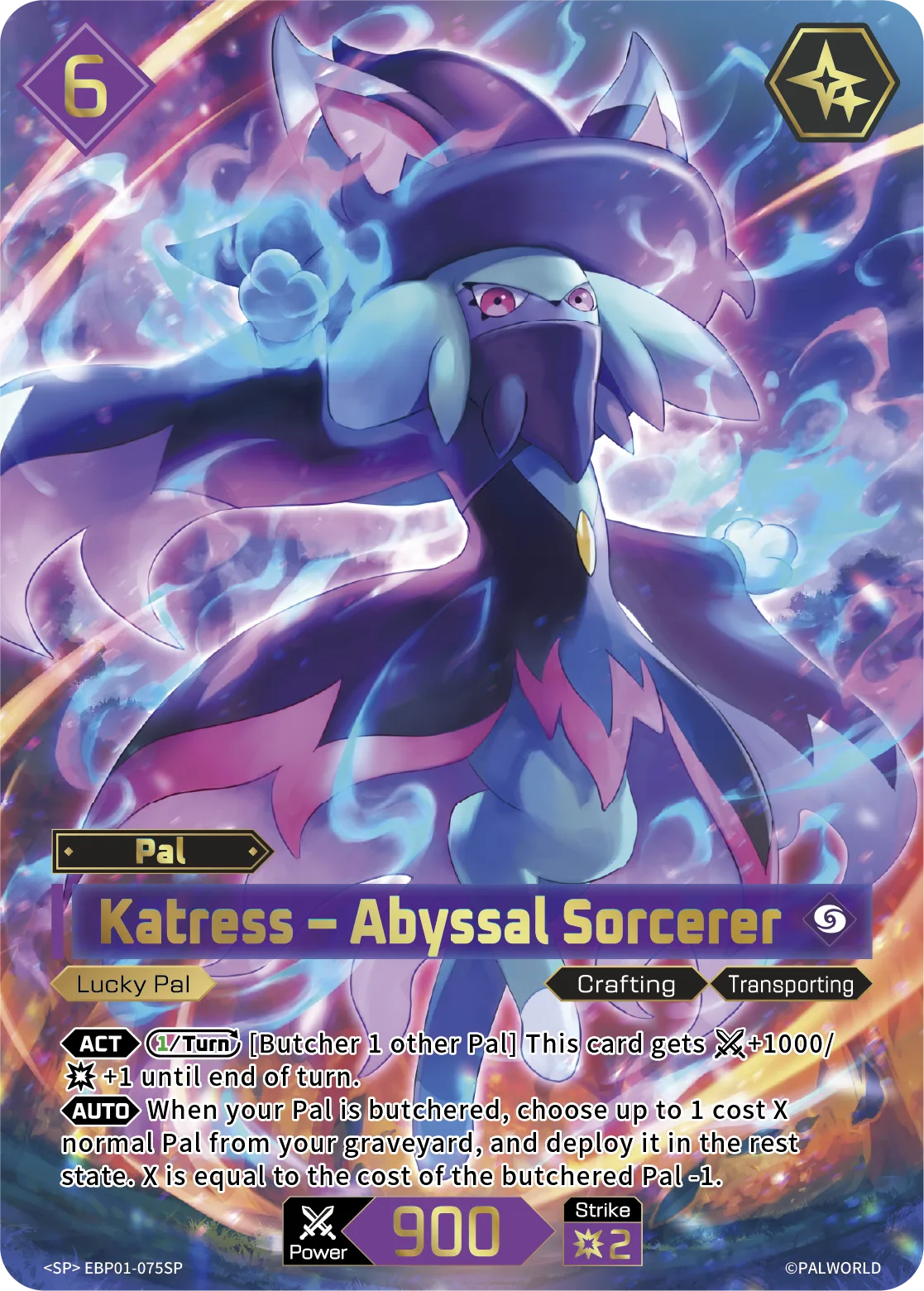
| Katress – Abyssal Sorcerer | EBP01-075 | Pal | Purple | 5 | 9 |
| Shadowbeak – Seed of Despair | EBP01-074 | Pal | Purple | 5 | 8 |
| Helzephyr – Wings of the Moonless Night | EBP01-073 | Pal | Purple | 3 | 6 |
| Digtoise – Seismic Drillback | EBP01-050 | Pal | Green | 2 | 4 |
| Digtoise – Keen Needleback | EBP01-059 | Pal | Green | 2 | 4 |
| Elizabee – Queen of the Flower Garden | EBP01-053 | Pal | Green | 2 | 6 |
| Wumpo – Frostpeak Sentinel | EBP01-033 | Pal | Blue | 2 | 2 |
| Foxparks – A Toasty Hug | ETD01-004 | Pal | Red | 2 | 3 |
| Foxparks – Light of Courage | EBP01-006 | Pal | Red | 2 | 3 |
| Foxparks' Harness | EBP01-019 | Gear | Red | 2 | 5 |
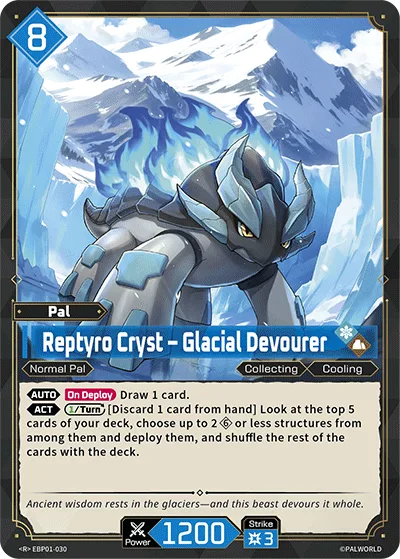
The gap between the two columns is the tell. Reptyro Cryst – Glacial Devourer picks up seven tags but only one card-specific answer; it is a card that keeps getting swept up by generic rules about looking at the top of your deck, not a card Bushiroad had to explain. The four at the top are the reverse.
The most-ruled card in the game is a dresser
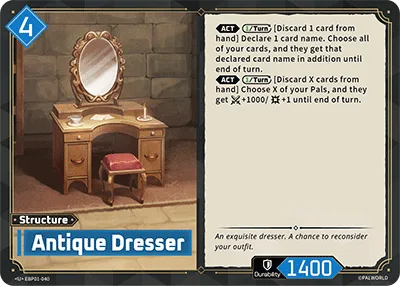
Antique Dresser is a 4-cost Blue structure at Uncommon with 1400 Durability, and it ties Katress for the most rulings of any card in the game. Five of its nine are about one clause: 〈Declare 1 card name. Choose all of your cards, and they get that declared card name in addition until end of turn.〉
Naming a card out loud turns out to need a lot of rules.
| Entry | Question | Answer |
|---|---|---|
| #67 | Can you declare a card that has not been released or distributed yet? | No |
| #68 | Can you declare a name that does not exist? | No — it must exist in the official card list |
| #69 | What if you forget the exact name? | Valid if both players can identify the card; call a judge at an event if you cannot agree |
| #66 | Does declaring 《Farming Hat》 make a structure count as a "Farming" structure? | No — "Farming" means the Work Suitability, not the name |
| #97 | Does the granted name satisfy "3 or more Pals with different card names containing 《My First》"? | No |
The last two are the ones that matter for deckbuilding, because they both close the same loophole from opposite ends. Adding a card name does not add the properties that name implies, and it does not manufacture the different names a counting condition asks for. Work Suitability is a separate field, which is exactly the point entry #15 makes, and the structures guide covers how little Work Suitability currently gates.
The other four tags on Antique Dresser are generic: #27 (an unspecified zone means the base), #36 ("Choose all" cannot be trimmed), #44 and #48 (both about [Once Per Turn]).
Purple's night engine is the other half
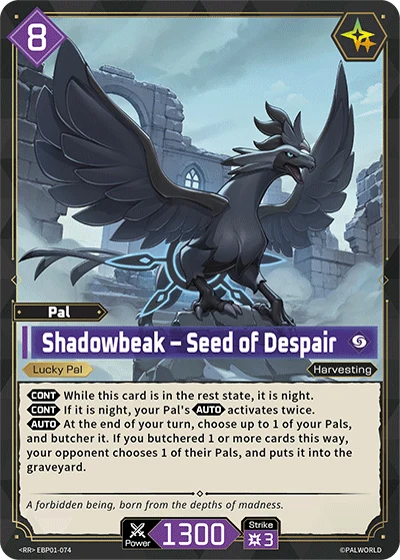
Three of the four most-ruled cards are Purple: Shadowbeak – Seed of Despair, Katress – Abyssal Sorcerer and Helzephyr – Wings of the Moonless Night. Purple also leads the pool on total ruling tags at 85, against 74 Green, 72 Red and 66 Blue, off a pool that is 38 Purple cards to 37 each of the others.
The reason is one clause on Shadowbeak: 〈【CONT】 If it is night, your Pal's 【AUTO】 abilities activate twice〉, sitting on a card whose other continuous ability makes it night whenever the card is rested. Doubling every automatic ability you control creates ordering questions that a single card cannot answer on its own, and Bushiroad wrote five entries about it.
- #82 — Shadowbeak's own 【AUTO】 ability is doubled by its own 【CONT】 ability.
- #85 — Two copies of Shadowbeak in the base still means twice, not three times. The ability does not add an activation; it causes an 【AUTO】 to activate twice each time it triggers.
- #86 — 〈Breakthrough〉 counts. It is an 【AUTO】, so it doubles.
- #83 and #84 — Butchering Shadowbeak while it is the only source of night still doubles what that butcher triggers. Katress activates twice, not once, and #84 spells out the whole end-of-turn sequence: Shadowbeak's own ability activates twice and pends, resolving one of them butchers Shadowbeak, and Katress then activates twice anyway.
Katress is the card those doublings feed. Its 【AUTO】 deploys a Pal from the graveyard whose cost equals the butchered Pal's cost minus one, and three entries pin down what that means.
- #88 — Butchering Katress itself still activates Katress's own ability.
- #89 — "cost minus 1" is exact. Butcher a ◇5 and you may deploy a ◇4, not a ◇3.
- #90 — If Katress triggers mid-resolution of Meat Cleaver, Meat Cleaver finishes first. That is #42's general rule applied to a specific pair.
Helzephyr's three are about 〈Nocturnal〉: it triggers on its own deployment because it has 〈Nocturnal〉 itself (#78), it does nothing extra if it is already rested at end of turn (#79), and a Pal that gains 〈Nocturnal〉 from Lamp counts (#80).
The 45 wording rulings that cover cards you have not read
This is the half of the database worth reading front to back, because these answers attach to a phrase rather than a card. Learn them once and they resolve cards that have not been printed yet.
| Wording on the card | Can you take fewer? | Entry |
|---|---|---|
| "Choose X cards" | No — you must choose as many as possible, up to X | #33 |
| "Choose up to X cards" | Yes — including 0, even when legal targets exist | #34 |
| "Choose all …" | No — you cannot exclude any of them | #36 |
| "Consume X [resource]" | Yes — 0 is a legal choice | #35 |
| "You may [do X]" | Yes — the whole thing is optional | #46 |
| An automatic ability whose condition is met | No — it must activate | #37 |
The split between the first two rows is the one to memorise. "Choose 2 Pals" with two Pals on the board forces both, including your own if they are the only legal targets; "Choose up to 2 Pals" lets you take none. The event card guide works through what that does to the Strategy cards specifically.
Four more entries handle the case where the effect simply cannot find what it wants — #59 and #60 for "look at the top X and take a specific card", #87 for the same from the graveyard, #95 for the same from hand. The answer is identical in all four: choose 0 and resolve the rest of the effect. The effect does not fizzle, and any "and then" clause after it still happens.
Running the deck low is also safe. Entries #38 and #39 both say that looking at or revealing more cards than your deck holds resolves with what is there, and that a deck temporarily hitting zero mid-resolution does not lose you the game as long as there is at least one card in it when resolution finishes.
Where an ability works from
Five entries define the zone rules, and they do not all point the same way.
| Situation | Ruling | Entry |
|---|---|---|
| Any ability, zone unstated | Effective only in the base | #31 |
| "Choose X Pals" with no zone named | Refers to cards in the base | #27 |
| 【On Deploy】 | Activates from deck, graveyard or anywhere else, not just hand | #32 |
| 〈When this card is put into the graveyard〉 | Only from the base — not from hand or deck | #41 |
| 〈Interrupt〉 | Only from the hand; cannot be activated in the base | #51 |
〈Interrupt〉 is the one that reads backwards. It is printed on a Pal card, but it is a hand ability — the nine Pals that carry it, thirteen printings once parallels and the two promo reprints are counted, are discarding themselves out of hand to nullify an attack. A copy sitting in your base does nothing.
Do not read #51's tag list as the roster, though. It lists eleven printings, and two of them are wrong in opposite directions: it tags ETD02-014 (Leezpunk – Treasure Bandit), whose card text carries no Interrupt at all, and omits ETD02-017 (Blazehowl Noct – Darkflame Defender), which carries it. The card database is the authority on who has the keyword; the Q&A is the authority on how it works.
Two more that are easy to get the wrong way round: an 【On Deploy】 ability fires when a card is deployed by another card's effect, not only when you play it from hand (#32), while a graveyard trigger does not fire when the card is milled or discarded (#41).
Once per turn means once per copy, and once per ability
Three entries triangulate [Once Per Turn], and the answer is more generous than the wording suggests.
| Question | Answer | Entry |
|---|---|---|
| Two copies of the same card in the base — one activation each? | Yes, each card gets its own | #44 |
| One card with two [Once Per Turn] 【ACT】 abilities — both usable? | Yes, each ability once | #48 |
| One ability with two alternative costs — pay the other and go again? | No, still once | #52 |
Antique Dresser is where the first two stack: it carries two [Once Per Turn] 【ACT】 abilities on one card, so both fire, and a second copy in the base doubles that again — four activations from two cards. #52 is the limit on the other side, and it was written about Jormuntide Ignis – Savage Lava Dragon, whose ability offers a choice of costs: paying the other one does not buy a second activation.
Resolution order is #42 and #43. An 【AUTO】 that triggers mid-resolution waits; you finish what you are doing first. When several are pending, the turn player resolves all of theirs in any order they like, then the non-turn player does the same — and a newly triggered ability does not have to go last.
Power 0 does not kill a Pal
Three entries cover the damage model, and together they say something the card faces do not.
- #92 — A Pal whose Power drops to 0 or less is not put into the graveyard for that reason alone.
- #93 — It dies once the damage it has already taken reaches its Power.
- #74 — A Pal kept alive by a 【CONT】 Power buff dies the moment the condition lapses, if its accumulated damage has already reached the number it falls back to.
Power is a threshold checked against damage, not a pool that empties, which is the model the Pal cost breakdown works from. A Power-reduction effect kills only if the Pal is already damaged.
One caution on the exact boundary. The closing sentence of #92 and of #93 both phrase the trigger as damage becoming "greater than" the Pal's Power, which reads as though a Pal sitting on damage exactly equal to its Power survives. It does not. Rule 11.4.1 of the Comprehensive Rules ver. 1.00 puts a Pal or structure into the graveyard when it "takes greater than 0 damage, and it is equal to or greater than that Pal's power or structure's durability" — and the Q&A itself agrees everywhere it puts the boundary to an actual case. #93's question is the boundary case: a Pal whose Power is reduced to "equal to or less than" the damage it has already taken, answered "Yes, it is put into the graveyard." #74 uses the rulebook's wording verbatim. So a 900-Power Pal carrying exactly 900 damage dies; the loose "greater than" in those two summary lines is a phrasing slip, not a third rule.
Strike behaves differently again: #64 says Strike can go to 0 or below, and a player-damage effect at 0 or less Strike simply deals nothing.
Five setup answers that are not the obvious one
Buried in the Game Preparation and Flow of the Game categories are five that read the other way from the card text.
| Question | Official answer | Entry |
|---|---|---|
| Mulligan — can you redraw some of the five? | No. All five or none | #9 |
| Your base has 5 Pals. Can you deploy a sixth? | Yes. Deploy it, then put Pals into the graveyard until you are back to 5 | #11 |
| Can you decline your draw in the Draw Phase? | No. The draw is mandatory | #22 |
| Is there a hand size limit? | No | #10 |
| Is there a cap on structures and gear? | No. Only Pals are capped | #12 |
Entry #11 is the useful one. The five-Pal ceiling is not a restriction on deploying — it is a rule action that trims afterwards, and you choose which Pals go. Deploying over the cap to bin a Pal you want in the graveyard is legal.
Two more worth carrying: souls cap at 10 and an effect that would raise you past it simply cannot (#76), and abilities that refer to "all red Pals" do not include Colorless Pals, because Colorless is the absence of a colour rather than a fifth one (#47) — the distinction the colours guide is built on.
Three references in the index point at nothing
Cross-checking every card number cited in the Q&A against the official card list turns up three that do not resolve, and all three come back with a blank card name in Bushiroad's own data.
| Cited as | Appears in | Problem |
|---|---|---|
| BT01-039, BT01-039SR | #32, #34 | BT01 is not an English expansion prefix. EBP01-039 is Antique Curtain, and EBP01-039SR exists |
| ETD01-0011 | #28, #29, #30 | One digit too many. The card is ETD01-011, Ignis Breath |
| ETD02-002TSR | #14, #32 | ETD02-002 is Gumoss – Dreamy Seedling, but it has no TSR printing |
None of the three changes a ruling, and two of them cost you nothing in practice, because a correctly numbered printing is tagged alongside the typo. Entries #28, #29 and #30 also carry ETD01-011TSR, and #14 and #32 also carry ETD02-002, so a card-number lookup on Ignis Breath or Gumoss still returns them — the filter matches any printing, parallels included.
The BT01-039 pair is the one that actually costs something. Neither #32 nor #34 carries an EBP01-039 tag alongside it, so a card-number lookup on Antique Curtain comes back empty in Bushiroad's own database even though two rulings apply to the card.
The ETD02-002TSR case is the odd one. Each launch trial deck has exactly 12 TSR printings, and ETD02-002 is not one of them, so the Q&A is citing a parallel that was never printed.
How to look up the rulings for one card
The official Q&A page at en.palworld-official-cardgame.com/question/ is the front door, and its underlying database accepts a card number filter — pass EBP01-075 and you get Katress's nine entries, base printing and parallels together. A keyword filter works too, so Quick returns the five Quick-timing entries.
Two things to know before you trust a lookup. Rulings are filed against every printing they touch, so an entry tagged to EBP01-002, EBP01-002OSR and EBP01-002SP is one ruling, not three — and because the filter matches any printing, a typo on one number is usually absorbed by a correct tag on its parallel. The exception is Antique Curtain: EBP01-039 returns 0 entries, because the only tags on the two rulings that cover it are the mistyped BT01-039 and BT01-039SR.
What the database does not have
- No revisions. All 97 entries are dated 30 July 2026 with no update date, and none is marked as reflecting a rules revision.
- No entries added since launch. All 97 carry a registration date of 30 July 2026, and the total read 97 again on 30 August 2026.
- Almost nothing on tournament play. One entry, on time limits, which defers to per-event floor rules.
- No entry for 140 of the 166 cards. They have no card-specific answer, which means the generic wording rules and the comprehensive rules are all you get.
Errata are kept separately, at the errata page, and there is still exactly one: ETD01-024TSR, the Trial Deck Super Rare printing of Ribbuny – Little Princess, dated 31 July 2026. The trial deck comparison has the notice in full.
Quick reference
| Question | Answer |
|---|---|
| Official rulings published | 97, numbered 1 to 97 |
| Date on every entry | 30 July 2026 |
| Entries revised since | 0 |
| Card-specific entries | 32 |
| Cards with a card-specific ruling | 26 of 166 |
| Cards tagged by any ruling | 114 of 166 |
| Most-ruled cards | Antique Dresser and Katress – Abyssal Sorcerer, 9 tags each |
| Largest category | Card Abilities, 45 entries |
| Entries naming no card | 23 |
| Soul cards with a ruling | 0 of 9 |
| Broken card references | 3 |
| Errata issued | 1 (ETD01-024TSR) |
Counts read from Bushiroad's official Q&A and card databases on 30 August 2026. Booster Pack "Legends Awaken" arrives 30 October with another 100 card types, and the Sleeve & Card Set Vol.1 on 16 October (delayed from 2 October in a notice posted 28 August) adds five more; expect the entry count to move then rather than before.
Frequently Asked Questions
How many official rulings does the Palworld TCG have?
Which Palworld TCG card has the most official rulings?
What is the difference between "Choose X" and "Choose up to X" in the Palworld TCG?
Can you deploy a sixth Pal in the Palworld TCG?
Does a Palworld TCG Pal die when its Power drops to 0?
Can Interrupt be used from the base in the Palworld TCG?
How do you look up a Palworld TCG ruling for a specific card?
Are there Palworld TCG errata?
Keep Reading
- Palworld Official Card Game - Official Rules Q&A (97 entries)
- Palworld Official Card Game - Official Card List
- Palworld Official Card Game - Errata
- Palworld Official Card Game - Rules and Comprehensive Rules
- Palworld Official Card Game Comprehensive Rules ver. 1.00 (Bushiroad, PDF, 30 July 2026)
- Booster Pack "Legends Awaken" - Official Product Page (30 October 2026)
- Sleeve & Card Set Vol.1 - Official Product Page (16 October 2026)
Related Guides
Palworld TCG AUTO, CONT and ACT Abilities Explained
Every ability on a Palworld TCG card opens with one of three tags - AUTO, CONT or ACT - and Comprehensive Rules 10.1 makes that tag the most important word in the text box. It decides whether the ability works on your opponent's turn, whether you are allowed to decline it, and whether a [Once Per Turn] clock applies. I counted all 153 printed abilities across the 157 distinct cards in the launch pool and sorted them by category, trigger and cost.
Palworld TCG Keyword Abilities - 10 Counted, 14 in the Rules
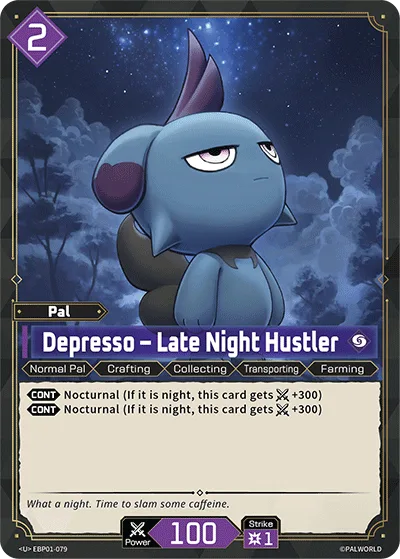
Comprehensive Rules ver. 1.00 defines fourteen keywords in one section, and How to Play the Palworld TCG tables all of them - what Brave does, what Taunt does - and stops there. Nobody has counted how many cards actually carry each one. I pulled every card tagged with one of the ten keyword abilities Bushiroad's official database filters on and cross-referenced all 97 rulings: Interrupt covers nine Pals, Retaliate covers exactly one, and Depresso - Late Night Hustler prints Nocturnal twice on the same card, which the official Q&A confirms stacks to +600 Power.
Palworld TCG Elements - All 9, and Why Only 2 Cards Care
Every Pal card in the Palworld TCG carries an element icon, and the video game trained you to expect that icon to decide fights. It does not. Comprehensive Rules ver. 1.00 spends three sub-rules on elements and never mentions them again, and exactly two of the 166 cards in the launch pool have text that reads an element. Here is the full census of all nine across the 100 Pal cards, and the one element that already has support.
How to Play the Palworld TCG - Souls, Power vs Strike, and How You Actually Win
Bushiroad's Palworld card game launched 30 July 2026, and its comprehensive rules landed the same day. Here is the full walkthrough - the four colours plus colourless, the soul deck, the Power and Strike split that decides every attack, structures and Pal labour, and the Damage Check that turns your own deck into your life total. Everything here is sourced from the official rules, and I flag what Bushiroad has not published.
Palworld TCG Colours Explained - What Red, Green, Blue and Purple Actually Do
Bushiroad has published comprehensive rules for the Palworld TCG, but it has not published a colour-identity document - there is no official page telling you what Red or Purple is supposed to do. So I read the rules for what colour legally means, then went through all 150 unique cards in the launch pool and counted. Here is what colour actually is, the single hard rule it imposes, why souls make it cheaper than you think, and what the card pool says each colour was built for.
Palworld TCG Meta: What Won the Kyoto Masters League
Bushiroad has published the decks that finished first, second and third in all four blocks of Japan's first Masters League 26-27 qualifier, held in Kyoto on 22 September 2026. Every card in them has an English printing, so this is the first Masters League data for the Dawn of Palpagos format English players are about to take into October's Grand Challengers Cups. Eight of the 12 are Blue-Purple, ten run four Chillet, all 12 run exactly eight Lucky Pals, and not one contains a Green card.