Palworld TCG Elements - All 9, and Why Only 2 Cards Care
Every Pal card in the Palworld TCG carries an element icon, and the video game trained you to expect that icon to decide fights. It does not. Comprehensive Rules ver. 1.00 spends three sub-rules on elements and never mentions them again, and exactly two of the 166 cards in the launch pool have text that reads an element. Here is the full census of all nine across the 100 Pal cards, and the one element that already has support.
Open any Pal card in the Palworld TCG and there are one or two little icons sitting to the right of the card name. Fire. Water. Dragon. All 100 Pal cards carry at least one, and not one of them prints a word beside the icon to tell you what it is for.
They decide nothing. There is no type chart in this game, no strong-against, no resistance, and no combat modifier attached to an element anywhere in the rules. I pulled Bushiroad's own card database - all 256 rows, 166 base cards - and the Comprehensive Rules ver. 1.00 PDF, and the count is stark: the word "element" appears seven times in the entire rules document - six of them inside one short section, the seventh as a callout label on the card-anatomy diagram - and exactly two of the 166 cards have text that reads an element at all.
Both of those two name Dragon. That is the whole story of elements in the launch set, and it is worth reading before you build around one.
What the rules actually say about elements
Section 2.4 of Comprehensive Rules ver. 1.00 is three sub-rules long, and this is all of it:
2.4.1 The information about the element that the card has.
2.4.2 The elements are displayed with icons.
2.4.2.1 Neutral element means that the card possesses the "Neutral" element. It does not mean that the card has no element.
That is the complete legal definition. The section lists nine icons - Neutral, Fire, Water, Grass, Electric, Ground, Ice, Dark and Dragon - and then the document moves on to Work Suitability and never returns. Search the rest of the PDF for "element" and you get nothing: not in the battle rules, not in deck construction, not in damage.
What makes elements usable at all is a generic clause much later in section 2. Rule 2.16.1 says that if a card's ability refers to a card "by specifying certain information of the card, it refers to any card that has the information specified" - the same clause that lets a card say "red structure" or "cost 6 or less structure". Element is plumbed into that system. Bushiroad can print "choose 1 Fire Pal" whenever it wants. It just has not, yet, twice over.
The official Q&A carries this in one entry, #18, filed under Card Abilities:
Q. What are terms like [Fire] or [Dragon] on the cards?
A. They are elements. It is a piece of information possessed by cards, and may be referred to by card abilities.
That entry exists for a good reason. On the printed card the element inside an ability is rendered as a bare icon with no word beside it, so Chillet's text literally reads "if it is a cost 8 or less [icon] Pal". If you have not matched the icon to the icons beside the card name, the sentence is unreadable. Q&A #18 is tagged to exactly two base cards - EBP01-025 and EBP01-098 - which is its own confirmation of how narrow this is.
Every element in the launch pool, counted
There are 100 Pal cards in Bushiroad's database across the booster, the two trial decks and the 2026 promos. Nine of those are promo reprints whose element and colour match their originals field for field, so the distinct roster is 91 Pals. Both counts are below, because both get quoted.
| Element | Pal cards | Distinct Pals | Colours it appears on |
|---|---|---|---|
| Neutral | 6 | 5 | Colorless 6 |
| Fire | 22 | 20 | Red 18, Purple 4 |
| Water | 14 | 13 | Blue 13, Green 1 |
| Grass | 17 | 16 | Green 17 |
| Electric | 5 | 5 | Red 5 |
| Ground | 15 | 13 | Red 1, Blue 2, Green 11, Purple 1 |
| Ice | 13 | 12 | Blue 13 |
| Dark | 24 | 22 | Purple 24 |
| Dragon | 9 | 9 | Red 1, Blue 5, Green 1, Purple 1, Colorless 1 |
| Total | 125 | 115 | across 100 Pal cards |
The totals exceed the card counts because 25 of the 100 Pals carry two elements. Every Pal in the pool has at least one - there is no blank.
Dark is the biggest element at 24 cards, Electric the smallest at five. That five-card Electric pool is the number to sit with if you came here looking for an Electric deck: it is the entire printed support, and all five are Red - Jolthog, Sparkit, Univolt, Mossanda Lux and Grizzbolt, one card each.
Five of the nine elements never leave one colour
Cross-referencing element against colour across all 100 Pal cards, five elements are locked to a single colour and four are not:
- Neutral - all 6 cards (5 distinct Pals) are Colorless
- Grass - all 17 cards (16 distinct) are Green
- Electric - all 5 cards are Red
- Ice - all 13 cards (12 distinct) are Blue
- Dark - all 24 cards (22 distinct) are Purple
Those "cards" and "distinct" figures are the two columns of the table above: the first counts printed cards including promo reprints, the second counts unique Pals. Both get quoted, so it is worth knowing which one you are reading.
The four that travel are Fire (Red and Purple), Water (Blue and Green), Ground (all four colours) and Dragon (all four colours plus Colorless). Ground is the workhorse: 15 cards spread over Red, Blue, Green and Purple, though 11 of the 15 are Green.
This is why the colours guide is careful to say colour and element are separate fields doing separate jobs. They correlate hard - if you see a Dark icon you are looking at a Purple card, no exceptions in this pool - but the correlation is a design habit, not a rule. Nothing in Comprehensive Rules ver. 1.00 stops a Green Dark Pal from existing in a later set.
Twenty-five Pals carry two elements
Dual-element Pals are a quarter of the pool, and they skew expensive: 10 of the 25 cost 7 or 8, against 15 of the 75 single-element Pals - 40 per cent against 20 per cent. Cost, Power and Strike are set by the cost curve, not by element count, but the biggest bodies in the set do tend to be the two-icon ones.
| Pal | Number | Colour | Elements | Cost | Power | Strike |
|---|---|---|---|---|---|---|
| Gumoss – Dreamy Seedling | ETD02-002 | Green | Grass / Ground | 2 | 300 | 1 |
| Pengullet – Frequent Flyer | ETD01-014 | Blue | Water / Ice | 3 | 500 | 1 |
| Pengullet – Yearning for the Sky | EBP01-028 | Blue | Water / Ice | 4 | 600 | 2 |
| Dumud – Mellow Bounty | EBP01-057 | Green | Ground / Water | 4 | 500 | 2 |
| Gumoss – Curious Sprout | EBP01-058 | Green | Grass / Ground | 4 | 600 | 2 |
| Gumoss – Curious Sprout | EPR-006 | Green | Grass / Ground | 4 | 600 | 2 |
| Vanwyrm – Marauder of the Skies | EBP01-083 | Purple | Fire / Dark | 4 | 600 | 2 |
| Dinossom – Radiant Fragrance | ETD02-004 | Green | Grass / Dragon | 4 | 400 | 2 |
| Chillet – Dragon Whisperer | EBP01-025 | Blue | Ice / Dragon | 5 | 900 | 2 |
| Penking – Mighty Warrior of the Deep | EBP01-031 | Blue | Water / Ice | 5 | 600 | 2 |
| Menasting – Darkness-Dwelling Scorpion | EBP01-084 | Purple | Dark / Ground | 5 | 700 | 2 |
| Incineram – Lurking Stalker | ETD02-016 | Purple | Fire / Dark | 5 | 900 | 2 |
| Azurobe – Water Dragon Waltz | EBP01-029 | Blue | Water / Dragon | 6 | 1200 | 2 |
| Elphidran Aqua – Gentle Ripples | ETD01-012 | Blue | Dragon / Water | 6 | 900 | 2 |
| Blazehowl Noct – Darkflame Defender | ETD02-017 | Purple | Fire / Dark | 6 | 900 | 2 |
| Relaxaurus – Hungry Gunner | EBP01-026 | Blue | Dragon / Water | 7 | 1200 | 3 |
| Pyrin Noct – Steed of Azure Flames | EBP01-077 | Purple | Fire / Dark | 7 | 1100 | 3 |
| Jormuntide Ignis – Savage Lava Dragon | EBP01-001 | Red | Dragon / Fire | 8 | 1700 | 4 |
| Reptyro – Ore Gorger | EBP01-005 | Red | Fire / Ground | 8 | 1500 | 3 |
| Jormuntide – Surging Sea Serpent | EBP01-027 | Blue | Dragon / Water | 8 | 1600 | 3 |
| Reptyro Cryst – Glacial Devourer | EBP01-030 | Blue | Ice / Ground | 8 | 1200 | 3 |
| Warsect – Iron Fortress | EBP01-054 | Green | Ground / Grass | 8 | 1500 | 3 |
| Mammorest Cryst – Roar of the Tundra | ETD01-018 | Blue | Ice / Ground | 8 | 1700 | 3 |
| Mammorest – Roar of the Wilds | ETD02-007 | Green | Grass / Ground | 8 | 2000 | 4 |
| Astegon – Aegis Wyvern of Death | ETD02-012 | Purple | Dragon / Dark | 8 | 1200 | 3 |
One trap in that table if you ever filter the card list yourself: the print order of a dual pair is not standardised. Those 25 cards use 14 distinct orderings for what are only 12 distinct element pairs. Grass/Ground appears four times in that order and once as Ground/Grass on Warsect. Dragon/Water appears three times and once reversed as Water/Dragon on Azurobe. Sorting or grouping on "the first element" will split those pairs apart. Rule 2.16.1 does not care about order - a card that has Dragon has Dragon - but a spreadsheet will.
Only two cards in the game read an element
Search the text of all 166 base cards for any of the nine element names and you get two hits, both Dragon.
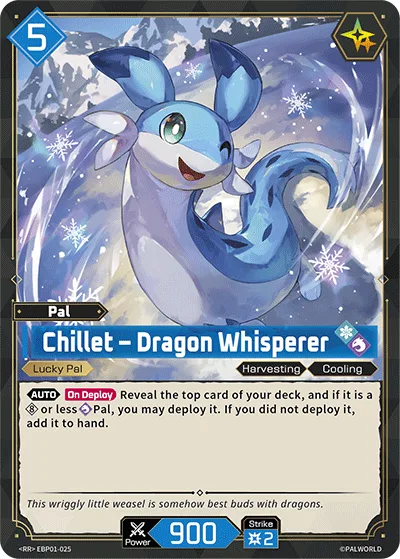
Chillet – Dragon Whisperer (EBP01-025), a Blue cost-5 Lucky Pal with Power 900 and Strike 2:
AUTO On Deploy - Reveal the top card of your deck, and if it is a cost 8 or less Dragon Pal, you may deploy it. If you did not deploy it, add it to hand.
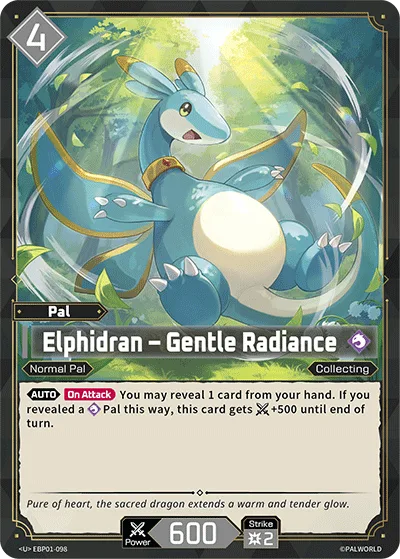
Elphidran – Gentle Radiance (EBP01-098), a Colorless cost-4 Normal Pal with Power 600 and Strike 2:
AUTO On Attack - You may reveal 1 card from your hand. If you revealed a Dragon Pal this way, this card gets Power +500 until end of turn.
That is it. No card reads Fire, Water, Grass, Electric, Ground, Ice, Dark or Neutral. No structure, gear or event references an element either. Nor does any of the 97 official rulings: the only other places an element name shows up in the Q&A are inside two card names, Jormuntide Ignis - Savage Lava Dragon in #52 and Suzaku - Wings of Blazing Fire in #53.
Two more details worth having. Chillet is itself a Dragon Pal, and Elphidran is itself a Dragon Pal, so a second copy in hand turns Elphidran on. And Chillet's ability has no failure case that costs you the card: if the revealed card is not a legal deploy, it goes to your hand instead, which makes it a cantrip on a 900-Power body at worst.
Every Dragon Pal in the pool
Nine cards, and they are the only element with any mechanical reason to be counted.
| Pal | Number | Colour | Elements | Cost | Power | Strike | Subtype |
|---|---|---|---|---|---|---|---|
| Elphidran – Gentle Radiance | EBP01-098 | Colorless | Dragon | 4 | 600 | 2 | Normal Pal |
| Dinossom – Radiant Fragrance | ETD02-004 | Green | Grass / Dragon | 4 | 400 | 2 | Normal Pal |
| Chillet – Dragon Whisperer | EBP01-025 | Blue | Ice / Dragon | 5 | 900 | 2 | Lucky Pal |
| Azurobe – Water Dragon Waltz | EBP01-029 | Blue | Water / Dragon | 6 | 1200 | 2 | Lucky Pal |
| Elphidran Aqua – Gentle Ripples | ETD01-012 | Blue | Dragon / Water | 6 | 900 | 2 | Normal Pal |
| Relaxaurus – Hungry Gunner | EBP01-026 | Blue | Dragon / Water | 7 | 1200 | 3 | Normal Pal |
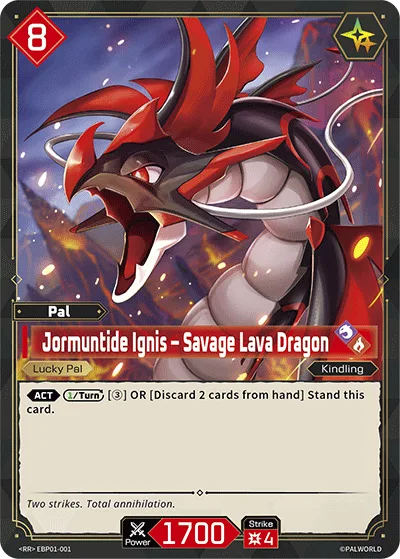
| Jormuntide Ignis – Savage Lava Dragon | EBP01-001 | Red | Dragon / Fire | 8 | 1700 | 4 | Lucky Pal |
| Jormuntide – Surging Sea Serpent | EBP01-027 | Blue | Dragon / Water | 8 | 1600 | 3 | Lucky Pal |
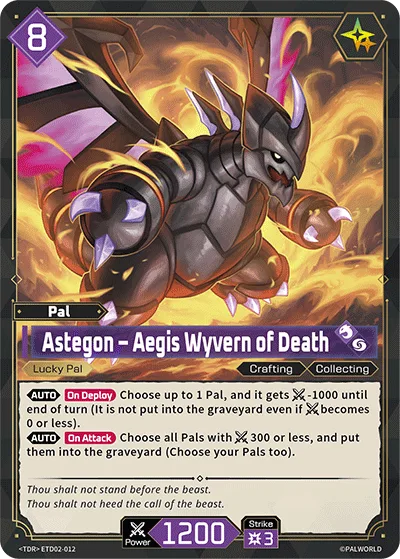
| Astegon – Aegis Wyvern of Death | ETD02-012 | Purple | Dragon / Dark | 8 | 1200 | 3 | Lucky Pal |
Three things fall out of that table.
Elphidran – Gentle Radiance is the only mono-Dragon Pal, and the only Colorless card in the game with an element other than Neutral. Every other Dragon shares its slot with a second icon.
Five of the nine are Lucky Pals, which is a much higher hit rate than the pool average - 24 of the 100 Pal cards carry the Lucky icon. Dragons are, on the whole, the expensive top end, and the Lucky Pal rules apply to them like anything else: eight Lucky slots per deck, no more.
Chillet's cost filter cannot exclude anything. Its ability reads "cost 8 or less", and 8 is the highest printed cost on any card in the entire 166-card pool - Pals, structures, gear and events alike. Every Dragon Pal that exists is a legal hit. That clause is future-proofing for a set that has not shipped.
What Chillet actually hits in a real deck
Deck construction allows up to two chosen colours in the 50-card main deck, plus colorless cards, which go anywhere - that rule lives in the official Q&A (#17), not in the Comprehensive Rules. It turns the nine-card Dragon list into a much shorter list of what any one deck can actually run.
| Your colours | Dragon Pals legal in the deck |
|---|---|
| Blue only (plus Colorless) | 6 |
| Blue and Red | 7 |
| Blue and Green | 7 |
| Blue and Purple | 7 |
| Any two colours other than Blue | 3 |
Chillet is Blue, so a Blue deck is the only place its ability has real density: five Blue Dragons plus Colorless Elphidran. That is six card names, not six cards. Rule 6.1.1.2 allows four copies of a name in the 50-card deck and 6.1.1.3 caps the whole deck at eight Lucky Pals, and three of those six Dragons are Lucky - Chillet, Azurobe and Jormuntide. So the ceiling is twelve copies of the three Normal Dragons plus eight Lucky slots: 20 Dragon cards in a 50-card deck, if you build for nothing else. Splashing a second colour adds exactly one more Dragon to choose from, because Red, Green and Purple have one apiece.
Which is the honest read: Dragon is not a deck yet. The density is buildable; the payoff is not there. Two cards in the entire 166-card pool reward a Dragon count, one of them is Chillet itself, and Chillet reveals a single card rather than digging. It is a two-card theme with nine bodies scattered across every colour, and Chillet is a fine cost-5 Lucky Pal with a small upside rather than an engine piece.
Neutral is an element, Colorless is not a colour
These two look like the same idea printed twice, and the rules are explicit that they are opposites.
| Field | Rule | What it means |
|---|---|---|
| Neutral element | 2.4.2.1 | The card has an element, and that element is Neutral |
| Colorless | 2.6.3 | The card has no colour assigned; Colorless is not a fifth colour |
So a Neutral Pal is a legal target for a hypothetical "choose 1 Neutral Pal" effect, while a Colorless Pal is not a legal target for "choose 1 red Pal" or any other colour. It matters the moment Bushiroad prints an element reference that is not Dragon.
There are seven Colorless Pal cards in the database, and six of the seven are Neutral: Lamball – My First Pal (ETD01-023, reprinted as EPR-001), Ribbuny – Little Princess (ETD01-024), Cattiva – My First Pal (ETD02-023), Chikipi – My First Pal (ETD02-024) and Direhowl – Proud Fang (EBP01-099). The seventh is Elphidran – Gentle Radiance. Every Neutral card in the pool is Colorless, and every Colorless Pal except Elphidran is Neutral.
Element is a Pal-only field
The card-anatomy diagram at the top of section 2 annotates four layouts - a Pal, a Gear, a Structure and an Event - against one shared legend of fifteen numbered fields. Callout ④ Element appears on the Pal card only. The Gear, Structure and Event frames in that same diagram have no element slot drawn on them at all. Bushiroad's database agrees: across the 166 base cards, all 66 non-Pal cards - 26 structures, 17 events, 14 gear and 9 souls - carry an empty element field.
That is worth knowing for the same reason the gear guide is worth knowing: a future "choose 1 Fire card" would sweep up Pals only, and a gear card attached to a Fire Pal is not itself Fire. Attachment does not transfer elements, and nothing in Comprehensive Rules ver. 1.00 says it does.
The promos change none of this. All nine promo Pals are element-and-colour identical to the cards they reprint, so the 2026 PR set added zero new element data.
What Bushiroad has not published
- No element interaction of any kind. Nothing in Comprehensive Rules ver. 1.00 makes one element strong, weak or resistant against another. There is no type chart.
- No stated design intent. Bushiroad has published no article explaining why elements exist or what it plans to do with them.
- Nothing about the next two sets. Booster Pack "Legends Awaken" is dated 30 October 2026 and the two Eternal Ascent trial decks 18 December 2026, per the official products page. Neither has been released and no card list for either is on the site, so whether they add element-referencing text is unknown. Anyone telling you what Legends Awaken does with Fire is guessing.
Quick reference
| Question | Answer |
|---|---|
| Elements in the game | 9 - Neutral, Fire, Water, Grass, Electric, Ground, Ice, Dark, Dragon |
| Rules section | Comprehensive Rules ver. 1.00, section 2.4 (three sub-rules) |
| Times "element" appears in the rules PDF | 7, all in section 2.4 and the field diagram |
| Pal cards in the database | 100 (91 distinct; 9 are promo reprints) |
| Pals with two elements | 25 of 100 |
| Pals with no element | 0 |
| Non-Pal cards with an element | 0 of 66 |
| Cards whose text reads an element | 2 of 166 - EBP01-025 and EBP01-098 |
| Elements referenced by any card | 1 (Dragon) |
| Biggest element | Dark, 24 cards |
| Smallest element | Electric, 5 cards |
| Elements locked to one colour | 5 - Neutral, Grass, Electric, Ice, Dark |
| Dragon Pals in the pool | 9, across all four colours plus Colorless |
| Type chart / elemental advantage | None |
Counts read from Bushiroad's official card database (256 rows, 166 base cards), the official Q&A (97 entries) and Comprehensive Rules ver. 1.00 on 2 September 2026.
Frequently Asked Questions
What are the elements in the Palworld TCG?
Do elements do anything in the Palworld TCG?
Is element the same thing as colour in the Palworld TCG?
How many Dragon Pals are in the Palworld TCG?
What does Chillet - Dragon Whisperer actually hit?
Does a Neutral element mean a Palworld TCG card has no element?
Do structures, gear and event cards have elements in the Palworld TCG?
Keep Reading
- Palworld Official Card Game - Official Card List
- Palworld Official Card Game Comprehensive Rules ver. 1.00 (Bushiroad, PDF)
- Palworld Official Card Game - Official Rules Q&A (entry #18 defines elements)
- Palworld Official Card Game - Rules and Comprehensive Rules
- Palworld Official Card Game - Products (Legends Awaken 30 Oct 2026, Eternal Ascent 18 Dec 2026)
Related Guides
Palworld TCG AUTO, CONT and ACT Abilities Explained
Every ability on a Palworld TCG card opens with one of three tags - AUTO, CONT or ACT - and Comprehensive Rules 10.1 makes that tag the most important word in the text box. It decides whether the ability works on your opponent's turn, whether you are allowed to decline it, and whether a [Once Per Turn] clock applies. I counted all 153 printed abilities across the 157 distinct cards in the launch pool and sorted them by category, trigger and cost.
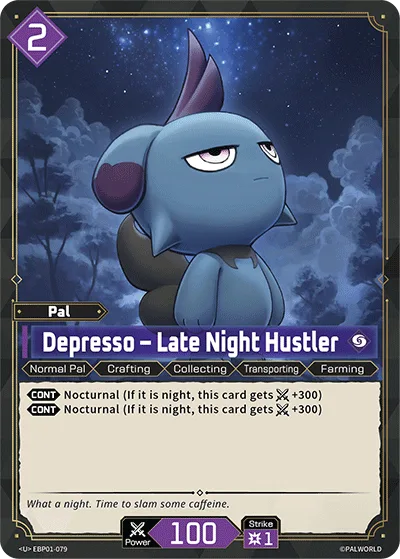
Palworld TCG Keyword Abilities - 10 Counted, 14 in the Rules
Comprehensive Rules ver. 1.00 defines fourteen keywords in one section, and How to Play the Palworld TCG tables all of them - what Brave does, what Taunt does - and stops there. Nobody has counted how many cards actually carry each one. I pulled every card tagged with one of the ten keyword abilities Bushiroad's official database filters on and cross-referenced all 97 rulings: Interrupt covers nine Pals, Retaliate covers exactly one, and Depresso - Late Night Hustler prints Nocturnal twice on the same card, which the official Q&A confirms stacks to +600 Power.
Palworld TCG Rulings - All 97 and the Most-Ruled Cards
The Palworld TCG shipped with an official Q&A of 97 entries and has not added or revised one since. Pulling the whole database and sorting it by card shows where the game is genuinely hard: 45 of the 97 are wording rules that apply to cards nobody has printed yet, only 26 of the 166 cards ever earned a card-specific answer, and four cards account for 16 of the 32 that exist.
How to Play the Palworld TCG - Souls, Power vs Strike, and How You Actually Win
Bushiroad's Palworld card game launched 30 July 2026, and its comprehensive rules landed the same day. Here is the full walkthrough - the four colours plus colourless, the soul deck, the Power and Strike split that decides every attack, structures and Pal labour, and the Damage Check that turns your own deck into your life total. Everything here is sourced from the official rules, and I flag what Bushiroad has not published.
Palworld TCG Colours Explained - What Red, Green, Blue and Purple Actually Do
Bushiroad has published comprehensive rules for the Palworld TCG, but it has not published a colour-identity document - there is no official page telling you what Red or Purple is supposed to do. So I read the rules for what colour legally means, then went through all 150 unique cards in the launch pool and counted. Here is what colour actually is, the single hard rule it imposes, why souls make it cheaper than you think, and what the card pool says each colour was built for.
Palworld TCG Pal Cards - Power and Strike by Cost
Pals are 100 of the 166 distinct cards in the Palworld TCG launch pool, and the two numbers along the bottom of each one are most of what they do. Sorting all 91 unique Pal designs by cost turns up a ladder: Strike is not a design lever at all, it is a straight function of cost, with three exceptions in the whole set. Power is the only stat Bushiroad negotiates, and the textless Pal at each cost sets the price.