Palworld TCG Keyword Abilities - 10 Counted, 14 in the Rules
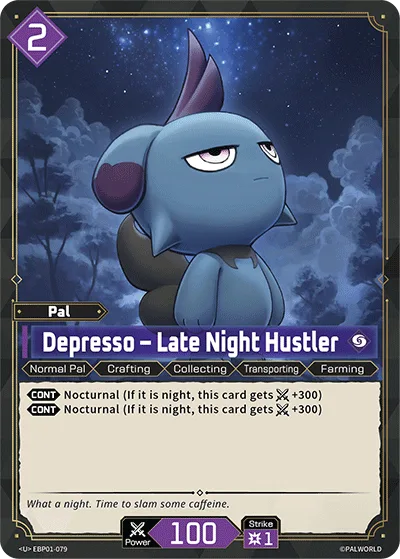
Comprehensive Rules ver. 1.00 defines fourteen keywords in one section, and How to Play the Palworld TCG tables all of them - what Brave does, what Taunt does - and stops there. Nobody has counted how many cards actually carry each one. I pulled every card tagged with one of the ten keyword abilities Bushiroad's official database filters on and cross-referenced all 97 rulings: Interrupt covers nine Pals, Retaliate covers exactly one, and Depresso - Late Night Hustler prints Nocturnal twice on the same card, which the official Q&A confirms stacks to +600 Power.
Open the rules walkthrough for this game and there is a table near the bottom: fourteen keywords, one line each. Brave gives Power on attack. Taunt forces the attack. Interrupt cancels one. That table tells you what each word means. It does not tell you how many cards actually carry one, which keywords barely exist in print, or what happens when two of them collide on the same card.
I pulled every card tagged with a keyword ability out of Bushiroad's own database - filtering the official card list search by each of the ten values its Keyword Abilities filter offers, in turn - and cross-referenced the hits against all 97 published rulings. The spread is lopsided in a way the definitions table can't show: one keyword covers nine cards, four of them cover two or fewer, and one covers exactly one. And there's a genuine anomaly sitting in the middle of it: a cost-2 Pal that prints the same keyword ability twice on one card, which Bushiroad has ruled stacks - the Pal cost breakdown covers it from the price-tag angle, and it belongs here too because it's the only case of a doubled keyword in the whole 166-card pool, not just an outlier at cost 2.
Fourteen keywords in the rules, ten in the card database
Comprehensive Rules ver. 1.00 does treat keyword abilities as a formal category. Section 12 is titled "Keywords and Keyword Abilities," and rule 12.1.1 defines the term: "Keywords are terms that are used to abbreviate abilities that perform specific processes. Abilities that are indicated by specific keywords are called keyword abilities." It then defines fourteen of them, 12.2 through 12.15, and they split into two kinds. Four are the bracketed timing and trigger markers - Quick, On Deploy, On Attack and On Assign - which the rules say may be represented by an icon within card text (12.2.2, 12.3.2.1, 12.4.2.1 and 12.5.2.1), and which Bushiroad's card database does render as icons. Three of those four are automatic abilities by the rules' own wording (12.3.1, 12.4.1 and 12.5.1); Quick is a keyword that marks an ability or event as playable in the Quick Step (12.2.1) rather than an ability in itself. The other ten are printed as a bolded word in the text box followed by a parenthetical that spells out what it does in full, and they are the ten values the official card list's "Keyword Abilities" filter offers. Official Q&A #21 confirms the parenthetical is flavour, not function - "the text written in parentheses ( ) is explanatory text, so its presence or absence does not change the card's effect" - so a reprint that drops the reminder text is identical to the original.
Those ten words - Interrupt, Nocturnal, Taunt, Vigilance, Assault, Stealth, Brave, Retaliate, Breakthrough and Serious - are what this post counts, because they are the ones the database tags as keyword abilities; the four timing markers are not among its Keyword Abilities filter values and are not tallied here. The rules walkthrough tables all fourteen in one place and moves on to phases and deck construction. That's the right call for a rules primer - it is not the right depth for "which of these am I actually going to see," and nothing else in the vertical answers that question either. Colours, elements and Work Suitability have all had this treatment. Keyword abilities have not.
Every keyword ability, counted
Searching the official card database by keyword ability and collapsing every parallel printing and promo reprint down to one entry per distinct card name gives this:
| Keyword | Cards | Card types |
|---|---|---|
| Interrupt | 10 | 9 Pal, 1 Event (reference only) |
| Nocturnal | 7 | 5 Pal, 2 Structure |
| Taunt | 5 | 3 Pal, 2 Structure |
| Stealth | 3 | 2 Pal, 1 Gear |
| Serious | 3 | 3 Pal |
| Vigilance | 2 | 1 Pal, 1 Gear |
| Assault | 2 | 2 Pal |
| Brave | 2 | 2 Pal |
| Breakthrough | 2 | 2 Pal |
| Retaliate | 1 | 1 Pal |
| Total | 37 | across 36 distinct cards |
The total column reads 37 against 36 distinct cards because one card, Pyrin Noct - Steed of Azure Flames, carries two keywords at once. More on that below. Weighed against the pool's 166 base cards, a keyword ability sits on roughly one card in five - and that "roughly" hides an enormous spread, from Interrupt's nine Pals down to Retaliate's one.
Interrupt: nine Pals, and the event that only checks
Interrupt is the biggest keyword by a wide margin, and it's already the best-documented one in the vertical - the event cards guide covers its Quick-step timing in full, and the Lucky Pals guide covers which of the nine is worth running. The short version: rule 12.8.2 defines it as a Quick activated ability - rest one soul and discard the card, or discard the card plus one other from hand, to nullify an attack outright, skipping the damage step (rule 5.18). Official Q&A #51 confirms it only works from hand, never from the base.
Nine Pals carry it as a printed ability: Bushi - Ephemeral Blade, Blazehowl - Hellflame Defender, Cryolinx - Arctic Ordeal, Wumpo Botan - Tropical Sentinel, Pyrin Noct - Steed of Azure Flames, Foxparks - A Toasty Hug, Reindrix - Icy Gaze, Dinossom - Radiant Fragrance and Blazehowl Noct - Darkflame Defender. The tenth card the search turns up, Black Marketeer, doesn't have Interrupt at all - its text reads "choose up to 2 Pals without Interrupt from your graveyard" - it's tagged in the database because it references the keyword as a filter, not because it grants or possesses it. That distinction matters if you're counting: nine Pals actually defend with it, one event just checks for it.
One more ruling worth having that isn't in the event guide: Bushi - Ephemeral Blade also carries "at the end of the battle this card attacked, you may return this card to hand," and official Q&A #45 confirms that ability still fires even if the attack it's attached to gets Interrupted by the opponent. Cancelling the damage doesn't cancel the trigger.
Nocturnal: five Pals, and one structure that grants it to everyone
Nocturnal reads simply on the card: "if it is night, this card gets Power +300." Five Pals print it - Helzephyr - Wings of the Moonless Night, Pyrin Noct - Steed of Azure Flames, Depresso - Late Night Hustler, Daedream - First Slumber and Daedream - Deep Slumber - and two Structures interact with it without carrying it themselves. Shoddy Bed only checks whether you have a Nocturnal Pal resting, for a card-draw payoff. Lamp does something bigger: its continuous ability reads "all of your Pals get the skill in 〈 〉. 〈CONT Nocturnal (If it is night, this card gets Power +300)〉" - which hands Nocturnal to every Pal you control, not just the five that print it. Official Q&A #80 confirms the effect is live: a Pal that doesn't naturally have Nocturnal can still trigger Helzephyr's on-deploy graveyard ability once Lamp is out, because Lamp made it Nocturnal.
Night itself is a named game state, not a keyword - official Q&A #13 defines it as "a game state that changes via card effects" with no rules effect of its own beyond what individual cards check for. It doesn't expire when its source leaves play either: Q&A #94 confirms that if the card that turned it night gets removed mid-effect, night stays in force until the duration it named runs out.
The card that prints Nocturnal twice
Depresso - Late Night Hustler is a plain cost-2 Common: 100 Power, Strike 1, no other text. Its ability box reads "CONT Nocturnal (If it is night, this card gets Power +300)" on one line, and then the identical clause again on the next. It looks like a database duplication error, the kind that gets silently fixed in an errata pass. It isn't one.
Official Q&A #91 asks the question directly - "does BP01-079 Depresso possess two instances of CONT Nocturnal?" - and Bushiroad's answer is unambiguous: "Yes, that is correct. If it is night, it receives a total of +600 Power." A 100-Power cost-2 Pal that becomes a 700-Power body at night. Nothing else in the 166-card pool repeats a keyword ability twice on one printing, checked across all 36 keyword-carrying cards and their parallels - Depresso is the only card in the game where you have to double a number the card itself only states once.
It is the same design space Shadowbeak - Seed of Despair occupies from the other direction, doubling other cards' triggered abilities rather than its own static bonus - covered in full in the colours guide. Depresso does the doubling to itself, printed directly on the card, and the ruling exists because someone asked whether that was intentional.
Taunt forces the attack, it does not block it
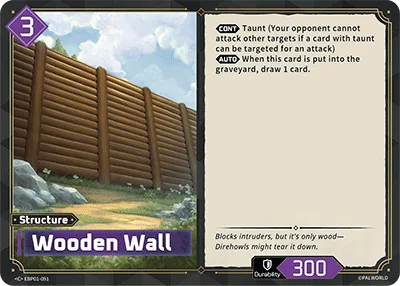
Taunt reads "your opponent cannot attack other targets if a card with taunt can be targeted for an attack" - it doesn't stop damage, it removes your opponent's choice of who takes it. Three Pals carry it intrinsically: Warsect - Iron Fortress, Eikthyrdeer Terra - Guardian of Nature and Broncherry - Brimming Adoration. Two Structures are involved differently. Wooden Wall has Taunt printed on itself - a structure can be forced to eat an attack the same as a Pal - and draws you a card when it finally goes down. No Pals Beyond Sign doesn't have Taunt itself; its activated ability grants it to whatever Pal is assigned to it, until the end of the opponent's next turn, turning any Pal you're willing to rest into a temporary lightning rod.
Official Q&A #40 closes the one rules question Taunt raises with multiple copies on board: "the attacking player can choose the target of the attack from among the cards that possess Taunt" - Taunt narrows the legal target pool down to itself, it doesn't dictate which Taunt card gets hit if there's more than one.
The four keywords with two or fewer cards
Four keywords sit at two cards each, and none of them behaves quite the same way underneath.
Vigilance - "at the end of your turn, stand this card" - undoes the normal rest-to-attack tempo cost. Suzaku Aqua - Way of the Current has it printed permanently. Grappling Gun, a Blue Gear, grants it to whichever Pal you choose for the turn when you rest the Gear itself.
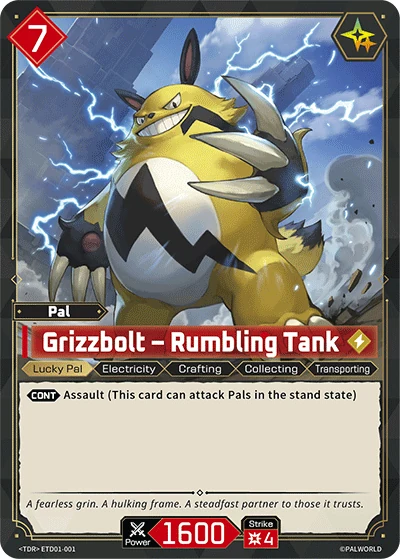
Assault - the keyword the rules walkthrough calls out as the sole exception to "you cannot attack a standing Pal" - lets its holder target Pals that haven't rested. Grizzbolt - Rumbling Tank has it as a permanent CONT ability. Gumoss - Curious Sprout only gets it for one turn, granted to itself by its own On Deploy trigger alongside a Power bump.
Stealth - "this card cannot be blocked" - belongs to Cawgnito - Looming Shadow and Felbat - Lifestealer permanently, plus Cawgnito Hat, a Purple Gear that lends it to any Pal you attach it to.
Breakthrough - the answer to Taunt and to standing Pals in general, converting a kill into face damage on the opposing player - belongs to neither Digtoise variant by default. Both Seismic Drillback and Keen Needleback have to pay 2 Ingredient and activate an ability to grant it to themselves for the turn, alongside a Power boost. It's the only keyword in the pool with zero permanent holders; every copy of it that hits the table was paid for that turn. Official Q&A #65 has already settled the one edge case that matters here: if the attacking Pal's Strike gets reduced before Breakthrough triggers, the extra damage uses the reduced number, not the card's printed value.
Retaliate has exactly one card in the whole game
Menasting - Darkness-Dwelling Scorpion, a Purple cost-5 Pal, is the only card in the 166-card launch pool with Retaliate: "when this card is put into the graveyard during battle, put the opposing combat Pal into the graveyard too." Trade your Pal for theirs, guaranteed, regardless of the stat line on either side. Menasting also returns a Normal Pal to your hand when it dies for any reason, so the card is doing two jobs even before Retaliate triggers - it's covered from the resource-recursion angle in the dual-element table and the Pal cost breakdown, neither of which flags that its combat clause is the rarest keyword in the game. Whether that stays true past the launch set depends on Legends Awaken, which has no card list published as of this writing.
Brave and Serious are the two remaining keywords, and both are two- and three-card commons respectively that read the same way on every copy. Foxparks - Light of Courage and Univolt - Valiant Thunderclap both print "Brave 300 (On Attack, this card gets Power +300 until end of turn)" - identical text, different Pal. Rooby - Brave Sparks, Teafant - Fountain of Cheer and Tanzee - Cheerful Worker each print "Serious 400 (On Assign, choose 1 Pal and it gets Power +400 until end of turn)" at cost 2 - one in Red, one in Blue, one in Green. There is no Purple Serious card and none Colorless; every colour that has one has exactly one.
Granted vs. printed: half these keywords are borrowed
Sort the 36 cards by whether the keyword is permanently printed on them or only shows up conditionally, and the picture changes:
| Keyword | Permanently printed | Granted or self-triggered |
|---|---|---|
| Interrupt | 9 | 0 (1 references it) |
| Nocturnal | 5 | Lamp grants to all Pals |
| Taunt | 4 | 1 (No Pals Beyond Sign) |
| Serious | 3 | 0 |
| Stealth | 2 | 1 (Cawgnito Hat) |
| Brave | 2 | 0 |
| Retaliate | 1 | 0 |
| Vigilance | 1 | 1 (Grappling Gun) |
| Assault | 1 | 1 (Gumoss, self only) |
| Breakthrough | 0 | 2 (both self, cost 2 Ingredient) |
Four of the ten keywords - Vigilance, Assault, Stealth and Breakthrough - have a Gear card or a self-granting ability doing at least some of the work, rather than a Pal simply printing the keyword and having it always on. Breakthrough is the extreme case: nobody owns it permanently, so every point of Breakthrough damage in a real game was a soul-and-Ingredient investment made that turn, not a stat line you drafted around. Interrupt, Brave, Serious and Retaliate sit at the other end - every copy that exists does the thing every time, no activation required.
Quick reference
| Question | Answer |
|---|---|
| Keywords defined in Comprehensive Rules ver. 1.00 | 14 (Section 12, rules 12.2-12.15): Quick, On Deploy, On Attack, On Assign, plus the ten below |
| Keyword abilities counted here | 10 - the official card database's Keyword Abilities filter values: Interrupt, Nocturnal, Taunt, Vigilance, Assault, Stealth, Brave, Retaliate, Breakthrough, Serious |
| Cards carrying at least one | 36 distinct (37 keyword instances - Pyrin Noct has two) |
| Biggest keyword | Interrupt, 9 Pals plus 1 event reference |
| Smallest keyword | Retaliate, 1 card - Menasting - Darkness-Dwelling Scorpion |
| Only card with a keyword twice | Depresso - Late Night Hustler, Nocturnal x2, ruled to stack (+600 Power at night, Q&A #91) |
| Keyword with zero permanent holders | Breakthrough - both Digtoise variants pay 2 Ingredient to grant it for the turn |
| Structure that grants a keyword to your whole board | Lamp - all your Pals gain Nocturnal (Q&A #80) |
| Does the parenthetical reminder text change anything | No - Q&A #21 confirms it's flavour only |
| Colours missing a Serious card | Purple and Colorless - Red, Blue and Green each have exactly one |
Counts read from Bushiroad's official card database (166 base cards) and the official Q&A (97 entries) on 2-3 September 2026.
Frequently Asked Questions
What are the keyword abilities in the Palworld TCG?
How many Palworld TCG cards have Interrupt?
Does Depresso - Late Night Hustler really have Nocturnal twice?
How many Palworld TCG cards have Retaliate?
Which Palworld TCG keyword ability has no card that owns it permanently?
Does the structure Lamp give Nocturnal to every Pal you control?
What does Taunt actually do in the Palworld TCG?
Keep Reading
- Palworld Official Card Game - Official Card List (Keyword Abilities filter: 10 values)
- Palworld Official Card Game Comprehensive Rules ver. 1.00 (Bushiroad, PDF) - Section 12, rules 12.1.1 and 12.2-12.15
- Palworld Official Card Game - Official Rules Q&A (entries #13, #21, #40, #45, #51, #65, #80, #91, #94)
- Palworld Official Card Game - Rules and Comprehensive Rules
Related Guides
Palworld TCG AUTO, CONT and ACT Abilities Explained
Every ability on a Palworld TCG card opens with one of three tags - AUTO, CONT or ACT - and Comprehensive Rules 10.1 makes that tag the most important word in the text box. It decides whether the ability works on your opponent's turn, whether you are allowed to decline it, and whether a [Once Per Turn] clock applies. I counted all 153 printed abilities across the 157 distinct cards in the launch pool and sorted them by category, trigger and cost.
Palworld TCG Elements - All 9, and Why Only 2 Cards Care
Every Pal card in the Palworld TCG carries an element icon, and the video game trained you to expect that icon to decide fights. It does not. Comprehensive Rules ver. 1.00 spends three sub-rules on elements and never mentions them again, and exactly two of the 166 cards in the launch pool have text that reads an element. Here is the full census of all nine across the 100 Pal cards, and the one element that already has support.
Palworld TCG Rulings - All 97 and the Most-Ruled Cards
The Palworld TCG shipped with an official Q&A of 97 entries and has not added or revised one since. Pulling the whole database and sorting it by card shows where the game is genuinely hard: 45 of the 97 are wording rules that apply to cards nobody has printed yet, only 26 of the 166 cards ever earned a card-specific answer, and four cards account for 16 of the 32 that exist.
How to Play the Palworld TCG - Souls, Power vs Strike, and How You Actually Win
Bushiroad's Palworld card game launched 30 July 2026, and its comprehensive rules landed the same day. Here is the full walkthrough - the four colours plus colourless, the soul deck, the Power and Strike split that decides every attack, structures and Pal labour, and the Damage Check that turns your own deck into your life total. Everything here is sourced from the official rules, and I flag what Bushiroad has not published.
Palworld TCG Colours Explained - What Red, Green, Blue and Purple Actually Do
Bushiroad has published comprehensive rules for the Palworld TCG, but it has not published a colour-identity document - there is no official page telling you what Red or Purple is supposed to do. So I read the rules for what colour legally means, then went through all 150 unique cards in the launch pool and counted. Here is what colour actually is, the single hard rule it imposes, why souls make it cheaper than you think, and what the card pool says each colour was built for.
Palworld TCG Pal Cards - Power and Strike by Cost
Pals are 100 of the 166 distinct cards in the Palworld TCG launch pool, and the two numbers along the bottom of each one are most of what they do. Sorting all 91 unique Pal designs by cost turns up a ladder: Strike is not a design lever at all, it is a straight function of cost, with three exceptions in the whole set. Power is the only stat Bushiroad negotiates, and the textless Pal at each cost sets the price.