Pokémon TCG Evolution Explained: Stages, Rare Candy, Mega
Evolving looks like the simplest action in the Pokémon TCG until you count the restrictions — there are three, plus two more that get treated as restrictions and are not. Here is what the rulebook actually says about stages, timing, and what survives an evolution, plus how the 2025-26 Mega Evolution era quietly rewrote the whole mechanic for the second time.
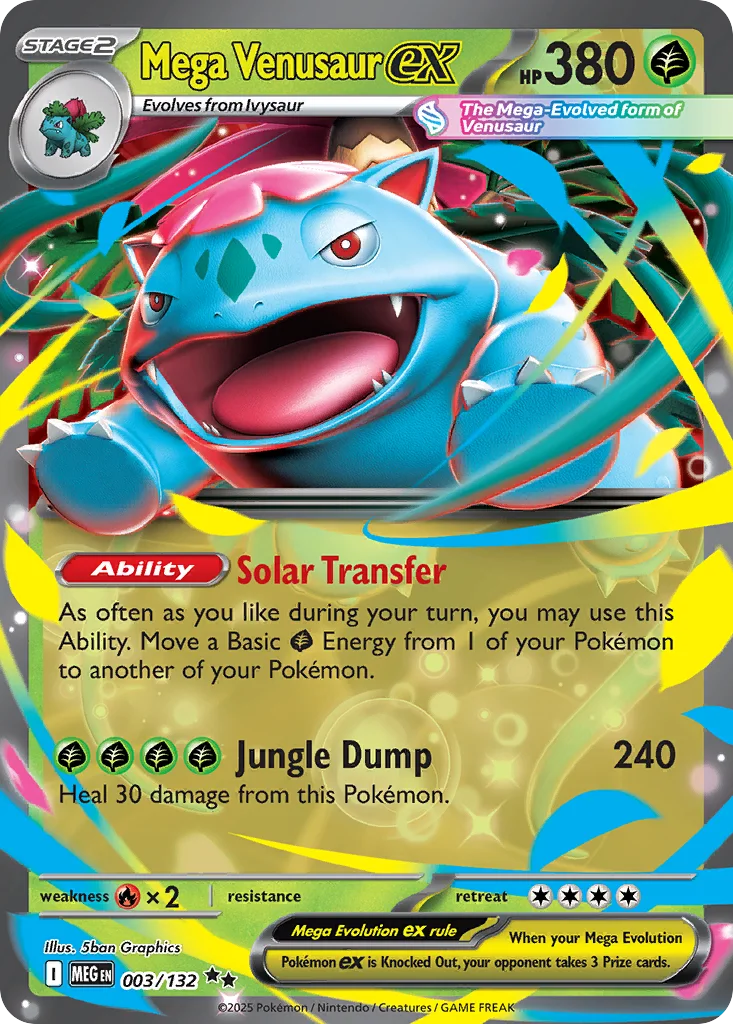
Mega Venusaur ex is a Stage 2 that evolves from Ivysaur. Not from Venusaur, not from a Basic Pokémon ex — from Ivysaur, the same rung the Base Set Venusaur has evolved off since 1999. Twelve years ago the previous Mega Venusaur evolved from Venusaur-EX and ended your turn on the spot. The card looks like the same idea. The rules underneath it are not remotely the same.
Evolution is the mechanic new players think they understand after one game and then quietly misplay for a year. There are three timing restrictions on it, three things that survive an evolution and three that do not, and a 2025 era that rewrote the most famous exception in the game's history. Everything below is checked against the 2026 Web Rulebook from The Pokémon Company and against live card text from the Pokémon TCG API.
What actually counts as an Evolution card
The rulebook draws the line in one sentence: "Stage 1 and Stage 2 Pokémon are also called Evolution cards." So a Basic is never an Evolution card, and everything above Basic is. Simple — until you meet the cards that wear a stage name without being one.
| Card type | Is it an Evolution card? | Why it matters |
|---|---|---|
| Basic Pokémon | No | The only thing you can put into play straight from your hand onto the Bench |
| Stage 1 | Yes | Goes on top of the named Basic |
| Stage 2 | Yes | Goes on top of the named Stage 1, or onto the Basic via Rare Candy |
| Pokémon VMAX, Pokémon BREAK | Yes | New stages, but "all the normal rules for Evolution apply" |
| Restored Pokémon | No | The rulebook is explicit: "Restored Pokémon are not Evolution cards" |
| Basic Mega Evolution ex | No | Printed as Basics despite the Mega branding — see below |
Restored Pokémon are the classic trap. They sit in play looking evolved, but the rulebook says cards referring to "Basic," "Stage 1," "Stage 2," or "Evolution" cards do not affect them — and cards that affect unevolved Pokémon do.
The other thing the stage does not tell you is the name check. Evolution is matched by printed name, not by species: the rulebook's own example is that Graveler can evolve from Geodude or from Geodude LV. 12, but not from Brock's Geodude. That rule is doing enormous work in the current Standard format, where owner-prefixed cards are everywhere. Marnie's Grimmsnarl ex evolves from Marnie's Morgrem, and a plain Morgrem will not do it. Regional forms work the same way — a Galarian Rapidash only evolves from a Galarian Ponyta.
The three timing rules that decide your setup
Here is the whole restriction set. The Evolution notes on page 11 of the rulebook run to four sentences, and only three of them restrict anything — the third is a permission that players file as a fourth rule:
"Neither player can evolve a Pokémon on its first turn in play. When you evolve a Pokémon, it means that Pokémon is new in play, so you can't evolve it a second time the same turn! You can evolve any Pokémon you have in play, whether it's Active or Benched. Finally, neither player can evolve a Pokémon on that player's first turn unless a card says so."
Pulled apart:
| Rule | What it blocks | What it does not block |
|---|---|---|
| Summoning sickness | Evolving a Pokémon the turn you played it | Evolving it on any later turn |
| One step per turn | Basic to Stage 1 to Stage 2 in a single turn | Two different Pokémon each taking one step |
| First turn of the game | Any evolution on your own opening turn | Your opponent evolving on theirs |
| Active or Benched — not a restriction | Nothing | Evolving on the Bench, on the same terms as your Active |
| No per-turn cap — not a restriction | Nothing | Evolving as many separate Pokémon as you like |
The bottom two rows are the ones that cost people tempo, because they are not rules at all and get played around anyway. The one step per turn rule is per Pokémon, not per player — you can evolve four different Basics into four different Stage 1s in the same turn, and the rulebook lists the action itself as "Evolve Pokémon (as many as you want)". And the Bench is fully live. Benched Pokémon evolve on the same terms as your Active, which is the entire reason a Stage 2 deck can build its second attacker while its first one is still swinging.
The first-turn rule is the one that decides games. Going first means no Supporter and no evolution, so your turn-one board is whatever Basics you can physically put down. That is why deck ratios lean so hard on Basics and search Items.
What carries over when a Pokemon evolves
An evolution is a card going on top of a stack, not a replacement. The rulebook:
"When a Pokémon evolves, it keeps all attached cards (Energy cards, Evolution cards, etc.) and any damage counters on it. Any effects of attacks or Special Conditions affecting the Pokémon—such as Asleep, Confused, or Poisoned—end when it evolves. A Pokémon cannot use the attacks or Abilities of its previous Evolution unless a card says so."
| Thing on the Pokémon | Survives the evolution? |
|---|---|
| Attached Energy | Yes |
| Pokémon Tools | Yes |
| Damage counters | Yes |
| Special Conditions | No — all five clear |
| Effects of attacks (damage reduction, attack locks) | No |
| The previous stage's attacks and Abilities | No, unless a card says otherwise |
The damage line is the one that hurts. A Stage 1 with 100 damage on it becomes a Stage 2 with 100 damage on it — evolving raises the HP ceiling, it does not heal anything. Players who evolve a wounded attacker expecting a fresh body lose it to the same swing that would have killed it anyway.
The Special Condition line is the one that wins games. Evolving is a free, unconditional answer to Poison, Burn, Sleep, Paralysis, and Confusion all at once, and unlike retreating it costs no Energy and works while your Pokémon is Asleep or Paralyzed. If you are sitting Poisoned with a Stage 1 in hand, you already have the out. The full Special Conditions breakdown covers why that matters more against Poison than anything else.
Rare Candy and the Stage 2 shortcut
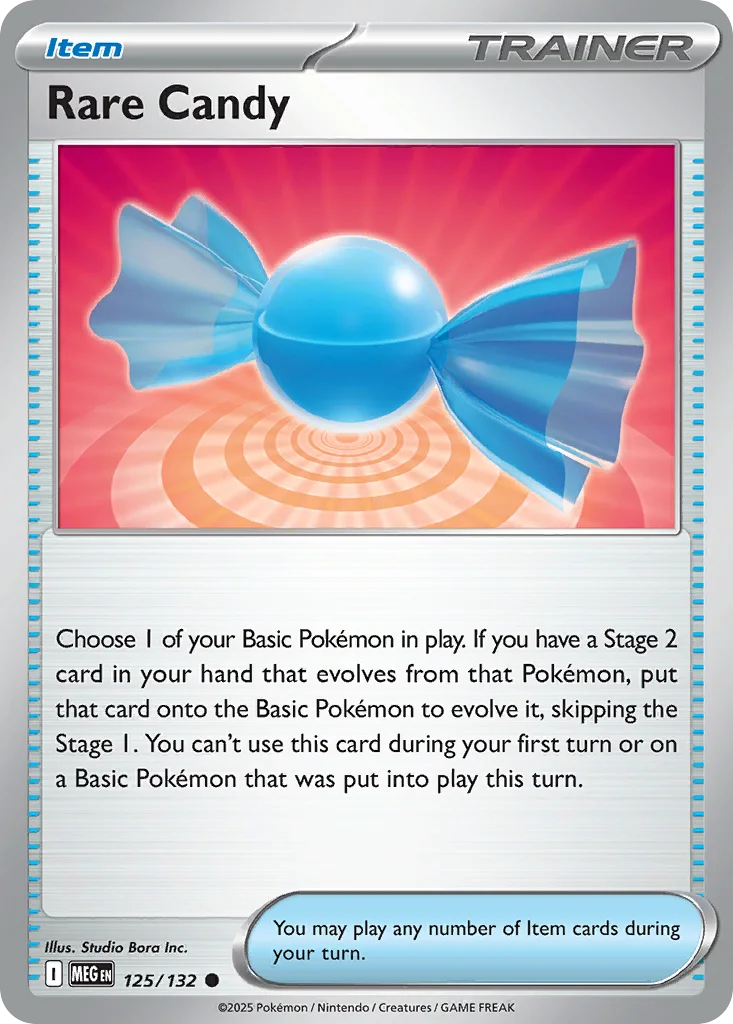
Rare Candy is the single most important card in the evolution system, and its current text is worth reading closely:
"Choose 1 of your Basic Pokémon in play. If you have a Stage 2 card in your hand that evolves from that Pokémon, put that card onto the Basic Pokémon to evolve it, skipping the Stage 1. You can't use this card during your first turn or on a Basic Pokémon that was put into play this turn."
Note what it does and does not remove. It kills the one step per turn rule — Basic straight to Stage 2, no Stage 1 needed. It leaves the summoning sickness and first turn of the game rules completely intact, restating both on the card. So Rare Candy turns a three-turn setup into a two-turn one, not a one-turn one.
It also works on Stage 2 Mega Evolution Pokémon ex, which is not obvious from the card face. Anar Guliyev's Mega Gardevoir list from Regional Utrecht — 310th place, 16 May 2026, so a snapshot from before Chaos Rising and Pitch Black rather than a read on the current meta — ran 3 Ralts, 2 Kirlia, 2 Mega Gardevoir ex and 2 Rare Candy. The Candy is there to skip Kirlia, and the Kirlia count is there for the turns you do not draw one.
One name-matching detail that catches people: Mega Gardevoir ex and Mega Gallade ex both evolve from Kirlia. A single Ralts-Kirlia line can branch into either, which makes the Candy targets flexible in a way most Stage 2 lines are not.
Grand Tree and the cards that break the timing rules
The rulebook's phrasing — "unless a card says so" — is an open invitation, and the current card pool takes it. Three templates exist, and they are worth knowing by shape because new ones keep arriving.
Abilities that switch off summoning sickness. Eevee from Surging Sparks has Boosted Evolution: "As long as this Pokémon is in the Active Spot, it can evolve during your first turn or the turn you play it." Both restrictions gone, on a Common. Shelmet and Karrablast do the same thing for each other with Stimulated Evolution, conditional on the partner being in play — a nice piece of design that quotes the video games' trade evolution without needing a trade.
Abilities that widen the name check. Eevee ex has Rainbow DNA: it "can evolve into any Pokémon ex that evolves from Eevee." The parenthetical is the tell — "(This Pokémon can't evolve during your first turn or the turn you play it.)" Rainbow DNA relaxes the name rule and leaves the clock alone.
Stadiums and Items that hand you the evolution outright. Grand Tree, the ACE SPEC Stadium from Stellar Crown, is the strongest of these:
"Once during each player's turn, that player may search their deck for a Stage 1 Pokémon that evolves from 1 of their Basic Pokémon and put it onto that Pokémon to evolve it. If that Pokémon was evolved in this way, that player may search their deck for a Stage 2 Pokémon that evolves from that Pokémon and put it onto that Pokémon to evolve it. Then, that player shuffles their deck."
Two full stages out of the deck, no cards from hand, once per turn — and it is symmetric, so your opponent gets it too. It also closes with the same parenthetical these cards carry: "(Players can't evolve a Basic Pokémon during their first turn or a Basic Pokémon that was put into play this turn.)"
That is the pattern to internalize. Almost every evolution accelerator in the modern game will happily break the stage rules. Almost none of them break the timing rules. Since you may only run one ACE SPEC in the entire deck, Grand Tree is a genuine deckbuilding decision rather than a free include.
The Mega Evolution era rewrote evolution twice
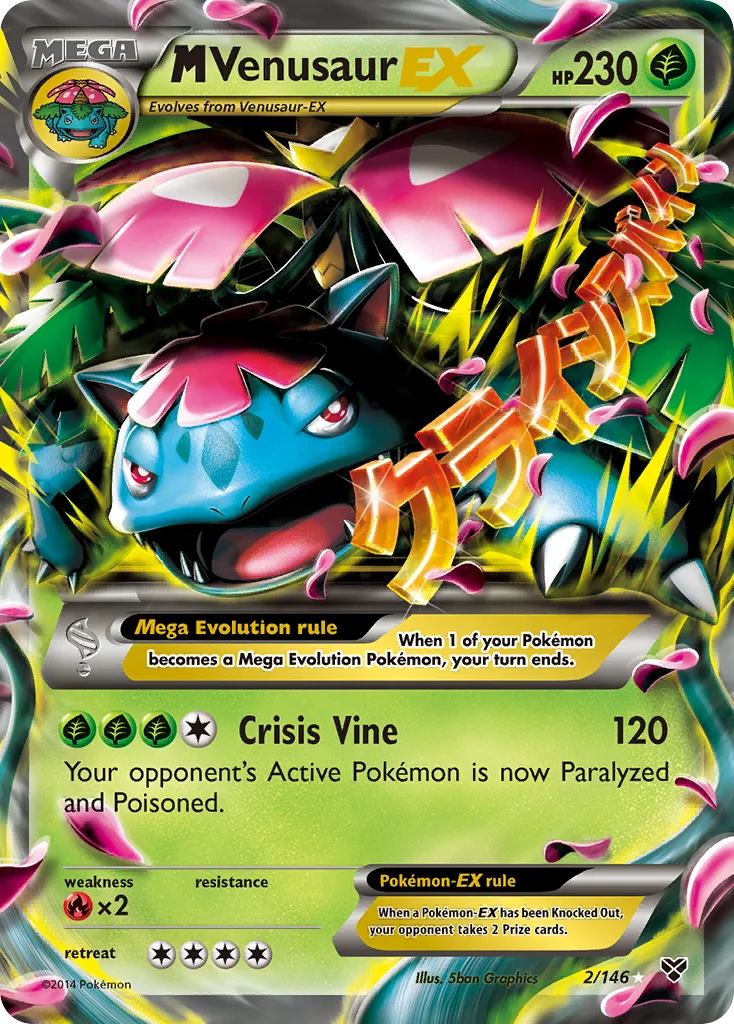
The first Mega Evolution mechanic ran from the 2014 XY base set through the XY era. Its rule was brutal and printed on every card: "Mega Evolution rule: When 1 of your Pokémon becomes a Mega Evolution Pokémon, your turn ends." You Mega Evolved and that was your whole turn. No attack. The Spirit Link Tools existed purely to buy that turn back.
The 2025 relaunch kept the name and threw out the mechanic. Here is the comparison, pulled from card text rather than memory:
| XY-era Mega Evolution Pokémon-EX | Mega Evolution Pokémon ex (2025 onward) | |
|---|---|---|
| Stage | MEGA, its own stage above Pokémon-EX | Basic, Stage 1, or Stage 2 like anything else |
| Evolves from | The matching Pokémon-EX | The normal pre-evolution — Ivysaur, Kirlia, Riolu |
| Turn ends on evolving | Yes, on every printing | No |
| Prizes given up | 2 | 3 |
| First printed | XY base set, February 2014 | Mega Evolution, September 26, 2025 |
The turn-ending line is falsifiable and I checked it. Querying the Pokémon TCG API for every card carrying the MEGA subtype returns 207 printings. The 114 from the six Mega Evolution-era sets released between September 2025 and July 2026 carry no turn-ending rule at all. Of the other 93, 92 do carry one: 91 XY-era printings, plus a 2021 Celebrations: Classic Collection reprint of M Rayquaza-EX. (85 of those 91 print the Mega Evolution rule word for word; the other six are Primal Kyogre-EX and Primal Groudon-EX printings, whose Primal Reversion rule ends your turn the same way.) The single card in that 93 with no turn-ending rule is TM Machine, a 2025 Destined Rivals Item that happens to share the subtype tag — not an XY-era Pokémon at all. Appendix 1 of the 2026 Web Rulebook states the modern position outright: Mega Evolution Pokémon ex "can appear as Basic, Stage 1, or Stage 2 Pokémon, and they follow the normal rules of Evolution," and they let your opponent take three Prize cards when Knocked Out.
Three Prizes is the balancing weight, and it is a heavy one — half your opponent's Prize requirement on a single Knock Out. Mega Venusaur ex is what you get in exchange: 380 HP, an unlimited-use Solar Transfer Ability that shuffles Basic Grass Energy around your board, and Jungle Dump for 240 that heals 30 off itself. Reachable on turn two with a Rare Candy, and worth the risk — which is the whole design.
Thirteen Mega Evolution ex are not Evolution cards at all
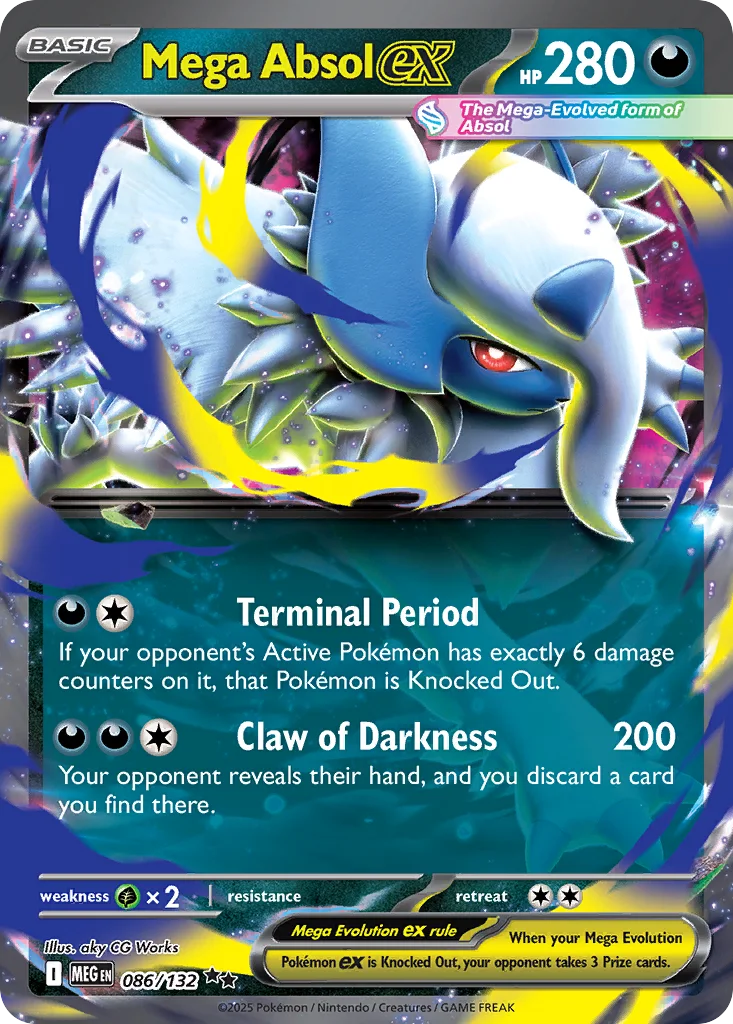
This is the detail that trips up everyone reading a Mega Evolution decklist for the first time. Across the six English sets in the era, the 41 unique Mega Evolution Pokémon ex split almost perfectly three ways:
| Printed stage | Unique Mega Evolution ex | Examples |
|---|---|---|
| Basic | 13 | Mega Absol ex, Mega Darkrai ex, Mega Kangaskhan ex, Mega Zygarde ex |
| Stage 1 | 14 | Mega Lucario ex (from Riolu), Mega Excadrill ex (from Drilbur) |
| Stage 2 | 14 | Mega Venusaur ex (from Ivysaur), Mega Gardevoir ex (from Kirlia) |
A Basic Mega Evolution ex is a Basic. It goes down from your hand, it can be your opening Active, it is not an Evolution card, Rare Candy does nothing for it, and no evolution timing rule applies to it at all. Mega Absol ex is a 280 HP Basic whose Terminal Period attack Knocks Out any Active Pokémon sitting on exactly six damage counters. Mega Darkrai ex, the cover card of Pitch Black, is also a Basic — 280 HP, Dusk Raid for 110 that doubles to 220 if your own Bench has damage on it.
The trade-off is visible in the numbers. The Basics run 250 to 310 HP; the Stage 2s run 350 to 380. You are paying setup turns for HP, which is the choice Stage 2 decks have always faced — just with a much bigger number on the losing side of the ledger.
Evolving is a trigger now, not just an upgrade
The most important change to evolution over the past two years was not a rule change at all. It was a template. Search the Standard-legal card pool for Abilities containing "from your hand to evolve" and you get 43 printings — a whole category of Pokémon that pay you a bonus at the exact moment they evolve.
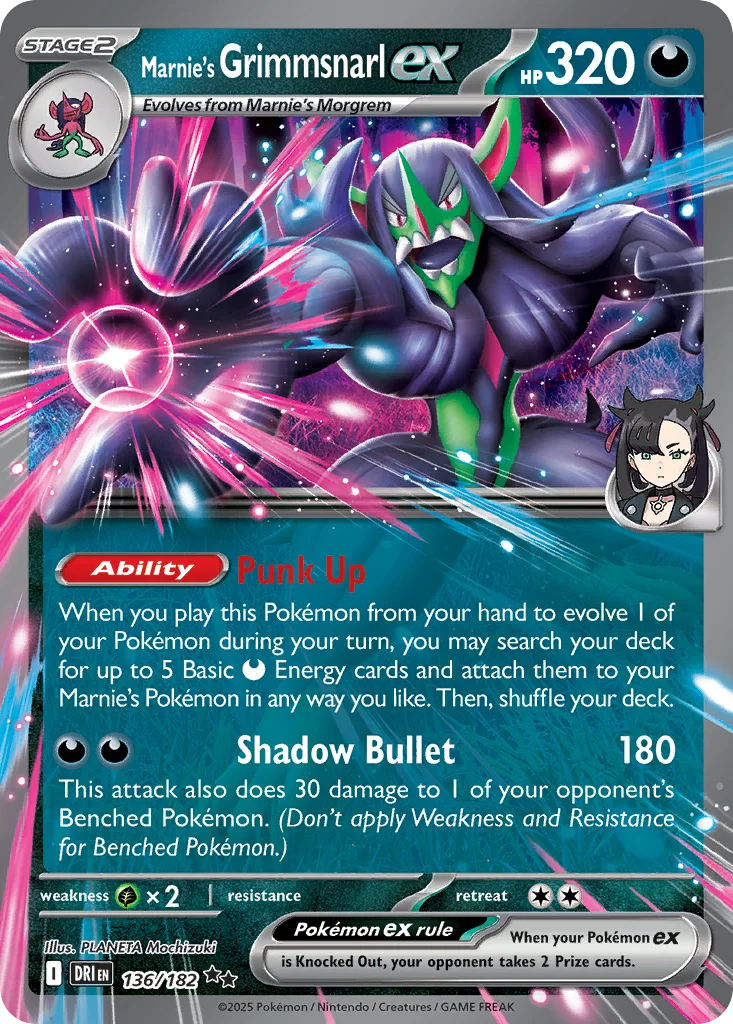
Marnie's Grimmsnarl ex is the loudest example. Punk Up reads: "When you play this Pokémon from your hand to evolve 1 of your Pokémon during your turn, you may search your deck for up to 5 Basic Darkness Energy cards and attach them to your Marnie's Pokémon in any way you like." Five Energy off one evolution, in a game whose baseline is one Energy attachment per turn.
The rest of the category is just as pointed:
- Team Rocket's Crobat ex — Biting Spree puts 2 damage counters on each of two of your opponent's Pokémon.
- Archaludon ex — Assemble Alloy attaches up to 2 Basic Metal Energy from the discard pile.
- Hop's Dubwool — Defiant Horn switches in one of your opponent's Benched Pokémon, a free gust effect stapled to a Stage 1.
- Noctowl — Jewel Seeker searches out 2 Trainer cards if you have any Tera Pokémon in play.
Two consequences follow. Every one of these triggers is worded "when you play this Pokémon from your hand," so a Grand Tree evolution pulled out of your deck does not fire them. And holding an evolution back a turn to line up its trigger is a real play, not a misplay.
Devolution and the cards that punish evolving
Devolving is the reverse operation, and the rulebook glossary treats it as a distinct game action: a devolved Pokémon "also loses Special Conditions and any other effects." The important part is what devolving does not undo: damage counters. A Stage 2 with 250 damage on it that gets knocked back to a 90 HP Stage 1 is dead on the spot. That is the whole appeal.
Standard has a small but real toolbox for it. Espathra from Surging Sparks devolves one of your opponent's evolved Pokémon for free with Mystical Eyes. Espeon ex from Prismatic Evolutions goes wide with Amazez — every evolved Pokémon on the other side loses its top card, shuffled into the deck rather than returned to hand, so it cannot simply be replayed. Claydol from Chaos Rising bolts a single-target devolve onto a 50-damage attack.
And there is a punisher that skips the whole exchange. Team Rocket's Ampharos from Destined Rivals has Darkest Impulse: "Whenever your opponent plays a Pokémon from their hand to evolve 1 of their Pokémon, put 4 damage counters on that Pokémon. The effect of Darkest Impulse doesn't stack." Forty damage every time the other player takes an evolution step, from the Bench, with no attack spent — but read that second sentence before you build the line. A second Ampharos on your Bench adds nothing, so this is a one-of, and against the trigger-heavy decks above that one copy taxes the exact action they are built around.
Quick Action Checklist
- Never evolve a Pokémon on the turn you play it, or on your own first turn of the game. Both are hard rules; only a card that says so overrides them.
- One evolution step per Pokémon per turn, but as many different Pokémon as you like, Active or Benched.
- The name on "Evolves from" must match exactly. Marnie's Morgrem is not Morgrem, and Galarian Ponyta is not Ponyta.
- Damage counters, Energy, and Tools stay. Special Conditions and attack effects clear.
- Evolve out of Poison or Sleep — it is free, and it works when retreating is blocked.
- Rare Candy skips the Stage 1 only. It still cannot be used on your first turn or on a Basic you just played, and it works fine into a Stage 2 Mega Evolution ex.
- Check the printed stage on every Mega Evolution ex before you build the line — 13 of the 41 are Basics with no evolution line at all.
- Sequence around evolve-triggered Abilities. They only fire from your hand, so a deck-searched evolution skips the payoff.
- Budget for three Prizes, not two, every time a Mega Evolution ex is your Active.
Frequently Asked Questions
Can you evolve a Pokémon on your first turn in the Pokémon TCG?
Do damage counters stay on a Pokémon when it evolves?
How does Rare Candy work in the Pokémon TCG?
Do Mega Evolution ex cards end your turn like the old Mega Evolution Pokémon-EX?
What does a Mega Evolution ex evolve from?
Can you evolve a Benched Pokémon in the Pokémon TCG?
How do you devolve a Pokémon in the Pokémon TCG?
Keep Reading
- The Pokémon Company — Pokémon Trading Card Game Web Rulebook, 2026 edition (PDF): Evolution notes p. 11, Appendix 1: Mega Evolution Pokémon ex p. 23, glossary
- Pokémon TCG API — card text, stages, and printing counts
- Limitless — Mega Gardevoir decklist, Anar Guliyev, 310th place, Regional Utrecht, 16 May 2026
- Bulbapedia — Mega Evolution (TCG)
Related Guides
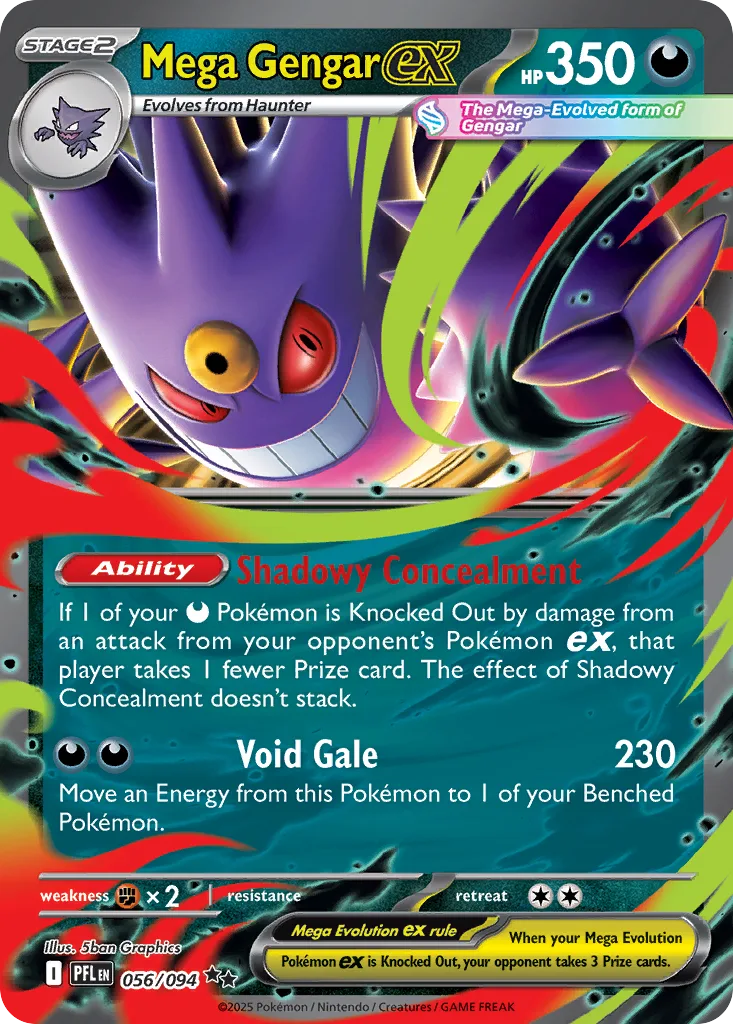
Pokémon TCG Prize Cards Explained: 1, 2, and 3-Prizers
The Prize count is the only score the Pokémon TCG keeps. Here is what each Pokémon actually costs you when it goes down — one, two or three — measured across all 2,947 Standard-legal printings, plus the 44 Standard-legal card names whose text reads the Prize count or changes what a Knock Out pays.
Pokémon TCG Formats Explained: Standard, Expanded, Unlimited
Play! Pokémon sanctions three Constructed formats, and Standard is the one the circuit runs on. Here is what the other two actually are: the Expanded card pool the Tournament Handbook enumerates set by set, the 27-card ban list that trims it, the Unlimited format with no bans at all, and the awkward truth about where you can still sit down and play any of it.
Pokémon TCG Tournament Rules: Deck Lists, the Clock, and Penalties
The rules that decide your first League Cup are not in the rulebook. They are in three separate Play! Pokémon documents, revised on a quarterly cycle, and they cover sleeve colour, how a die has to be numbered, what happens to your match when the clock hits zero, and the two penalties that exist in the Pokémon TCG and nowhere else in the program.
Pokémon TCG Abilities Explained: Triggers, Ability Lock, and Damage Math
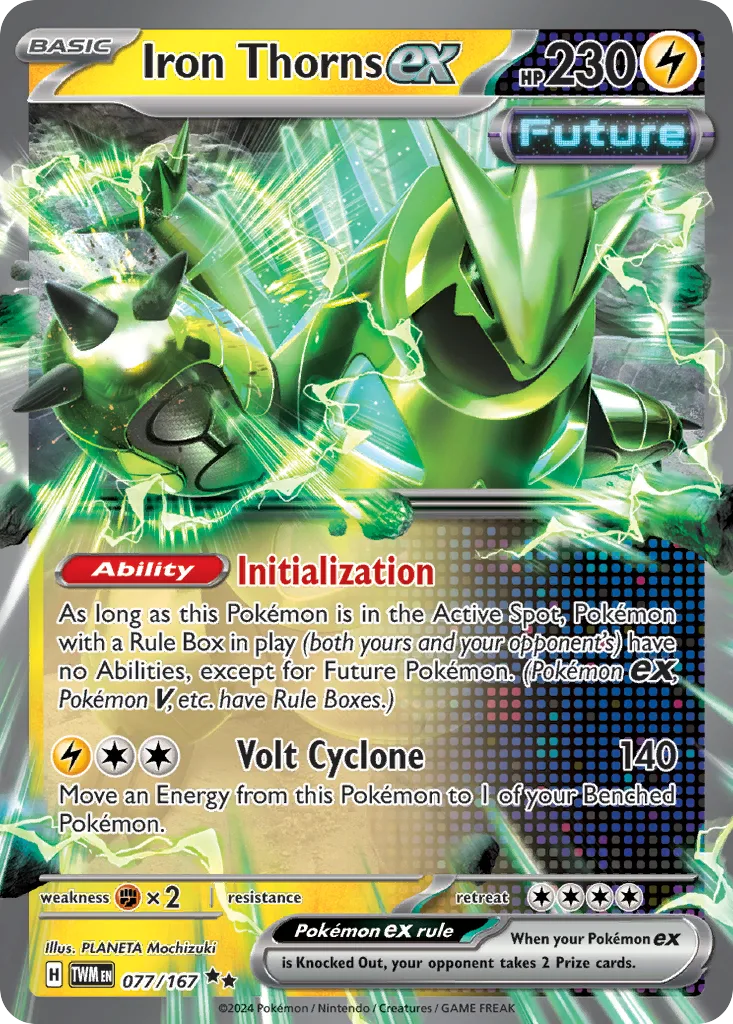
An Ability is not an attack, and almost every rules argument about Abilities comes from someone forgetting that one line. Here is what the 2026 Web Rulebook says about when Abilities fire, where they work from, why a Paralyzed Pokémon still uses them, and what the parenthetical at the end of a damage-reduction Ability is really telling you.
How to Play the Pokémon TCG — Full Rules and Turn Structure (2026)
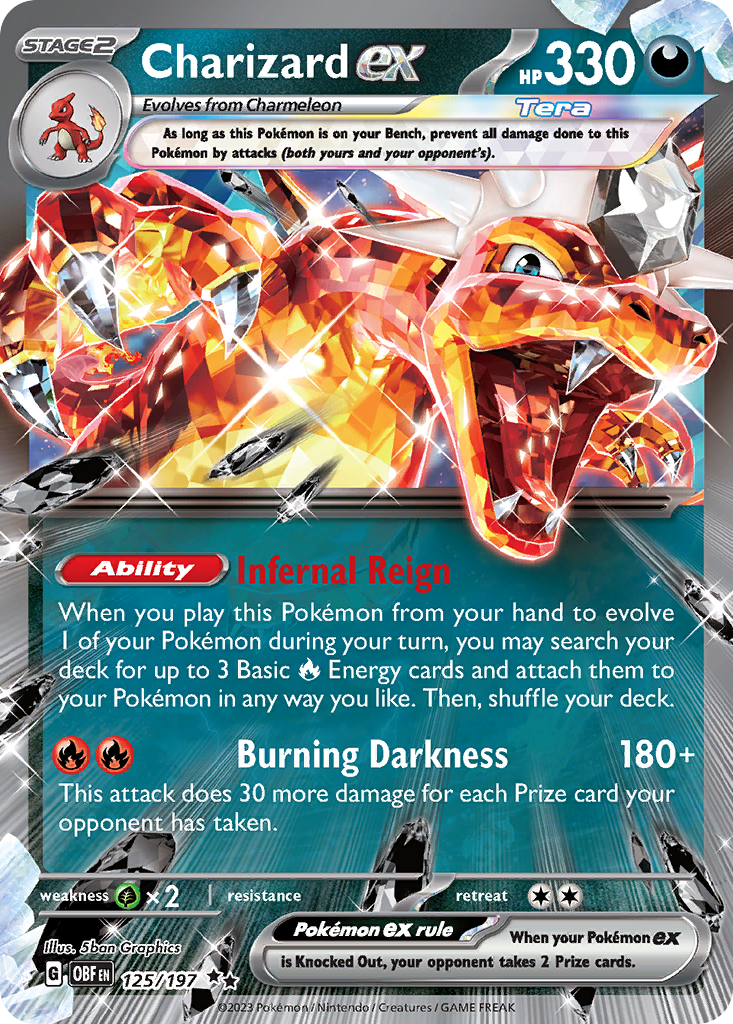
Two players, 60 cards each, six face-down Prize cards, and a coin flip. That is the whole skeleton of the Pokémon TCG. Here is every rule that actually matters on turn one, from setup through the three ways to win.
Pokémon TCG Energy Explained: Basic vs Special, Attack Costs, and the One-Per-Turn Rule
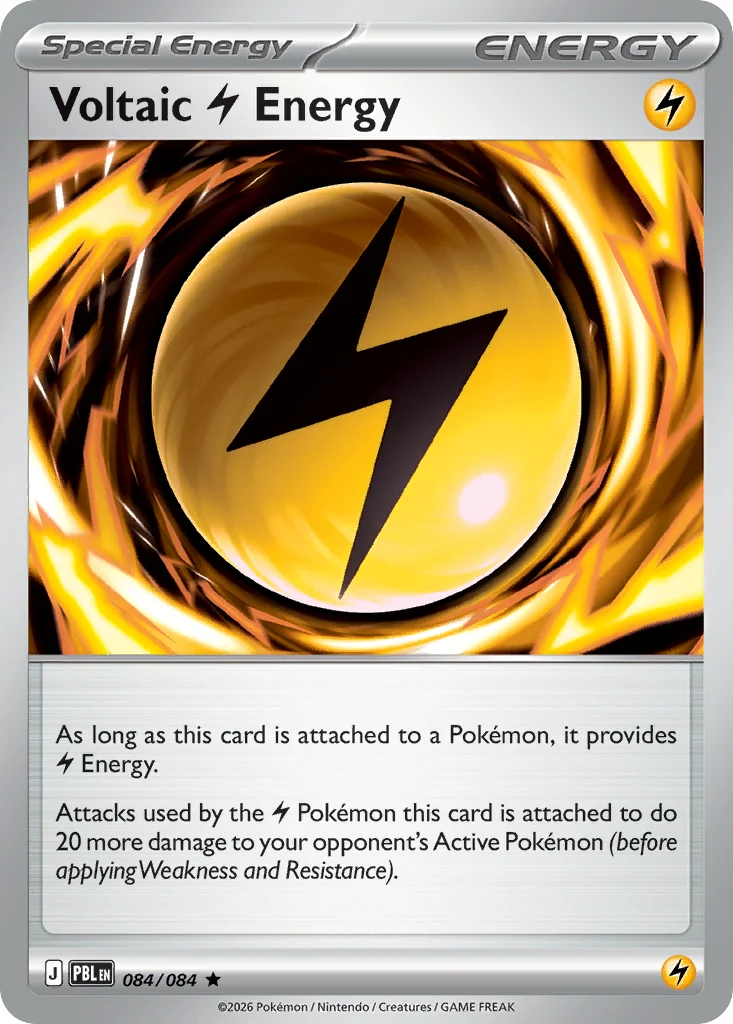
Attacking never spends your Energy. Retreating does. There are exactly nine basic Energy cards in the game's history and two Pokemon types that never got one. Here is how Energy actually works, straight from the rulebook and the card database — attack costs, the one-per-turn attachment rule, every legal way around it, and why Special Energy is a target painted on your attacker.