Pokémon TCG Special Conditions Explained: Poison, Burn, Sleep, Paralysis, and Confusion
Poison never stops ticking. Sleep does nothing half the time. Paralysis steals exactly one turn, no more. Here is what the official rulebook actually says about all five Special Conditions, the Checkup order they resolve in, which ones overwrite each other, and every legal way to clear them.
Your opponent spends a whole turn putting your Active Pokémon to Sleep. Then, before they even pass, the Checkup flip comes up heads and it wakes right back up. Their turn accomplished nothing. Meanwhile the player who Poisoned you two turns ago has been quietly collecting a damage counter at every single Checkup and has never had to flip anything.
That gap is the whole story of Special Conditions. There are five, they look like one category of effect on the card, and they behave nothing alike. Two are guaranteed, two are coin flips, and one punishes the player who got hit only if that player chooses to attack.
Everything below is checked against the official Pokémon Trading Card Game Rules PDF from The Pokémon Company — the "Special Conditions" section on pages 15 and 16, plus the "Pokémon Checkup" entry in Parts of a Turn. Card text comes from the Pokémon TCG API.
What a Special Condition actually is
The rulebook opens the section with the constraint that matters most:
"Some attacks make the Active Pokémon Asleep, Burned, Confused, Paralyzed, or Poisoned—these are called 'Special Conditions.' They can only happen to an Active Pokémon—when a Pokémon goes to the Bench, it recovers from all Special Conditions. Pokémon also recover when they evolve."
Two facts in there that most new players get wrong. Special Conditions only exist in the Active Spot — a Benched Pokémon cannot be Poisoned, Burned, or anything else. And they are not sticky: the moment the card moves to the Bench or gets an Evolution card placed on it, everything clears.
Mechanically the five split into two groups, and that split determines almost everything about how they interact:
| Condition | Tracked by | Stops attacking | Stops retreating | Resolves at Checkup | Clears on its own |
|---|---|---|---|---|---|
| Poisoned | Marker | No | No | 1 damage counter | Never |
| Burned | Marker | No | No | 2 damage counters, then a coin flip | On a heads |
| Asleep | Card rotation | Yes | Yes | Coin flip to wake up | On a heads |
| Paralyzed | Card rotation | Yes | Yes | Recovers after its owner's next turn | Yes, after one turn |
| Confused | Card rotation | No | No | Nothing | Never |
Poisoned and Burned use physical markers placed on the card. Asleep, Paralyzed, and Confused are shown by rotating the card — counterclockwise for Asleep, clockwise for Paralyzed, head pointed toward you for Confused. That is not flavor. A card can only point one direction at a time, and the stacking rules lean on that fact.
If any of the turn vocabulary here is unfamiliar, start with how a game of Pokémon TCG actually plays out and come back.
Checkup is where the whole system lives
Pokémon Checkup is the step between turns, and the rulebook is explicit about the order things resolve:
"Before the game continues to the next player, you'll need to take care of Special Conditions in this order: 1) Poisoned 2) Burned 3) Asleep 4) Paralyzed"
Four items. Confusion is not on the list, because Confusion never does anything at Checkup. It sits there indefinitely and only matters at the moment its Pokémon tries to attack.
The order is not decoration. Poison lands its damage counter before Burn lands its two, and both land before the Sleep flip. A Pokémon on 10 HP that is both Poisoned and Burned is dying at that Checkup regardless of any coin. The rulebook also bars you from interleaving Checkup effects with other between-turns text: "You can check Special Conditions and then other effects, or you can check other effects and then Special Conditions, but you can't mix them up." Knockouts are batched at the end — after both players finish, anything with no HP remaining is Knocked Out and the opponent takes a Prize card.
One more thing to internalize: there are two Checkups per full round, one after each player's turn. Every "per Checkup" number below therefore fires twice per round cycle, not once.
Poisoned: the only one that never fixes itself
"When a Pokémon is Poisoned, put a Poison marker on it. During Pokémon Checkup, put a damage counter on your Poisoned Pokémon."
That is the whole rule, and what it does not say is the important part. No coin flip. No timer. Poison ticks at every Checkup until the Pokémon retreats, gets switched, evolves, or dies — 10 damage per Checkup, twice per round, indefinitely. It is the only Special Condition with unbounded output, which is why the good ones pair it with escape denial.
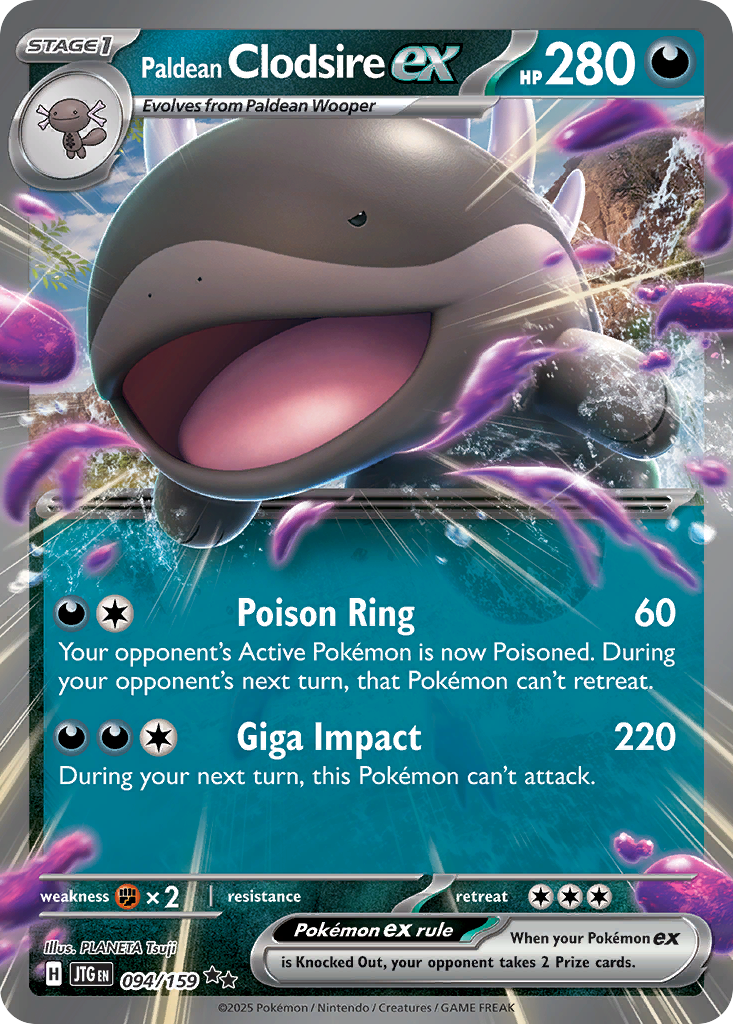
Paldean Clodsire ex from Journey Together is the clean example. Poison Ring costs one Darkness and one Colorless, does 60, and reads: "Your opponent's Active Pokémon is now Poisoned. During your opponent's next turn, that Pokémon can't retreat." Poison plus a retreat lock in one attack, off two Energy, on a 280 HP Stage 1.
Designers also scale the tick directly. Toxicroak ex from the Scarlet & Violet base set has Toxic Ripper, which Poisons and adds: "During Pokémon Checkup, put 6 damage counters on that Pokémon instead of 1." Team Rocket's Nidoking ex from Destined Rivals pushes the same template to 8 counters — 160 damage a round from a condition, not an attack. Okidogi ex from Shrouded Fable runs it in reverse, Poisoning itself to attach Energy and then hitting 130 harder while Poisoned, a design that only works because Poison never wears off.
Burned: two counters, then a coin flip
"When a Pokémon is Burned, put a Burn marker on it. During Pokémon Checkup, put 2 damage counters on your Burned Pokémon, then flip a coin. If heads, the Pokémon recovers (remove the Burn marker)."
Note the sequence: damage first, flip second. A Burn always deals at least 20, because the counters go down before you get the chance to remove the marker. That is a far better floor than Sleep, which can evaporate before it does anything at all.
Run the geometry out. Each Checkup, Burn deals 20 and then clears on a heads, so an unanswered Burn survives two Checkups on average and deals 40 damage across its life. A quarter of the time it deals 20 and vanishes. A quarter of the time it deals 60 or more.
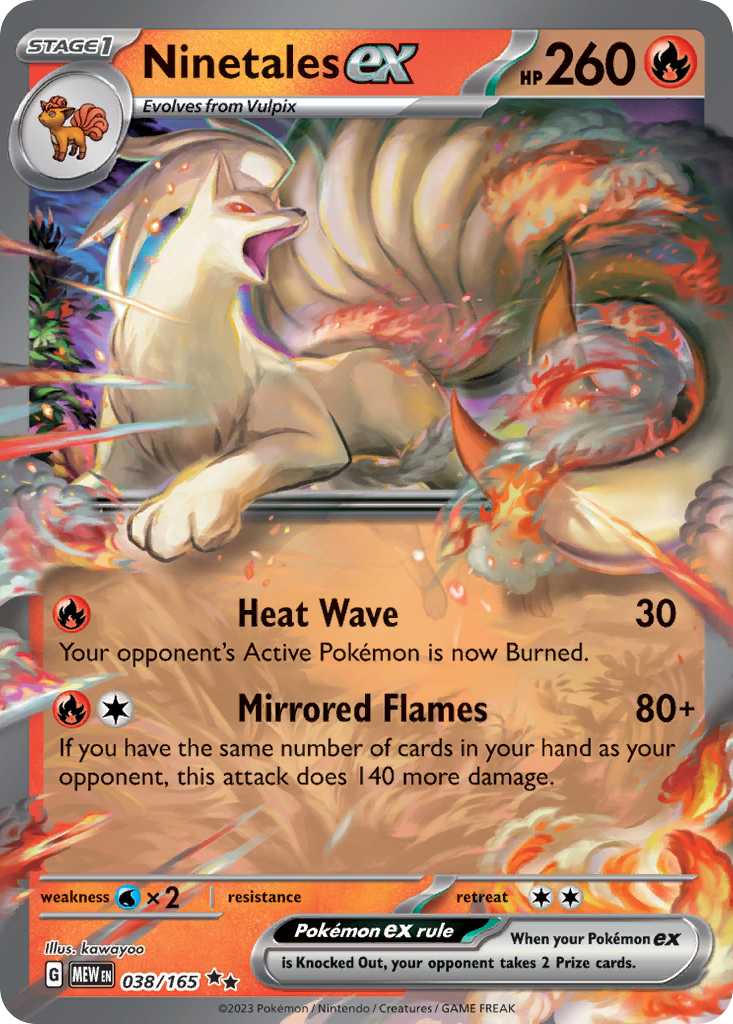
Ninetales ex from the 151 set shows the cost of entry: Heat Wave, one Fire Energy, 30 damage and a Burn. Magcargo ex from Twilight Masquerade does the same job for two Energy and 70. Burn is cheap to hand out precisely because it is unreliable.
One clean-up rule from the same paragraph: "A Pokémon cannot have two Burn markers; if an attack gives it another Burn marker, the new Burned Condition simply replaces the old one."
Asleep: a coin flip that often does nothing
"If a Pokémon is Asleep, it cannot attack or retreat. During Pokémon Checkup, flip a coin. If you flip heads, the Pokémon recovers (turn the card right-side up), but if you flip tails, it stays Asleep."
Here is the design flaw hiding in plain sight. You put a Pokémon to Sleep during your turn. The very next event is the Checkup between your turn and theirs — and that Checkup flips the coin. Heads, and they wake up before their turn even starts. Half the time, Sleep costs your opponent nothing whatsoever. It steals two or more turns only 25% of the time. Any deck that treats Sleep as a lock is a deck that loses to a coin.
Which is why the cards that care about Sleep bolt an enormous payoff onto it instead of leaning on the lock.
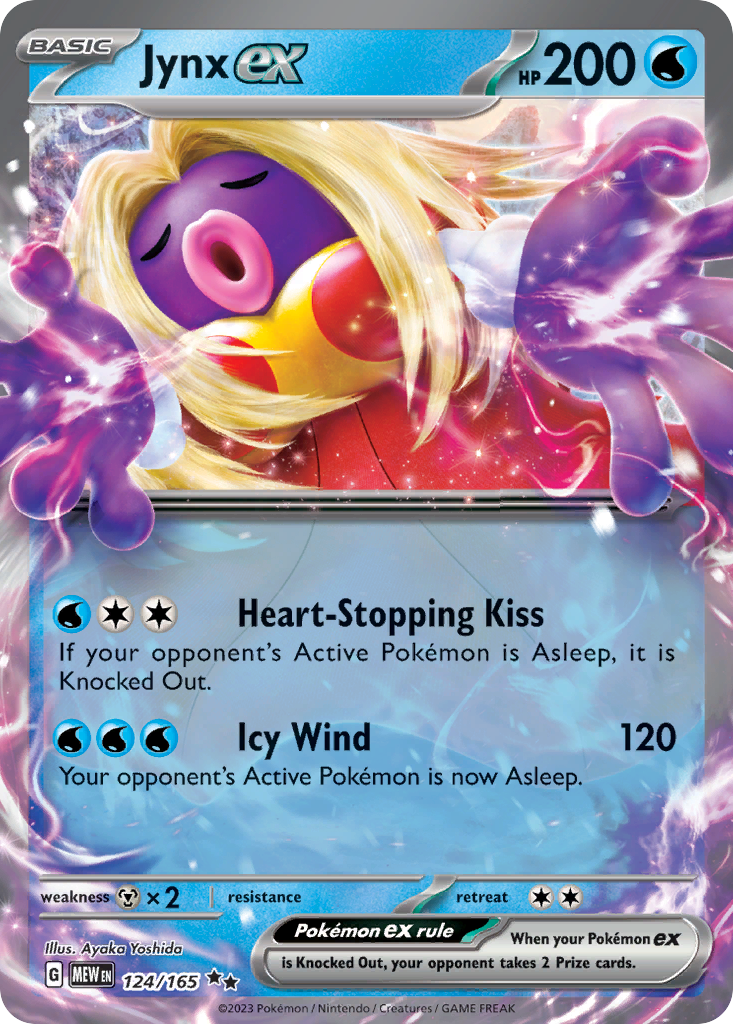
Jynx ex from the 151 set is the archetype. Icy Wind costs three Water, does 120, and puts the target to Sleep. Heart-Stopping Kiss costs one Water and two Colorless and reads, in full: "If your opponent's Active Pokémon is Asleep, it is Knocked Out." No damage number, no HP check, no size limit. Sleep stops being a tempo effect and becomes a two-turn removal spell that ignores 340 HP as happily as 60. Amoonguss ex from Journey Together is the budget version: Spore Ball, one Grass Energy, 30 damage and Asleep.
Paralyzed: exactly one stolen turn
"If a Pokémon is Paralyzed, it cannot attack or retreat. After its owner's next turn, it recovers during Pokémon Checkup."
This is the most misunderstood condition in the game, and the wording is precise. Paralyze the opponent's Active on your turn. At the Checkup immediately after your turn it does not recover — its owner has not had their next turn yet. Their turn happens: no attacking, no retreating. Then the Checkup after their turn clears it.
So Paralysis is worth exactly one turn of not attacking. Guaranteed, no coin — and no more than that. You cannot chain it into a lock unless you Paralyze again next turn, which means spending your attack on a status effect instead of damage every single turn. What you do get is a genuinely locked turn: they cannot walk a damaged attacker to safety, so pairing it with a gust effect strands whatever you dragged up.
The card design reflects that reliability: Paralysis is rarely handed out unconditionally on strong Pokémon. In the Scarlet & Violet era it mostly sits on small Basics behind a coin flip, like Pincurchin from Paldea Evolved, or behind a hard restriction — Cryogonal from Obsidian Flames has First Freeze, "If you go second and it's your first turn, your opponent's Active Pokémon is now Paralyzed," and Black Kyurem ex from Surging Sparks only Paralyzes Dragon Pokémon.
Confused: the one that punishes you for attacking
"If your Pokémon is Confused, you must flip a coin before attacking with it. If heads, the attack works normally. If tails, the attack doesn't happen, and you put 3 damage counters on your Confused Pokémon."
Confusion is the odd one out in three ways.
It does nothing at Checkup. It is not on the Checkup list. It can sit on a Pokémon for the entire game without generating a single point of damage, until that Pokémon attacks.
It does not stop retreating. The rulebook is unambiguous: "The only Special Conditions that prevent Pokémon from retreating are Asleep and Paralyzed." Older players still flip for a Confused retreat out of muscle memory. That rule is gone.
The 30 damage lands on the Confused Pokémon, not the opponent.
Timing matters too. In the rulebook's full attack sequence, the Confusion flip is step C — after you announce the attack and after any effects that alter or cancel it, but before you make the choices the attack requires. You are already committed when you flip. So Confusion is a tax on attacking, not a lock: a 50% whiff plus self-damage against a deck that wants to swing every turn, and worth nothing against a setup turn where the opponent was passing anyway.
Which conditions stack and which overwrite
This is where the marker-versus-rotation split pays off, and the rulebook spells it out:
"Since Asleep, Confused, and Paralyzed all rotate the Pokémon card, whichever one happened last to the Pokémon is the only one that is still in effect. Since Poisoned and Burned use markers, those don't affect other Special Conditions. An unfortunate Pokémon could be Burned, Paralyzed, and Poisoned all at the same time!"
So: the three rotation conditions are mutually exclusive — a new one removes the old one, and putting an already-Paralyzed Pokémon to Sleep swaps a guaranteed lock for a coin flip. Poison and Burn are independent of everything, including each other, so a Pokémon can carry both markers plus one rotation condition. Re-applying a marker you already have does nothing.
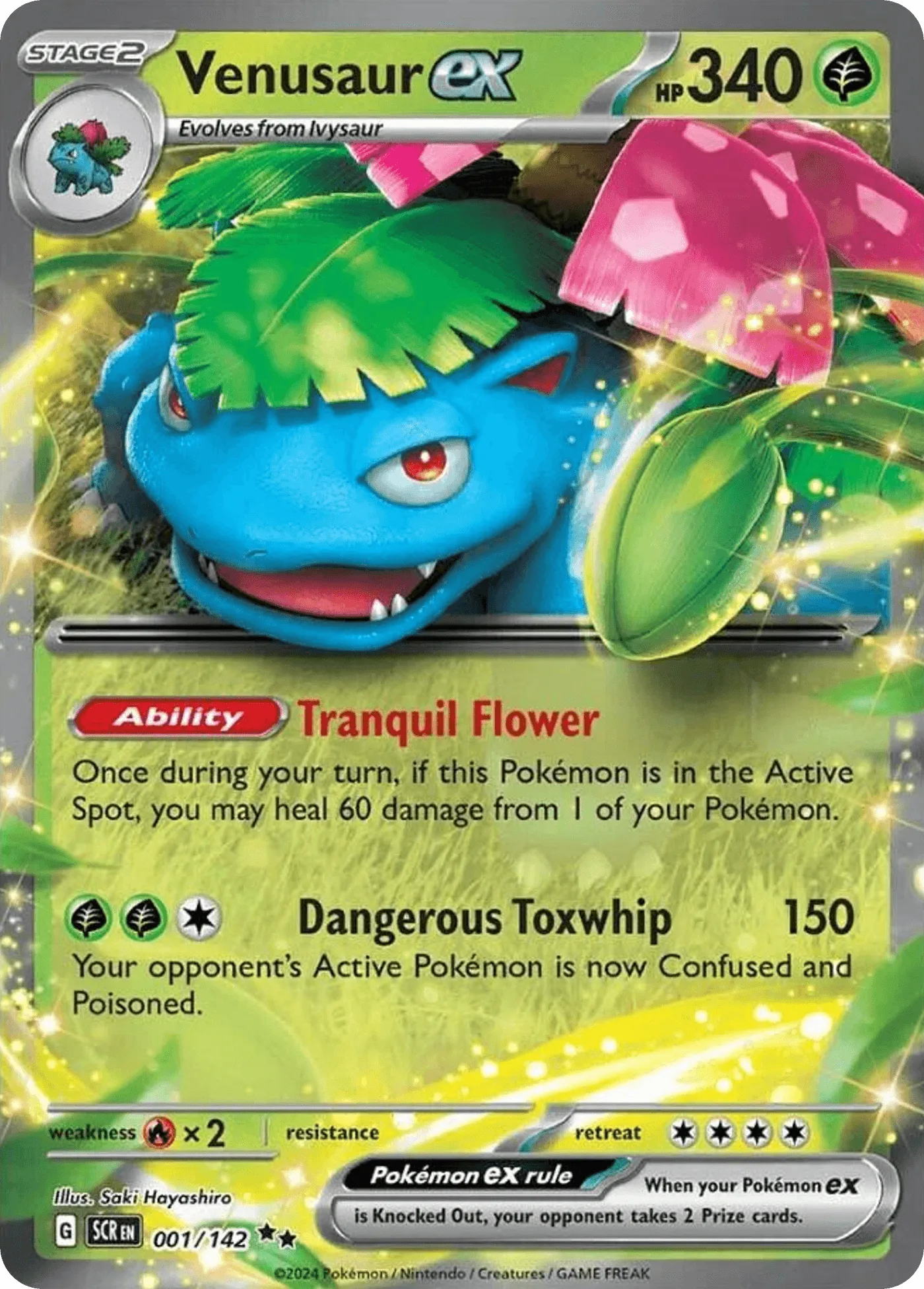
Venusaur ex from Stellar Crown shows the pattern in a single attack. Dangerous Toxwhip costs two Grass and one Colorless, does 150, and applies Confused and Poisoned — one rotation condition plus one marker condition, exactly the pair the rules allow to coexist. Amoonguss from Obsidian Flames does the same trick with Paralyzed and Poisoned on a coin flip.
Every legal way to clear a condition
There are only five, and none of them are complicated:
- Retreat. Discard Energy equal to the retreat cost and swap to the Bench. Blocked while Asleep or Paralyzed.
- Get switched or gusted to the Bench by a card effect. The rulebook: "When your Active Pokémon goes to your Bench (whether it retreated or got there some other way), some things do go away—Special Conditions and any effects from attacks." This works even while Asleep or Paralyzed, because a switch effect is not a retreat. That distinction wins games.
- Evolve it. From the turn-actions section: "Any effects of attacks or Special Conditions affecting the Pokémon—such as Asleep, Confused, or Poisoned—end when it evolves." Putting a Stage 1 onto a Poisoned Basic is a free answer.
- Wait it out, where the condition can clear — Burn and Sleep on a heads, Paralysis after one turn. Poison and Confusion never expire.
- Prevent it outright with a card that grants immunity, like the Ancient Booster Energy Capsule Tool or the Stadium below.
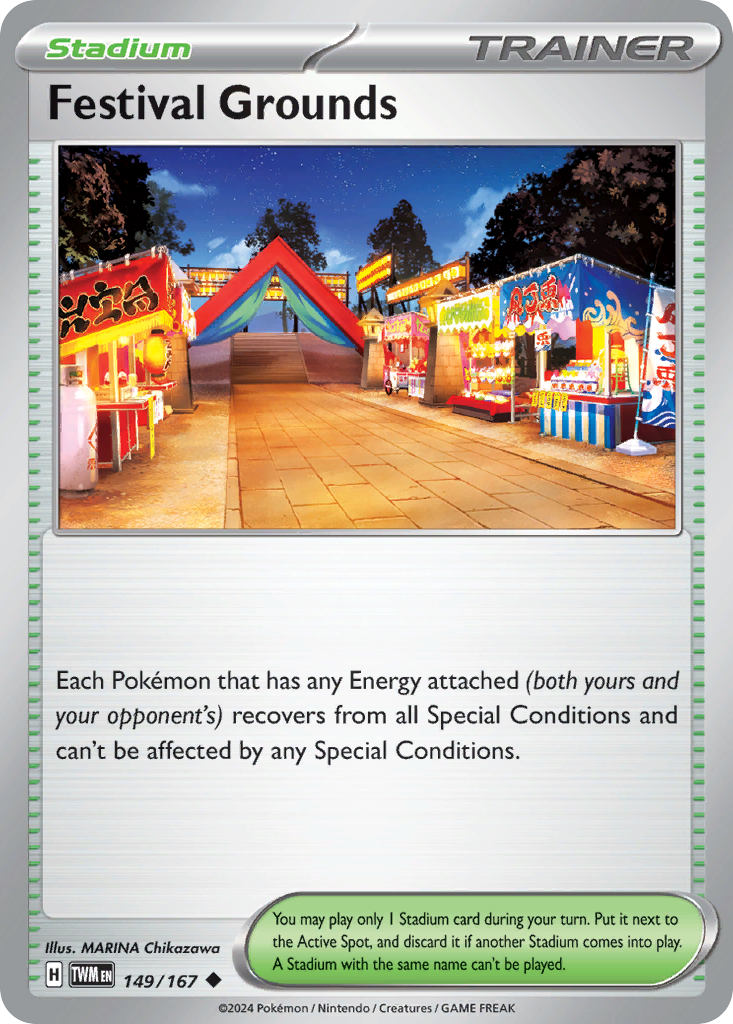
Festival Grounds, a Stadium from Twilight Masquerade, is the widest version of that fifth option: "Each Pokémon that has any Energy attached (both yours and your opponent's) recovers from all Special Conditions and can't be affected by any Special Conditions." One card in play shuts the entire category off for every attacker on the table. It is symmetric, so it is a hoser rather than an engine — but if a conditions deck is real in your local meta, one Stadium slot answers all five at once.
What the card database says about each condition
Here is the falsifiable part. Querying the Pokémon TCG API for card printings whose attack text contains the standard inflict phrasing "is now [Condition]" gives this distribution across the full English card database:
| Condition | Printings, all sets | Printings, Scarlet & Violet series |
|---|---|---|
| Paralyzed | 941 | 79 |
| Confused | 644 | 71 |
| Asleep | 616 | 46 |
| Poisoned | 526 | 57 |
| Burned | 332 | 46 |
Two honest caveats before anyone quotes these. They are printings, not unique cards — reprints and alternate arts each count once, and the database is English-language. And it is a phrase match, so an attack that Paralyzes only under a restriction counts the same as one that always does.
Even so, the shape matches what the rules predict. Paralysis leads by a wide margin because it is the most reliable condition and therefore the easiest to balance behind a coin flip on a small Basic. Burn is the rarest, roughly a third as common as Paralysis, because it is the only condition that pairs fixed damage with a self-clearing flip — hard to build around, hard to make exciting. The Scarlet & Violet column flattens out, which tracks with modern design: conditions have drifted toward riders on attacks that already do damage rather than being the point of the attack.
How to actually build around conditions
The short version: four of the five are tempo, and one is damage.
- If you want a clock, you want Poison. No expiry, no flips. Pair it with retreat denial like Paldean Clodsire ex, or a Checkup-damage modifier, and it becomes a free second attack every Checkup.
- If you want a lock, you want Paralysis every turn. One application buys one turn, so your Paralyzer has to be cheap enough to keep firing while something else does the damage.
- Never make Sleep the plan. Make it the setup for a payoff card like Jynx ex, where the flip decides whether you win outright instead of whether your turn did anything.
- Burn and Confusion are riders. Take them stapled to an attack you already wanted. Do not pay extra Energy for them.
The wider principle is the one that governs deck ratios and consistency: the six-Prize race is decided by turns, and anything that costs your opponent a turn is worth about as much as a knockout. Conditions are the cheapest turns in the game — as long as you are honest about which ones actually deliver.
Quick Action Checklist
- Special Conditions only affect the Active Pokémon. The Bench is immune, always.
- Checkup order is Poisoned, Burned, Asleep, Paralyzed — and it runs twice per round cycle. Confusion is not on that list and never resolves at Checkup.
- Poison never expires. Burn deals its 20 before the recovery flip, so it always lands at least 20 and averages 40.
- Sleep flips before your opponent's turn, so it does nothing at all half the time.
- Paralysis is worth exactly one turn, guaranteed, and no more.
- Confusion only matters if the Pokémon attacks, and the 30 damage lands on the Confused Pokémon.
- Only Asleep and Paralyzed block retreating. Confusion does not.
- Asleep, Paralyzed, and Confused overwrite each other. Poison and Burn stack with everything.
- Benching or evolving clears every condition. A switch effect works even when retreating is blocked.
Frequently Asked Questions
What are the five Special Conditions in the Pokémon TCG?
What order do Special Conditions resolve in during Pokémon Checkup?
How long does Paralysis last in the Pokémon TCG?
How much damage does Burn do in the Pokémon TCG?
Do Special Conditions stack in the Pokémon TCG?
Can a Confused Pokémon retreat in the Pokémon TCG?
How do you remove a Special Condition in the Pokémon TCG?
Which Special Condition is the best one to build a deck around?
Keep Reading
Related Guides
Pokémon TCG Prize Cards Explained: 1, 2, and 3-Prizers
The Prize count is the only score the Pokémon TCG keeps. Here is what each Pokémon actually costs you when it goes down — one, two or three — measured across all 2,947 Standard-legal printings, plus the 44 Standard-legal card names whose text reads the Prize count or changes what a Knock Out pays.
Pokémon TCG Formats Explained: Standard, Expanded, Unlimited
Play! Pokémon sanctions three Constructed formats, and Standard is the one the circuit runs on. Here is what the other two actually are: the Expanded card pool the Tournament Handbook enumerates set by set, the 27-card ban list that trims it, the Unlimited format with no bans at all, and the awkward truth about where you can still sit down and play any of it.
Pokémon TCG Tournament Rules: Deck Lists, the Clock, and Penalties
The rules that decide your first League Cup are not in the rulebook. They are in three separate Play! Pokémon documents, revised on a quarterly cycle, and they cover sleeve colour, how a die has to be numbered, what happens to your match when the clock hits zero, and the two penalties that exist in the Pokémon TCG and nowhere else in the program.
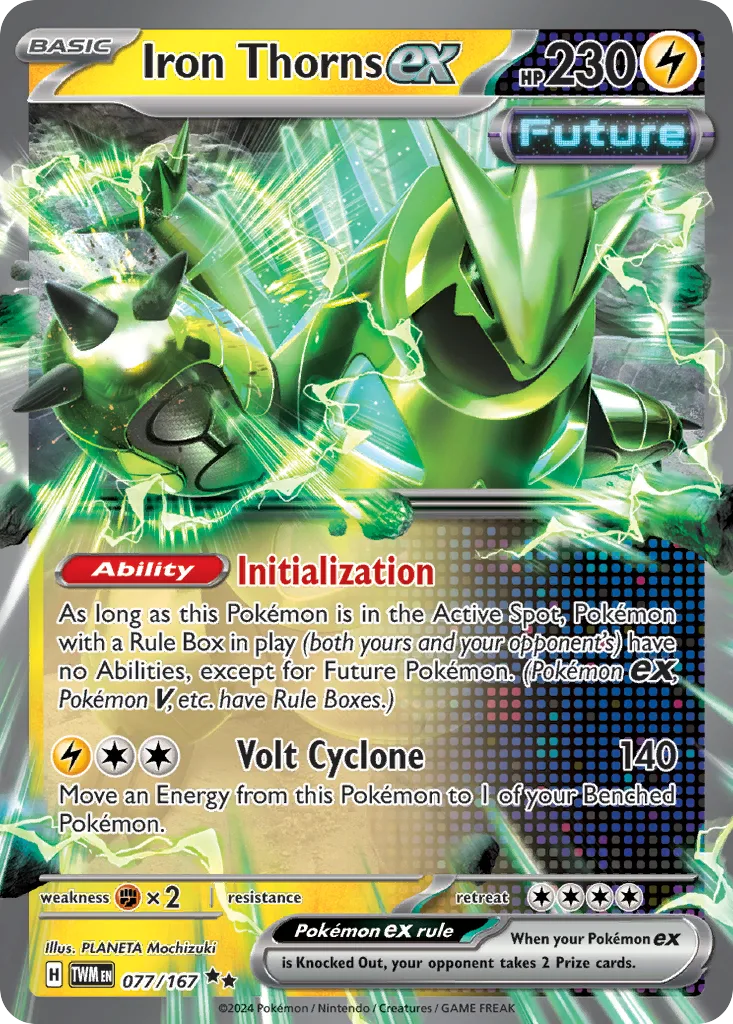
Pokémon TCG Abilities Explained: Triggers, Ability Lock, and Damage Math
An Ability is not an attack, and almost every rules argument about Abilities comes from someone forgetting that one line. Here is what the 2026 Web Rulebook says about when Abilities fire, where they work from, why a Paralyzed Pokémon still uses them, and what the parenthetical at the end of a damage-reduction Ability is really telling you.
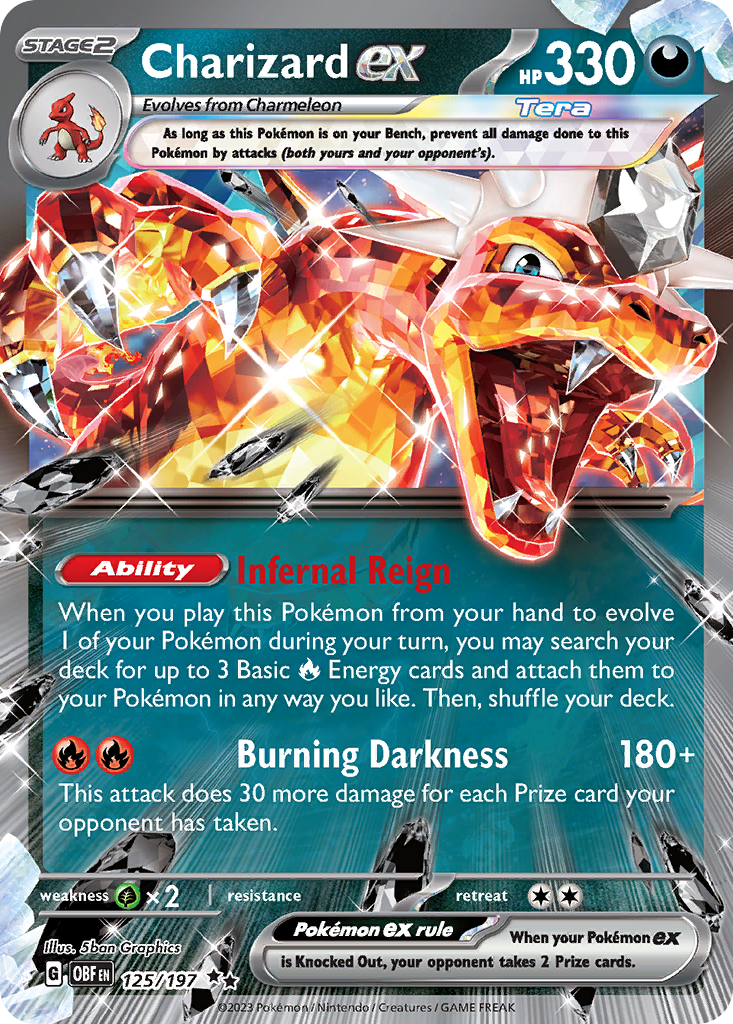
How to Play the Pokémon TCG — Full Rules and Turn Structure (2026)
Two players, 60 cards each, six face-down Prize cards, and a coin flip. That is the whole skeleton of the Pokémon TCG. Here is every rule that actually matters on turn one, from setup through the three ways to win.
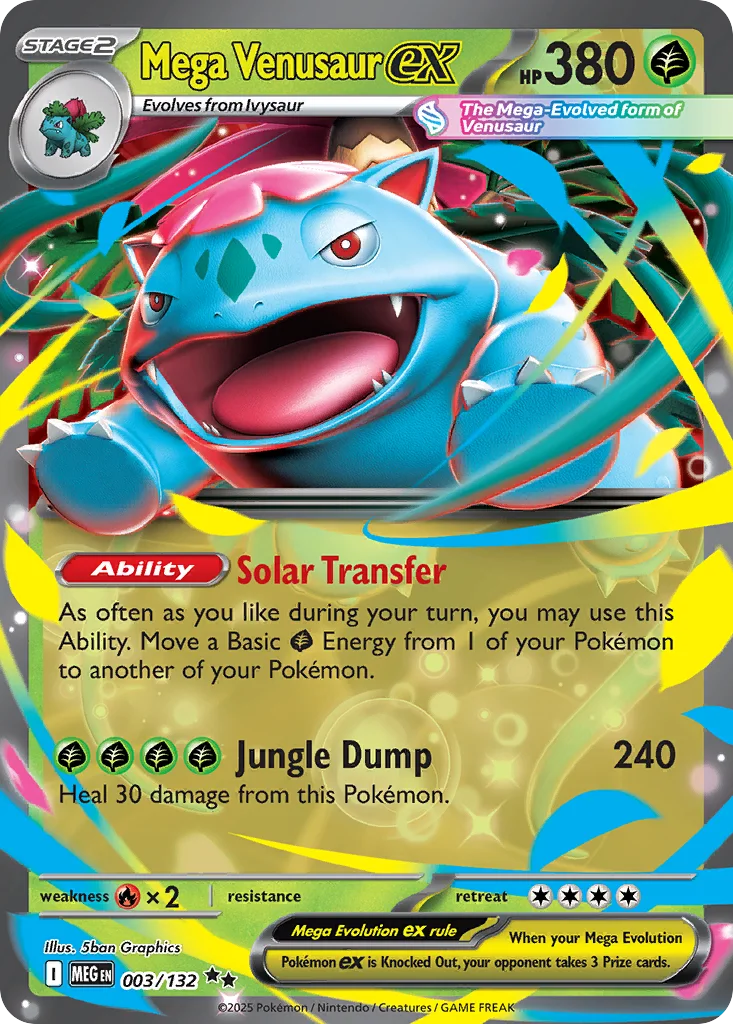
Pokémon TCG Evolution Explained: Stages, Rare Candy, Mega
Evolving looks like the simplest action in the Pokémon TCG until you count the restrictions — there are three, plus two more that get treated as restrictions and are not. Here is what the rulebook actually says about stages, timing, and what survives an evolution, plus how the 2025-26 Mega Evolution era quietly rewrote the whole mechanic for the second time.