Super Mario 64 Music: Every Track and Where It Plays
Super Mario 64 scores 15 courses with seven songs, and only one of them belongs to a single course. Here is which track plays in every course and secret level, the five levels whose music rearranges itself as Mario moves, what triggers the boss music and the jingles, all 36 soundtrack tracks under their 1996 and current names, and where to listen today.
Super Mario 64 has 15 main courses and seven songs to score them with. The decompiled level scripts assign each course and castle area its background track, and read in one sitting they show how hard Nintendo leaned on sharing: Shifting Sand Land runs on Lethal Lava Land's theme, Snowman's Land on Cool, Cool Mountain's, and Wet-Dry World on the Hazy Maze Cave track. Big Boo's Haunt is the only main course with a song no other course plays.
That economy is the interesting part of a soundtrack everyone already knows by ear. Koji Kondo, credited in the game as sound composer, stretches one melody across eight of the 15 courses in three arrangements, has five courses rebuild their arrangement depending on where Mario is standing, and uses a handful of short stings to tell you when you have done something right. Here is which track plays where, what triggers the music that cuts in over the top, all 36 tracks on the official soundtrack under both their 1996 and current names, and where you can listen to it legally today.
Where a track plays comes from the n64decomp decompilation of the game's code. Track names, instrumentation and the descriptions of what each layer sounds like come from the Super Mario Wiki's music pages. Everything below is the N64 game, with the DS remake's differences at the end.
Fifteen courses, seven songs
Track names below are the ones Nintendo uses today on its Nintendo Music app. The 1996 North American soundtrack CD named several of them differently, and the full cross-reference is further down.
| # | Course | Main track | Also inside the course |
|---|---|---|---|
| 1 | Bob-omb Battlefield | Main Theme | Slider, during Koopa the Quick's race |
| 2 | Whomp's Fortress | Main Theme | Piranha Plant's Lullaby, near the sleeping Piranha Plants |
| 3 | Jolly Roger Bay | Dire, Dire Docks | Nothing else |
| 4 | Cool, Cool Mountain | Cool, Cool Mountain | Slider, on the slide inside the cabin |
| 5 | Big Boo's Haunt | Big Boo's Haunt | The Merry-Go-Round, in the basement |
| 6 | Hazy Maze Cave | Hazy Maze Cave | Nothing else |
| 7 | Lethal Lava Land | Lethal Lava Land | Nothing else; the volcano keeps the same track |
| 8 | Shifting Sand Land | Lethal Lava Land | Hazy Maze Cave, inside the pyramid |
| 9 | Dire, Dire Docks | Dire, Dire Docks | Nothing else |
| 10 | Snowman's Land | Cool, Cool Mountain | Hazy Maze Cave, inside the igloo |
| 11 | Wet-Dry World | Hazy Maze Cave | Nothing else |
| 12 | Tall, Tall Mountain | Main Theme | Slider, on the hidden slide |
| 13 | Tiny-Huge Island | Main Theme | Hazy Maze Cave in Wiggler's cave, and Slider during the Koopa the Quick rematch |
| 14 | Tick Tock Clock | Slider | Nothing else |
| 15 | Rainbow Ride | Slider | Nothing else |
Three things fall out of that table.
Six of the seven course themes are shared. Main Theme, Slider, Cool, Cool Mountain, Dire, Dire Docks, Lethal Lava Land and Hazy Maze Cave all score at least two courses. Big Boo's Haunt, an atonal piece in the Super Mario Wiki's description, is the one that never leaves its own course.
One melody carries eight courses. The Super Mario Wiki identifies both Slider and Cool, Cool Mountain as arrangements of Main Theme's main motif: Slider is a presto bluegrass version with the melody on fiddle, a whistle countermelody and banjo, and Cool, Cool Mountain is a winter arrangement. Main Theme scores four courses, Slider two and Cool, Cool Mountain two, so eight of the 15 courses are the same tune in different clothes.
Slider is the workhorse. Beyond Tick Tock Clock and Rainbow Ride, the level scripts give it to the Princess's Secret Slide, the slides inside Cool, Cool Mountain and Tall, Tall Mountain, two of the three cap levels and Wing Mario Over the Rainbow, and the Koopa the Quick code switches to it for both of his races. The wiki notes the name comes from the Japanese term for a slide stage. Hazy Maze Cave's theme is the other traveller: two full courses plus the pyramid, the igloo, Wiggler's cave and the Cavern of the Metal Cap.
That sharing doubles as navigation. The Shifting Sand Land guide uses the switch to the cave theme as the sign you are inside the one-way pyramid, and the Lethal Lava Land guide notes the desert borrows its music.
The castle, the secret levels and Bowser
| Area | Track |
|---|---|
| Inside Peach's Castle, all floors | Peach's Castle |
| Castle Grounds and the courtyard | No song at all |
| The Princess's Secret Slide | Slider |
| Tower of the Wing Cap | Slider |
| Vanish Cap Under the Moat | Slider |
| Cavern of the Metal Cap | Hazy Maze Cave |
| Wing Mario Over the Rainbow | Slider |
| The Secret Aquarium | Dire, Dire Docks |
| Bowser in the Dark World, the Fire Sea and the Sky | Bowser's Road |
| The first two Bowser fights | Bowser's Theme |
| The final Bowser fight | The Final Battle |
Three notes on that table.
Outside, there is no music. The level scripts for the Castle Grounds and the courtyard assign the game's sound-effects player instead of a song, so all you hear out there is ambient sound and birdsong.
The castle waits for Bowser. On a file that has never been saved, the decompiled code holds the castle theme back the first time you walk in. Bowser's "Welcome. No one's home!" message plays its own sting first, Bowser's Message, the same one you hear when you try a star door you cannot open yet, and Peach's Castle only starts once that text box closes.
The last fight gets its own track. The first two Bowser arenas share Bowser's Theme. Bowser in the Sky's arena switches to The Final Battle, which the Super Mario Wiki notes quotes twelve notes of Bowser's Theme. The Bowser levels guide covers the obstacle courses that Bowser's Road plays over.
Five courses remix their music as you move
The decompilation contains a table its authors call music dynamics: per-level rules that raise or mute individual instrument channels according to Mario's position, area or room. Five playable levels have one, and they are the five below. A sixth table is attached to an empty level slot the game never uses.
| Course | Track | What changes, and where |
|---|---|---|
| Dire, Dire Docks | Dire, Dire Docks | Base version in the first area. Synths fade in from the tunnel entrance. Percussion comes in on land in the second area |
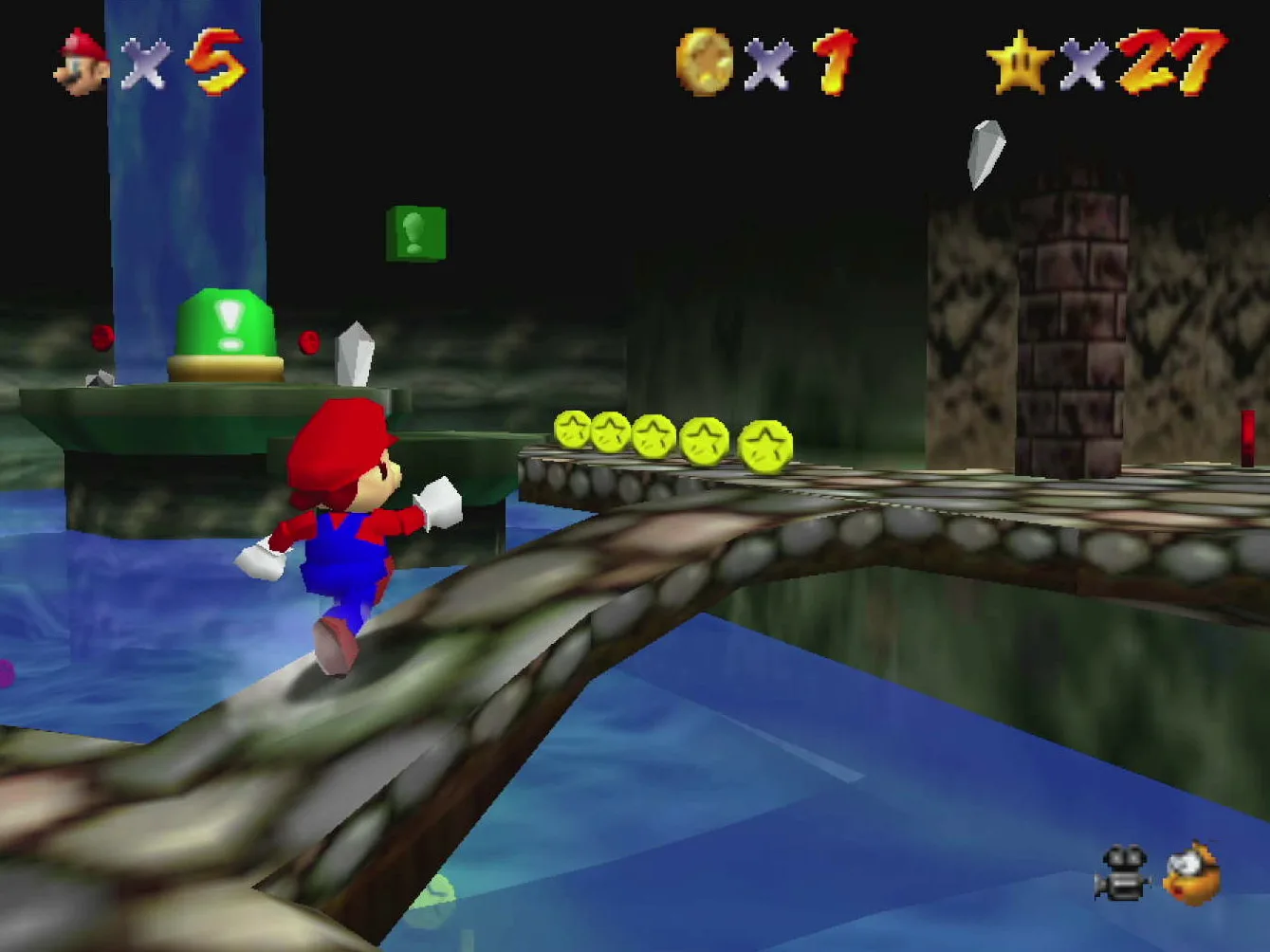
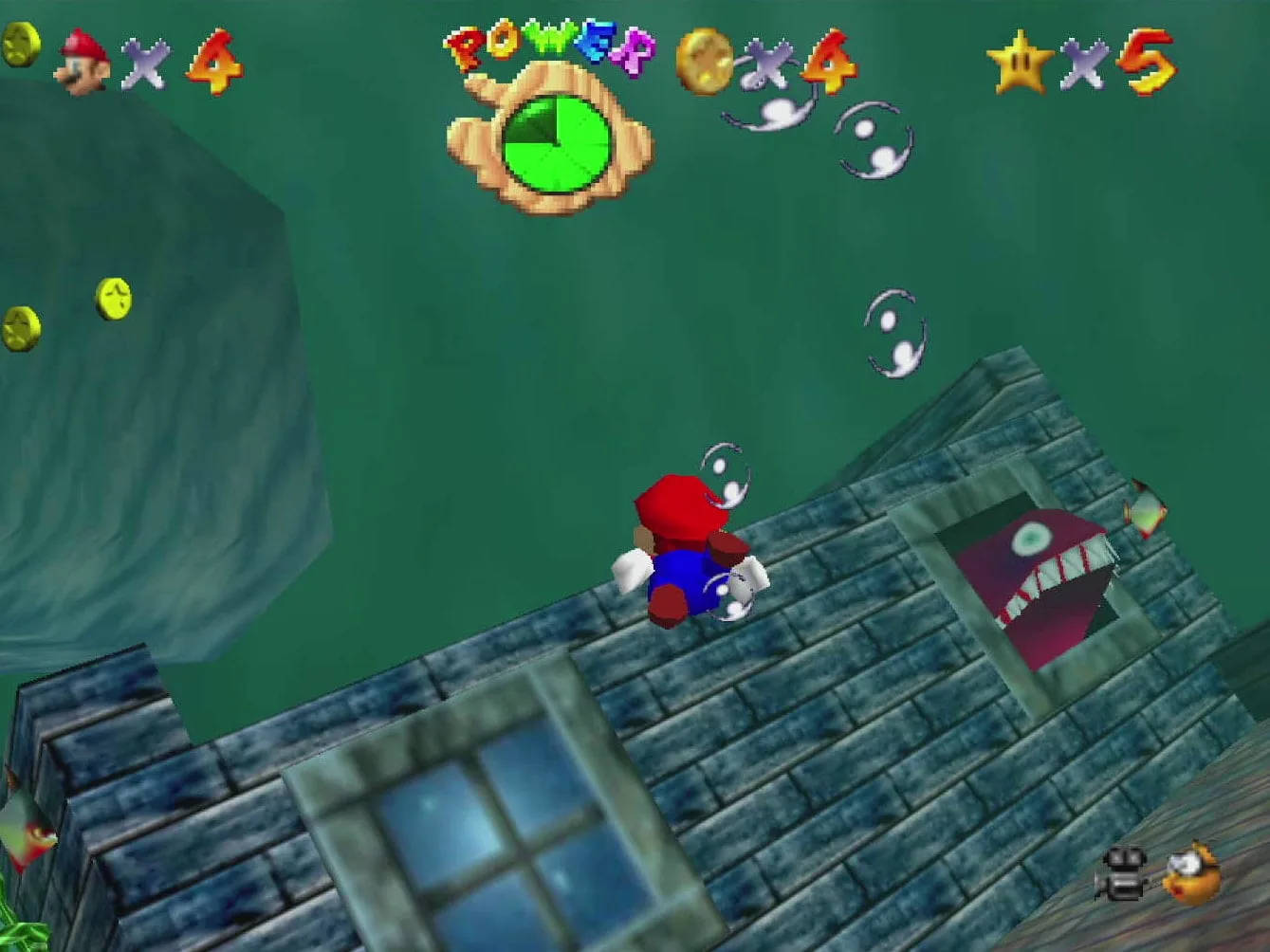
| Jolly Roger Bay | Dire, Dire Docks | Base version out of the water and inside the sunken ship. Synths while swimming. Percussion on land in the cavern area |
| Hazy Maze Cave | Hazy Maze Cave | A vocal track comes in, in the Hazy Maze and at the Underground Lake |
| Wet-Dry World | Hazy Maze Cave | The same vocal layer downtown, and per the code low down in the main room |
| Big Boo's Haunt | Big Boo's Haunt | Part of the arrangement drops out on the grounds outside the mansion and in the basement room around the merry-go-round |
The descriptions of what each layer sounds like are the Super Mario Wiki's, and the locations are what the decompiled table checks. For the cave theme the code swaps one instrument channel for another rather than simply adding one. That fits the wiki's note that in the four other places the theme plays (the pyramid, the igloo, Wiggler's cave and the Cavern of the Metal Cap) you hear the bass-guitar melody and the vocal track together.
Big Boo's Haunt has a second trick on top. Walk into the room around the basement carousel and the decompiled code starts The Merry-Go-Round with the course theme still running underneath at reduced volume. Step into the carousel's enclosure and the course music drops out completely, leaving only The Merry-Go-Round. Leave both and it fades back. The Big Boo's Haunt guide covers the fight in that room.
The practical use is the one the Dire, Dire Docks guide already points out: if the track thickened, you moved. In Jolly Roger Bay the synth layer is the swimming cue.
The music that cuts in over the level
| Track | What triggers it |
|---|---|
| Powerful Mario | Putting on the Wing Cap or the Vanish Cap, or riding or swimming with a Koopa Shell |
| Metal Mario | Putting on the Metal Cap |
| Stage Boss | King Bob-omb, the Whomp King, Eyerok and Wiggler |
| Race Fanfare, then Slider | Accepting a race from Koopa the Quick |
| Piranha Plant's Lullaby | Getting near a sleeping Piranha Plant |
| The Merry-Go-Round | The carousel room in Big Boo's Haunt |
| The Endless Stairs | Climbing the endless stairs with fewer than 70 Power Stars |
Stage Boss is reserved for four bosses. The decompiled dialog handler starts it when King Bob-omb, the Whomp King, Eyerok or Wiggler delivers his opening speech, starts it again if King Bob-omb has to warn you about throwing him out of the ring, and fades it out on their defeat lines. Big Boo, Big Bully, Chill Bully and Big Mr. I never trigger it. You fight them to whatever the room is already playing, the course theme or, on the merry-go-round, The Merry-Go-Round, which squares with the Big Boo's Haunt guide's note that those four have no boss theme of their own. Bowser has his two tracks. The boss guide has the fights themselves.
Koopa the Quick's races switch the course to Slider. Accepting a race plays Race Fanfare, and the same handler plays it when you accept either Big Penguin race in Cool, Cool Mountain. For Koopa the Quick, the race code then changes the course music to Slider and starts the on-screen timer. The penguin race does neither; the cabin slide is already playing Slider. Reach Koopa's finish line before he does and Race Fanfare plays again. The Bob-omb Battlefield guide covers the race rules.
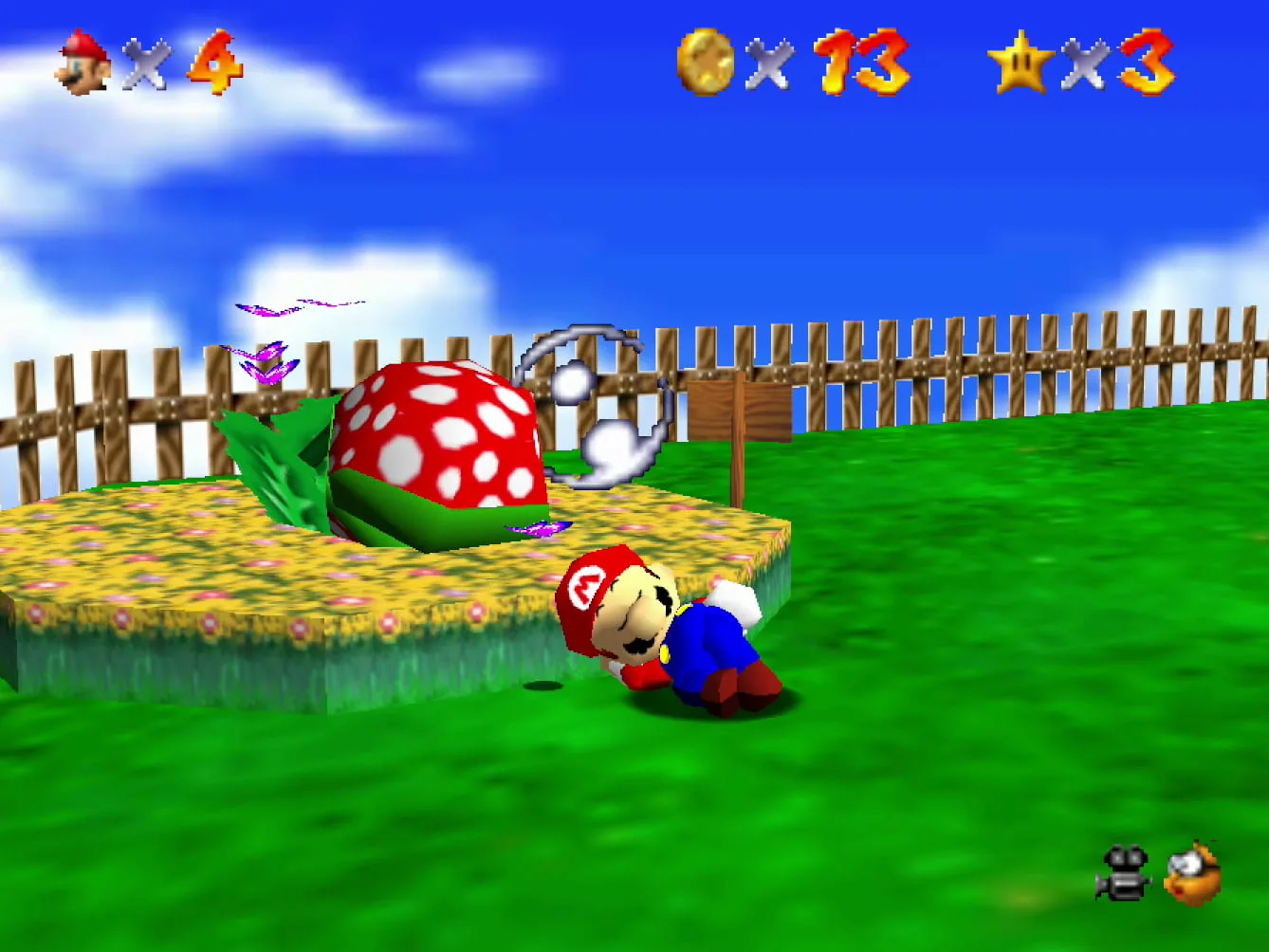
The lullaby is a stealth meter. In the decompiled Piranha Plant code, the lullaby replaces the level music once Mario is within 1,000 units of a sleeping plant. Inside 400 units, moving forward faster than 10 units per frame wakes it, and so does rising faster than 10, which a jump does. So when the lullaby starts, walk very slowly and do not jump. The sleeping plants are in Whomp's Fortress, and the course's level script opens with a Lakitu Bros. message telling you Mario has to walk very slowly to sneak up on enemies.
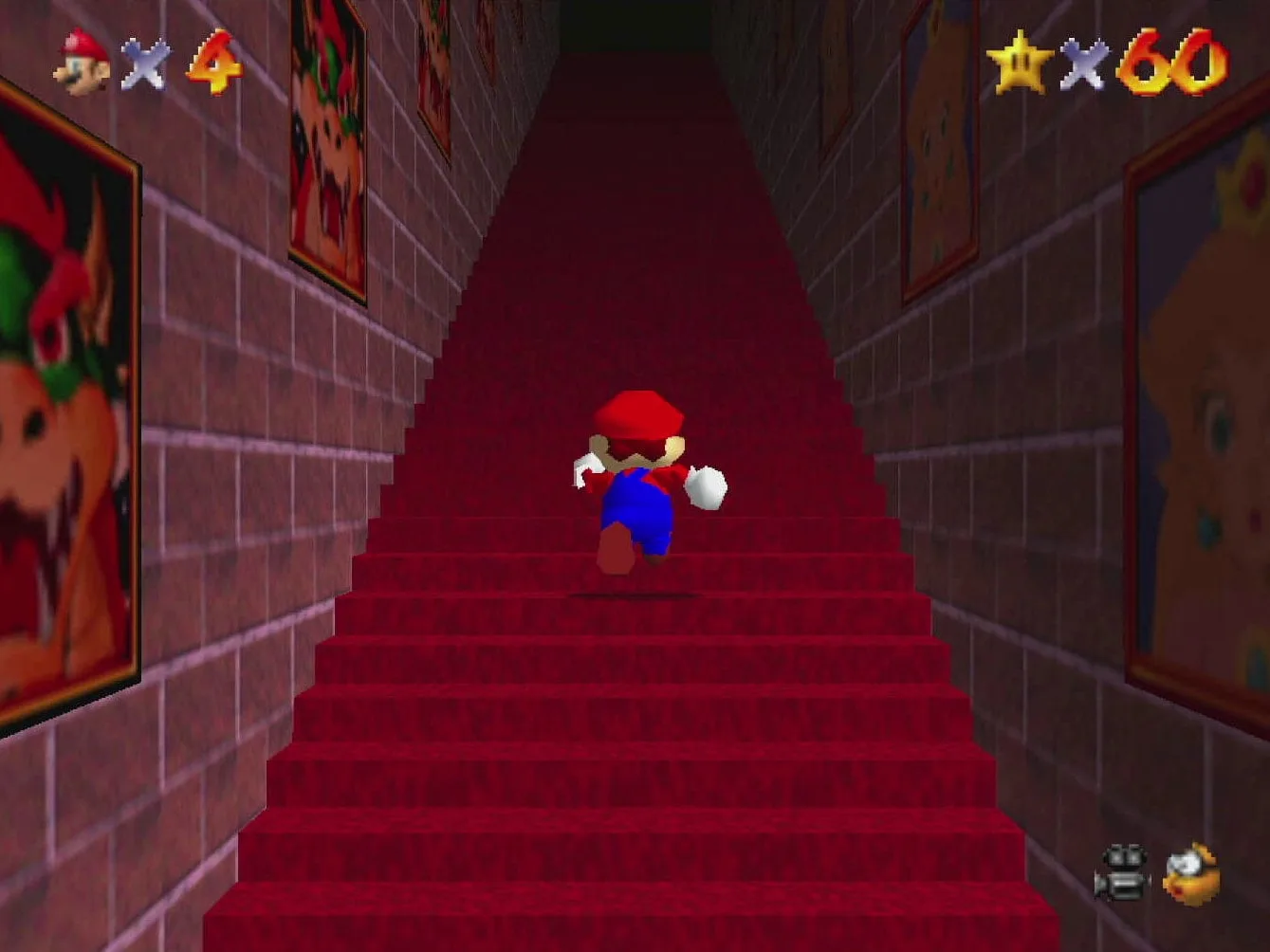
The Endless Stairs is an illusion scored with an illusion. The staircase loops you back, and the track, per the Super Mario Wiki, is built on the Shepard tone, a sound that seems to rise forever, and on György Ligeti's piano étude "The Devil's Staircase". The decompiled check that plays it uses the same threshold as the stairs: fewer than 70 Power Stars. At 70, the loop and the music stop together.
The jingles, and what each one means
The short stings are information, not decoration, and Correct Solution is the most useful of them. It is the "you got it" chime, and the moments the decompiled code plays it include:
- the courtyard Boo dies and drops the Big Boo's Haunt cage
- Big Boo appears after the five Ghost Hunt Boos
- the Big Bully drops in after his three minions in Lethal Lava Land
- the Chain Chomp's post is pounded flat
- the haunted bookshelf opens
- a treasure chest puzzle is solved, in Jolly Roger Bay's ship, its ocean cave, or Dire, Dire Docks
- the top of the pyramid opens after all four pillars
- the snowman's head lands on its new body in Cool, Cool Mountain
- the pool at the top of Tiny-Huge Island drains
- Ukiki lands on his cage in Tall, Tall Mountain
- the moat pillars drain the moat
- you defeat eight Monty Moles in a row in Tall, Tall Mountain, which also spawns a 1-Up (the streak resets if a kill is 1,500 units or more from the last)
- Yoshi turns to greet you on the castle roof
In every build the decompilation covers except the original Japanese one, stepping on a cap switch plays it too. The cap guide covers the switches.
The rest, per the Super Mario Wiki:
| Jingle | When it plays |
|---|---|
| Game Start | Entering a main course. It is the first six notes of the 1985 Super Mario Bros. ground theme, with a "paah" voice sample |
| Power Star | A Power Star appears |
| Course Clear | You collect a Power Star. It is a short arrangement of Main Theme |
| Star Catch Fanfare | The results screen after Mario jumps out of the painting, and after a Bowser level except Bowser in the Sky |
| Toad's Message | Talking to a Toad |
| Bowser's Message | Your first entry into the castle, and star doors you cannot open yet |
| Peach's Letter | The opening letter, and whenever you have enough stars to open a new area |
| Red coin sound | Each red coin plays a short Main Theme phrase, and the pitch rises with each one |
One melody, and a lot of 1985
The Super Mario Wiki counts six extra arrangements of Main Theme inside the game itself: Opening, Slider, Cool, Cool Mountain, Course Clear, Game Over and the red coin sound. Game Over is a slow, mournful take on it.
The 1985 callbacks run deeper than that, and all of them are on the wiki's track pages:
- Title Theme is the Super Mario Bros. ground theme played on steelpan.
- Hazy Maze Cave is an arrangement of the Super Mario Bros. underground theme, with the melody on bass guitar.
- Metal Mario is an arrangement of the Super Mario Bros. invincibility theme.
- Powerful Mario, the Wing Cap and Vanish Cap music, is an arrangement of a theme from Super Mario World 2: Yoshi's Island (1995), itself built on that same invincibility tune.
Two more details from the same pages: Peach's Castle is written for strings in string-quartet style, and the Ending is a medley of Peach's Castle and the Super Mario Bros. ending theme.
The credits in the decompiled code list Koji Kondo as sound composer, Yoji Inagaki on sound effects and Hideaki Shimizu as sound programmer. Outside the original Japanese release they also credit Charles Martinet as the voice of Mario and Leslie Swan as the voice of Peach.
All 36 tracks on the soundtrack
The official album, the Super Mario 64 Original Soundtrack, was published by Pony Canyon in Japan on July 19, 1996, and released in North America in November 1996, per the Super Mario Wiki. Its 36 tracks are 34 pieces of game music, the "It's a me, Mario!" voice clip from the boot-up sequence, and a bonus piano version of Piranha Plant's Lullaby performed by Koji Kondo. Nintendo Music carries the same 36, reordered and partly renamed, and no track title says "Koopa" any more. The 1996 titles below are the North American CD's; the Japanese CD printed different English titles for some tracks, such as WATER for Dire, Dire Docks and FIRE BUBBLE for Lethal Lava Land.
| # | 1996 US CD title | Nintendo Music title | Where it plays |
|---|---|---|---|
| 1 | It's a me, Mario! | It's-a Me, Mario! | Voice clip at boot-up |
| 2 | Title Theme | Title Theme | Title screen |
| 3 | Peach's Message | Peach's Letter | Opening letter; enough stars for a new area |
| 4 | Opening | Opening | Lakitu's flyover of the castle |
| 5 | Super Mario 64 Main Theme | Main Theme | Bob-omb Battlefield, Whomp's Fortress, outside on Tall, Tall Mountain and Tiny-Huge Island |
| 6 | Slider | Slider | Tick Tock Clock, Rainbow Ride, all slides, two cap levels, Wing Mario Over the Rainbow, Koopa races |
| 7 | Inside the Castle Walls | Peach's Castle | Inside the castle |
| 8 | Looping Steps | The Endless Stairs | Endless stairs, under 70 stars |
| 9 | Dire, Dire Docks | Dire, Dire Docks | Jolly Roger Bay, Dire, Dire Docks, the Secret Aquarium |
| 10 | Lethal Lava Land | Lethal Lava Land | Lethal Lava Land, Shifting Sand Land's desert |
| 11 | Snow Mountain | Cool, Cool Mountain | Cool, Cool Mountain, Snowman's Land |
| 12 | Haunted House | Big Boo's Haunt | Big Boo's Haunt |
| 13 | Merry-Go-Round | The Merry-Go-Round | The carousel room in Big Boo's Haunt |
| 14 | Cave Dungeon | Hazy Maze Cave | Hazy Maze Cave, Wet-Dry World, Cavern of the Metal Cap, the pyramid, the igloo, Wiggler's cave |
| 15 | Piranha Plant's Lullaby | Piranha Plant's Lullaby | Near a sleeping Piranha Plant |
| 16 | Powerful Mario | Powerful Mario | Wing Cap, Vanish Cap, Koopa Shell |
| 17 | Metallic Mario | Metal Mario | Metal Cap |
| 18 | File Select | File Select | File select screen |
| 19 | Correct Solution | Correct Solution | A puzzle solved |
| 20 | Toad's Message | Toad's Message | Talking to a Toad |
| 21 | Power Star | Power Star | A Power Star appears |
| 22 | Race Fanfare | Race Fanfare | A race accepted; reaching Koopa's finish first |
| 23 | Star Catch Fanfare | Star Catch Fanfare | Results screen after a star |
| 24 | Game Start | Game Start | Entering a main course |
| 25 | Course Clear | Course Clear | Collecting a Power Star |
| 26 | Game Over | Game Over | Game Over screen |
| 27 | Stage Boss | Stage Boss | King Bob-omb, Whomp King, Eyerok, Wiggler |
| 28 | Koopa's Message | Bowser's Message | First castle entry; locked star doors |
| 29 | Koopa's Road | Bowser's Road | The three Bowser levels |
| 30 | Koopa's Theme | Bowser's Theme | The first two Bowser fights |
| 31 | Koopa Clear | Bowser Clear | Fanfare for beating Bowser (its Japanese title means "Koopa clear fanfare") |
| 32 | Ultimate Koopa | The Final Battle | The final Bowser fight |
| 33 | Ultimate Koopa Clear | Final Battle Clear | After the final Bowser fight |
| 34 | Ending Demo | Ending | The ending with Peach |
| 35 | Staff Roll | Staff Roll | The credits |
| 36 | Piranha Plant's Lullaby-Piano | Piranha Plant's Lullaby (Piano Version) | Bonus track, not in the game |
Where to listen to it today
Nintendo Music. Nintendo added the full 36-track Super Mario 64 soundtrack to its Nintendo Music app in December 2024. The Super Mario Wiki dates it December 23, and Nintendo Life reported it on December 24. Nintendo describes the app as exclusive to Nintendo Switch Online members at no additional cost, and lets you extend select tracks to 15, 30 or 60 minutes. Per the Super Mario Wiki's track table, 16 of the 36 support that: Title Theme, File Select, Peach's Castle, Main Theme, Stage Boss, Slider, Piranha Plant's Lullaby, Cool, Cool Mountain, Bowser's Road, Bowser's Theme, Powerful Mario, The Merry-Go-Round, Metal Mario, Lethal Lava Land, The Endless Stairs and The Final Battle. Dire, Dire Docks, Hazy Maze Cave and Big Boo's Haunt are not on that list.
Super Mario 3D All-Stars. The 2020 collection includes the soundtrack in its music player, per the Super Mario Wiki, but Nintendo's support site confirms the digital version stopped being sold on March 31, 2021. If you already own it, it is still there.
In the game. Nintendo's Nintendo 64 – Nintendo Classics app for Nintendo Switch Online + Expansion Pack members includes Super Mario 64 itself. The version differences guide covers which build each modern release uses.
What changes between versions
The original Japanese cartridge has two music bugs. The decompilation's version flags mark both as fixed in the North American and European releases, the 1997 Shindou revision and the iQue port:
- After you beat King Bob-omb, the Japanese build never fades the boss music, so Stage Boss keeps playing until Bob-omb Battlefield's own music reloads after the star cutscene.
- In Bob-omb Battlefield, taking a warp during Koopa the Quick's race stops the race music on the Japanese build. The later builds put Slider back on if the race timer is still running.
Super Mario 64 DS mostly keeps the same tracks. Per the Super Mario Wiki:
| N64 | Super Mario 64 DS | |
|---|---|---|
| Stage Boss | Four bosses | Also Goomboss, King Boo and Chief Chilly |
| Dire, Dire Docks synth layer | Starts at the tunnel entrance | Starts halfway through the tunnel |
| Hazy Maze Cave | Original arrangement | Rearranged with slightly different instruments, otherwise near identical |
| The Final Battle | Original tempo | Extra tempo changes, with a slower five-note bridge |
| Endless Stairs music | Under 70 stars | Under 80 stars |
| New variations | None | Powerful Mario for riding Hoot and for Mario's balloon power; Metal Mario versions for Mega Mario and Yoshi's fire power |
Quick Action Checklist
- Use the music as a map: a thicker Dire, Dire Docks track means you moved areas, and the cave theme in Shifting Sand Land means you are inside the one-way pyramid.
- When Piranha Plant's Lullaby starts in Whomp's Fortress, walk very slowly and do not jump. Inside 400 units, moving faster than 10 units per frame wakes the plant.
- Expect Stage Boss only for King Bob-omb, the Whomp King, Eyerok and Wiggler. Bowser has his own two tracks, and every other boss fights to whatever the room is already playing.
- Treat Correct Solution as a confirmation. When it plays, the puzzle is done and a star, a cage or a new path is usually on its way.
- The Endless Stairs music, like the stairs, stops at 70 Power Stars.
- To listen outside the game, use Nintendo Music with a Nintendo Switch Online membership. 16 of the 36 tracks can be extended to up to 60 minutes.
- Looking up an old name? Koopa's Road is Bowser's Road, Inside the Castle Walls is Peach's Castle, Cave Dungeon is Hazy Maze Cave, Snow Mountain is Cool, Cool Mountain and Haunted House is Big Boo's Haunt.
Frequently Asked Questions
Who composed the music for Super Mario 64?
What song plays in Bob-omb Battlefield in Super Mario 64?
Why does the music change in Dire, Dire Docks and Jolly Roger Bay?
Which levels use the Slider music in Super Mario 64?
Where can I listen to the Super Mario 64 soundtrack?
Why is there no music outside Peach's Castle in Super Mario 64?
Keep Reading
- Mythras blog
- Super Mario 64 coverage hub
- Super Mario 64 Dire, Dire Docks guide
- Super Mario 64 Jolly Roger Bay guide
- Super Mario 64 Big Boo's Haunt guide
- Super Mario 64 Shifting Sand Land guide
- Super Mario 64 Lethal Lava Land guide
- Super Mario 64 Whomp's Fortress guide
- Super Mario 64 Bob-omb Battlefield guide
- Super Mario 64 boss guide
- Super Mario 64 Bowser levels guide
- Super Mario 64 cap guide
- Super Mario 64 version differences
- Super Mario 64 Original Soundtrack — Super Mario Wiki
- Super Mario 64 (Nintendo Music) — Super Mario Wiki
- Main Theme (Super Mario 64) — Super Mario Wiki
- Title Theme (Super Mario 64) — Super Mario Wiki
- Slider — Super Mario Wiki
- Dire, Dire Docks (theme) — Super Mario Wiki
- Hazy Maze Cave (theme) — Super Mario Wiki
- Cool, Cool Mountain (theme) — Super Mario Wiki
- Lethal Lava Land (theme) — Super Mario Wiki
- Big Boo's Haunt (theme) — Super Mario Wiki
- Peach's Castle (theme) — Super Mario Wiki
- Piranha Plant's Lullaby — Super Mario Wiki
- The Endless Stairs — Super Mario Wiki
- Stage Boss (Super Mario 64) — Super Mario Wiki
- Powerful Mario (theme) — Super Mario Wiki
- Metal Mario (theme) — Super Mario Wiki
- Bowser's Theme (Super Mario 64) — Super Mario Wiki
- The Final Battle (Super Mario 64) — Super Mario Wiki
- Game Start (Super Mario 64) — Super Mario Wiki
- Star Catch Fanfare — Super Mario Wiki
- Course Clear (Super Mario 64) — Super Mario Wiki
- Mushroom Castle (Super Mario 64) — Super Mario Wiki
- Castle Grounds — Super Mario Wiki
- seq_ids.h music sequence list — Super Mario 64 decompilation (n64decomp)
- Dire, Dire Docks level script (background music) — Super Mario 64 decompilation (n64decomp)
- Shifting Sand Land level script (background music) — Super Mario 64 decompilation (n64decomp)
- Castle Grounds level script — Super Mario 64 decompilation (n64decomp)
- level_defines.h (per-level music dynamics) — Super Mario 64 decompilation (n64decomp)
- external.c (music dynamics and jingles) — Super Mario 64 decompilation (n64decomp)
- ingame_menu.c (boss music and race fanfare triggers) — Super Mario 64 decompilation (n64decomp)
- sound_init.c (endless stairs and cap music) — Super Mario 64 decompilation (n64decomp)
- koopa.inc.c (Koopa the Quick race music) — Super Mario 64 decompilation (n64decomp)
- piranha_plant.inc.c (lullaby range) — Super Mario 64 decompilation (n64decomp)
- bbh_merry_go_round.inc.c — Super Mario 64 decompilation (n64decomp)
- mario_actions_cutscene.c (first castle entry music) — Super Mario 64 decompilation (n64decomp)
- level_update.c (staff credits) — Super Mario 64 decompilation (n64decomp)
- config.h version bug-fix flags — Super Mario 64 decompilation (n64decomp)
- Nintendo Music, a new smart-device app for Nintendo soundtracks, is available today — Nintendo
- Nintendo Music adds Super Mario 64 soundtrack — Nintendo Life
- Nintendo 64 – Nintendo Classics — Nintendo
- Why was Super Mario 3D All-Stars only available for a limited time? — Nintendo Support
Related Guides

Super Mario 64 Swimming Guide: Tap A, Don't Hold It
Holding A is the slow way to swim in Super Mario 64. Here is the stroke rhythm the code rewards, how the stick steers, how to jump out of the water, what each current does, and the eight seconds of free speed hiding in two clams.
Super Mario 64 Lives and Game Over: What You Actually Lose
A Game Over in Super Mario 64 is a file reload: you keep everything you saved and lose everything you did not. Here is when the game actually writes your file, exactly what a Game Over rolls back, the five courses where a fall is free, and every way to earn a life, from the coin tally to the Monty Mole streak that never runs dry.
Super Mario 64 Bowser Levels Guide: All 24 Red Coins
Bowser in the Dark World, the Fire Sea and the Sky each hide one Power Star behind eight red coins on the obstacle course in front of the fight. Here is the route through all three, where every red coin sits, and what else the level data holds.
Super Mario 64 120-Star Reward: Yoshi and the Castle Roof
Super Mario 64 does not announce your 120th Power Star. The reward is outside: a cannon grate that stops loading, Yoshi on the castle roof, and a gift that quietly resets the next time you load your file. Here is what 120 stars changes, checked against the wikis and the decompiled code.
Super Mario 64 Beginner Guide: Your First 30 Power Stars
Super Mario 64 does not gate you on difficulty, it gates you on Power Stars. Here is exactly which doors need what, which stars are fastest to grab, and the route that gets a first-timer from one star to thirty without wandering the castle in circles.
Super Mario 64 Snowman's Land Guide: All 7 Stars
Snowman's Land looks like the throwaway snow level, and the wiki record on it backs that read up in one specific way: it is the only one of the game's 15 main courses with no Blue Coins at all. What it does have is two freezing ponds that hurt you in two different ways, an enemy species that appears nowhere else in the game, and a cap-stealing snowman nobody warns you about. Here is every star, the full 127-coin breakdown, and the course's last remaining gap in this vertical.