TETR.IO Blitz Explained: Levels, Gravity, and Score
TETR.IO's own wiki calls Blitz "similar to Ultra" and leaves it there. What that skips: a 15-level gravity ladder that multiplies every point you score and eventually outruns your reaction time, a Perfect Clear bonus that does not work the way Tetris Effect's does, and a spin rule the all-spin rework never touched.
TETR.IO's own wiki describes BLITZ in one sentence: similar to Ultra, requiring the player to score as many points as possible within two minutes. That sentence is accurate and it is also the least useful thing you will read about the mode, because it skips the part that actually decides your score. Blitz runs a fifteen-level ladder that accelerates every time you clear lines, multiplies every point on the board by whatever level you are on, and eventually starts moving faster than a human can react to. Ultra does none of that. Blitz is a different game wearing Ultra's name tag.
Our scoring and attack guide already has a line about this and stops there: "TETR.IO's solo 40 LINES and BLITZ modes use separate scoring entirely." This is that explanation, plus the ladder, the spin rule, and the small list of patch notes that mention Blitz by name.
Blitz is Ultra with a level system stapled on
Ultra-style modes exist across most Guideline games as the genre's standard "how much can you score before the clock runs out" test — our Tetris Effect modes guide covers that game's own Ultra, a three-minute score attack with an SS threshold at 35,000 points. TETR.IO's Blitz keeps the score-attack shape but shortens the clock to two minutes and adds a Marathon-style level system on top, one with an escalating line-clear goal per level. Nothing else in TETR.IO works this way: 40 LINES has no level ladder to speak of, and Zenith (the mode behind Quick Play, covered in our Quick Play guide) is a shared multiplayer tower that measures Climb Speed against fixed floors, not a level system that speeds up your own board.
What two minutes actually buys you
Blitz uses the same base point values as the rest of Guideline Tetris. Single 100, Double 300, Triple 500, Quad 800, a T-Spin Double at 1200, a T-Spin Triple at 1600, back-to-back difficult clears at 1.5 times their value, combos at 50 points times your combo count — all of it is the table our scoring guide already documents in full, and TETR.IO's own solo scoring reference confirms the identical figures. Two things sit outside that table: hard drop scores a flat 2 points per cell and soft drop scores 1 point per cell, and neither number is touched by anything else on this page.
Here is the part that is actually Blitz's: every point value in that table, except the two drop-point numbers, is multiplied by your current level. A Quad at level 1 is 800 points. The same Quad at level 10 is 8,000. None of this runs through TETR.IO's versus Multiplier system either — tetris.wiki is explicit that BLITZ and 40 LINES "use other scoring systems," meaning the combo-amplification math covered in our scoring guide's TETR.IO section never applies here. Blitz's economy is the plain Guideline table, plus a level multiplier, plus a clock.
The level ladder: what climbing costs
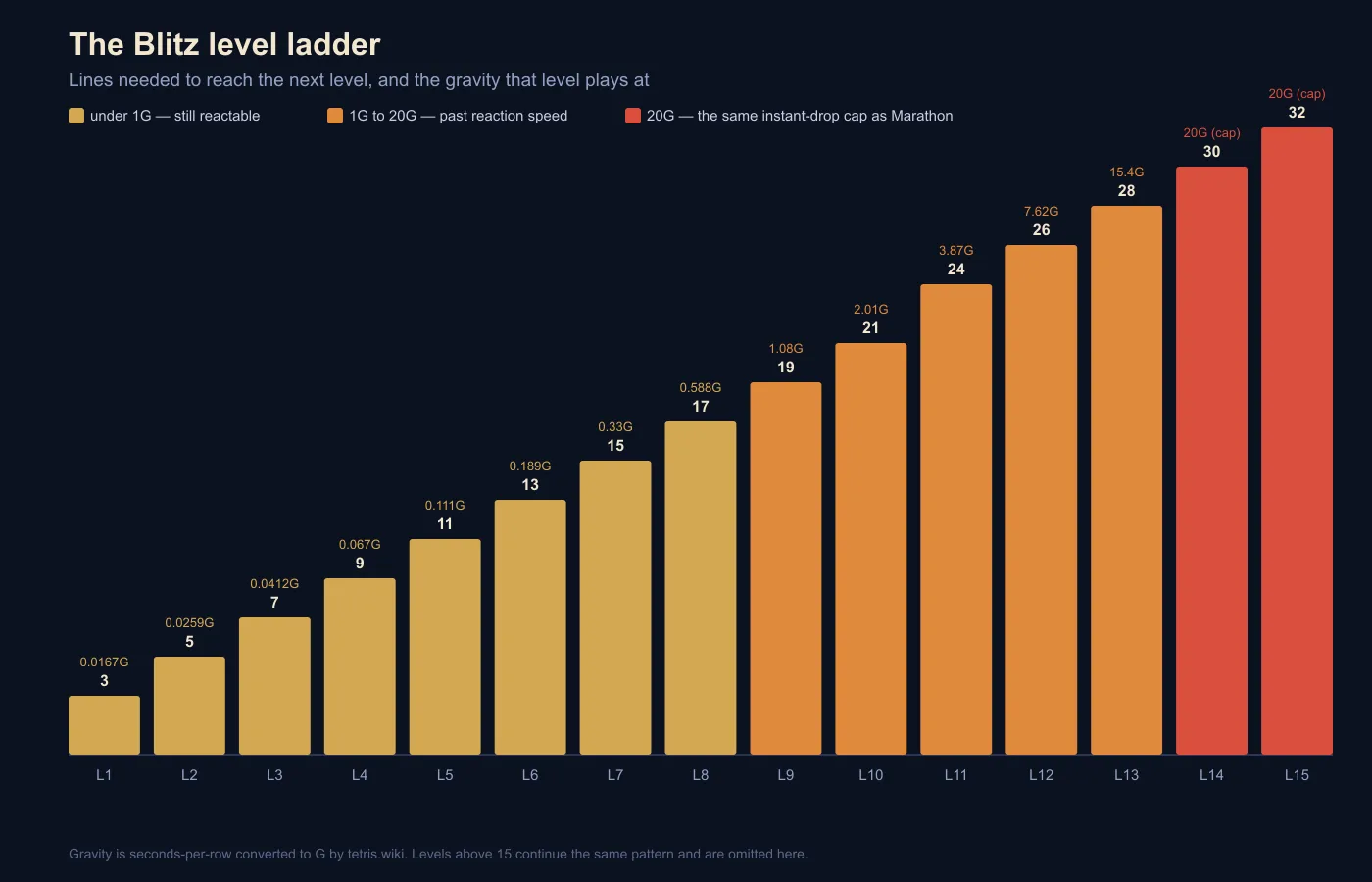
Level 1 asks for 3 lines. Level 2 asks for 5 more. The gap grows by two lines at almost every step, which is what actually produces the acceleration — you are not just facing faster gravity as you level up, you need more lines each time to keep leveling.
| Level | Lines to level up | Total lines cleared | Gravity |
|---|---|---|---|
| 1 | 3 | 3 | 0.0167G |
| 2 | 5 | 8 | 0.0259G |
| 3 | 7 | 15 | 0.0412G |
| 4 | 9 | 24 | 0.0670G |
| 5 | 11 | 35 | 0.111G |
| 6 | 13 | 48 | 0.189G |
| 7 | 15 | 63 | 0.330G |
| 8 | 17 | 80 | 0.588G |
| 9 | 19 | 99 | 1.08G |
| 10 | 21 | 120 | 2.01G |
| 11 | 24 | 144 | 3.87G |
| 12 | 26 | 170 | 7.62G |
| 13 | 28 | 198 | 15.4G |
| 14 | 30 | 228 | 20G (cap) |
| 15 | 32 | 260 | 20G (cap) |
One quirk worth knowing before you plan a run around it: every step before level 11 grows by exactly two lines over the last one (3, 5, 7, 9...). The step into level 12 breaks the pattern and grows by three instead (21 to 24), and every step after that goes back to growing by two. That one irregular jump leaves a permanent one-line offset for the rest of the ladder — level 15 asks for 32 rather than the 31 the earlier pattern would predict. Levels past 15 keep climbing the same way and are left off the table above for space.
Gravity turns the ladder into a cliff
Line up Blitz's own ladder against the standard Marathon speed curve from our gravity and lock delay guide and Blitz is running well ahead of it. Marathon's curve does not cross 1G until the jump from level 13 to level 14. Blitz crosses the same line five levels earlier, between level 8 and level 9. And where Marathon does not reach a gravity value near the 20G ceiling until level 19 (20.23G), Blitz hits that exact 20G cap at level 14 — the same cap our gravity guide defines as the point where a piece appears already resting on the stack the instant it spawns, because there is no fall left to have.
Practically, that means the back half of a good Blitz run is not being played the way the front half was. Levels 1 through 8 are still slow enough to plan a placement while the piece falls. From level 9 on, gravity has crossed the line where a human can watch a piece drop and still choose where it lands, and by level 14 there is no falling to watch at all — only lock delay, and whatever inputs you can land in that window. A run that is going well accelerates itself into exactly this problem, which is the whole reason the level ladder is Blitz's real opponent and not the clock.
The Perfect Clear bonus is flat, not scaled
TETR.IO's own solo scoring table lists a single "All Clear" row worth 3,500 points, multiplied by level like everything else. That is a different shape from the Perfect Clear bonuses our scoring guide documents for other Guideline games, where the bonus scales with how many lines the clearing move took — 800 for a Single, 1,200 for a Double, 1,800 for a Triple, 2,000 for a Tetris, 3,200 for a back-to-back Tetris. Blitz does not appear to make that distinction: one flat number regardless of how many lines the All Clear itself was worth. TETR.IO's documentation does not spell out whether that 3,500 stacks on top of the line-clear score the same way the other games' scaled bonuses do, so treat the flat value as what is confirmed and the stacking behavior as unconfirmed.
Either way, at low levels a Perfect Clear is a clear windfall. At high levels, where a single well-placed T-Spin Double is already worth five figures, chasing a flat 3,500-point bonus can cost more tempo than it returns — a math problem 40 LINES and Sprint runners, who our 40-line sprint guide covers separately, do not have to solve, because time attacks do not care how a line got cleared.
The spin rule the 2025 rework skipped
Our all-spin guide covers TETR.IO's 2024 to 2025 spin-detection rework in full: All-Mini arrived in Beta 1.1.0 (2 August 2024), All-Mini+ and All+ in Beta 1.5.0 (18 January 2025), and — as of Beta 1.7.6 on 18 December 2025 — All-Mini+ became the rule in solo 40 LINES too, the same patch that shipped a Naga Eyes achievement for clearing 40 lines using only Spin-Singles.
Blitz is not named in that patch note, or in any of the others that introduced or extended the all-spin rules. Checked against TETR.IO's full published changelog through the newest entry as of this writing, nothing updates Blitz's spin detection. tetris.wiki's read matches: Blitz still does not award All-Spins, so only the original three-corner-rule T-Spin detection — full T-Spins and Mini T-Spins, nothing else — counts for extra scoring there. If you learned S, Z, L, J or I spins from our all-spin guide or built sprint routes around 40 LINES' Naga Eyes update, none of that scoring transfers into a Blitz run. A non-T piece wedged into an unmovable slot in Blitz clears normally and scores nothing extra, exactly like it would have before any of TETR.IO's spin-rule history happened at all.
Blitz vs Ultra vs Zenith vs 40 Lines vs Sprint
Five names that all sound like the same "how good are you" test, measuring different things:
| Mode | Where | What it measures | Clock | Ranked by |
|---|---|---|---|---|
| Blitz | TETR.IO | Score, on a ladder whose own gravity accelerates as you play | 2 minutes | Points |
| Ultra | Tetris Effect: Connected | Score, at a fixed gravity | 3 minutes | Points |
| 40 LINES | TETR.IO | Clearing a fixed line count | None | Time |
| Sprint | Most Guideline games | Same idea as 40 LINES, covered game by game in our sprint guide | None | Time |
| Zenith (Quick Play) | TETR.IO | How far you climb a shared tower before you top out | None | Climb Speed |
The mode that looks most like Blitz on paper — Ultra — is actually the one that shares the least mechanically with it. Ultra's gravity does not move. Blitz's entire identity is that it does.
The changes that name Blitz directly
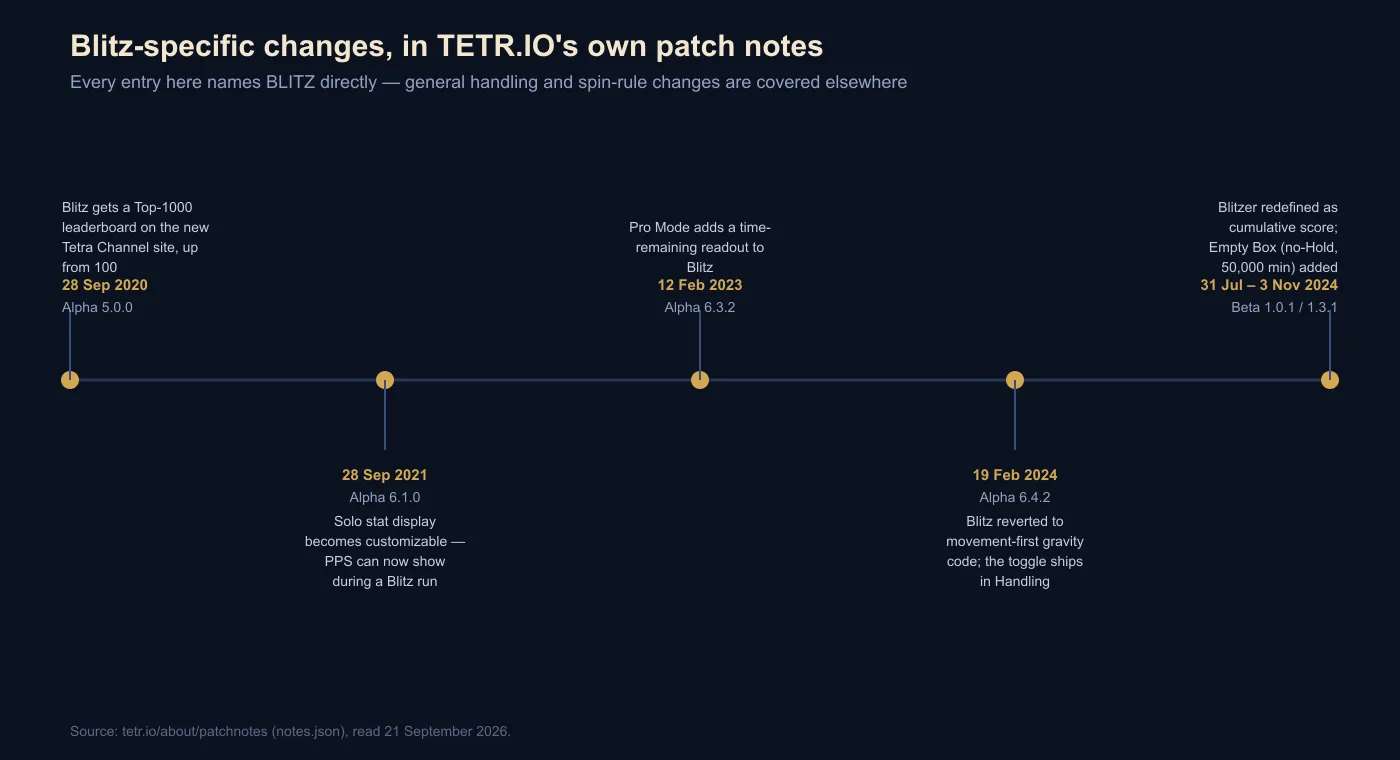
TETR.IO's published patch notes go back to February 2020, and Blitz has existed since that earliest record — an INFDEV-era bugfix from 9 February 2020 already references the Blitz timer jittering. Most of the mode's history rides on general handling and spin-rule changes covered elsewhere on this site. A short list of entries name BLITZ specifically:
| Date | Version | Change |
|---|---|---|
| 28 Sep 2020 | Alpha 5.0.0 | Blitz gets a Top-1000 leaderboard on the new Tetra Channel site, up from the previous top 100 |
| 28 Sep 2021 | Alpha 6.1.0 | Solo stat display becomes customizable; PPS can now be shown during a Blitz run |
| 12 Feb 2023 | Alpha 6.3.2 | Pro Mode adds a time-remaining readout to Blitz |
| 19 Feb 2024 | Alpha 6.4.2 | Blitz is reverted to movement-first gravity code; a toggle for it ships under Handling |
| 31 Jul 2024 | Beta 1.0.1 | The Blitzer achievement is redefined as total score across completed Blitz games |
| 3 Nov 2024 | Beta 1.3.1 | Empty Box achievement added: highest Blitz score without using Hold, minimum 50,000 |
Three achievements built around it
Beyond Blitzer's cumulative tracking, two single-run achievements are built specifically around denying yourself a Blitz tool: Empty Box asks for your highest Blitz score without ever using Hold, minimum 50,000, added in the same November 2024 patch as a batch of other altitude and garbage-mod achievements. Wabi-Sabi, documented on the Wiki for TETR.IO's achievement guide, asks for your highest Blitz score without landing a single All Clear — which, given the flat 3,500-point All Clear bonus covered above, is a real constraint at low levels and largely irrelevant at high ones, where an All Clear setup rarely has time to pay for itself anyway.
How to actually play it
Play the ladder, not the clock. Two minutes sounds like the constraint, but the level you are on decides both your score multiplier and your gravity. A run that stalls at level 6 for lack of pace never gets access to the point values that make Blitz worth playing.
Decide your breakpoint before gravity decides it for you. Somewhere around level 9, gravity crosses 1G and pieces stop giving you a full second of visible fall. Know roughly which level that happens for your own reaction speed, and treat everything past it as a lock-delay game rather than a falling-piece game — the same reframe our gravity and lock delay guide recommends for any 20G-adjacent mode.
Turn on the Blitz timer in Pro Mode. Since Alpha 6.3.2, Pro Mode shows time remaining directly on the Blitz board, which matters more here than in 40 LINES because your pace target changes as gravity ramps, not just as you tire.
Do not hunt All Clears past the levels where they pay. A flat 3,500 is real money at level 2 and a rounding error at level 12, once a single T-Spin Double is worth five figures.
Remember the spin rule does not travel with you. Setups built around 40 LINES' Naga Eyes update or the all-spin mod in Quick Play score nothing extra here. Blitz still only pays out on three-corner T-Spins.
Stride Mode is available and worth turning on for serious attempts. It speeds up the countdown, lets you tap rather than hold to retry, and keeps your first piece from being an S, Z or O outside custom games — one less variable in a mode that already has plenty of them.
Quick Action Checklist
- Know that every scored point except hard/soft drop is multiplied by your current level — leveling up is the scoring engine, not a side effect.
- Expect gravity to cross 1G around level 9 and cap at 20G by level 14; plan your play style to change there, not stay the same.
- Do not expect an All-Spin, All-Mini or All-Mini+ bonus in Blitz — only the classic three-corner T-Spin rule applies, full and Mini.
- Treat the flat 3,500-point All Clear as a low-level tool, not a late-run strategy.
- Turn on Pro Mode for the Blitz-specific time-remaining readout, and Stride Mode to cut dead time between attempts.
- If you are chasing Empty Box or Wabi-Sabi, decide which constraint you are playing under before the run starts — both cost you tools the scoring table assumes you have.
Frequently Asked Questions
How does scoring work in TETR.IO Blitz?
How does leveling up work in TETR.IO Blitz?
What gravity does TETR.IO Blitz reach at high levels?
Do All-Spin or All-Mini bonuses work in TETR.IO Blitz?
How is TETR.IO Blitz different from Ultra in Tetris Effect?
What achievements are built around TETR.IO Blitz?
Keep Reading
- TETR.IO — official patch notes (Alpha 5.0.0, 6.1.0, 6.3.2, 6.4.2; Beta 1.0.1, 1.3.1, 1.1.0, 1.5.0, 1.5.1, 1.7.6), read 21 September 2026
- tetris.wiki — TETR.IO: the BLITZ scoring table, the 15-level gravity ladder, and the spin-detection note
- Wiki for TETR.IO — BLITZ: mode overview, Pro Mode and scoring strategy
- Wiki for TETR.IO — Guide:Achievements: Wabi-Sabi and Empty Box
Related Guides
TETR.IO Handling Settings Explained: DAS, ARR, SDF, DCD
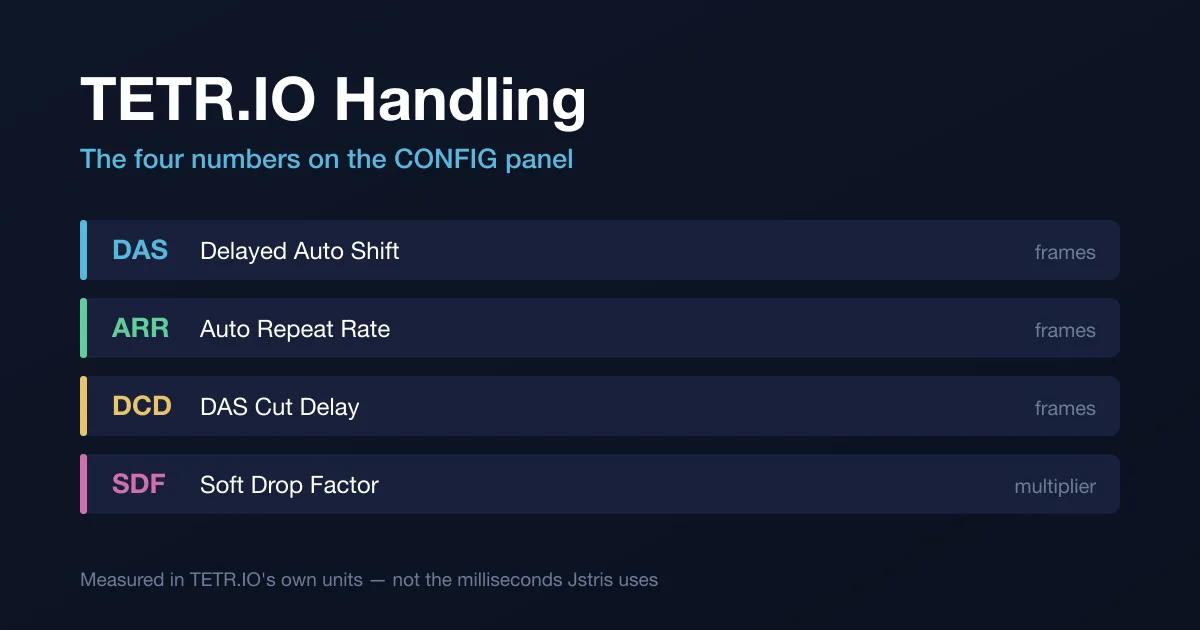
TETR.IO gives you four handling numbers and explains none of them in the panel. One of them had its ceiling raised out from under a warning, and one is described differently by the two sources that document it. Here is the whole panel, with the version and date each behaviour arrived.
NES Tetris Level Transition and Scoring Explained
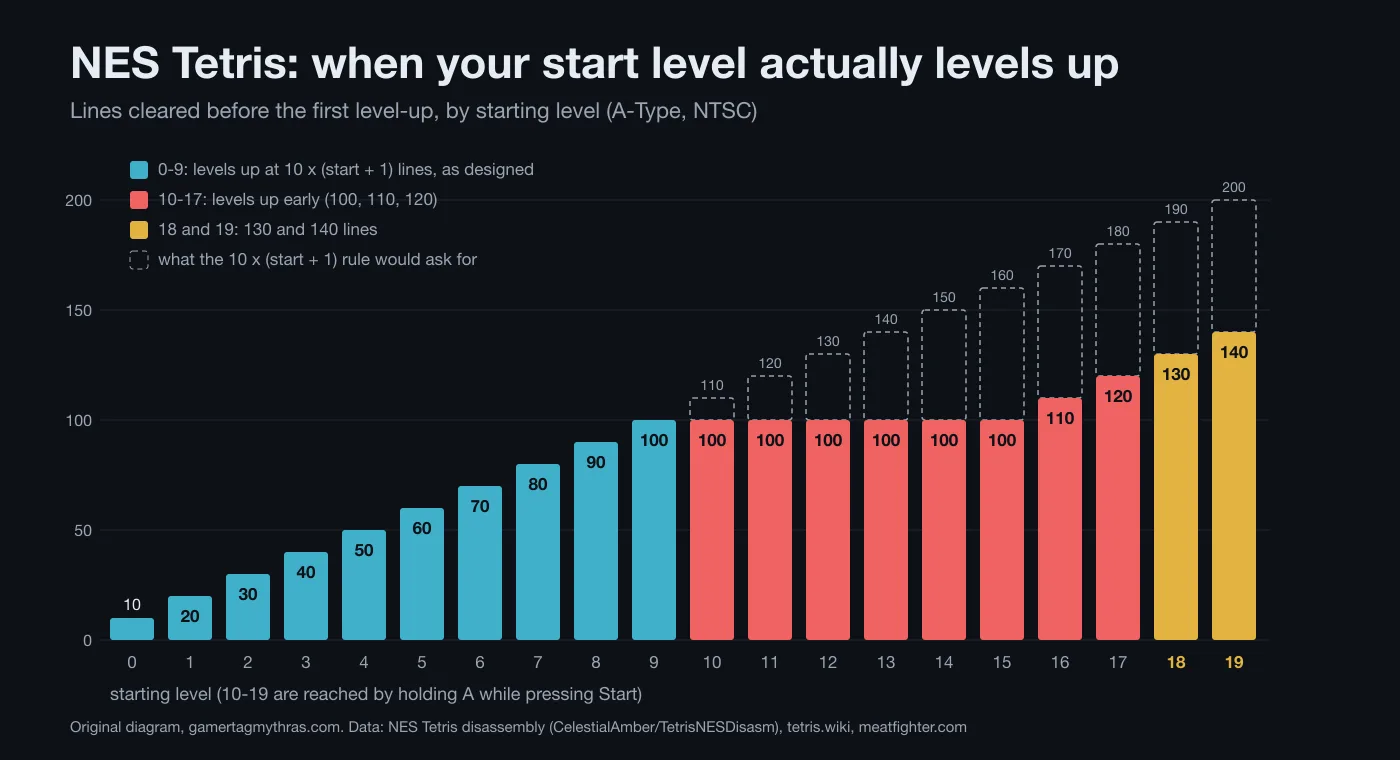
Start NES Tetris on 18 and you stay there for 130 lines. Start on 19 and it is 140. Start on 12 and it is 100. One missing conversion in the cartridge explains all three, and it also decides which clear gets paid at the higher rate.
Tetris Downstacking: How to Dig Out of Garbage
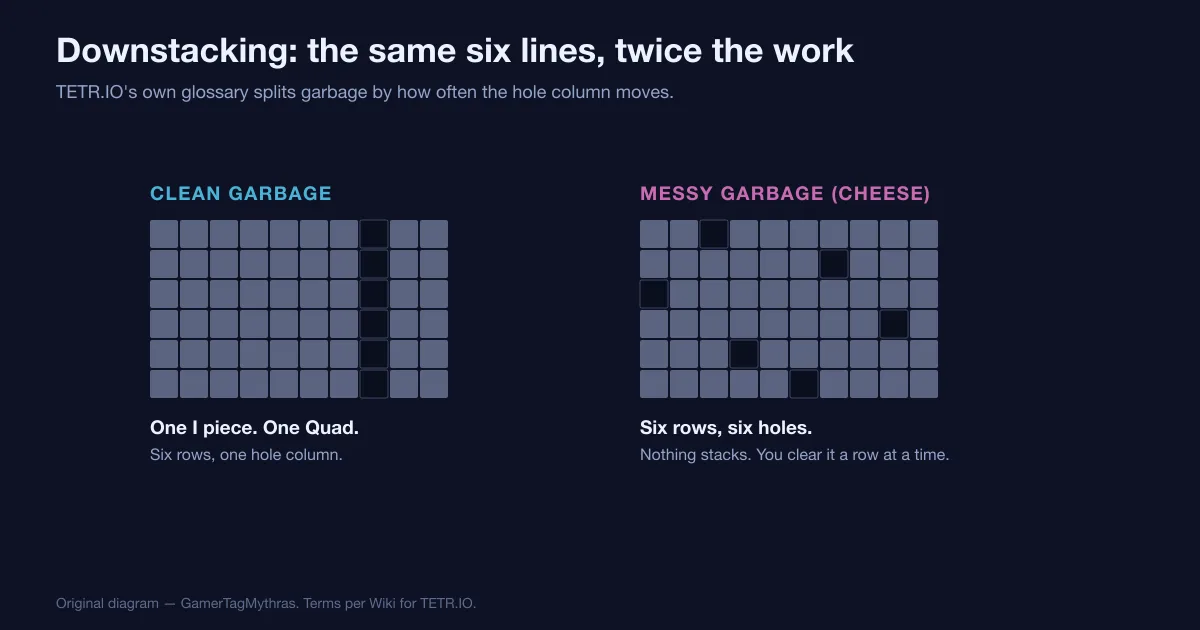
Garbage is not one obstacle, it is two. Where the hole column sits from row to row decides whether six lines cost you one piece or six, and TETR.IO scores the lines you dig out at exactly the same rate as the lines you send.
TETR.IO Ranks Explained: TR, Percentiles and Cutoffs
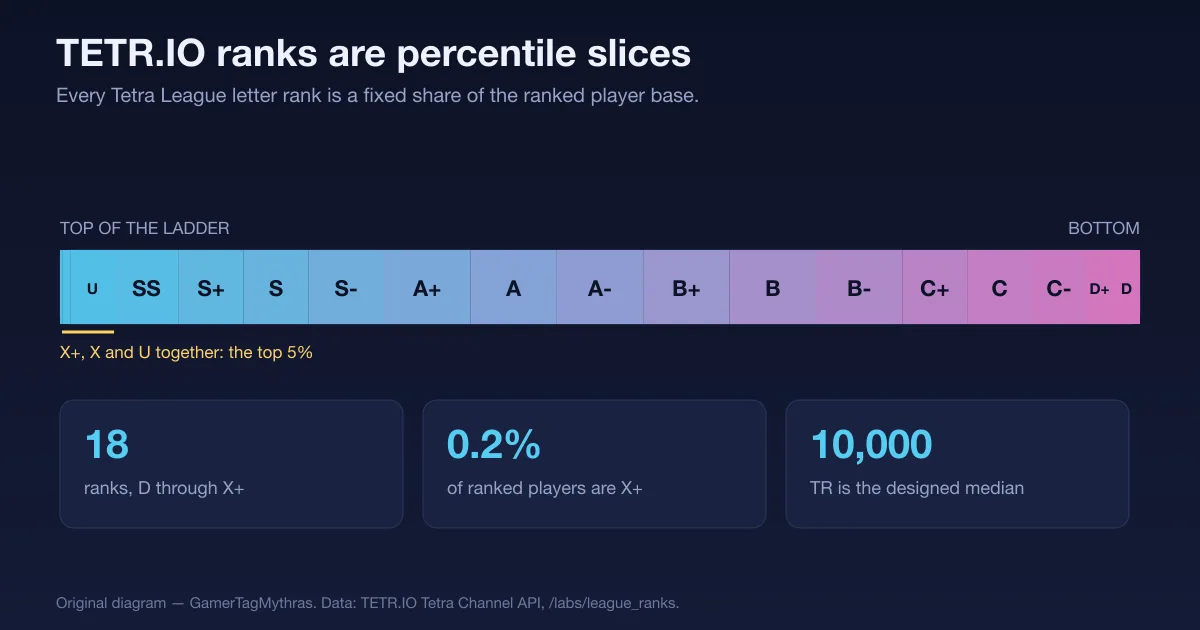
A Tetra League letter is not a skill score, it is a slice of the leaderboard — and TETR.IO publishes exactly how big each slice is, what TR it currently costs, and how fast the people inside it play.
Tetris Stacking Fundamentals: Build a Board That Wins
Most players do not lose to speed. They lose to a board they built themselves three minutes earlier. Here is how stacking actually works in modern Guideline Tetris, and the habits that stop you from burying your own well.
Tetris All-Spin Explained: S, Z, L, J and I Spins
A Z piece rotated into a slot nothing else reaches is either a scored spin or an ordinary Double, and which one it is has nothing to do with you. It is a setting, and most Tetris games have it switched off.