Best Yellow Cards in Cookie Run: Braverse, Ranked
Yellow is the control color: trade efficiently, recur your threats out of the break area, and grind the game into the dirt until you're the only one with a board. Here are the real Yellow cards worth building around, ranked top to bottom.
Yellow wins the game nobody else wants to play. While Red is counting down its clock and Blue is praying it draws the payoff, Yellow in Cookie Run: Braverse is happy to let the game go long - because the longer it goes, the more lopsided it gets. Trade your threats one-for-one, recur them right back out of the break area, and tax the opponent until they simply run out of things to do. It's the color you beat by closing fast, and the color that crushes anyone who can't.
This is a ranked tour of the real Yellow cards worth building around, pulled from the official card database, plus the framework for evaluating any Yellow card that drops next set. Stats below - cost, HP, and effect text - are quoted from the official listings; the {Y} symbol is a single Yellow resource and {N} is any color, so a cost like "one Yellow, two any" is what a card actually demands. One term you need: the break area is the zone Cookies go to when they faint and where Yellow's whole recursion engine lives, and its Level (the combined Cookie Levels sitting there) is a threshold many Yellow cards scale off. If you're brand new, read the five colors explained and deck archetypes first.
What makes a Yellow card good
Color identity is the lens, and Yellow's identity is control, removal, and recursion out of the break area. Braverse rewards efficient trades, and Yellow trades better than anyone because its Cookies don't stay dead - they come back from the break area, often bigger. A Yellow card is good when it either removes an opposing threat at a profit or recurs one of yours to keep the value train rolling. Concretely, the best Yellow cards tend to do one of these:
- Remove efficiently. Targeted damage, "place that Cookie in the break area," and bounce that answer a threat for less than it cost the opponent to play it. Yellow has the best removal suite in the game.
- Recur from the break area. Effects that replay a Cookie out of your break area turn every trade into a two-for-one over time. This is the engine that wins long games.
- Scale off the break area's Level. Many Yellow cards check whether your break area is large enough and reward you with extra damage or effects - the late game is where they come online.
- Tax and lock. Effects that raise the opponent's attack costs or shut off their healing buy the turns Yellow needs and grind their plan to a halt.
The control test: a Yellow card earns its slot if it trades up, comes back, or shuts the opponent down. Vanilla beatdown that doesn't interact with the break area belongs in Red.
A card that's "fine" tempo in a Red shell can be a trap in Yellow, because Yellow isn't racing - it's grinding. Attrition and inevitability are the currency, not speed.
How to read this list
We're grouping by role, not by raw power, because role is what survives a meta shift - but within each role the picks are ranked, real cards with their actual numbers. The buckets are: removal/disruption, recursion engines, late-game payoffs, and the Cookies a Yellow deck actually wants on the board. Costs and effects are quoted from the official database; the named cards span several sets (BRAVE BEGINNING through Paradise of Passion & Sloth), so a few will rotate in relevance as new sets land. Treat the ranking as a snapshot of the current pool, not a "run exactly these" decklist.
The removal and disruption
This is the slot that makes Yellow, Yellow. The whole color is built on answering threats more efficiently than the opponent can deploy them. Ranked top to bottom:
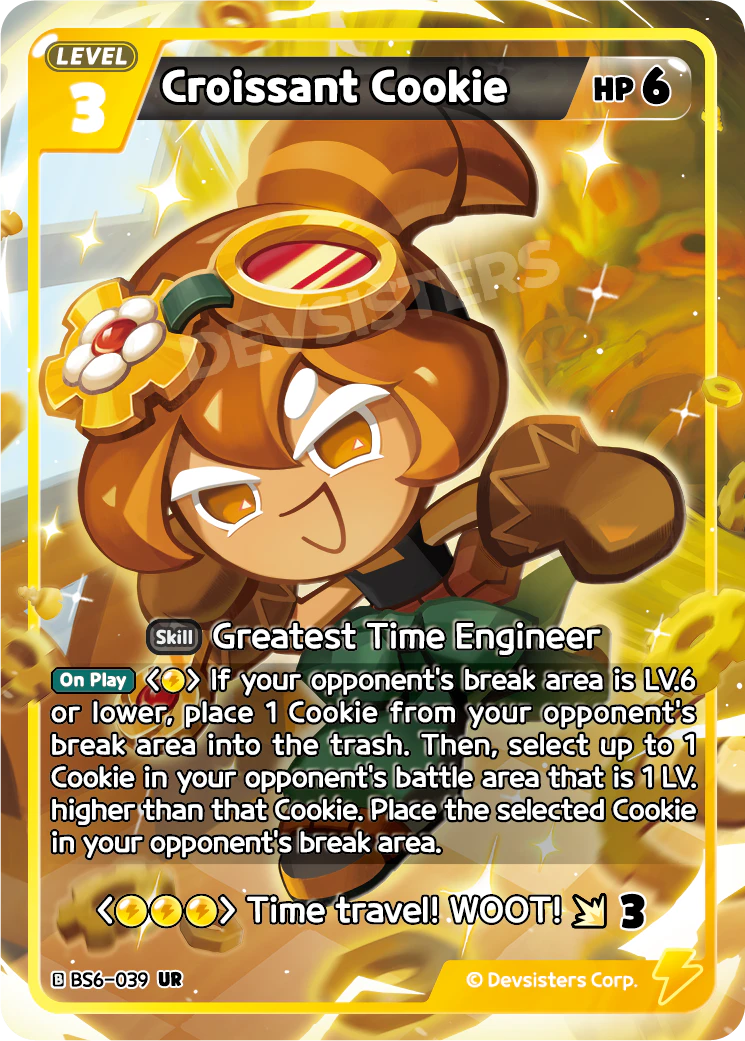
- Croissant Cookie (BS6-039, Ultra Rare, LV.3, 6 HP). The premier Yellow control body. Its On Play, for one Yellow, mills a Cookie out of the opponent's break area (if theirs is LV.6 or lower) and then bounces a one-Level-higher Cookie from their battle area - a disruption-and-removal two-for-one on a six-HP frame, with a clean three-cost attack for 3 on top. It attacks their board and their recursion at once.
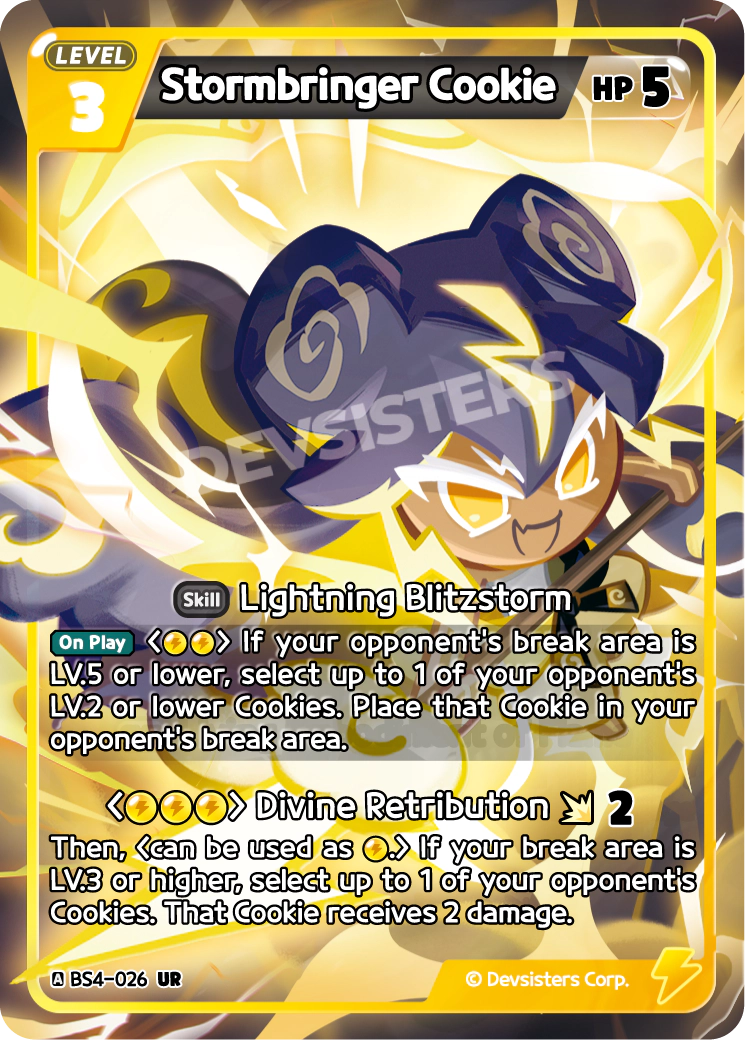
- Stormbringer Cookie (BS4-026, Ultra Rare, LV.3, 5 HP). The break-area scaling answer. Its skill, for two Yellow, sends an opponent's LV.2-or-lower Cookie straight to their break area, and its attack deals 2 then - if your break area is LV.3 or higher - lets you deal 2 more to a Cookie. Hard removal that gets better the longer the game goes.
- Timekeeper Cookie (BS6-031, Ultra Rare, LV.3, 5 HP). The repeatable ping. On Play it deals 1 to a Cookie, and its attack deals 3, then - if your break area is LV.4 or higher - 2 more to a Cookie. A removal body that doubles as a finisher once the break area fills up.
What you're looking for in this slot, set after set, is the most removal-per-resource you can find, ideally with a body attached, and Croissant is the current benchmark. The discipline is that removal without a win condition just postpones the loss, so the answers have to be paired with a way to actually close.
A Yellow deck wants to be making efficient, profitable trades on most turns of the game. If you're trading down or chump-blocking with no follow-up, you're playing the color backwards.
The recursion engines
Removal is half of it; the other half is making sure your threats outnumber theirs over time, which means bringing Cookies back from the break area. Ranked:
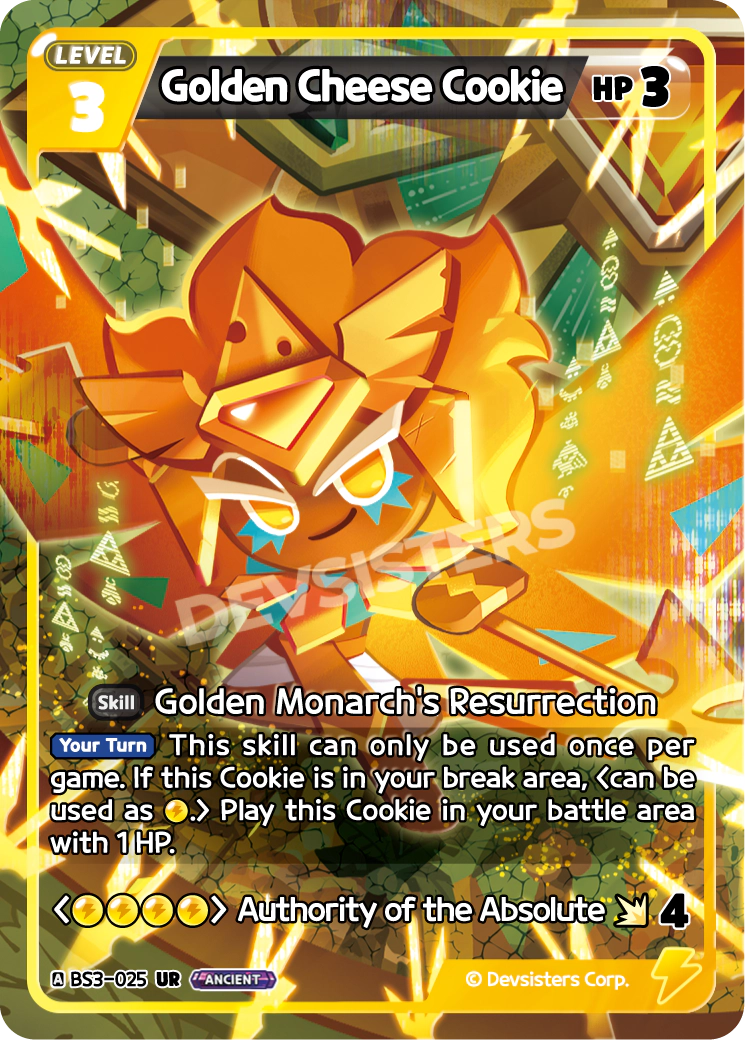
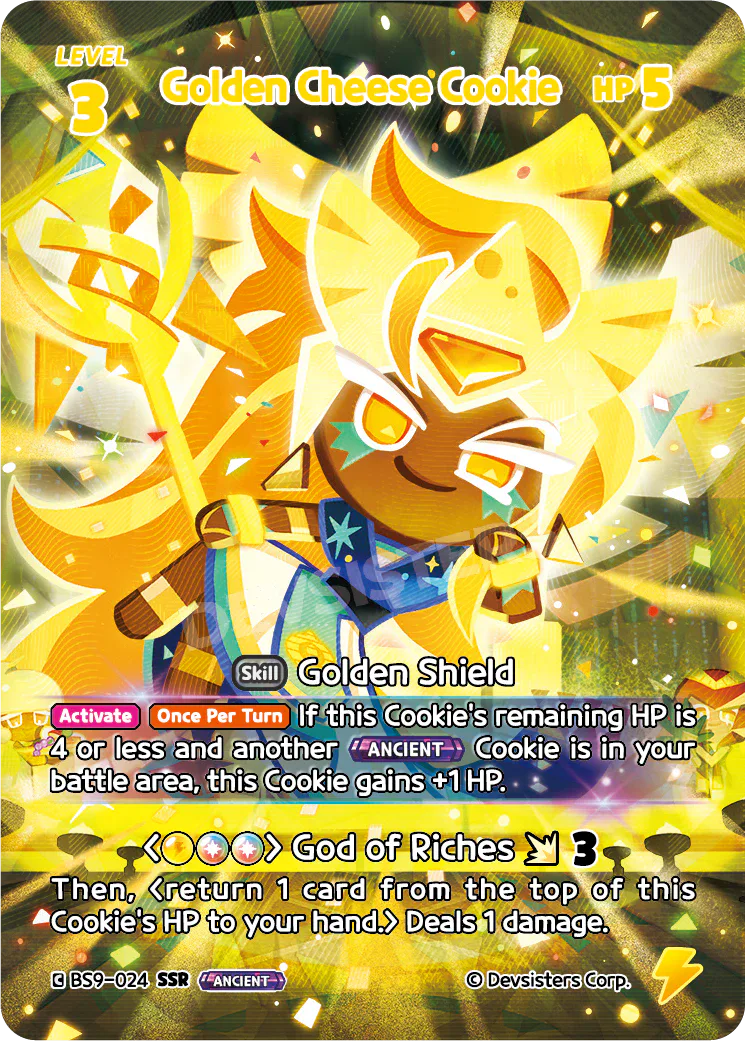
- Golden Cheese Cookie (BS3-025, Ultra Rare, LV.3, 3 HP). The marquee Yellow recursion card. Its Golden Monarch's Resurrection skill - usable once per game - reads: "If this Cookie is in your break area, can be used as {Y}, play this Cookie in your battle area with 1 HP," and it swings for 4. A four-Level Ancient that comes back from the dead for effectively one resource is the kind of inevitability that breaks attrition mirrors. The Ancient package (the Burnt Cheese and Smoked Cheese Cookies that loop it back) is built entirely around making this body un-killable.
- Millennial Tree Cookie (BS4-038, Ultra Rare, LV.3, 5 HP). The repeatable engine. Its skill, for one Yellow, replays a LV.2-or-lower {Y} Cookie straight out of your break area, and its attack deals 3 and pings a Cookie when another {Y} Cookie is alongside. Every faint becomes a redeploy - that's the value loop that buries control mirrors.
- Snake Fruit Cookie (BS1-036, Super Rare, LV.3, 4 HP). The budget recursion body - pay two Yellow to replay a LV.1 {Y} Cookie from your break area, with a clean three-cost attack for 3. Not flashy, but exactly the kind of repeatable two-for-one that makes the engine consistent.
The best recursion scales with the work you've already done - your break area fills naturally as you trade, so these get better as the game grinds on. The risk is real: lean too hard on recursion with no removal and you'll just keep replaying Cookies into a wall, so the engine has to be paired with the answers above.
If you can't point to the card that makes your threats outlast theirs, you don't have a control deck - you have a midrange deck that runs out of gas. Build the recursion alongside the removal, not instead of it.
The late-game payoffs
This is the slot that converts a grind into a win and the one new Yellow players most often skip. "Late-game payoff" means the card that, once your break area is fat and the opponent is out of resources, actually ends things. Ranked:
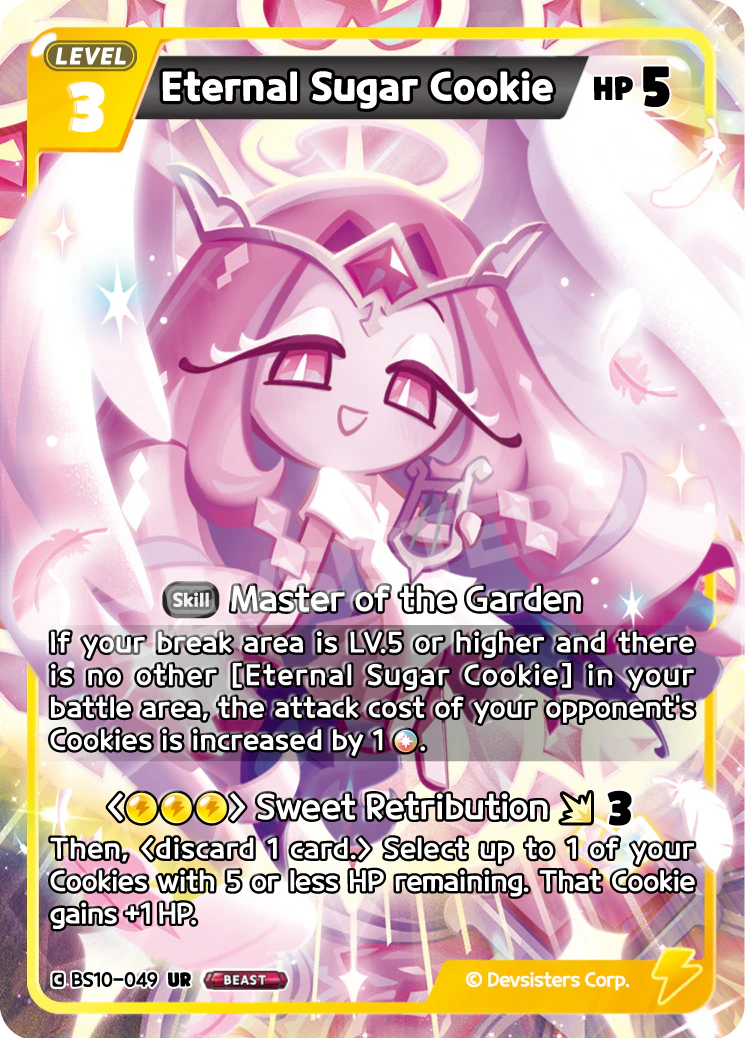
- Eternal Sugar Cookie (BS10-049, Ultra Rare, LV.3, 5 HP). The control lock. While your break area is LV.5 or higher and no other copy is out, "the attack cost of your opponent's Cookies is increased by 1 {N}" - a tax that strangles a slower opponent's whole turn - and its attack deals 3 and heals one of your Cookies +1 HP. It's the card that turns a grind you're winning into a grind they literally can't act in.
- Latte Cookie (BS1-028, Super Rare, LV.3, 5 HP). The board-wide closer: a buff skill plus an attack that deals 2 and then, if your break area is LV.5 or higher, deals 1 to all of the opponent's Cookies. A clean late-game sweep-and-swing on a sturdy body.
- Golden Cheese Cookie (BS11-034, Super Rare, LV.3, 5 HP). The newest finisher - its attack deals 3 and then 1 more for each LV.2-or-higher Ancient Cookie in your break area. In a dedicated Ancient build, a break area full of Cheeses turns one swing into a haymaker.
The best payoffs reward the break area you've filled by playing the long game - the recurring "if your break area is LV.5 or higher" clauses mean they come online exactly when control wants to close. The risk: hold them too long and you can deck yourself or get raced, so close once the lock is set.
The Cookies Yellow actually wants
Yellow is an effect-first color, but it still has to put bodies down that remove, recur, or carry the lock. Here's what to look for, with the real cards that fill each lane:
| Card role | Real example | Why it matters |
|---|---|---|
| Efficient removal bodies | Croissant Cookie (BS6-039, UR) | Answers a threat and their recursion in one play |
| Break-area scaling threats | Stormbringer Cookie (BS4-026, UR) | Removal that gets better as the game grinds on |
| Recursion anchors | Millennial Tree Cookie (BS4-038, UR) | Turns every faint into a redeploy |
| Tax / lock pieces | Eternal Sugar Cookie (BS10-049, UR) | Strangles a slower opponent's whole turn |
The single best Yellow Cookie for winning the long game is Golden Cheese Cookie (BS3-025) - a recurring four-Level Ancient that the entire Cheese package exists to loop. Mozzarella Cookie (BS3-028, Ultra Rare, LV.3, 4 HP) is the disruptive glue: for one Yellow and a discard, it places a LV.1 Cookie from the opponent's trash back into their break area while their break area is LV.6 or lower - a clever tempo-and-recursion hate piece - and its attack heals itself. And the confirmed Yellow Dragon Cookie, Ananas Dragon Cookie (BS5-040, Ultra Rare, LV.3, 5 HP), is your self-sustaining removal body: trash a card off its own HP to ping a Cookie for 1, with an attack for 3 that heals it back up when it's low. The discipline across all of these is the same: a Cookie earns its slot in Yellow if it removes, recurs, or locks.
Cards that look good but underperform
A few archetypes of card consistently fool new Yellow players:
- Vanilla beaters with no break-area text. A LV.3 body that just attacks for 3 is a worse Red card. Yellow's threats should remove, recur, or scale off the break area (Croissant, Stormbringer, Golden Cheese), not just be large.
- Recursion with no removal. Stacking Millennial Tree and Snake Fruit feels powerful, but if you have nothing to trade with, you're just replaying Cookies into a board you can't beat. Recursion multiplies a removal advantage; it doesn't create one.
- Hyper-greedy late-game cards in a fast meta. Eternal Sugar's lock is backbreaking against control, but if the room is full of Red aggro, a payoff that needs a LV.5 break area to fire can be too slow. Tune your payoff density to what you expect to face.
Deckbuilding tip: when in doubt, cut the third payoff for another efficient removal piece. The most common reason a Yellow deck loses is that it got run over before the grind kicked in - early answers fix that, a fourth finisher doesn't.
How many of each to run
A clean Yellow control shell, role by role, looks roughly like this. Treat it as a starting skeleton you tune, not gospel - and remember a legal deck is exactly 60 cards with up to four copies of any card number, at least one Cookie, and up to 16 FLIP cards.
| Role | Rough share of the deck | Anchor cards |
|---|---|---|
| Removal / disruption | A large core block | Croissant, Stormbringer, Timekeeper |
| Recursion engines | A solid secondary block | Golden Cheese, Millennial Tree |
| Late-game payoffs | A small, deliberate set | Eternal Sugar, Latte |
| Tax / lock pieces | A focused package | Eternal Sugar, Mozzarella |
| FLIP cards | Up to the 16-card cap | Yellow FLIP draws that stabilize the early game |
The 60-card, four-copy, and 16-FLIP figures are the standard deck-construction limits; confirm them against the official rulebook before a sanctioned event. For the full rules on ratios and curve, see deck-building basics, and for a cheaper way into the color, our budget deck guide.
Quick Action Checklist
- Lead with removal. Yellow's edge is efficient trades - Croissant, Stormbringer, Timekeeper - so load the front of your deck with answers, not finishers.
- Build the recursion engine. Golden Cheese and Millennial Tree turn every faint into a redeploy; that loop is how you win the grind.
- Mind the break-area Level. A huge share of Yellow scales off "if your break area is LV.5 or higher" - sequence your trades so the payoffs come online when you need them.
- Run a lock, not just damage. Eternal Sugar's attack-cost tax can end the game on its own against a slower deck; one or two lock pieces beat a fourth generic threat.
- Don't go too greedy vs aggro. If the room is fast, trim the slowest payoffs for early answers - a LV.5 break-area payoff is dead if you're already losing.
- Recur, don't hoard. Replaying a Cookie from the break area is usually better than holding a fresh one; let the engine churn.
- Mulligan all-payoff hands. A Yellow opener with no early interaction is a mulligan - you have to survive to the late game to win it.
Frequently Asked Questions
What are the best Yellow cards in Cookie Run: Braverse?
What makes a card good for a Braverse control deck?
What is the break area and why does Yellow care about it?
How many removal pieces should a Yellow deck run?
Are Dragon Cookies good in Yellow control?
Why does my Yellow deck lose to fast aggro decks?
Keep Reading
Related Guides
Best Cookie Run: Braverse Cards for Beginners
You don't need chase rares to play real Braverse. These are the cheap, easy-to-use cards across all five colors that punch above their cost - the staples a new player should actually prioritize.
Best Trap Cards in Cookie Run: Braverse, Ranked
Braverse has 120 different Trap cards and 115 of them are Uncommons. There is not a single Ultra Rare Trap in the game. That means the entire interaction layer - the cards that decide close games - is fully available to anyone who owns a starter deck and a fistful of bulk.
Best Draw and Search Cards in Cookie Run: Braverse
Search the official Braverse database for skills that draw two or more cards and you get 61 hits. Sixty of them charge you something - a discard, a mill, a hand-size cap, a body that has to die first. Exactly one doesn't, and it's a Common. Here's the full draw and search pool, color by color.

Best FLIP Cards in Cookie Run: Braverse, Ranked
FLIP is the signature Braverse mechanic where your own hit points punch back, and here is the strange part: the best FLIP cards are all cheap. Not one is above Rare. These are the standout FLIP Cookies ranked by color and role, with the exact flip text off the official database.

How to Play Cookie Run: Braverse - A Complete Beginner Guide
Cookie Run: Braverse is the rare TCG you can teach in a single match. This guide covers everything a first-time player needs: card types, setup, turn structure, how you pay for cards, the FLIP mechanic, and how to win.
Cookie Run: Braverse Meta Tier List — Best Decks & Archetypes Ranked
Which Cookie Run: Braverse decks are actually carrying right now? Here's a meta tier list of the strongest archetypes - the real cards that anchor each one, why they rank where they do, and what's overrated.