Disney Lorcana Items Explained: All 205, and Why Nothing Can Attack Them
The item card type gets four numbered rules in a 55-page rulebook, and not one of them explains how to get rid of one. Here is the whole type, counted from the live card pool - 205 items, the cheapest average cost in the game, and the 32 cards that can actually remove one.
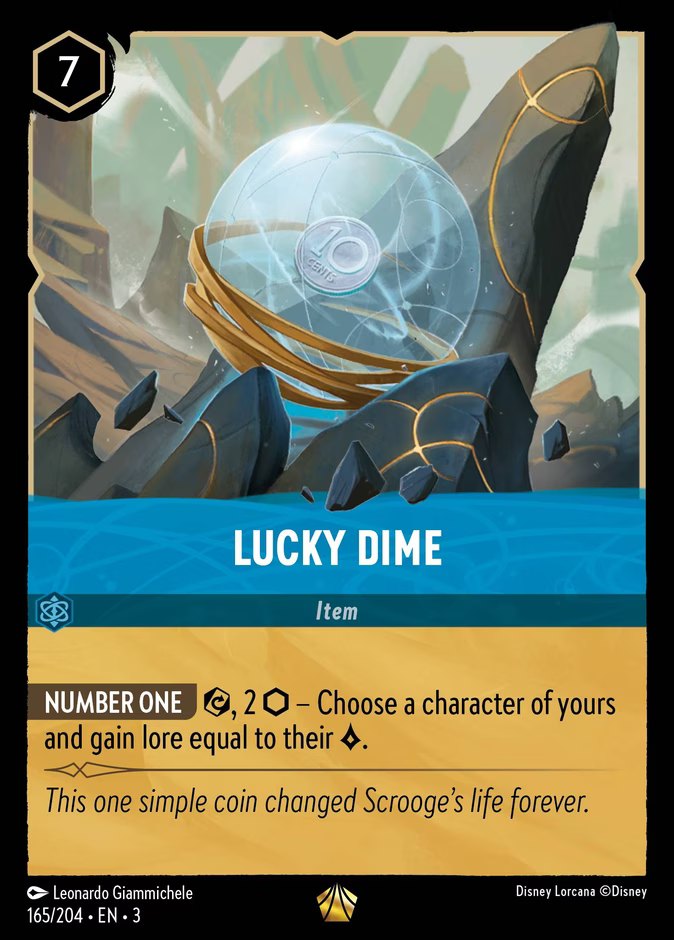
Lucky Dime costs 7 ink, cannot go in your inkwell, and does nothing the turn it arrives except sit on the table looking expensive.
Your opponent cannot challenge it. No damage can be placed on it. It has no Willpower to whittle down and no Strength to trade with. Unless they drew one of 32 specific cards out of a 2,476-card pool, the dime stays there for the rest of the game, converting 2 ink into lore every single turn.
That is the item card type in one card, and it is the type Lorcana explains the least. Songs get an alternate-cost rule with three subsections. Locations get a whole printed stat line. Items get four sentences.
Everything below comes from two sources and nothing else: Comprehensive Rules 2.2.0, effective 9 July 2026, and one pass over the Lorcast bulk card export pulled on 14 August 2026. Cards are deduped by full name - name plus version, apostrophes and capitalisation folded - which gives 2,476 unique cards from 3,192 printings, of which 205 are items across 227 printings.
Four rules, and not one statistic
Section 5.5 of the Comprehensive Rules is the entire law on items. It has four numbered rules and no sub-clauses:
- 5.5.1 - An item is an item only while in the Play zone. Anywhere else it is an item card.
- 5.5.2 - Items are generally played during your Main Phase.
- 5.5.3 - An item is anything with "Item" on the classification line, and items can have additional classifications.
- 5.5.4 - If an item has an ability, that ability can be used the turn the item is played.
For scale: characters get twelve numbered rules in section 5.3, actions get ten in 5.4, locations get ten in 5.6. Items get four, and one of them is a definition.
Rule 5.5.3 is nearly decorative in practice. Items can carry extra classifications, and after three years of printing exactly two of them do: Magical Hunny Staff and Big Book of Hunny, both Hunny, both from Attack of the Vine!. Every other item in the game has a classification line reading "Item" and nothing else.
What is missing matters more than what is there. Checked across all 227 item printings, not one has a Strength value, a Willpower value, a Lore value, or a move cost. Locations at least have Willpower and a lore number printed on them. An item is a permanent with no numbers on it below the ink cost.
Nothing in the game can attack an item
The consequence is easy to miss, because it falls out of two rules that never mention items at all.
Rule 4.6.1 defines a challenge: only characters can challenge, and what gets challenged is "the opposing character or location." Items are not on that list. There is no legal way to declare a challenge against one.
Rule 1.9.1 and 1.9.2 define damage: damage counters go on a character or location, and damage is dealt to, put on, removed from, or moved between characters and locations. Items are not on that list either.
So the game's main interaction system - point a body at a thing and kill it - simply does not reach this card type. A location that stops earning its keep can at least be challenged and worn down, because it has a Willpower number and damage sticks to it. An item that stops earning its keep is still sitting there on turn 20, and the only thing that removes it is a card printed specifically to remove items.
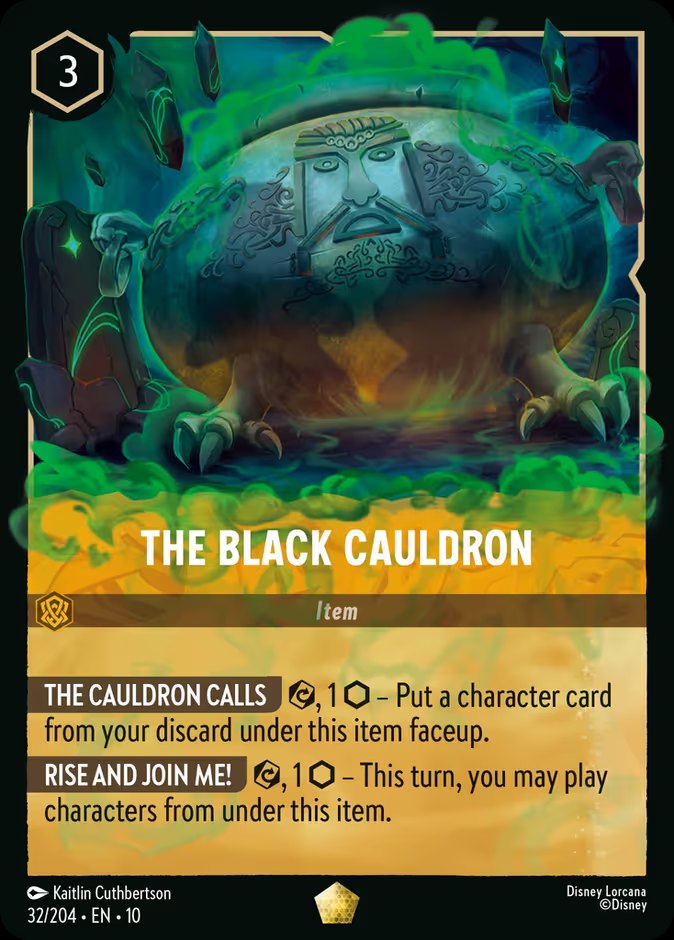
The Black Cauldron is the cleanest illustration. It costs 3, it is uninkable, and it does two things: exert plus 1 ink to stash a character card from your discard underneath it, and exert plus 1 ink to let you play characters from under it this turn. It is a graveyard engine that builds a second hand over several turns, and there is no attack that interrupts the process. It and Lucky Dime are the only two Legendary items in the game.
The census: 205 items across 13 sets
Counting by the set a card first appeared in:
| Set | Released | New items |
|---|---|---|
| 1 The First Chapter | Aug 2023 | 20 |
| 2 Rise of the Floodborn | Nov 2023 | 18 |
| 3 Into the Inklands | Feb 2024 | 18 |
| 4 Ursula's Return | May 2024 | 17 |
| 5 Shimmering Skies | Aug 2024 | 19 |
| 6 Azurite Sea | Nov 2024 | 18 |
| 7 Archazia's Island | Mar 2025 | 14 |
| 8 Reign of Jafar | May 2025 | 10 |
| 9 Fabled | Aug 2025 | 2 |
| 10 Whispers in the Well | Nov 2025 | 18 |
| 11 Winterspell | Feb 2026 | 18 |
| 12 Wilds Unknown | May 2026 | 15 |
| 13 Attack of the Vine! | Jul 2026 | 17 |
Plus one promo item, for 205.
Compare that to the same census for locations, which vanished for three straight sets. Items never did. The only real dip is the Reign of Jafar to Fabled stretch, and Fabled is a reprint set that shipped just 2 new items. From Whispers in the Well onward the type is back at 15 to 18 per set, which is where it started.
Items also barely exist at the top of the rarity ladder. Of 224 Enchanted printings in the game, 8 are items: The Sorcerer's Hat, Maleficent's Staff, The Glass Slipper, Devil's Eye Diamond, The Sword of Shan-Yu, The Black Cauldron, The Sword of Hercules and DunBroch Family Tapestry. Of the 90 Epic printings and 10 Iconic printings introduced from Fabled onward, items have zero of both. If you are chasing the game's chase cards, this type is not where they live.
The cheapest card type, and the hardest to ink
Two numbers define how items sit in a curve.
| Card type | Unique cards | Average ink cost | Inkable |
|---|---|---|---|
| Character | 1,871 | 3.74 | 79.2% |
| Action | 315 | 3.05 | 68.9% |
| Location | 85 | 2.48 | 82.4% |
| Item | 205 | 2.32 | 60.0% |
Items are the cheapest type in the game on average, and the least likely to carry the inkwell symbol - 123 of 205 can be inked, against 82 that cannot.
The cost curve is even more lopsided than the average suggests. 183 of the 205 items cost 1, 2 or 3 ink, with the single biggest bucket being 2-cost at 85 cards. Exactly four items in the entire game cost 5 or more: Merlin's Carpetbag at 5, Half Hexwell Crown and Steel Chromicon at 6, and Lucky Dime at 7. All four are uninkable.
That combination is the design bargain. Items are cheap enough to deploy alongside a real turn, and Ravensburger charges for it by taking the inkwell symbol away far more often than on any other type. A hand full of items is a hand you cannot ramp with.
They work the turn they land
Rule 5.5.4 is one sentence carrying a lot of weight: an item's ability can be used the turn it is played.
Characters do not get this. A character that entered play this turn is drying - it cannot quest, cannot be declared as a challenger, and cannot exert, which is why it also cannot sing. Items skip that entirely, and so do locations under 5.6.4.
This matters because 121 of the 205 items - just under 60% - have an activated ability using the exert symbol. Play Dinglehopper for 1 ink and you can immediately exert it to heal a point of damage. Play Fishbone Quill for 3 and you can immediately exert it to put a card from hand into your inkwell, which is the ramp effect the rules otherwise cap at one per turn.
The exception is small and card-by-card: 10 items are printed with text saying they enter play exerted, which switches 5.5.4 off for that card alone. Hidden Trap and MegaBot both do it, and both of them are item removal.
A quarter of all items destroy themselves
Here is the stat that reframes the type: 54 of the 205 items, 26%, include "Banish this item" as part of a cost.
They are not permanents at all. They are actions with a delay switch - you pay the ink now, you choose the timing later, and the card goes to the discard when you cash it. Magic Golden Flower costs 1, sits on the table indefinitely, and banishes itself to remove up to 3 damage from a character. Sword of Truth costs 4 and banishes itself to banish a Villain outright.
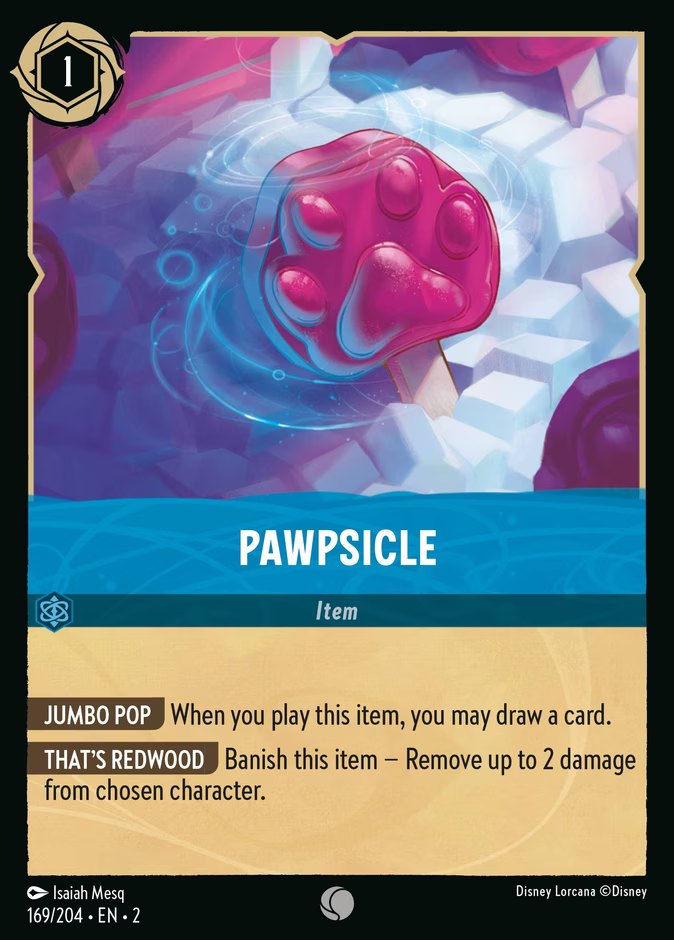
Pawpsicle is the archetype: 1 ink, draw a card on the way down, then banish it later to remove up to 2 damage. You are effectively paying 1 ink for a cantrip and holding a heal in reserve.
The strategic point is that self-banishing items dodge the type's biggest weakness. An item your opponent can remove is a liability; an item that was always going to remove itself cannot be two-for-one'd in any meaningful way. It also means the 32 answer cards below are worth much less against a deck built on Pawpsicle-style items than against one built on Lucky Dime.
The 32 cards that answer an item
Counting every card whose text banishes a chosen, all, another or each item - and excluding the four cards that only sacrifice your own items - the game has printed 32 pieces of opposing item removal in three years.
| Ink | Answer cards |
|---|---|
| Steel | 15 |
| Emerald | 14 |
| Sapphire | 4 |
| Amber, Amethyst, Ruby | 0 |
Those add to 33 rather than 32 because one of them, Maui - Stubborn Trickster, is a dual-ink Emerald/Steel card counted in both rows.
Read that table as a deckbuilding constraint. Three of the six inks have never printed a card that removes an opposing item. If your pairing is Amber/Amethyst, Amber/Ruby or Amethyst/Ruby, you have no way to interact with one at all, and your opponent's Lucky Dime is simply a fact of the game you now have to outrace.
The removal itself splits into two shapes. Some is stapled to a body - Break costs 2 and does nothing else, but Beast - Hardheaded, Judy Hopps - Optimistic Officer and Fred - Major Science Enthusiast all banish an item as a play-trigger on a character you wanted anyway. The rest is standalone, and the most brutal of those is Sabotage from Wilds Unknown: 3 ink, banish a chosen item or location and every other item or location with the same name. Against a deck running four copies of one engine item, that is a one-card sweep.
Sapphire owns this card type
Item distribution by ink, with the three dual-ink items counted in both of their inks:
| Ink | Items |
|---|---|
| Sapphire | 51 |
| Emerald | 34 |
| Steel | 34 |
| Amethyst | 32 |
| Ruby | 29 |
| Amber | 28 |
Sapphire has half again as many items as the next ink, which matches its identity in our ink breakdown: ramp, artifacts and card quality.
The payoffs are more concentrated than the raw count. Eight cards in the game trigger on playing an item - Ariel - Whoseit Collector, Maurice - World-Famous Inventor, Maurice's Workshop, Prince John - Opportunistic Briber, Gadget Hackwrench - Creative Thinker, Norton Nimnul - Misanthropic Genius, Alpha - Pack Leader and Charles Muntz - Obsessive Explorer. All eight are Sapphire.
Other inks touch items from the other end. Emerald's Archimedes - Resourceful Owl draws you a card whenever an item is banished, either player's, which is a payoff for breaking them rather than deploying them - and Emerald is also the ink with 14 ways to do the breaking. The split is tidy for a three-year-old card pool, and it tells you where an item deck has to start.
The only item ever banned
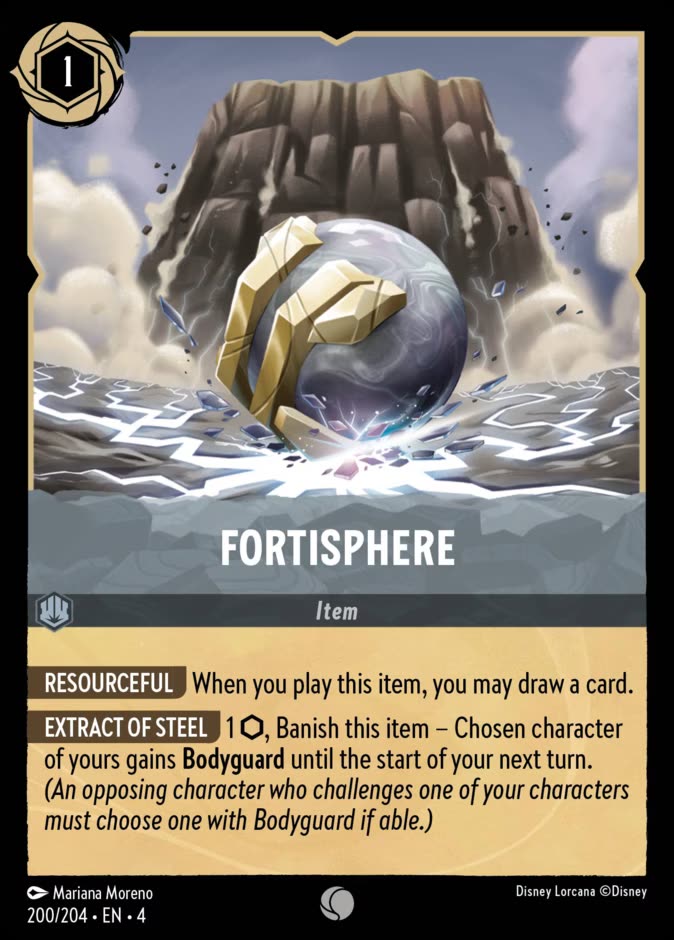
Lorcana has banned two cards in its history, and one of them is an item.
On 8 April 2025 Ravensburger banned Hiram Flaversham - Toymaker and Fortisphere from Core Constructed. Hiram is a 4-ink Sapphire character who banishes one of your items to draw 2 cards, on play and on every quest. Fortisphere is a 1-ink Steel item that draws a card when played and can banish itself to grant Bodyguard. Hiram turned each of your items into a two-card draw, Fortisphere was a one-drop that replaced itself on the way in, and Ravensburger's stated reason for the Fortisphere half was that it put too much emphasis on items in Steel, which is not what that ink is supposed to do.
The same announcement notes the team considered banning Pawpsicle as well and chose not to, on the grounds that Pawpsicle without Hiram is exactly the kind of item value Sapphire is meant to have. That is a rare piece of published design reasoning about this card type, and it lines up with the ink table above.
There is a footnote worth knowing. In March 2026 Ravensburger extended the Hiram ban to Infinity Constructed, the eternal format. Fortisphere was not included in that second ban, and Ursula's Return is not a Core Constructed set any more regardless. The only item ever banned is legal today in Infinity Constructed, which is the format that still accepts the set it came in.
What rotation left you: 82 items
Core Constructed rotated on Attack of the Vine!'s release - prerelease 17 July 2026, wide release 24 July 2026 - dropping Shimmering Skies, Azurite Sea, Archazia's Island and Reign of Jafar. Sets 9 through 13 are what is left.
Counting items with at least one printing in sets 9-13, the Core-legal item pool is 82 cards. Its curve is tighter than the full pool: 16 one-drops, 36 two-drops, 24 three-drops, 6 four-drops, and nothing above 4 ink. Lucky Dime, Half Hexwell Crown, Steel Chromicon and Merlin's Carpetbag are all Infinity Constructed cards now.
The answer count contracted harder than the item count. Of those 32 removal cards, 13 have a printing in sets 9-13 - six Emerald, five Steel, two Sapphire. In the current format, an item that resolves against a deck without Emerald, Steel or Sapphire is close to permanent.
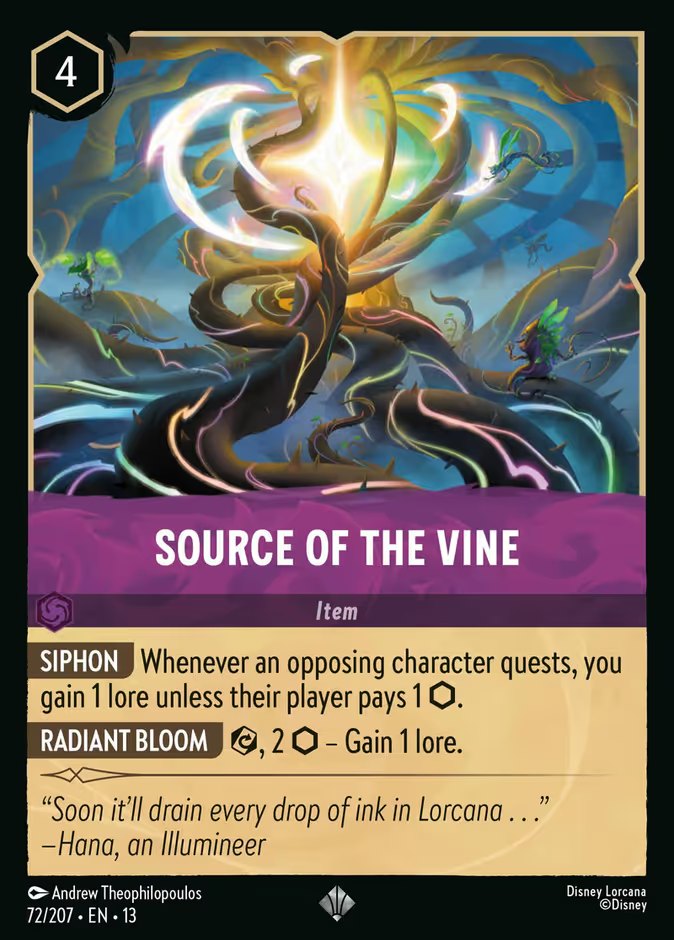
Source of the Vine is the current set's argument for the whole card type. Four ink, uninkable, Amethyst. It taxes every opposing quest by 1 ink or hands you a lore, and it can exert for a lore on its own. It is a card that punishes the opponent for playing the game normally, it cannot be challenged, and in Core the only inks that can remove it are Emerald, Steel and Sapphire.
Quick Action Checklist
- Never plan to remove an item with a challenge. Rule 4.6.1 only allows characters and locations to be challenged, and rule 1.9 only allows damage on characters and locations.
- If you are not in Steel, Emerald or Sapphire, accept that you have no item removal. All 32 answers sit in those three inks.
- Play items on curve, not off it. 183 of 205 cost 3 or less, and only 60% are inkable - the lowest of any card type.
- Use an item's ability the turn it lands. Rule 5.5.4 exempts items from drying; 121 items have an exert ability waiting.
- Check for "Banish this item" before you count it as a permanent. 54 items are one-shot effects wearing a permanent's frame.
- In an item deck, start in Sapphire. It has 51 items and all 8 of the cards that pay you for playing one.
- Hold Sabotage for a repeated engine. It banishes a chosen item or location and every other one sharing its name.
Counts here reflect the pool as of Attack of the Vine!, and rule numbers reflect Comprehensive Rules 2.2.0. One methodology note if you want to reproduce the Core figures: do not trust the Lorcast export's legalities field for this. As pulled on 14 August 2026 it still marks The First Chapter cards as Core-legal and Attack of the Vine! cards as not legal, which is backwards on both counts. Filter by set code instead. A second one, for the card-type table: the export types the Promo Set 1 printing of Ursula's Lair - Eye of the Storm as a Character, while the card itself is printed with "Location" on its classification line, a move cost and no Strength. Count it as a location, or the Character and Location rows both come out one card off.
Frequently Asked Questions
Can you challenge an item in Disney Lorcana?
How many item cards are in Disney Lorcana?
Can an item use its ability the turn you play it?
Which ink has the most items in Lorcana?
Has an item ever been banned in Disney Lorcana?
How many items are legal in Core Constructed right now?
Keep Reading
- Disney Lorcana Comprehensive Rules 2.2.0, effective July 9, 2026 (Ravensburger)
- Lorcast bulk card export - the card pool counted in this post
- Lorcast set list - release dates used for the per-set census
- Update to Core Constructed Format - the April 2025 Fortisphere and Hiram Flaversham ban (Ravensburger)
- Ravensburger Bans Card in Disney Lorcana TCG Infinity Constructed Format, March 2026 (Ravensburger)
- Lorcana Rotation 2026: Every Set Leaving Core Constructed July 24 (InkSight)
Related Guides
Lorcana Shift Explained: Stacks, Damage and All 6 Variants
Shift is 199 cards across the 13 main sets before Hyperia City and a full page of rules, and most of that page is about the card underneath. Here is what a shifted character inherits, why 63 Core-legal cards care about the stack, where every card goes when the top one leaves play, and what each of the six variants actually lets you shift onto.
Disney Lorcana's Bag Explained: How Trigger Order Works
Six other posts on this site mention "the bag" in passing and none of them explain it. Here is the actual rule: what goes in, what never does, the exact order it resolves in when two abilities fire at once, and the two different ways a Lorcana card can make something happen later.
Disney Lorcana Uninkable Cards: All 585, and How to Ink One
The inkwell symbol is the first rule Lorcana teaches and the last one anybody puts a number on. Here is the whole uninkable pool counted off the live card data - 585 of 2,476 cards - cut by rarity, cost, type and ink, plus the Comprehensive Rules clause that lets five specific cards put an uninkable card into your inkwell anyway.
Disney Lorcana Format Coconut Explained: All 18 Beta Cards
Ravensburger put a new multiplayer format into open beta and then did not print a single card for it. The 18 Coconut cards live in the Companion app, the rules fit on one page, and the deckbuilding restrictions are stranger than the summary makes them sound. Here is the whole thing, with the card pool behind each Coconut counted.
How to Play Disney Lorcana - Rules, Turn Structure, and the Race to 20 Lore
Lorcana is the rare TCG where you never attack your opponent directly. You race them to 20 lore. This is the full rules walkthrough - inkwell, turn phases, questing, challenging, drying, card types, and deck limits.
Disney Lorcana Actions Explained: All 196, No Instant Speed
An action in Lorcana resolves the moment it is played, and the rules give your opponent no window to answer it. Here is the whole card type counted from the live pool - 196 non-song actions, what they actually do, and the handful of cards that can interfere before the fact.