Lorcana Tournament Rules: Time, Takebacks and Penalties
The Comprehensive Rules tell you how to play Lorcana. Two other Ravensburger documents tell you what happens at a tournament table: the five turns after time is called, when a Lore Guide will let you take a play back, what a missed trigger or an extra card costs you, and what you can and cannot write down, sleeve or keep on your phone.
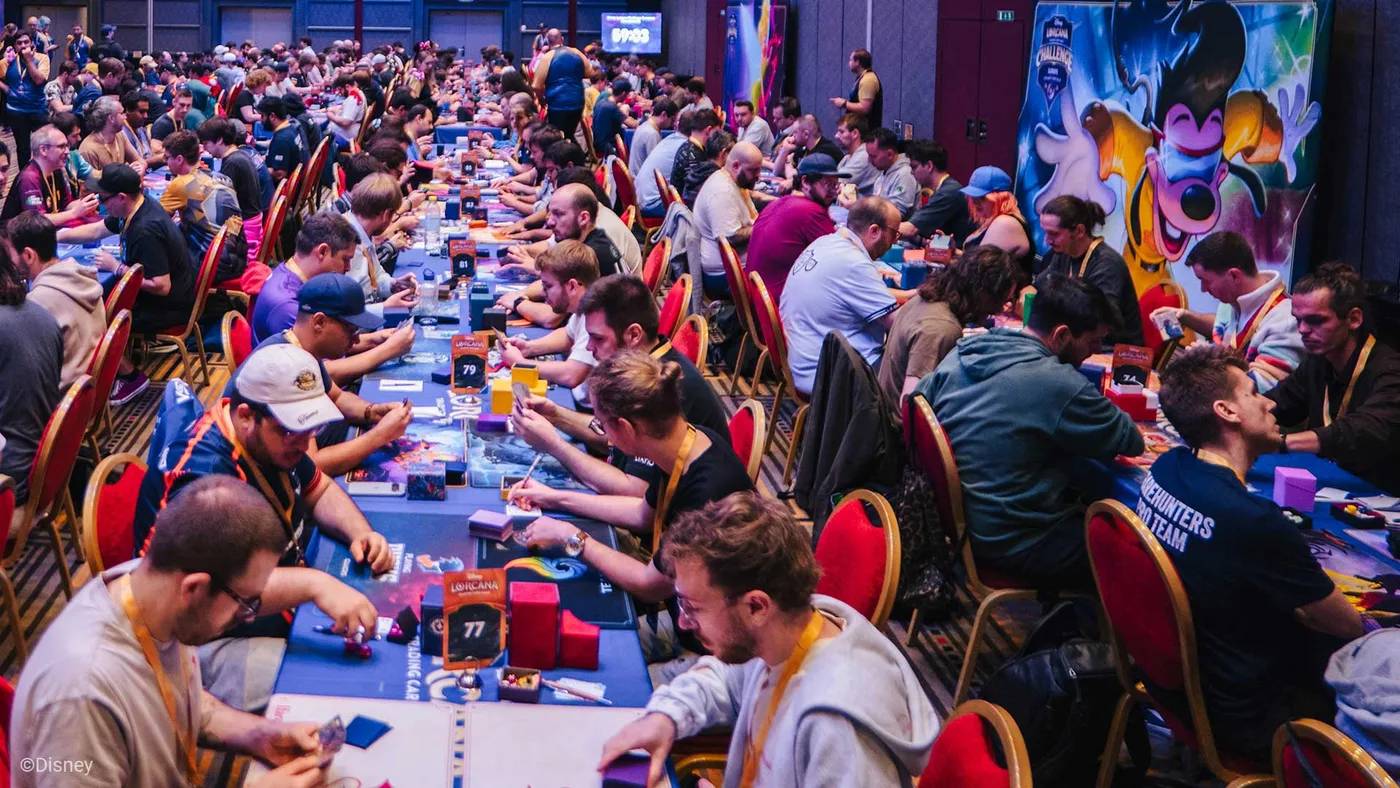
Time is called in round four. You won game one, game two is a grind, and neither of you is near 20 lore. Under Ravensburger's Tournament Rules, the player whose turn it is finishes that turn, which counts as turn 0, and then the two of you get five more turns between you. If nobody wins game two in those five, the match is recorded 1-0-1 in your favour: a match win, worth 3 points.
None of that is in the Comprehensive Rules, which say how Disney Lorcana is played. It is in the Tournament Rules (TR below), effective 14 July 2026, and the Play Correction Guidelines (PCG), effective 21 May 2024, which set what a Lore Guide, Lorcana's word for a judge, does when something goes wrong. Both are about to get a workout: Hyperia City prereleases on 16 October, and the main event of the Season of Villainy Challenge in Bangkok starts on 31 October.
This is the tournament layer. The game itself is in how to play Disney Lorcana, and the season's events and qualifiers are in the 2026-27 Challenge schedule.
Sources: the TR and PCG as listed on Ravensburger's resources page on 14 October 2026, Ravensburger's CORE guide for Lore Guides, its Hyperia City Set Championship instructions and CCQ term sheet, the Hyperia City set release notes, and the Bangkok and London organizer pages. Section numbers are given throughout so you can check any of it.
Three levels, and the two rulebooks behind them
Every sanctioned Lorcana event sits at one of three levels (TR 1.2), and the level decides how strict the room is. The Tournament Rules give an example of each and attach these differences:
| Entry-level | Competitive | Premier Play | |
|---|---|---|---|
| Ravensburger's example | Prerelease events | Set Championships | Challenge events and World Championships |
| Deck list required (3.8) | No | Yes | Yes |
| Deck checks (3.9) | Not addressed | As many as possible | At least 10% of decks |
| Top cut (3.2) | Not required | Required | Required |
| Match structure (3.3) | Organizer's choice | Organizer's choice; Premier structure encouraged at 64+ players | Best-of-three |
| Altered-art cards (3.11) | Allowed | Unaltered official cards only | Unaltered official cards only |
| Organizer may also be Lead Lore Guide (2.2) | Yes | No | No |
| Officials may play (1.5) | Yes | Not in an event they officiate | Not in an event they officiate |
| Prize splits (7.1) | Allowed, with conditions | Allowed, with conditions | Not one of the levels 7.1 allows |
Every official event needs at least eight players and three rounds (3.1, 3.2). The Hyperia City prerelease guide covers the advised round counts for a store-sized event.
The line between the two rulebooks is not tidy. TR 1.2 says every tournament handles in-game errors with the PCG. Ravensburger's CORE guide for Lore Guides says Entry-level events should put education ahead of penalties, and calls the PCG the document for Competitive and Premier events. The PCG has only two penalty columns, Casual and Competitive. TR 1.2 says some PCG corrective actions are modified at the Competitive level, but neither document spells out which column each of the three levels uses. Hyperia City's Set Championship instructions set "Rules Enforcement: Competitive", so this post reads the PCG's Competitive column as the one for Set Championships and above. If it matters on the day, ask the Lead Lore Guide, whose ruling is final (TR 2.2).
Before game one
Most of the pre-game procedure is in TR 3.3 and 3.4. The play-or-draw steps are written for Premier Play's best-of-three, which TR 3.3 encourages other best-of-three events to follow:
- Decide who chooses. Use any random method you both agree on, such as a die or a coin. If you cannot agree on one, a Lore Guide picks the method.
- Choose before you look. The player who won the toss decides whether to play first or draw first, and must decide before either player sees an opening hand. A player who cannot decide is treated as playing first. The first player skips their first draw.
- Shuffle, then offer. Each player shuffles and offers their deck to the opponent, who may shuffle further or cut. Then each draws 7 and gets one chance to alter that hand.
- Later games. The loser of each game chooses play or draw for the next one. In a single-elimination match, the higher Swiss seed chooses for game one.
Pile counting, dealing your deck into piles to count it, is allowed under TR 3.4 with conditions. You may do it once per game, only before the game starts and before you shuffle, and never to arrange the deck.
At Competitive and Premier events you register your deck before you play (TR 3.8), through the Ravensburger Play Hub or on paper as the organizer directs. If the organizer gives no deadline, lists are due before round one is paired. The list is the final word on what you meant to play, so write full names, version included. You can ask to see your list between matches.
Deck checks happen after shuffling and before opening hands, at any point in the event (TR 3.9). Your match gets the time the check took plus 3 minutes (TR 3.12). One line in the PCG matters here. Under PCG 3.3, extra cards in your deck box count as part of your deck. The only exceptions are promos handed out at the event and placeholder cards for the inkwell, and placeholders should not be Lorcana cards at all. A spare Lorcana card in your box is a deck error waiting to be found.
When time is called
The clock first. These are the limits in TR 6.1 and 6.2; the Limited and Draft figures apply at Competitive and Premier events:
| What | Limit |
|---|---|
| Swiss round | At least 50 minutes, recommended maximum 60 |
| Single-elimination match | Untimed recommended; if timed, at least 70 minutes, announced before the cut |
| An event that is single elimination throughout, if timed | At least 50 minutes, recommended maximum 60 |
| Sealed deck construction | 30 minutes |
| Sealed pool registration | 20 minutes |
| Draft deck construction and registration | 25 minutes together |
| Preconstructed deck construction | 10 minutes |
| Draft picks | 30 seconds with 12 cards left in the pack, falling to 3 seconds with 2 left |
The two upcoming events I checked sit at the top of the Swiss range. Hyperia City's Set Championship instructions set 60-minute best-of-three Swiss rounds and an untimed top cut, or 70 minutes if announced before the cut. The Bangkok Challenge page also lists 60-minute best-of-three rounds.
When the round clock runs out, any game still going moves to the end-of-match procedure in TR 3.4:
- The active player finishes the turn they are in. That is turn 0, and it does not count.
- Five more turns follow, alternating. Usually that is two for the player who was active when time was called and three for the other.
- If someone wins the game during those turns, the match is reported normally.
What happens if nobody wins depends on the stage of the event:
| If the current game has no winner | Swiss rounds, after turn five | Single elimination |
|---|---|---|
| One player is ahead on game wins | That player wins the match; the unfinished game is a draw, so 1-0 becomes 1-0-1 | That player wins the match as soon as time is called |
| Game wins are level | The match is a draw, 1 match point each | Five additional turns are played, starting a new game if none is in progress. Then the higher lore total in the current game wins. If lore is tied, play continues until one player pulls ahead on lore, and that player wins at once |
TR 3.3 adds that single-elimination brackets may use a different procedure, so listen for the announcement before a timed top cut.
The Swiss column has a consequence the Guidelines spell out. A player who won game one gains from the clock, so deliberately slowing down to run it out is listed as Cheating under PCG 4.4, and the penalty is disqualification in both columns. Slow play that is not deliberate is a Caution at Casual and a Warning at Competitive (PCG 3.2). If the match is still going when time is called, the remedy is two extra turns added to the end-of-match procedure.
Lost time comes back to you. A Lore Guide pause of more than a minute is added back (TR 3.12), and an opponent's lateness extends your match by the same amount (PCG 3.1). If the Lead Lore Guide starts a round early because every match has finished, nobody arriving before the old start time is penalized as late (TR 6.1).
Takebacks: one play, and nothing learned
The default in TR 3.7 is that a play, once made, stays made. The exception is an honest mistake or a dexterity slip, and only a Lore Guide can approve it. Players must never undo a play between themselves. The conditions:
- Only your most recent play, and only if nothing has happened since.
- Only if you learned nothing from it. A card drawn, a card revealed from the deck, a triggered ability resolving or your opponent's reaction to the play all count as new information, and any one of them rules the takeback out. A card you revealed from your own hand, for example to ink it, does not count.
- A declared batch is one play. Questing with several characters as one out-of-order sequence can be taken back as a whole. Several separate challenges cannot.
- When in doubt, no. If the Lore Guide cannot tell whether you gained information, the takeback is denied.
- No rushing. Your opponent may not hurry you into a play to lock it in before you can ask.
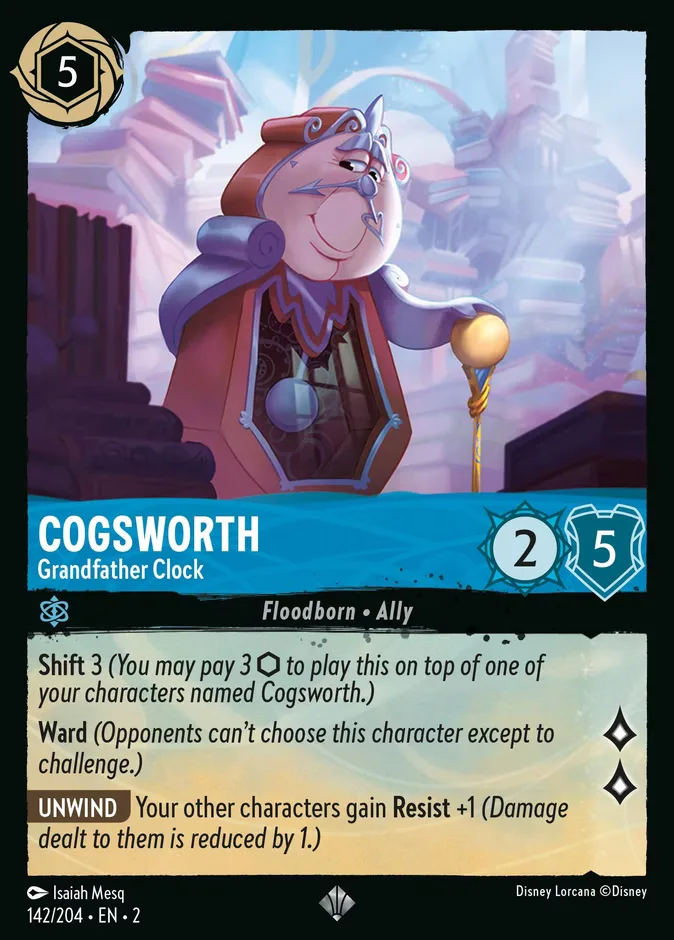
The Tournament Rules' own example uses the card above. A player plays Let the Storm Rage On, which deals 2 damage to a chosen character and then draws a card. They choose an opposing Cogsworth - Grandfather Clock, are reminded that he has Ward, and ask to take it back before drawing. That takeback is eligible, because nothing has been drawn yet. Choosing a Ward character was still illegal, so under TR 3.7.2 the player also gets a Warning for a General Rule Error, takeback or not. Both cards exist only in Rise of the Floodborn, a set TR 1.6.1 keeps out of Core, so this exact line is Infinity-only, but the principle is not. Every Lorcana keyword explained covers Ward.
The three takebacks the Rules tell a Lore Guide to refuse: changing a target after a triggered draw shows you the outcome, unwinding several challenges made one after another, and changing your ink choice after passing the turn and seeing your opponent act.
What each mistake costs
The PCG's ladder runs Caution (not recorded), Warning (recorded, and it can escalate), Game Loss, Match Loss and Disqualification (PCG 1.1). Here is every infraction it defines, in both columns:
| Infraction | Example from the PCG | Casual | Competitive |
|---|---|---|---|
| Missed Trigger (2.1) | Questing with Doc - Leader of the Seven Dwarfs, then paying full price | Caution | Caution; Warning if the trigger would have been bad for the player who missed it |
| Hidden Information Error (2.2) | Flipping over a card in your inkwell | Caution | Warning |
| Card Count Error (2.3) | Drawing 2 cards for the turn instead of 1 | Caution | Warning |
| General Rule Error (2.4) | Questing with a Reckless character | Caution | Warning |
| Tardiness (3.1), under 3 minutes | Sitting down after the round has started | Caution | Warning |
| Tardiness, 3 to 9 minutes | Warning | Game Loss | |
| Tardiness, 10 minutes or more | Match Loss and dropped | Match Loss and dropped | |
| Slow Play (3.2) | Checking the discards repeatedly without acting | Caution | Warning |
| Deck/Registration Error, Minor (3.3) | A 59-card deck with the 60th card in the deck box | Warning | Warning |
| Deck/Registration Error, Major (3.4) | A Constructed deck with three inks | Game Loss | Game Loss |
| Limited Error (3.5) | Passing a draft pack the wrong way | Caution | Warning |
| Information and Communication Error (3.6) | Announcing the wrong Strength for a challenger | Caution | Warning |
| Marked Cards (3.7) | A few sleeves with marks on them | Warning | Warning; Game Loss if easy enough to abuse |
| Outside Assistance (3.8) | Asking a spectator whether a play is right | Game Loss | Match Loss |
| Unsporting Conduct, Minor (4.1) | Loudly complaining about an opponent's deck | Warning | Warning |
| Unsporting Conduct, Major (4.2) | Ignoring a Tournament Official's instructions | Match Loss | Match Loss |
| Unsporting Conduct, Severe (4.3) | A slur, a threat, or theft | Disqualification | Disqualification |
| Cheating (4.4) | Noticing an extra card drawn and not calling a Lore Guide | Disqualification | Disqualification |
| Improper Match Result (4.5) | Rolling a die to decide a match | Match Loss | Disqualification |
| Wagering (4.6) | Betting on who will win the Top 8 | Match Loss | Disqualification |
Three escalation rules sit on top of the table. A third Warning in the same Rule Error category becomes a Game Loss. A second Warning in the same Tournament Error category, or in the same Unsporting Conduct category, also becomes a Game Loss. If both players earn a Game Loss for the same game, the two offset: both are recorded and the game is played as normal. Match Losses do not offset. A Match Loss during rounds with prizes leaves you eligible for them, while a disqualification forfeits any prize not yet handed over.
Read down the Competitive column and a pattern shows. No in-game rules mistake costs a game the first time. Every Rule Error is a Caution or a Warning. On a first offence, games are lost to things that happen away from the cards: arriving 3 or more minutes late, a deck or list that needs rewriting, help from outside the match, sleeves marked badly enough to abuse, and conduct. The cheapest protection is boring: be in your seat on time, count your deck, and call a Lore Guide the moment something goes wrong. Spotting an error that helps you and saying nothing is Cheating.
Missed triggers and the bag
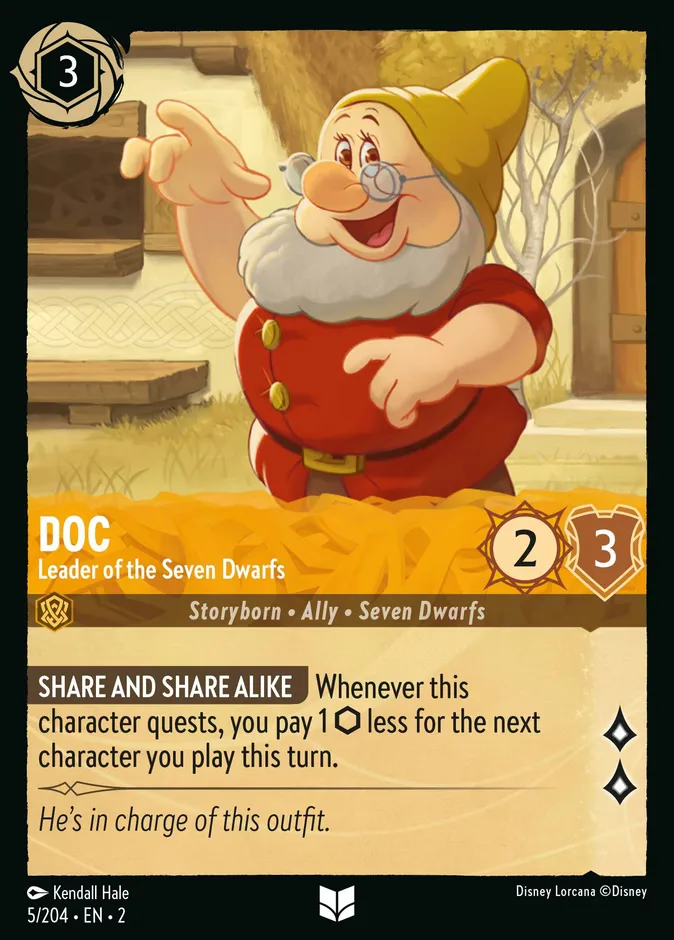
PCG 2.1 handles a forgotten trigger in a set order:
- Too late, do nothing. If the trigger was missed more than a turn cycle ago, or it had a duration that has already run out, nothing happens and play continues. Doc's discount lasts only "this turn", so once that turn ends it is simply gone.
- Otherwise the opponent decides. Your opponent chooses whether the missed trigger goes into the bag now, and if it does, it resolves immediately. Choices that could not have been made at the original moment, such as targeting a character that was not in play yet, cannot be made now.
- "May" means no. A missed trigger with "may" in it is treated as declined.
- Catch your own, no penalty. If the active player catches their own missed trigger before their turn ends, the remedy applies but no corrective action is given.
Both players are expected to point out mandatory triggers, the ones without "may", even on the opponent's cards (TR 5.4). Reminding an opponent of a "may" trigger is encouraged but not required. Entry-level play is gentler. The CORE guide tells Lore Guides to add a missed trigger to the bag if it is noticed before its controller's next turn and doing so would not be too disruptive. There is no opponent's choice in that version. How the bag orders everything once it gets there is in the bag explained.
Deck and deck list errors
The difference between Minor and Major is whether the fix changes what you registered. A 59-card deck whose 60th card turns up in the box, a fifth copy you catch yourself (as long as removing it still leaves 60 cards), or a deck and list that are both legal but don't match are all Minor, and cost a Warning. Fixing the deck to match the list keeps it Minor. Any fix that alters the list makes it Major. A missing card you cannot find, a third ink, or a list that has to be rewritten to match the deck are all Major, and cost a Game Loss.
The fixes are mechanical (PCG 3.3 and 3.4). A Constructed deck with too many inks loses the cards of its least-represented ink, and they are replaced with cards of the two inks it has most of. If inks tie, which one goes is decided at random. If you cannot get the missing cards, the Lore Guide can issue an Ink Card Proxy for each one. A proxy is worth 1 ink and has no text and no characteristics. If you get the real cards later in the event, you can switch back without another penalty.
Talking, tracking and the inkwell
Section 5 of the Tournament Rules is the part that changes how you physically play:
- Inking is public. When you ink a card with your turn action, announce its full name, and let your opponent check the inkwell symbol (5.4). Leave the card faceup until your turn ends, then turn it facedown (5.5). Keep your inkwell apart from any other facedown cards, with all your ready ink cards turned the same way as each other, and all your exerted ones likewise.
- Exert means about 90 degrees. Rotate every exerted card the same direction, clockwise or counterclockwise, but consistently (5.4).
- Say the new lore total. Every lore gain or loss is announced along with the player's new total (5.4).
- Answer state questions. If asked, you must say whether a card is ready or exerted, what damage it has and whether its ink is dry (5.4).
- Lay out your board clearly. Characters, items and locations sit in front of your inkwell from your opponent's side of the table, and a character at a location must clearly be at it. The inkwell itself can sit left, right or further back (5.1).
- Name cards properly. When an ability makes you name a card, its exact printed name is best. A description is allowed if it fits only one Lorcana card, such as describing exactly what that card's ability does. Something like "the blue card" is not enough, and only Lorcana cards can be named (5.6).
- Shortcuts are allowed if nothing changes. Exerting your ink before you reveal the card you are paying for leads to the same legal result, so it is fine. Drawing for the turn before resolving a start-of-turn "discard a card" is not, because the order changes which card can be discarded (3.5). Out-of-order play never excuses a missed trigger.
Then the notes rule. Under TR 5.2 the only notes you may write during a match are lore totals, tokens may track only your own public information, and no token may carry a number for anything except damage. Writing down the names of cards as they go into an inkwell, or using dice to mark the costs of cards you have seen, can count as Outside Assistance under the same rule: a Game Loss at Casual, a Match Loss at Competitive. The PCG files note-taking under Information and Communication Error instead (PCG 3.6), a Warning at Competitive, so which applies is the Lore Guide's call. The PCG's view is that most of an inkwell should be known to both players anyway, because every card inked with the turn action is announced (PCG 1.3). You are expected to remember it, not record it.
Your hand and any facedown zone are private; your opponent is entitled only to the number of cards in them (TR 5.4). Looking at a card in your own inkwell, unless a card effect lets you, is a Hidden Information Error. A card you inked with the turn action is shown to your opponent and put back; one that got there any other way is shuffled into your deck and replaced with a random card from it (PCG 2.2).
Ink drops and the dice question
From 16 October, Hyperia City adds ink drops: counters that go into your inkwell and can be removed to pay ink costs. Lorcana ink drops explained covers how they work, and the Hyperia City rules changes cover the Comprehensive Rules 2.3 text behind them. Ravensburger's set release notes say printed ink drops come in Hyperia City booster packs, and that dice or other objects can stand in if you have none.
The current Tournament Rules, effective 14 July, predate ink drops and do not mention them. The closest rule is 5.2, which allows no number on a token for anything except damage. By the letter of that rule, a die turned to 3 to represent three ink drops is a number on a token tracking something other than damage. The release notes and the Tournament Rules have not been reconciled as of 14 October. My suggestion: at a Competitive or Premier event, track drops with the printed tokens from your prerelease packs, or one plain object per drop, and ask the Lead Lore Guide before round one if you want to use a die.
Sleeves, dice, phones and the feature table
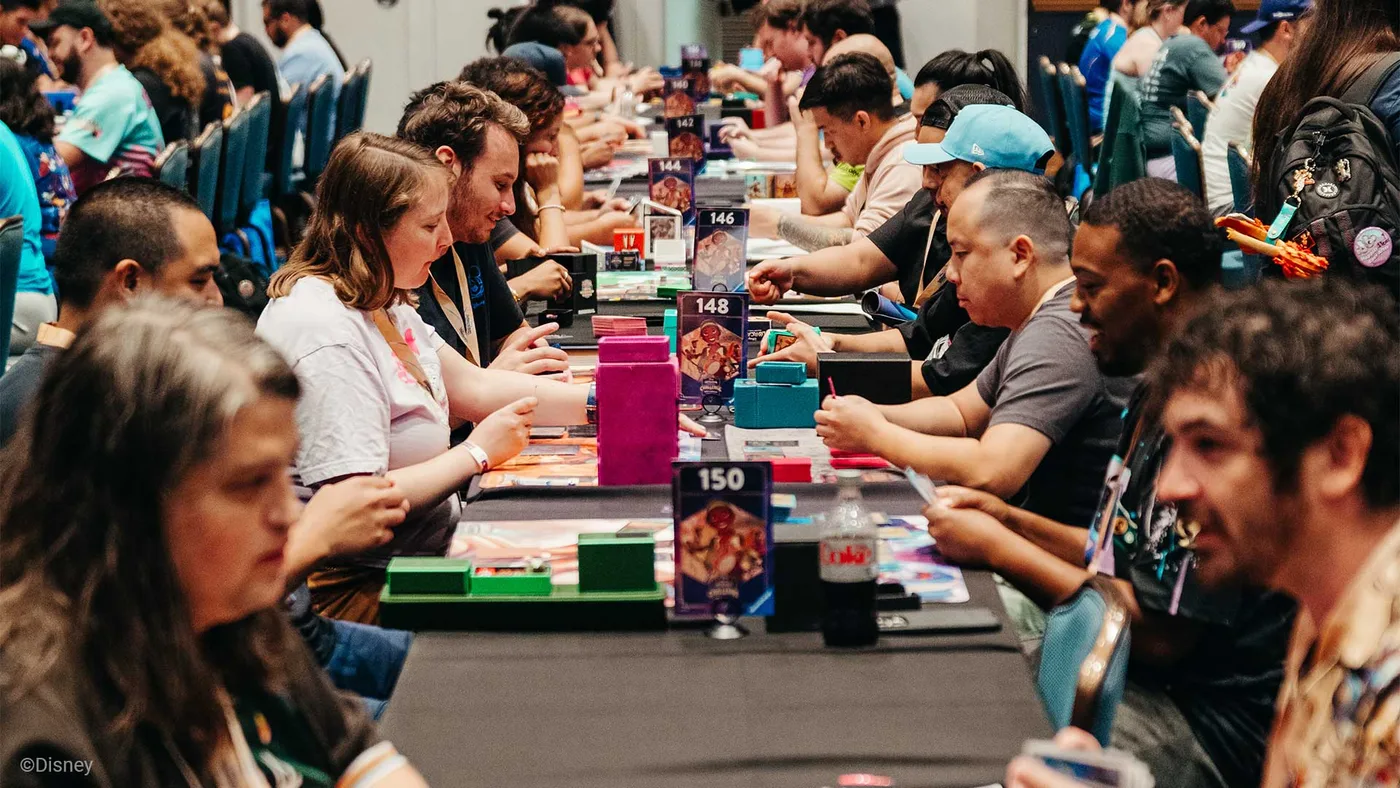
TR 3.11 lists what you can bring. Official Lorcana accessories are approved, anything else has to meet the same standards, and the organizer can still ask you to swap any accessory for an acceptable one:
- Sleeves. Each sleeve holds one card completely. Every sleeve in the deck is the same size, colour and style, with a fully opaque back, and none is reflective, damaged or marked. Inner sleeves and over-sleeves are allowed, and only those are exempt from the opaque-back rule. A sleeve problem found mid-match that isn't urgent can be fixed between games or after the match.
- Dice. Unbranded polyhedral dice or official ones, in good condition, with easily read numbers.
- Lore counters. Official counters, the Disney Lorcana Companion app, a custom counter that is easy to read and not misleading, or written totals.
- Deck boxes. Used to hold decks between games and matches, and not used while a game is in progress, except to get at another approved accessory.
- Playmats. Clean, flat on the table, and not in the way of play.
- Altered-art cards. Entry-level only. Competitive and Premier events allow only unaltered official cards, though a signature on unaltered art is fine.
Marked sleeves are a Warning in both PCG columns, and the fix is new sleeves at your earliest convenience (PCG 3.7). If the Lead Lore Guide decides the marks could easily be abused, you must replace them immediately, and at a Competitive event the penalty goes up to a Game Loss. The PCG's examples include one ink's worth of cards in a slightly different shade of sleeve, so sleeve the whole deck from one pack.
Phones are allowed if they stay in plain view of both players. The Companion app's lore counter and card database are the examples TR 5.3 gives. For anything private, such as a text or a call, tell a Lore Guide first. TR 7.1 also bans alcohol at every Lorcana event regardless of size, along with wagering and collusion.
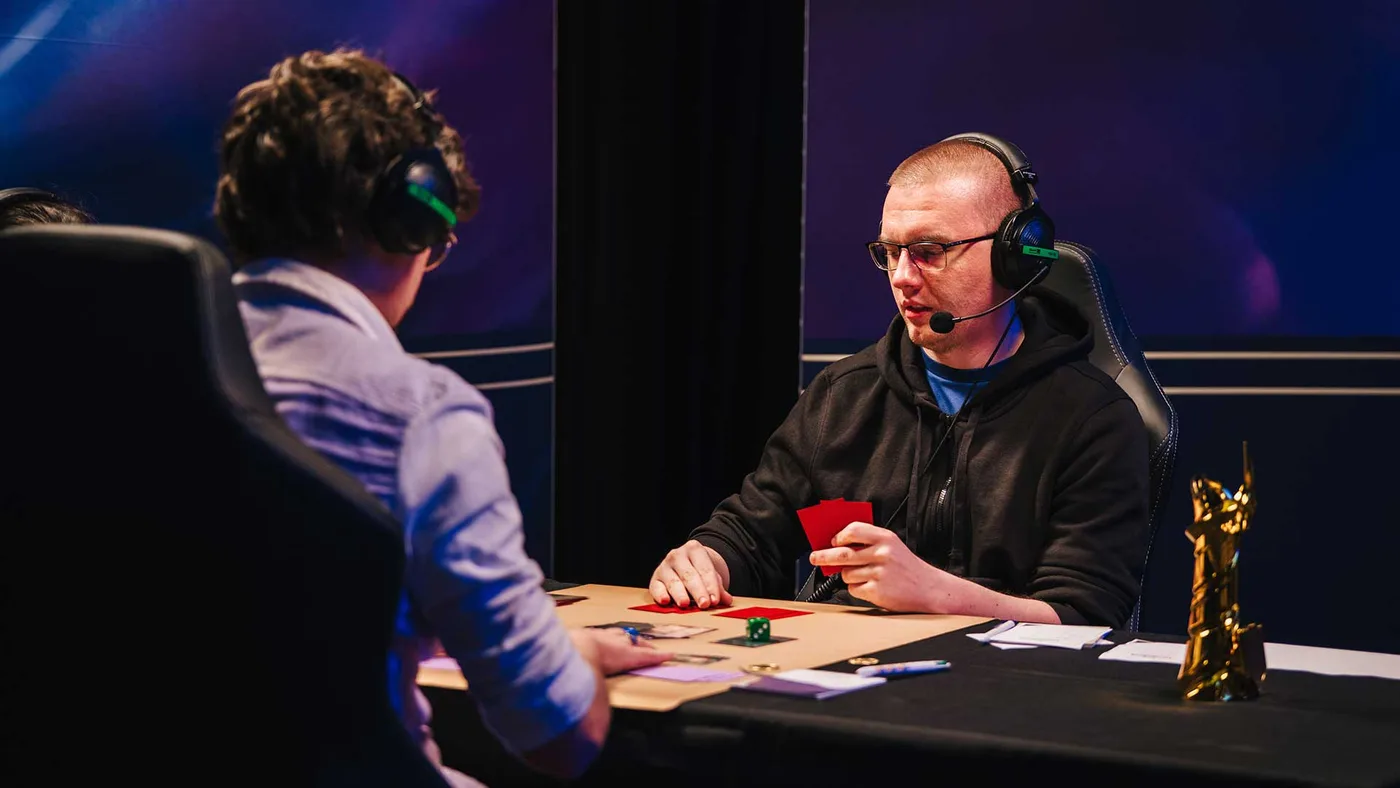
You cannot decline to be broadcast in a featured match (TR 7.3), and entering counts as consent to being filmed (TR 4.2); at non-broadcast and local events you can ask the organizer beforehand not to be recorded. Featured matches also carry a dress code: neat, broadcast-appropriate clothing and no third-party sponsor logos.
Draws, concessions, prize splits and tiebreakers
Matches are recorded as games won, lost and drawn: 2-0-0, 2-1-0, 1-1-1 or an intentional draw at 0-0-3, with unfinished games counted as draws (TR 3.3, 3.4). A match win is 3 points, a draw 1 and a loss 0. Both players confirm the result, and inaccurate reporting can be penalized with a Match Loss or disqualification (TR 3.4).
TR 3.6 covers the rest:
- Concede any time. You may concede a game or a match whenever you like. Refusing to play a match counts as conceding it.
- Never ask. You may not ask an opponent to concede. Under PCG 4.1, asking repeatedly is Unsporting Conduct, Minor.
- One draw offer. You may propose an intentional draw once per match.
- Nothing in return. You may not offer or accept anything for a concession or a draw, and anyone who gets such an offer must call a Lore Guide. Under PCG 4.5, an incentive for a concession is an Improper Match Result: a Match Loss at Casual and disqualification at Competitive.
Prize splits are allowed at Entry-level and Competitive events if three conditions hold (TR 7.1). Every remaining player must agree, the split must be reported to an official before it happens, and it must have nothing to do with match results. Officials can still refuse one.
Tiebreakers are the gap. The Tournament Rules do not define them. Pairings and results normally run through the Ravensburger Play Hub: the scorekeeper role in TR 2.4 is written around it, and both the Set Championship instructions and the CCQ term sheet require it. The Play Hub's cookie notice links to Carde.io's privacy policy. Carde.io's help centre gives the default order for events on its platform: match points, then opponents' match-win percentage, game-win percentage and opponents' game-win percentage, with every percentage floored at 33%. Its help centre also says each publisher can set its own order. None of the Ravensburger documents above says which order Lorcana uses, so treat that as the platform's default, not a Lorcana rule.
A checklist for your first Competitive event
This part is opinion, built on the rules above.
- Count to 60 after sleeving, then empty the deck box of every other Lorcana card.
- Check the list against the deck, full names and versions. A wrong deck with a right list costs a Warning; a list that has to change costs a Game Loss.
- Sleeve from one pack of identical, opaque, unmarked sleeves, and bring spares.
- Be seated when the round starts. At a Competitive event, three minutes late is a Game Loss.
- Say it out loud: inked cards by name, lore with the new total, and mandatory triggers on both sides.
- Call a Lore Guide for every error, including ones that help you, and never take a play back without one.
- Ask about ink drop dice before round one.
Quick reference
- Three documents: the Comprehensive Rules (how the game works), the Tournament Rules effective 14 July 2026 (how events run) and the Play Correction Guidelines effective 21 May 2024 (what mistakes cost).
- Three levels: Entry-level (prereleases), Competitive (Set Championships) and Premier Play (Challenges and Worlds). Deck lists are required at the top two.
- Swiss rounds: at least 50 minutes and recommended up to 60. Hyperia City Set Championships and the Bangkok Challenge use 60-minute best-of-three.
- Time called: turn 0, then five more turns. In Swiss, if nobody wins, the player ahead on games wins the match; level games make a draw.
- Takebacks: your most recent play only, with a Lore Guide's approval, and never once you have gained information.
- Penalties at Competitive: in-game rules errors are a Caution or Warning the first time. Game and match losses come from lateness, major deck or list errors, outside assistance, abusable marked cards, repeat Warnings and conduct.
- Notes: lore totals only, and no numbers on tokens except damage, which leaves ink drop dice for the Lead Lore Guide to rule on.
Section numbers refer to the Tournament Rules effective 14 July 2026 and the Play Correction Guidelines effective 21 May 2024, both read from Ravensburger's resources page on 14 October 2026, as were the event details. Check that page for newer versions before a big event.
Frequently Asked Questions
What happens when time is called in a Disney Lorcana tournament match?
How long is a round at a Disney Lorcana tournament?
Can you take back a play in a Disney Lorcana tournament?
What is the penalty for drawing an extra card in a Lorcana tournament?
What happens if you miss a triggered ability in a Lorcana tournament?
Can you take notes during a Disney Lorcana tournament match?
What sleeves are allowed in Disney Lorcana tournaments?
How are ties broken in Disney Lorcana tournament standings?
Can you use dice to track ink drops at a Lorcana tournament?
Keep Reading
- Disney Lorcana Tournament Rules, effective 14 July 2026 - tournament levels, match structure and end-of-match procedure, takebacks, deck registration and checks, accessories, information and notes, time limits and conduct (Ravensburger, official PDF)
- Disney Lorcana Play Correction Guidelines, effective 21 May 2024 - corrective actions, rewinds, rule errors, tournament errors and unsporting conduct (Ravensburger, official PDF)
- CORE: Core Operations, Rules and Enforcement - Ravensburger's guide for Lore Guides, including Entry-level missed-trigger handling (Ravensburger, official PDF)
- Official Disney Lorcana resources page - where the current Tournament Rules, Play Correction Guidelines and CORE documents are listed (Ravensburger, read 14 October 2026)
- Hyperia City Set Championship Instructions - Competitive rules enforcement, 60-minute best-of-three Swiss, untimed top cut (Ravensburger, published 28 September 2026)
- CCQ Event Term Sheet - Challenge Championship Qualifier requirements (Ravensburger, official PDF)
- Disney Lorcana TCG Set Release Notes: Hyperia City - printed ink drops in boosters, dice or other objects as stand-ins (Ravensburger, 8 October 2026)
- Disney Lorcana Trading Card Game Heads to Hyperia City - prerelease 16 October 2026 (Ravensburger, 22 September 2026)
- Disney Lorcana TCG Challenge Bangkok 2026 - 31 October to 1 November, 60-minute best-of-three rounds (Saka Saka)
- Disney Lorcana Challenge 26/27 Season of Villainy London - 13-15 November 2026 (Fanfinity)
- Tiebreakers - the default tiebreaker order and 33% floor on the Carde.io event platform, which publishers can change (Carde.io help centre)
- Europe Championship Recap - source of the tournament hall and feature-match photos (Ravensburger, 17 September 2026)
- North America Championship Recap - source of the Swiss tables photo (Ravensburger, 3 September 2026)
- Cogsworth - Grandfather Clock #142/204, Rise of the Floodborn (Lorcast)
- Let the Storm Rage On #199/204, Rise of the Floodborn (Lorcast)
- Doc - Leader of the Seven Dwarfs #5/204, Rise of the Floodborn (Lorcast)
Related Guides

Lorcana Challenge 2026-27 Schedule and How to Qualify
Under Ravensburger's updated format, a Season of Villainy Challenge weekend is three tournaments, not one, and each hands out Championship invites on different terms. Here are the 11 Challenge dates on Ravensburger's English-language Challenge page, what Main Event 1, Main Event 2 and the Infinity CCQ each qualify you for, the CCQ and Local Qualifier rules, the prize ladder and the golden Hades on it.
Disney Lorcana Digital Game: What's Confirmed So Far
The entire public case for a Disney Lorcana digital client is one graphic, two sentences and a QR code. Here is exactly what Ravensburger has confirmed since D23 2026, what three outlets disagree about, and what the last two TCGs to try this actually shipped, and when.
Disney Lorcana European Championship 2026 Results
Emerald/Steel has now lost the final at both of Season 2's regional championships. Here is what happened at Disney Lorcana's European Championship in Paris - the Top 16, the archetypes behind it, and who is headed to Worlds.
Disney Lorcana North America Championship 2026 Results
Emerald/Steel was a quarter of the field and eleven of the Top 16. It still lost the final. Here is what actually happened at Disney Lorcana's North America Championship in Anaheim - the Top 16 breakdown, both finalists' decklists, and every player now headed to the World Championship.

How to Play Disney Lorcana - Rules, Turn Structure, and the Race to 20 Lore
Lorcana is the rare TCG where you never attack your opponent directly. You race them to 20 lore. This is the full rules walkthrough - inkwell, turn phases, questing, challenging, drying, card types, and deck limits.

Disney Lorcana at Gen Con 2026: 118 Sessions, a Stitch Promo, and a Coconut
Ravensburger's cheapest Gen Con ticket costs two dollars, and it might be the most important thing the company is doing at the show. A live report from day three: every Lorcana session counted, the participation promo verified, and the first public playtest in the game's history.