Minecraft Dripstone Guide: Infinite Lava, Growth and Caves
One pointed dripstone, one cauldron and a lava source you never use up: that is renewable lava. Here is how the dripstone lava farm works, how much fuel each cauldron is really worth, how dripstone grows, where dripstone caves generate, and what falling stalactites and stalagmites do to you.
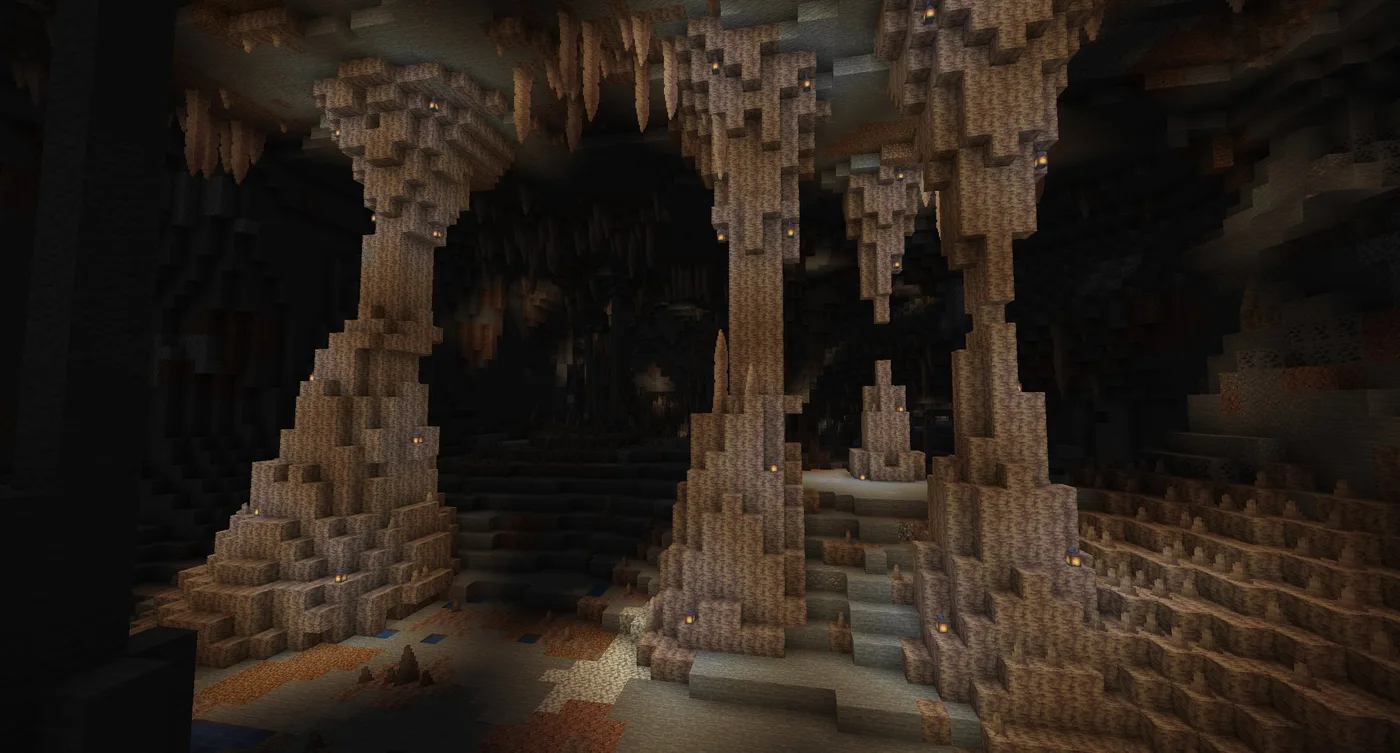
Lava is the longest-burning fuel in Minecraft, and out of the box it is something you have to go and find. Pointed dripstone fixes that. Hang one under a block with a lava source on top, put a cauldron underneath, and the cauldron keeps refilling with lava while the source above it is never used up. The Minecraft Wiki's own word for what that does to lava is renewable.
That is the headline, but dripstone does four more things worth knowing. It grows, slowly, if you give it water. It turns mud into clay. It falls on whatever is underneath when the block it hangs from is broken. And landing on it more than doubles your fall damage.
This guide covers all five with the real numbers, plus where to find dripstone caves in the first place. The rates are for Java Edition 26.3, taken from the Minecraft Wiki and the game's own data files; Bedrock works the same way in outline, and the delta table near the end lists the main differences.
Dripstone at a glance
| Detail | |
|---|---|
| Found in | Dripstone caves, which generate inland and often under mountains; also trial chambers |
| Blocks | Pointed dripstone (stalactites and stalagmites) and the dripstone block |
| Dripstone block recipe | 4 pointed dripstone in a 2×2 square; no recipe turns it back |
| Bought from | Wandering trader (2 pointed dripstone for 1 emerald); journeyman mason (4 dripstone blocks for 1 emerald) |
| Grows when | Hanging directly under a dripstone block with water on top |
| Growth speed | About one block per 100 minutes on average |
| Lava farm | Lava source, then any block, then pointed dripstone, then a cauldron up to 10 blocks below |
| Lava refill time | About 19.4 minutes on average per full cauldron |
| Mud to clay | About 6.5 minutes on average per block; does not work in the Nether |
| Falling stalactite | 6 damage per block fallen after the first, capped at 40 |
| Landing on a stalagmite | floor(2 × fall distance − 1) damage, against fall distance − 3 on flat ground |
Where dripstone caves generate
Dripstone caves are a cave biome, so you are looking underground, and the wiki's generation notes come down to one rule: go inland. They form where continentalness is high, which keeps them far from coasts and essentially never under oceans. Mountain biomes are the best bet, because they tend to sit far inland without much humidity, and under mountain peaks, per the wiki, dripstone caves usually sit above the deep dark.
Humidity works against you. Where it climbs, lush caves take the slot instead, and the wiki names dark forests, old growth taigas, bamboo jungles, wooded badlands and taigas as places that generate dripstone caves much less often. If you spawned in a dark forest, walk to the mountains before you dig.
Two shortcuts:
- Look for grey patches. Where a dripstone cave breaks through to the surface, the wiki says the surface is made entirely of stone with occasional patches of dripstone. A bare stone scar in otherwise grassy hills is worth a closer look.
- Use the command if cheats are on.
/locate biome minecraft:dripstone_caveson Java or/locate biome dripstone_caveson Bedrock. Turning cheats on permanently locks achievements on a Bedrock world, which our game rules list covers.
On Java, dripstone caves are one of the 56 Overworld biomes that Adventuring Time asks for; the advancements list has the rest.
What is down there
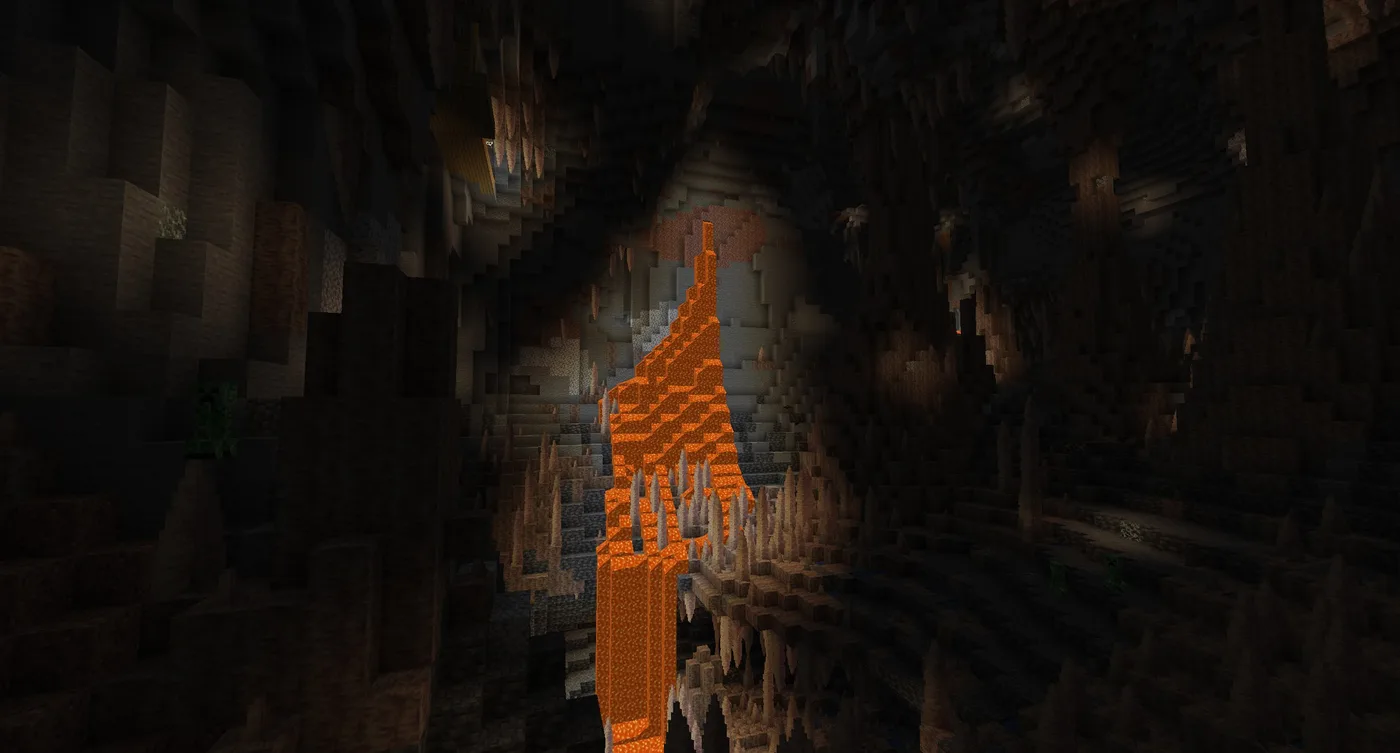
| Feature | What it is | Why it matters |
|---|---|---|
| Large dripstone | Huge stalactite and stalagmite formations in big caves and ravines | Dripstone blocks in bulk |
| Dripstone clusters | Patches of dripstone block with pointed dripstone hanging and standing | Where you mine pointed dripstone |
| Small water pools | Wells a few blocks wide holding waterlogged dripstone | Drowned spawn in the cave's water |
| Large copper veins | Copper ore veins of size 20, against 10 in other biomes | Double-size copper; no other biome uses this vein in the 26.3 data |
| The usual underground | Other ores, geodes, monster rooms, lava lakes and springs | Found in other Overworld biomes too |
The copper row comes straight from the game's world-generation files. In Java 26.3 the dripstone caves biome swaps the standard copper ore feature for a large one: the same 16 placement attempts per chunk between Y -16 and Y 112, but with a vein size of 20 instead of 10. Of the 67 biome files in that data, it is the only one that uses the large vein. The copper guide covers what to do with it once you have it.
The lava lake and lava spring features are in the biome's list too, as they are in plenty of Overworld biomes, so the lava source your farm needs may be in the same cave as the dripstone it needs.
In the Java data, the monster list is the same as lush caves' with one addition: drowned, at a weight of 95, spawning in the cave's water. Per the wiki's Drowned page, on Java they need water at least 2 blocks tall, below Y 58, at light level 0. An adult drowned that spawns here holding a trident has a 50% chance to come riding a zombie nautilus. Our trident guide covers the drop math, and the nautilus guide covers what to do with the mount.
Getting pointed dripstone: mine it, buy it or grow it
Mining. Pointed dripstone drops itself whatever you break it with, though a pickaxe is fastest, and a thrown trident breaks it instantly. The dripstone block needs a pickaxe or it drops nothing.
Buying. Two traders sell it, and they sell different things:
| Seller | Trade | Uses | Chance a given seller has it |
|---|---|---|---|
| Wandering trader | 1 emerald for 2 pointed dripstone | 5 | 5 picks from 78 common offers: about 6.4%, both editions |
| Journeyman mason (Java) | 1 emerald for 4 dripstone blocks | 16 | 2 picks from 7 journeyman offers: about 28.6% |
| Journeyman mason (Bedrock) | 1 emerald for 4 dripstone blocks | 16 | 1 of the 4 items its sell slot can roll: 25% |
The mason sells blocks, and four pointed dripstone craft one block, but nothing crafts back the other way. Blocks are what you grow from; you still need pointed dripstone to start. The wandering trader guide covers how to get more traders to show up, and the villager jobs guide covers giving a villager the stonecutter that makes it a mason.
Growing is the renewable route, and the slowest one.
How pointed dripstone grows
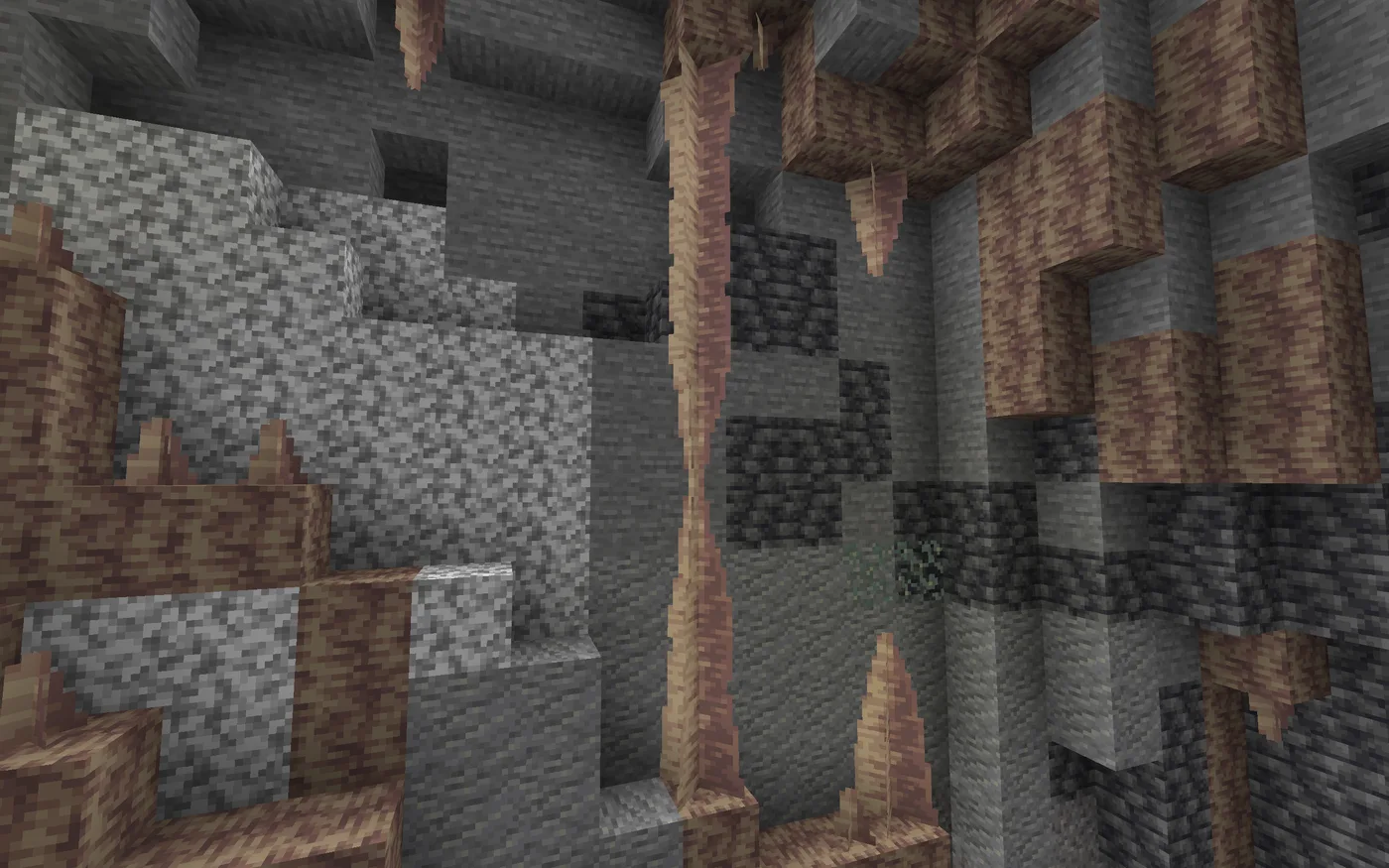
Per the wiki, pointed dripstone grows only when all of this is true:
- It hangs directly under a dripstone block. Any other block will drip, but it will not grow.
- There is a water source on top of that dripstone block. On Java, a waterlogged block also counts since 26.1.
- The tip is not waterlogged.
Each time the tip gets a random tick, there is a 1.138% (64 in 5,625) chance for the stalactite, or a stalagmite below it, to grow one block. At Java's default random tick speed that averages out to one block per 100 minutes. A stalactite stops at 8 blocks long.
The stalagmite half has a catch. It can only grow on a block with a full solid top less than 11 blocks below the tip, and only while the stalactite is shorter than 8. When a growth roll picks the stalagmite and there is no valid floor, the wiki says the roll fails rather than growing the stalactite instead. Give it a floor, and the rolls that pick the stalagmite count too.
What that rate means in practice: one growing stalactite averages about 0.6 pointed dripstone an hour, so 20 of them average about 12. The wiki's farming tutorial puts it bluntly: plan an enormous farm if you want more than you can collect by hand. Observer-and-piston and flying-machine harvesters exist, and the automatic farms guide covers the observer side.
Harvest from the tip upward. Breaking any block in a stalactite drops every unsupported piece below it as a falling stalactite, and the falling-stalactite section below explains why you do not want that on your head. Leave the top piece attached to the dripstone block and it keeps growing.
A lava farm needs one pointed dripstone per cauldron, and mining or a single wandering trader covers that, so growing is for builders who want dripstone in bulk.
The infinite lava farm
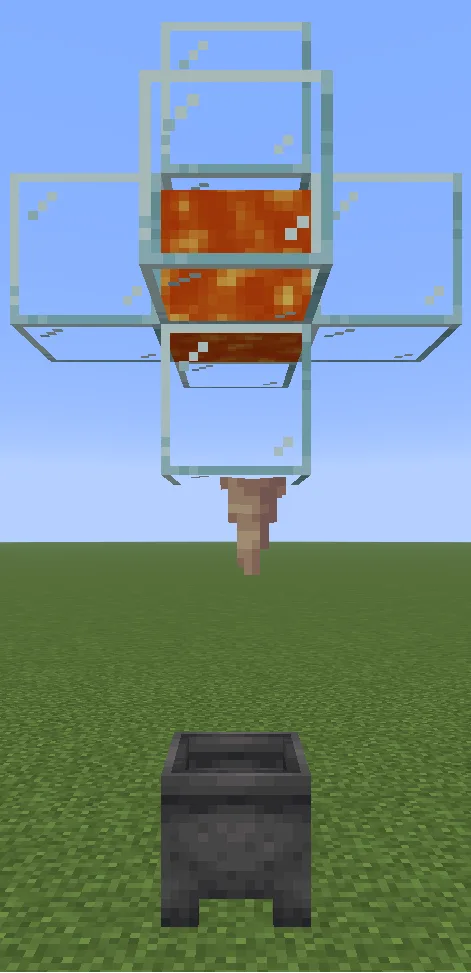
The build, top to bottom:
- A lava source block. Not flowing lava.
- Any block. It does not have to be a dripstone block; the wiki's screenshot uses glass.
- One pointed dripstone hanging from the underside of that block.
- Up to 10 blocks of air. Zero works too: the cauldron can sit directly under the tip.
- A cauldron. Seven iron ingots.
The rules that make or break it, per the wiki:
- The lava must sit directly above the block the dripstone hangs from.
- Keep the stalactite shorter than 11 blocks and the cauldron within 10 blocks of its tip.
- Nothing but air between the tip and the cauldron. Java also lets the drip pass open trapdoors, ladders and blocks with no collision box; Bedrock does not accept an open trapdoor (open bug MCPE-179085).
- Contain the lava with non-flammable blocks, as the wiki's tutorial recommends.
- The chunk has to be loaded. Since Java 1.21.5, random ticks reach every fully loaded chunk whether or not a player is nearby, but an unloaded chunk does nothing.
The lava source is the template, not the fuel: it is never consumed. Scale the farm by running a row of contained lava sources over a row of blocks, one stalactite and one cauldron under each.
Collect with an empty bucket, which empties the cauldron. A full lava cauldron gives a redstone comparator a signal of 3 in both editions, which is enough to light a lamp when a cauldron is ready.
The rate. Each random tick on the dripstone has a 15 in 256 chance, about 5.9%, to fill an empty cauldron completely. At Java's default random tick speed, a block is ticked every 68.27 seconds on average, which works out to about 19.4 minutes per full cauldron. That is an average, not a timer, and the wiki notes the time for any single refill varies. Run the same odds and about 23% of refills land within 5 minutes, while about 5% take longer than an hour.
What one cauldron is worth in fuel
One lava bucket smelts 100 items, and a furnace smelts one item every 10 seconds, 360 an hour; the fuel burn times guide has the full table. Put those together with the 19.4-minute average refill:
| Cauldrons | Lava buckets per hour (average) | Items smelted per hour | Furnaces it keeps running |
|---|---|---|---|
| 1 | 3.1 | 309 | 0.86 |
| 4 | 12.4 | 1,236 | 3.4 |
| 8 | 24.7 | 2,472 | 6.9 |
| 16 | 49.4 | 4,944 | 13.7 |
One cauldron covers about 86% of a furnace running nonstop, so the rule of thumb is seven cauldrons for every six furnaces. A blast furnace or smoker burns fuel twice as fast as a furnace, so each needs about 2.3 cauldrons.
Two cautions from the fuel guide carry over. A lava bucket burns its full 1,000 seconds whether or not there is anything left to smelt, and buckets do not stack, so feed lava to furnaces that have a full stack waiting, not to the one you use for four porkchops.
Water and mud: the other two drips
The same stalactite does something different depending on what sits on top of the block it hangs from:
| On top of the block | What the drip does | Chance per random tick | Average time (Java) |
|---|---|---|---|
| Lava source | Fills an empty cauldron completely | 15/256, about 5.9% | About 19.4 minutes per full cauldron |
| Water source, or a waterlogged block on Java | Adds 1 level of water to a cauldron | 45/256, about 17.6% | About 6.5 minutes per level, 19.4 for all 3 |
| Mud | Turns the mud into clay | 45/256, about 17.6% | About 6.5 minutes (388 seconds) per block |
Water and lava fill a cauldron at the same average pace. The water drip is mostly a curiosity, since two water source blocks already make infinite water.
Mud is the useful one. Use a water bottle on dirt, coarse dirt or rooted dirt to make mud, set it on top of a block with pointed dripstone underneath, and it turns into a clay block, which breaks into 4 clay balls without Silk Touch. It does not work in the Nether; Mojang closed that report as working as intended (MC-264720). Our mangrove swamp guide covers mud in bulk.
Falling stalactites: 6 damage a block, capped at 40
Break the block a stalactite hangs from, or any piece of it, and every unsupported piece below falls. On Java, per the wiki's Damage page, a falling stalactite deals 6 damage per block fallen after the first, three times an anvil's 2, and both are capped at 40. A single pointed dripstone falling 4 blocks deals 18, nine hearts. Stalactites longer than 6 pieces hit harder per block, at 1 per piece.
- A helmet cuts the damage by a quarter, per the wiki's Pointed Dripstone page and Mojang's fix for MC-251027 in snapshot 23w51a, but takes extra durability damage for it.
- The damage may come down. Mojira report MC-312430, still open, says falling pointed dripstone and sulfur spikes have dealt more damage since 26.2 Snapshot 6 than they did before. Mojang has not resolved it either way.
- Bedrock is far gentler: 1 damage per block fallen, under its own open report, MCPE-184329.
This is the hazard when you harvest a growth farm from underneath. The death message is "skewered by a falling stalactite".
Sulfur spikes and the icicles coming in the ice caves drop share the same falling behaviour; the ice caves guide compares all three.
Stalagmites: landing on one roughly doubles the fall
On Java, landing on the top of a stalagmite deals floor(2 × fall distance − 1) damage, per the wiki's Pointed Dripstone page, where ordinary ground deals floor(fall distance − 3). Run the two formulas side by side:
| Fall distance (blocks) | Damage on flat ground | Damage on a stalagmite |
|---|---|---|
| 1.25 (a normal jump) | 0 | 1 |
| 3 | 0 | 5 |
| 5 | 2 | 9 |
| 8 | 5 | 15 |
| 10.5 | 7 | 20 |
| 23 | 20 | 45 |
So an unarmoured player on 20 health dies from about 10.5 blocks onto a stalagmite, against 23 onto flat ground. The wiki notes the real figures run slightly off at greater heights, because the distance covered in the last game tick of the fall is not counted.
Three details:
- Feather Falling still works. The game's data tags stalagmite damage as fall damage, and Feather Falling protects against anything with that tag.
- Fall-immune mobs ignore stalagmites, and so do players when the fall damage game rule is off.
- For a mob farm, soften rather than kill. By the formula, a 10-block drop onto stalagmites deals 19, which leaves a 20-health zombie, skeleton or creeper on 1 health for a one-hit finish.
The death message is "impaled on a stalagmite". The wiki has not verified the formula on Bedrock.
Java vs Bedrock: the delta list
| Java | Bedrock | |
|---|---|---|
| Falling stalactite damage | 6 per block fallen after the first, capped at 40 | 1 per block fallen (open bug MCPE-184329) |
| Waterlogged block as the water source | Counts for filling, and for growth since 26.1 | The wiki lists it as Java-only |
| Open trapdoor or ladder between tip and cauldron | The drip passes through | An open trapdoor blocks it (open bug MCPE-179085) |
| Journeyman mason dripstone block trade | 2 of 7 offers picked: about 28.6% | 1 of 4 items in one slot: 25% |
| Biome temperature | 0.8 | 0.2, so per the wiki exposed caves above about Y 120 freeze their water and get snow cover (open bug MCPE-142225) |
| Cauldron fill rate | About 19.4 minutes per full cauldron | Not given in numbers by the wiki |
| Stalagmite formula | floor(2 × fall distance − 1) | Not verified by the wiki |
Quick Action Checklist
- Head inland to find dripstone caves, under mountains if you can; avoid coasts and humid biomes like dark forests and bamboo jungles.
- Mine copper while you are there. Copper veins in dripstone caves are size 20, double the usual 10.
- Mine or buy, do not grow, for a lava farm. One pointed dripstone per cauldron; wandering traders sell 2 for an emerald.
- Build the stack right: lava source, any block, pointed dripstone, up to 10 blocks of air, cauldron.
- Expect about 3 lava buckets per cauldron per hour, and build seven cauldrons for every six furnaces.
- Hook a comparator to each cauldron if you want a lamp to tell you it is full; a lava cauldron reads 3.
- Grow dripstone only under a dripstone block with water on top, give it a floor, and harvest from the tip upward.
- Turn mud into clay with the same setup, but not in the Nether.
- Wear a helmet under stalactites, and do not land on a stalagmite from more than about 10 blocks.
Frequently Asked Questions
How do you make an infinite lava farm in Minecraft?
How long does it take dripstone to fill a cauldron with lava?
How do you grow pointed dripstone in Minecraft?
Where do dripstone caves generate in Minecraft?
How much damage does a falling stalactite do in Minecraft?
Can you turn mud into clay with dripstone in Minecraft?
Keep Reading
- Mythras blog
- Minecraft coverage hub
- Fuel burn times (lava bucket smelts 100 items)
- Mangrove swamp guide (mud in bulk)
- Copper guide
- Trident guide (drowned in dripstone caves)
- Nautilus guide (zombie nautilus jockeys)
- Wandering trader guide
- Villager jobs guide (mason)
- Automatic farms guide (observer harvesters)
- Ice caves guide (icicles vs dripstone)
- Game rules list
- Advancements list (Adventuring Time)
- Minecraft Wiki — Pointed Dripstone: growth conditions and chance, cauldron filling odds, mud to clay, falling and stalagmite damage
- Minecraft Wiki — Tutorial: Lava farming: the lava source, block, dripstone and cauldron build and its failure conditions
- Minecraft Wiki — Tutorial: Dripstone farming: growth rate, manual harvesting and automatic designs
- Minecraft Wiki — Dripstone Caves: generation, features, spawn tables and edition differences
- Minecraft Wiki — Cauldron: lava and water storage, dripstone filling and comparator output
- Minecraft Wiki — Random tick: the 68.27-second average interval at Java's default random tick speed
- Minecraft Wiki — Tick: Java 1.21.5 random ticks in all fully loaded chunks
- Minecraft Wiki — Damage: falling stalactite and anvil damage, and the fall damage formula
- Minecraft Wiki — Mud: making mud and the 388.4-second average clay conversion
- Minecraft Wiki — Drowned: spawning in dripstone cave aquifers
- Java Edition 26.3 vanilla data (misode/mcmeta): dripstone caves biome features and spawn weights
- Java Edition 26.3 vanilla data (misode/mcmeta): ore_copper_large, vein size 20 (ore_copper_small is 10)
- Java Edition 26.3 vanilla data (misode/mcmeta): journeyman mason sells 4 dripstone blocks for 1 emerald, 16 uses
- Java Edition 26.3 vanilla data (misode/mcmeta): the 7 journeyman mason offers, 2 picked per villager
- Java Edition 26.3 vanilla data (misode/mcmeta): wandering trader sells 2 pointed dripstone for 1 emerald, 5 uses
- Java Edition 26.3 vanilla data (misode/mcmeta): stalagmite damage is tagged as fall damage
- Bedrock samples v1.26.50.4 (Mojang): stone mason journeyman sell slot with 4 possible items, dripstone block one of them
- Mojira MC-312430 — Falling pointed blocks deal more damage than before (open)
- Mojira MC-251027 — Wearing a helmet doesn't reduce the damage of falling anvils or stalactites by 1/4 (Fixed in 23w51a)
- Mojira MCPE-184329 — Falling stalactite does 1 damage per block fallen instead of 6 (open)
- Mojira MCPE-179085 — Dripstone does not fill a cauldron through an open trapdoor on Bedrock (open)
- Mojira MC-264720 — Mud does not convert to clay in the Nether with dripstone (Works As Intended)
Related Guides

Minecraft Slime Farm Guide: Slime Chunks, Swamps, Slimeballs
Slimeballs are the one item you can't mine, trade, or craft your way around — sticky pistons, leads, and slime blocks all dead-end at them. Here's how to build a slime farm that buries you in the stuff, whether you go slime-chunk or swamp.
Minecraft Iron Farm Guide: Build an Iron Golem Farm
An iron golem drops 3 to 5 iron ingots every single time it dies, guaranteed, and your villagers will manufacture them for free if you set the scene right. Here is how to weaponize the panic mechanic into a farm that buries you in iron.
Minecraft Spawner Guide: Mechanics, XP Farms, and Real Rates
A monster spawner is not a magic mob faucet. It is a timer with a hard mob cap, a spherical activation radius, and a spawn volume that is shaped differently in Java and Bedrock. Learn the actual numbers and you stop building farms that quietly run at half rate.
Minecraft Automatic Farms: Observer and Piston Designs
Observer-and-piston farms look identical in every tutorial and perform nothing alike. The difference is growth math, edition-specific observer timing, and whether the chunk is even loaded. Here are the numbers behind the builds.
Minecraft Survival Guide for Beginners: Your First Days
You have about ten minutes of daylight before the sun sets and the world tries to kill you. Here is exactly what to do with them — punch a tree, build a tool chain, and get a roof over your head before the zombies arrive.

Best Minecraft Enchantments, Ranked — The Ones Worth Your XP
Mending is the enchantment that ends the grind — gear that repairs itself forever. Everything else is a fight over your XP and anvil uses. Here is what actually earns a slot, ranked, with the real max levels.