Pokémon TCG Bench Rules: Can You Attack the Bench?
The Bench looks like a safe zone. It is not. The 2026 Web Rulebook gives each player five Bench slots and says only the Active Pokémon can attack — but 90 card names in the Standard-legal pool have an attack that reaches past it, Weakness and Resistance are switched off when they land, and the format's blanket Bench immunity has a hole in it big enough for five specific cards to walk through.
New players treat the Bench like a bomb shelter. You park the Stage 2 you are building there, you park the backup attacker there, and you assume nothing can touch any of it until it walks into the Active Spot. That assumption loses games, because the only things the rulebook takes off a Pokémon when it reaches the Bench are Special Conditions and lingering attack effects — not damage, and not attacks aimed at it.
Every rule and card text below is checked against two things: The Pokémon Company's Pokémon Trading Card Game Web Rulebook, 2026 edition, and live card text pulled from the Pokémon TCG API on 12 September 2026 for every printing carrying a Standard-legal regulation mark — H, I or J, 2,947 printings in total, of which 2,481 are Pokémon. The newest expansion indexed there on that date was Pitch Black (17 July 2026), so treat every count as "as of that pool."
Five slots, and only one Pokémon can attack
The rulebook's board diagram is unambiguous. On page 7: "The bottom row of a player's in-play section is for the Benched Pokémon. Each player may have up to 5 Pokémon on the Bench at any one time. Any Pokémon in play other than the Active Pokémon must be put on the Bench." The turn-actions page repeats the cap in the context of playing cards — you may put Basic Pokémon from your hand onto your Bench "as many as you want," and "Your Bench can hold up to 5 Pokémon."
The glossary draws the other half of the line: "Active Pokémon: Your in-play Pokémon that is not on the Bench. Only the Active Pokémon can attack."
So the Bench cannot attack. Note what that sentence does not say: "cannot attack" and "cannot be attacked" are two different rules, and the rulebook only prints the first one.
Three things do work perfectly well from the Bench, and all three are printed as rulebook text rather than card text:
- Abilities. Page 12: "You can use Abilities from both your Active and Benched Pokémon." Our Abilities guide has the full breakdown of which ones gate on position.
- Evolution. Page 11: "You can evolve any Pokémon you have in play, whether it's Active or Benched."
- Energy attachment. Page 11 again — your one attachment per turn can go "under your Active Pokémon or one of your Benched Pokémon."
That combination is why the Bench matters at all. It is where decks are assembled while the Active Spot takes the hits.
Yes, you can attack the Bench, if the card says so
A normal attack hits the Active Pokémon. To reach the Bench, the attack has to name it.
Across the 2,947 Standard-legal printings, 156 printings — 90 distinct card names — carry an attack that names a Benched Pokémon as a target, for damage, for damage counters, or for an outright Knock Out. The pool holds 1,389 distinct card names, so that is one name in fifteen. Build as if your opponent has one.
The wording comes in two flavours, and only one of them contains the word "Benched."
Explicit targeting reads like Armarouge from Surging Sparks: "Discard all Fire Energy from this Pokémon, and this attack does 180 damage to 1 of your opponent's Benched Pokémon." You cannot misread that.
The other flavour is the trap. Mega Charizard Y ex from Ascended Heroes reads "this attack does 280 damage to 1 of your opponent's Pokémon" — Pokémon, not Benched Pokémon — and the only thing telling you the Bench is a legal target is the parenthetical that follows.
The parenthetical that changes the math
That parenthetical is "(Don't apply Weakness and Resistance for Benched Pokémon.)" It appears on 133 Standard-legal printings across 81 card names.
It is a reprint of a rulebook line. Page 14, in the attack sequence: "Don't apply Weakness and Resistance for Benched Pokémon!"
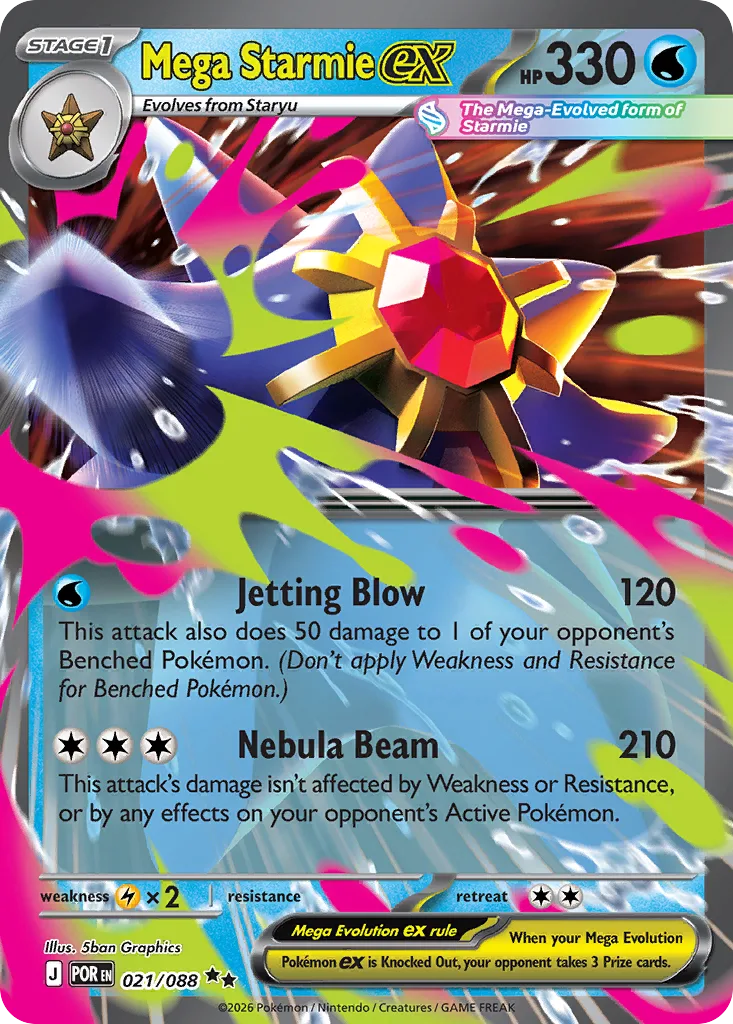
Treat the parenthetical as two pieces of information, not one. It tells you the math, and it tells you the Bench is on the menu — an attack that says "1 of your opponent's Pokémon" and carries that reminder can choose a Benched target even though it never used the word.
What the switched-off Weakness actually costs you, using Mega Starmie ex — a Water Pokémon — and its Jetting Blow (120 damage, plus 50 to a Benched Pokémon):
| Target | Weakness applies? | Damage landed |
|---|---|---|
| Active Pokémon with ×2 Weakness to Water | Yes | 240 |
| Active Pokémon with no Weakness to Water | Nothing to apply | 120 |
| Benched Pokémon with ×2 Weakness to Water | No | 50 |
| Benched Pokémon with Resistance to Water | No | 50 |
Those multipliers are not a range. Every Weakness printed in the Standard-legal pool is ×2 — 2,390 of them — and every Resistance is −30, across 529 printings. So the Resistance row is the one worth internalising: a Benched Pokémon never gets its 30 points back, and a Benched Pokémon never pays the double either. Snipe damage is flat damage, which is exactly what makes it good at killing 60- and 70-HP support Pokémon that would otherwise survive.
The four shapes Bench damage comes in
| Shape | How the text reads | Standard example | Numbers |
|---|---|---|---|
| Single Bench target, named | "does X damage to 1 of your opponent's Benched Pokémon" | Armarouge, Surging Sparks | 180, after discarding all Fire Energy |
| Any target, flagged by the parenthetical | "does X damage to 1 of your opponent's Pokémon" | Mega Charizard Y ex, Ascended Heroes | 280, after discarding 3 Energy |
| Splash onto the Bench alongside the Active hit | "this attack also does X damage to N of your opponent's Benched Pokémon" | Hydreigon ex, Surging Sparks | 130 to the Active, 130 to each of 2 Benched |
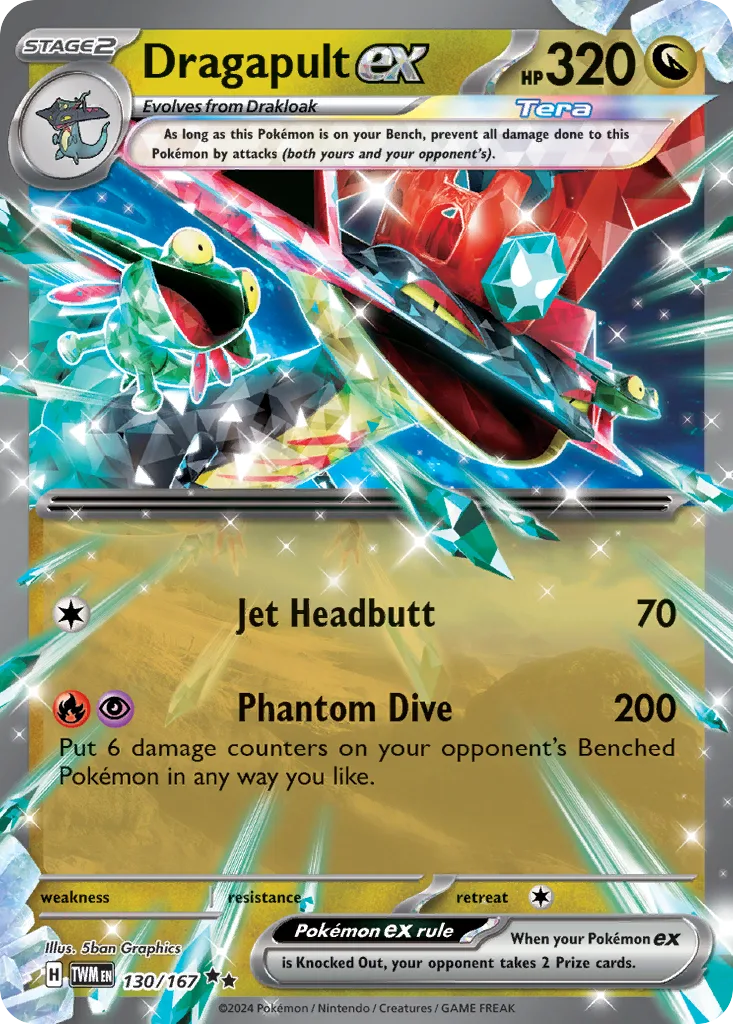
| Damage counters, not damage | "Put N damage counters on your opponent's Benched Pokémon" | Dragapult ex, Twilight Masquerade | 6 counters, spread as you like |
A fifth shape exists and is worth knowing purely because it ignores damage entirely. Alolan Exeggutor ex's Swinging Sphene reads: "Flip a coin. If heads, Knock Out your opponent's Active Basic Pokémon. If tails, Knock Out 1 of your opponent's Benched Basic Pokémon." No damage is dealt, so nothing that reduces or prevents damage matters. Sylveon ex's Angelite does something similar without a Knock Out — "Choose 2 of your opponent's Benched Pokémon. Shuffle those Pokémon and all attached cards into your opponent's deck."
Damage counters are not damage, and that is the loophole
This is the single most useful distinction on this page, and it is written into the rulebook's damage-calculation sequence on page 20, step 1: "If an attack tells you to place damage counters on a Pokémon, you have no more calculations to do because damage counters aren't affected by Weakness, Resistance, or any other effects on a Pokémon. Just place those damage counters on the affected Pokémon!"
Bulbapedia's glossary puts it the same way: "Placing damage counters is considered an effect and not damage dealt to that Pokémon."
Five card names in the Standard-legal pool place damage counters on the opponent's Bench:
| Card | Set | Attack | What it places |
|---|---|---|---|
| Dragapult ex | Twilight Masquerade / Prismatic Evolutions / Ascended Heroes | Phantom Dive | 6 counters, in any way you like, plus 200 to the Active |
| Mismagius | Ascended Heroes | Assassin's Magic | 6 counters on 1 Benched Pokémon, but only if the opponent's Active is affected by a Special Condition; plus 60 to the Active |
| Annihilape | Pitch Black | Ghostly Blow | 5 counters on 1 Benched Pokémon, plus 100 to the Active |
| Flutter Mane | Temporal Forces / Prismatic Evolutions | Hex Hurl | 2 counters, in any way you like, plus 90 to the Active |
| Palossand ex | Surging Sparks | Barite Jail | Counters on each Benched Pokémon until its remaining HP is 100 |
Five names is a small list, and it is the list to check before you decide your Bench is safe — because most of what protects a Bench in this format is worded around damage, and none of these five deal any to the Bench. Four cards are worded to catch them anyway, and they are in the table two sections down.
Tera Pokémon ex: the blanket Bench immunity
Tera Pokémon ex are the largest block of Bench-immune cards in Standard, and the rulebook gives them Appendix 6 to themselves: "Tera Pokémon ex have a crystalline appearance and a new effect that prevents all attack damage done to them while they're on your Bench. This effect applies to all attacks, both yours and your opponent's."
The card text matches exactly: "Tera: As long as this Pokémon is on your Bench, prevent all damage done to this Pokémon by attacks (both yours and your opponent's)."
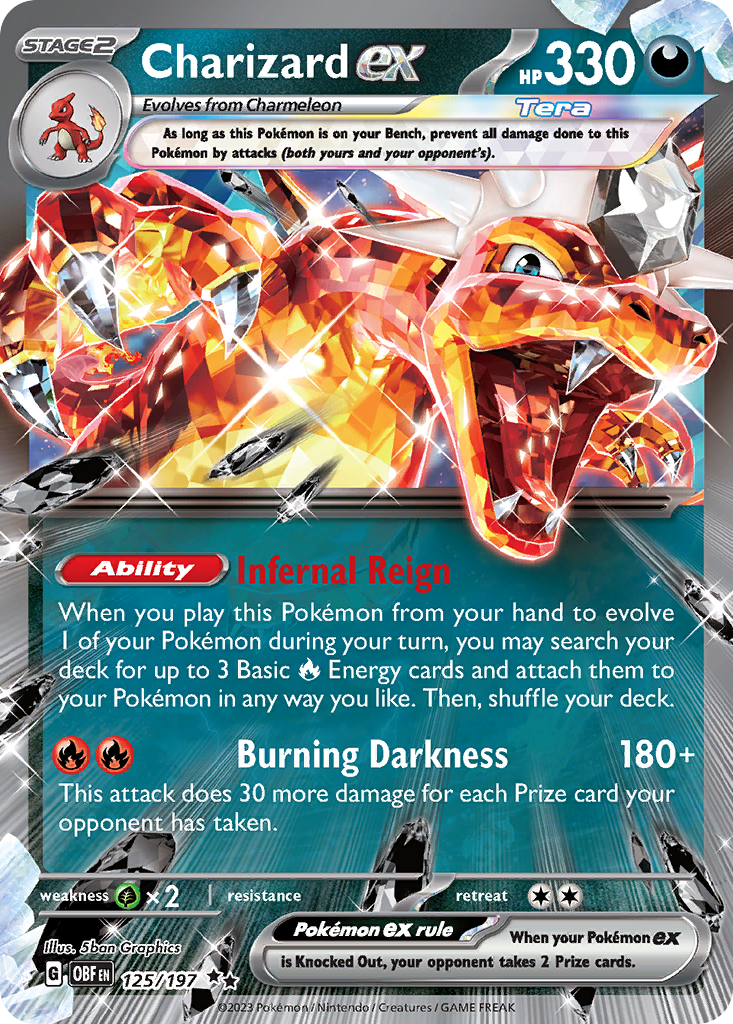
In the Standard-legal pool that is 103 printings across 33 card names, and every single one carries that identical line — Alolan Exeggutor ex, Ceruledge ex, Cinderace ex, the four Ogerpon ex, Cyclizar ex, Dragapult ex, the nine Eevee and Eeveelution ex, Farigiraf ex, Flygon ex, Galvantula ex, Greninja ex, Hydreigon ex, Koraidon ex, Lapras ex, Magcargo ex, Miraidon ex, Palossand ex, Pikachu ex, Revavroom ex, Tatsugiri ex, Terapagos ex and Wugtrio ex among them. 101 of those 103 printings carry regulation mark H; the two exceptions are the mark-J Miraidon ex and Koraidon ex reprints from Ascended Heroes.
Three details people get wrong:
- "Both yours and your opponent's" is literal. Your own splash damage cannot hit your own Benched Tera Pokémon ex either. Diggersby from Perfect Order swings for 140 and "this attack also does 30 damage to each of your Benched Pokémon" — your Tera ex sits that out.
- It is damage prevention, not effect prevention. Phantom Dive's counters land on a Benched Tera Pokémon ex. So do Mismagius's, Annihilape's, Flutter Mane's and Palossand ex's — and Palossand ex is itself a Tera Pokémon ex, which is a genuinely funny way to lose.
- It stops the moment it goes Active. The clause is conditional on being on your Bench. Getting gusted turns it off, which is the next section.
Eight cards protect a Bench without being Tera
Outside Tera, eight card names in the Standard-legal pool carry printed Bench protection, and the wording differences between them matter more than the names do.
| Card | Set | What the text protects | Stops damage counters? |
|---|---|---|---|
| Rabsca | Temporal Forces | "Prevent all damage from and effects of attacks from your opponent's Pokémon done to your Benched Pokémon" | Yes |
| Battle Cage (Stadium) | Phantasmal Flames | "Prevent all damage counters from being placed on Benched Pokémon (both yours and your opponent's) by effects of attacks and Abilities from the opponent's Pokémon. (Damage from attacks is still taken.)" | Yes — and only counters |
| Shaymin | Destined Rivals | "Prevent all damage done to your Benched Pokémon that don't have a Rule Box by attacks from your opponent's Pokémon" | No |
| Poltchageist | Twilight Masquerade | "prevent all damage from and effects of attacks from your opponent's Pokémon done to this Pokémon" | Yes |
| Misty's Magikarp | Destined Rivals | Same wording as Poltchageist | Yes |
| Antique Plume Fossil | White Flare | "prevent all damage done to this Pokémon by attacks from your opponent's Pokémon" | No |
| Bastiodon | Pitch Black | "As long as this Pokémon is on your Bench," protects each of your Pokémon, but only from attackers with 2 or less Energy attached | No |
| Shadowy Darkness Energy | Pitch Black | Protects the Benched Darkness Pokémon it is attached to | No |
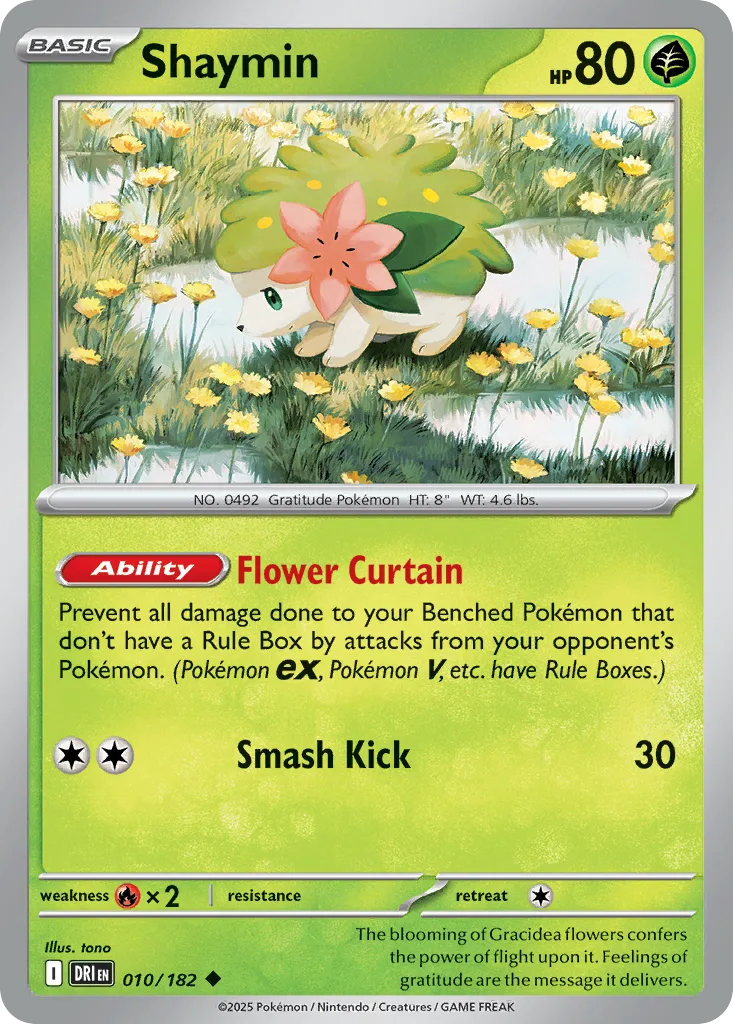
The "Stops damage counters?" column is doing real work. Rabsca, Poltchageist and Misty's Magikarp say "damage from and effects of attacks." Placing damage counters is an effect of an attack, so that wording catches it. Battle Cage goes further in one direction and not at all in the other — it is the one card in the pool printed specifically against counter placement, and it says so in its own parenthetical: damage from attacks is still taken. The remaining four entries, and every Tera Pokémon ex, say "damage," so counters go through them.
Four of the eight reach past a single card, and they reach differently. Shaymin's Flower Curtain pays for its reach with the Rule Box exclusion spelled out on the card — "(Pokémon ex, Pokémon V, etc. have Rule Boxes.)" — so your Ultra Ball targets are covered and your ex attacker on the Bench is not. Rabsca's Spherical Shield carries no such exclusion and stops effects as well as damage, so it covers Rule Box Pokémon and counter placement alike. Bastiodon's Ancient Bulwark covers each of your Pokémon, Active included, but only against attackers holding 2 or less Energy. Battle Cage is a Stadium, so it is symmetrical: it shuts off counter placement on both Benches, yours included.
Gusting: the other way to reach the Bench
If you cannot damage a Benched Pokémon, you can move it. Dragging an opponent's Benched Pokémon into the Active Spot is called gusting, and it turns off every Bench-conditional protection on that card the instant it arrives.
19 card names in the Standard-legal pool do it, across 32 printings.
| Card | Type | How it gusts |
|---|---|---|
| Boss's Orders | Supporter | Straight switch, no cost, no flip |
| Team Rocket's Giovanni | Supporter | Switches your Team Rocket's Pokémon too |
| Lisia's Appeal | Supporter | Benched Basic only; the new Active is Confused |
| Prime Catcher | Item (ACE SPEC) | Gusts, then switches your own Active as well |
| Pokémon Catcher | Item | Coin flip; heads to gust |
| Florges | Ability | Once per turn, coin flip |
| Meowstic | Ability | Discard a Chill Teaser Toy from hand to use it |
| Hop's Dubwool, Hariyama, Ledian | Ability | Fires when you play the card from hand to evolve one of your Pokémon |
| Malamar, Dipplin, Braviary, Primeape, Cryogonal, Mawile, Pangoro, Clefairy, Arven's Toedscruel | Attack | Gusts and usually damages the new Active |
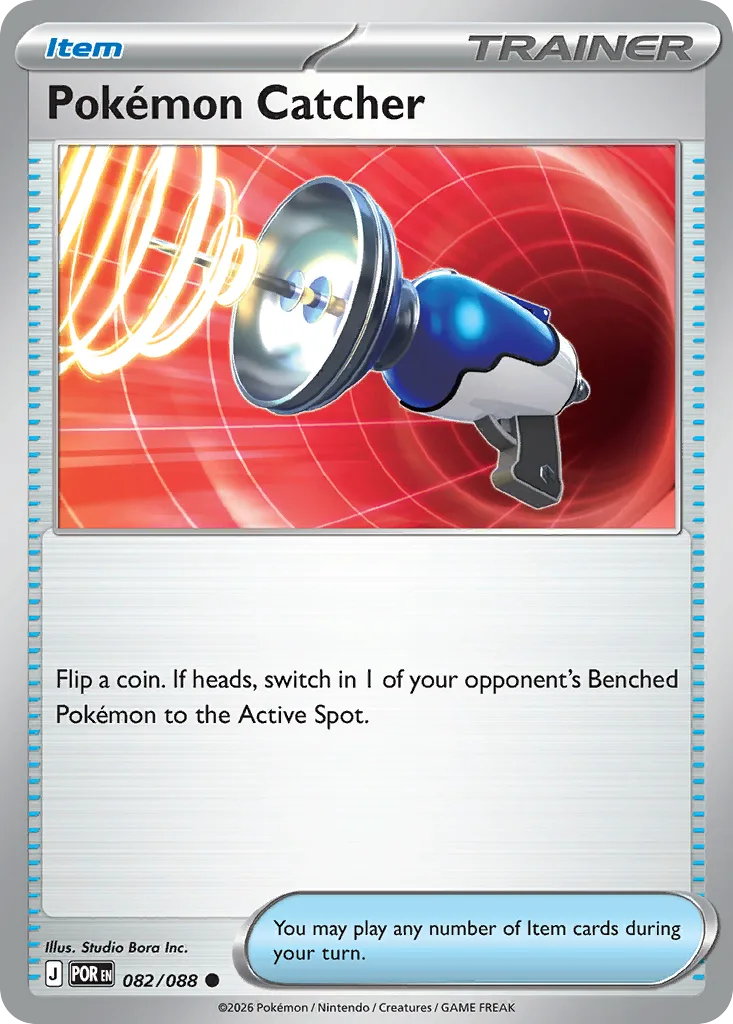
The Supporter/Item split is the part that changes how you play around it. A gust Supporter costs your opponent their whole Supporter for the turn, so it competes with drawing cards — which is why our deck building guide treats the gust count as a ratio decision. Pokémon Catcher and Prime Catcher are Items, so they cost nothing but the card, and Prime Catcher is an ACE SPEC — one copy in the whole deck, per the Trainer card rules.
One Standard card changes the five-slot limit
The five-slot cap is the rulebook default, and one Standard-legal card overrides it. Area Zero Underdepths, a Stadium from Stellar Crown reprinted in Prismatic Evolutions, reads: "Each player who has any Tera Pokémon in play can have up to 8 Pokémon on their Bench. If a player no longer has any Tera Pokémon in play, that player discards Pokémon from their Bench until they have 5. When this card leaves play, both players discard Pokémon from their Bench until they have 5, and the player who played this card discards first."
Read that text as three conditions. The three extra slots hang on a Tera Pokémon — any of the 33 Tera Pokémon ex names above qualifies — and the moment you no longer have one in play, you discard down to five yourself. It is symmetrical: an opponent with their own Tera Pokémon gets eight slots too. And it is a Stadium, so a replacement Stadium ends it for both players, with the player who put it down discarding first. It is not a fringe card, either — Dylan Kasturi won the Baltimore Regional on 19 September 2026 with four copies in the deck.
It appears to be the only one. Re-querying the Pokémon TCG API on 26 September 2026 for every Standard-legal Trainer rule and Pokémon Ability that mentions the Bench turned up cards that fill it (Buddy-Buddy Poffin, Precious Trolley), shuffle it around (the gust and switch cards), or tax it (Risky Ruins puts 2 damage counters on each Basic non-Darkness Pokémon that arrives) — and no second card that raises or lowers the cap.
What does exist is a set of cards that read the Bench and price themselves off it. 15 card names scale a number directly by how many Pokémon are benched, and a handful more key off a Bench threshold (Iron Crown wants 3 or more) or off a subset of it (Gourgeist ex counts only the damaged ones). Some count yours and some count your opponent's, and the direction flips what the card is worth:
| Card | Set | Reads | Effect |
|---|---|---|---|
| Iron Crown | Surging Sparks | Opponent's Bench | +80 damage if they have 3 or more Benched Pokémon |
| Gengar | Perfect Order | Opponent's Bench | +30 damage for each Benched Pokémon |
| Zoroark | White Flare | Opponent's Bench | 30 damage for each Benched Pokémon |
| Team Rocket's Hypno | Destined Rivals | Opponent's Bench | Opponent flips per Benched Pokémon; 80 to the Active per tails |
| Incineroar ex | Temporal Forces | Opponent's Bench | Attacks cost 1 Colorless less per Benched Pokémon |
| Morty's Conviction | Temporal Forces | Opponent's Bench | Draw a card for each Benched Pokémon |
| Tapu Koko ex | Journey Together | Your Bench | +20 damage for each of your Benched Pokémon |
| Terapagos ex | Ascended Heroes | Your Bench | 30 damage for each of your Benched Pokémon |
| Gourgeist ex | Chaos Rising | Your Bench | +50 for each of your Benched Pokémon with damage on it |
That is the real cost of a full Bench, and it is a cost you choose. Against a deck reading your Bench, five Pokémon down is not free board presence — it is a damage multiplier you handed over. Under Area Zero Underdepths the multiplier runs to eight.
An empty Bench loses the game on the spot
Page 14 of the rulebook: "The player whose Pokémon was Knocked Out chooses a new Active Pokémon from their Bench. If your opponent can't do this because their Bench is empty (or for any other reason), you win the game!"
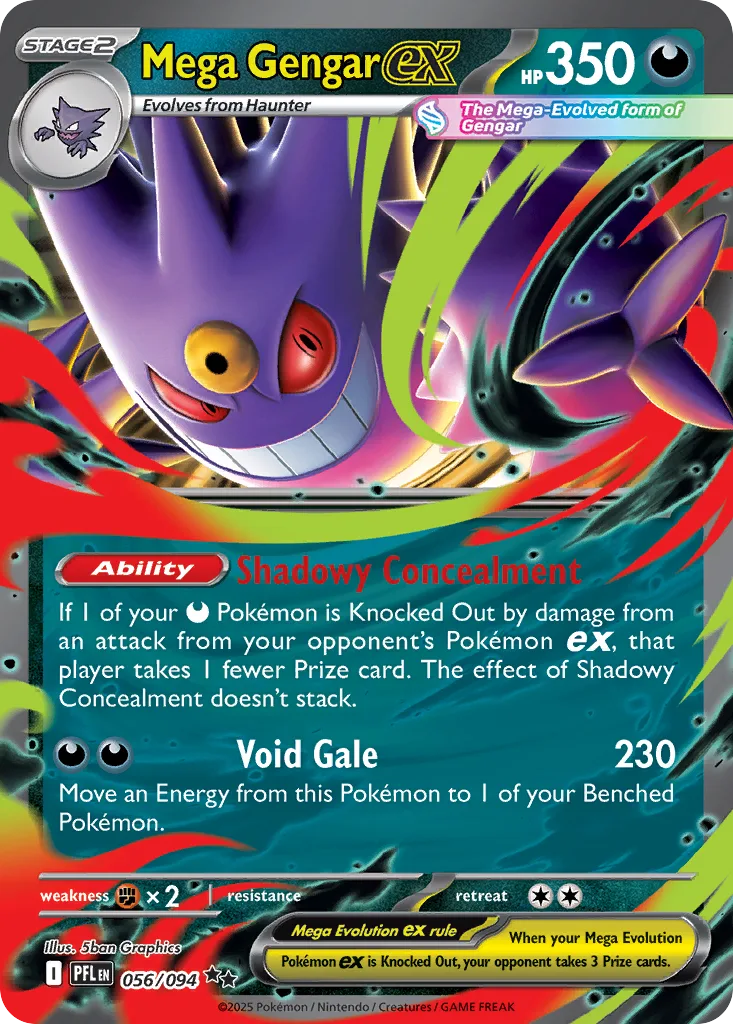
This is one of the three listed win conditions on page 8, alongside taking all your Prize cards and your opponent being unable to draw at the start of their turn. Our Prize card guide covers how the first of those interacts with ex and Mega Evolution ex Knock Outs.
The practical version: Bench damage is not just chip damage on a card you were not using. Every Benched Pokémon you lose is a card off your replacement supply, and a snipe deck that removes your last Bench body wins immediately regardless of the Prize count. A lone Active Pokémon with a full Bench behind it is in a completely different position from a lone Active Pokémon with nothing behind it.
What the Bench is genuinely immune to
Special Conditions. The rulebook is flat about it on page 15: "Some attacks make the Active Pokémon Asleep, Burned, Confused, Paralyzed, or Poisoned—these are called 'Special Conditions.' They can only happen to an Active Pokémon—when a Pokémon goes to the Bench, it recovers from all Special Conditions."
Page 12 extends that to attack effects generally: "When your Active Pokémon goes to your Bench (whether it retreated or got there some other way), some things do go away—Special Conditions and any effects from attacks."
Two consequences worth playing around:
- Retreating is a cleanse. A Poisoned, Burned Active Pokémon that retreats arrives on the Bench clean. Retreat costs Energy and it is once per turn, but it removes both markers at no extra cost. The full mechanics are in our Special Conditions guide.
- Damage counters do not come off. The glossary is explicit: a damage counter "stays on your Pokémon even if the Pokémon is Benched or evolved." Conditions reset; damage does not. This is also why evolving a damaged Pokémon clears Asleep but not the 90 damage already on it — see the Evolution guide.
Quick Action Checklist
- Read the parenthetical, not just the targeting clause. "(Don't apply Weakness and Resistance for Benched Pokémon.)" on an attack that says "1 of your opponent's Pokémon" means the Bench is a legal target. 133 Standard printings carry it.
- Never count on Weakness when you snipe. Bench damage is flat. Plan the Knock Out off the printed number.
- Check the five counter-placers before you call a Bench safe. Dragapult ex, Mismagius, Annihilape, Flutter Mane and Palossand ex place damage counters, and counters are not damage.
- Know which prevention wording you are holding. "Damage from and effects of attacks" — Rabsca, Poltchageist, Misty's Magikarp — stops counters, and the Battle Cage Stadium stops counters and nothing else. Plain "damage" does not stop them.
- Tera immunity ends when the card goes Active. A gust turns off all 33 names' Bench protection before your opponent even attacks.
- Count your opponent's Bench-reading cards before you fill your own Bench. 15 card names charge you for the fifth body — or the eighth, under Area Zero Underdepths.
- Never let your Bench hit zero with a damaged Active Pokémon. An empty Bench after a Knock Out is an immediate loss, whatever the Prize count says.
Frequently Asked Questions
Can you attack Benched Pokémon in the Pokémon TCG?
How many Pokémon can be on the Bench in the Pokémon TCG?
Does Weakness apply to Benched Pokémon in the Pokémon TCG?
Can a Tera Pokémon ex be damaged while it is on the Bench?
Do damage counters get through Bench protection in the Pokémon TCG?
Can a Benched Pokémon be Poisoned, Burned or Asleep in the Pokémon TCG?
What happens if your Active Pokémon is Knocked Out and your Bench is empty?
Keep Reading
- The Pokémon Company — Pokémon Trading Card Game Web Rulebook, 2026 edition (PDF): Bench size and board layout p. 7, three win conditions p. 8, playing Basics to the Bench p. 10, evolving and attaching from the Bench p. 11, retreating and Bench-side Abilities p. 12, Benched Weakness/Resistance and the empty-Bench loss p. 14, Special Conditions only in the Active Spot p. 15, damage-counter calculation step p. 20, Appendix 6 Tera Pokémon ex p. 27, glossary "Active Pokémon" and "damage counter" p. 42
- Pokémon TCG API — all 2,947 regulation-mark H, I and J printings, paged in full and queried 12 September 2026 for Bench-targeting attack text, the Benched Weakness/Resistance parenthetical, Tera rule boxes, Bench-protection Abilities and gust effects; re-queried 26 September 2026 for Trainer rules and Ability text mentioning the Bench, which surfaced Area Zero Underdepths (sv7-131, sv7-174, sv8pt5-94) as the one Bench-cap card
- Limitless TCG — Area Zero Underdepths (Stellar Crown 131): full Stadium text, regulation mark H, Standard legal
- Limitless TCG — Regional Baltimore, MD (19 September 2026) decklists: Dylan Kasturi's 1st-place list runs 4 Area Zero Underdepths
- Pokémon TCG — Learn to Play: each player may have up to five Pokémon on the Bench, and any Pokémon in play other than the Active Pokémon must be put on the Bench
- Bulbapedia — Bench (TCG): Bench cap and the rule that a Benched Pokémon must replace a Knocked Out Active Pokémon or the opponent wins
- Bulbapedia — Damage counter: placing damage counters is considered an effect and not damage dealt to that Pokémon
Related Guides
Pokémon TCG Pocket Rules vs the Pokémon TCG, Explained
Pokémon TCG Pocket looks like the Pokémon TCG and uses the same cards, but it is not the same game with a phone screen bolted on. Half the deck is gone, Energy cards do not exist, mulligans cannot happen, and the player who goes first gets the opposite restriction from the paper game. Here are the confirmed core rule differences Pocket made, sourced against Bulbapedia's maintained differences list and The Pokémon Company's own deck-building guide.
Pokémon TCG Prize Cards Explained: 1, 2, and 3-Prizers
The Prize count is the only score the Pokémon TCG keeps. Here is what each Pokémon actually costs you when it goes down — one, two or three — measured across all 2,947 Standard-legal printings, plus the 44 Standard-legal card names whose text reads the Prize count or changes what a Knock Out pays.
Pokémon TCG Formats Explained: Standard, Expanded, Unlimited
Play! Pokémon sanctions three Constructed formats, and Standard is the one the circuit runs on. Here is what the other two actually are: the Expanded card pool the Tournament Handbook enumerates set by set, the 27-card ban list that trims it, the Unlimited format with no bans at all, and the awkward truth about where you can still sit down and play any of it.
Pokémon TCG Tournament Rules: Deck Lists, the Clock, and Penalties
The rules that decide your first League Cup are not in the rulebook. They are in three separate Play! Pokémon documents, revised on a quarterly cycle, and they cover sleeve colour, how a die has to be numbered, what happens to your match when the clock hits zero, and the two penalties that exist in the Pokémon TCG and nowhere else in the program.
How to Play the Pokémon TCG — Full Rules and Turn Structure (2026)
Two players, 60 cards each, six face-down Prize cards, and a coin flip. That is the whole skeleton of the Pokémon TCG. Here is every rule that actually matters on turn one, from setup through the three ways to win.
Pokémon TCG Abilities Explained: Triggers, Ability Lock, and Damage Math
An Ability is not an attack, and almost every rules argument about Abilities comes from someone forgetting that one line. Here is what the 2026 Web Rulebook says about when Abilities fire, where they work from, why a Paralyzed Pokémon still uses them, and what the parenthetical at the end of a damage-reduction Ability is really telling you.