A Link to the Past Speedrun Guide: Categories and Tech
The world record for beating A Link to the Past is 1:28. The record for beating it the way Nintendo built it is 1:22:56. Here is what separates the three rulesets, what every category actually demands, and which glitches a "no major glitches" run is allowed to use.
The world record for beating The Legend of Zelda: A Link to the Past is one minute and twenty-eight seconds. The world record for beating it the way Nintendo built it is one hour, twenty-two minutes, fifty-six seconds. Same 1991 cartridge, same final door, and roughly fifty-six times the runtime between them.
That gap is not a skill gap. It is a rules gap. A Link to the Past has one of the oldest and most carefully legislated speedrun scenes on the SNES, and almost everything confusing about it comes down to which four glitches a category has decided to outlaw.
Three rulesets, two very different world records
The board at speedrun.com is not one leaderboard. It is three, stacked by how much of the game's code you are allowed to break.
No Major Glitches (NMG) describes itself, in its own rules text, as an optimized casual playthrough. Sequence breaking is fine. So is a list of more than thirty named glitches. What is not fine are the four techniques that would delete the game.
Restricted Major Glitches (RMG) is the stated gateway to glitched running. Everything NMG allows, plus save and quit, out of bounds, mirror wraps, mirror jumps, and overworld Exploration Glitch — and the underworld is open too, with wall clips, teleports, hookshot clips, fake clippers and stair-aided rail clips like Diver Down all on the legal list. What the ruleset keeps out is underworld EG, underworld transition corruptions, Plaid World and misslotting.
Major Glitches (MG) bans two things and nothing else: arbitrary code execution, and arbitrary memory writes. You may break the game. You may not reprogram it.
| Technique | What it does | NMG | RMG | MG |
|---|---|---|---|---|
| Exploration Glitch (EG) | Walks Link on a layer underneath the room, through walls | Banned | Overworld only | Allowed |
| Door Glitches (DG) | Bypasses or corrupts an underworld door transition | Banned | Banned | Allowed |
| Wrong Warp (WW) | Sends a hole to a room it was never connected to | Banned | Banned | Allowed |
| Misslotting | Writes an item ID into memory it does not belong in | Banned | Banned | Allowed only inside slots 0-9 |
| Out of bounds | Passing through designed walls and boundaries | Banned | Allowed | Allowed |
| Save and quit | Reloading the file to warp | Category-dependent | Allowed | Allowed |
Timing starts on file select and ends the instant you step into the Triforce room — not the credits, the door — unless the individual category rules say otherwise. Master Sword and Mirror Shield are where they say otherwise: those clocks stop on the item pickup.
The hardware rules are just as specific. Only official Japanese, American and European releases are legal. ZSNES in every version and SNES9x 1.43 and below are banned outright. Turbo is banned, and so is any technique that presses Up plus Down or Left plus Right at the same time.
Every category worth knowing, and the time to beat
Records below are the top of each speedrun.com board as of 9 August 2026.
| Category | Ruleset | Record | Holder |
|---|---|---|---|
| Any% (no S&Q) | NMG | 1:22:56 | Eriror, Jan 2024 |
| Any% (S&Q allowed) | NMG | 1:20:44 | Xelna, Apr 2026 |
| 100% | NMG | 1:40:59 | Xelna, Jun 2025 |
| Low% | NMG | 1:28:09 | Doomtap, Aug 2020 |
| Master Sword | NMG | 21:26 | Xelna, Apr 2026 |
| Any% | RMG | 20:34 | Doomtap, Aug 2025 |
| All Dungeons | RMG | 1:06:58 | Doomtap, Apr 2025 |
| All Dungeons (Swordless) | MG | 47:57 | hotarubi_ta, Mar 2022 |
| Reverse Boss Order | MG | 52:42 | hotarubi_ta, Sep 2022 |
| Any% | MG | 1:28 | Thunderbolt, Jul 2024 |
The goals are narrower than the names suggest. 100% wants a full inventory at maximum upgrade, 20 hearts and half magic — and the rules explicitly excuse you from intermediate upgrades and from bomb and arrow capacity, which means the entire Pond of Happiness money pit in the rupee guide is skipped. Low% asks you to drop every item and upgrade that is not load-bearing and finish the game with three heart containers.
All Dungeons (Swordless) bans picking up a sword at any point, and the ruleset quietly concedes that Ganon does not have to die, because without a sword he cannot. Reverse Boss Order fixes the sequence in advance: Ganon, Agahnim 2, Trinexx, Vitreous, Kholdstare, Blind, Mothula, Arrghus, Helmasaur King, Agahnim 1, Moldorm, Lanmolas, Armos Knights. You finish A Link to the Past by killing the Armos Knights and walking into the Triforce room.
Look at Low% again. It is more than five minutes slower than Any%. The items you skip cost more time than they save, and the sword is the worst of it. Any% is silverless too, so both routes finish Ganon on spin attacks in his final phase — Low% just has to land 24 of them on the base Master Sword where the Tempered Sword needs 12.
Start with Master Sword NMG, not Any%
The community's own getting-started page is blunt about it: your first Any% NMG run will probably take about two hours. Master Sword NMG covers roughly a quarter of the game, allows save and quit, and runs on the identical NMG ruleset, which makes it the standard on-ramp and a popular race category.
The route uses exactly five save and quits — the first three back to Link's House, the last two to the Sanctuary:
- Hyrule Castle. Boomerang, rescue Zelda, open her cell chest for the Lantern, escape to the Sanctuary. The Sanctuary heart container is optional here and can be taken later. S&Q.
- Eastern Palace. In the Big Chest room, the left pots hold arrows; the right pots hold arrows and a heart.
- Pegasus Boots, from the house you pass jumping down the ledges on the way out. S&Q.
- Book of Mudora from the library south of Kakariko. S&Q.
- Desert Palace. The four pots before Lanmolas split into arrows and a small magic jar on top, two hearts on the bottom. S&Q to the Sanctuary.
- Tower of Hera, after picking up the Magic Mirror from the old man on Death Mountain. Skip the Big Chest — you do not need the Moon Pearl. S&Q to the Sanctuary.
- The Lost Woods from the southern entrance, and the sword.
If any of those items are unfamiliar, the items and upgrades guide covers where they sit in a normal playthrough.
The Any% NMG route is not the game you played
Here is the full dungeon order of the main category: Hyrule Castle, Eastern Palace, Desert Palace, Tower of Hera, Agahnim's Tower, Palace of Darkness, Thieves' Town, Skull Woods, Ice Palace, Swamp Palace, Misery Mire, Turtle Rock, Ganon's Tower, Ganon.
Two of those placements will look wrong to anyone who played it normally. Thieves' Town runs before Skull Woods, and Ice Palace runs before Swamp Palace. Compare it against the sane, item-gated progression in the dungeon order guide and the difference is the whole discipline in one list.
The bigger tell is what is missing. The Gold Sword and the Silver Arrows are not in the route at all. Killing Ganon with the Tempered Sword and no Silver Arrows is explicitly legal under NMG, and dropping them is the route change that first broke 1:31 back in 2010.
Ganon himself has 255 HP. His phases flip at 208 and 160, and the final phase carries 96 HP of its own. Both torches in the room have to be lit for him to take damage at all, and they go out shortly after the last floor tile falls — so runners use the Torch Glitch, another NMG-legal trick, to keep the right torch burning.
Then there is the money. A Link to the Past speedrunning does not farm rupees, it audits them, and the whole ledger exists to pay one monkey.
The target is 110 rupees for Kiki at the Palace of Darkness. The route wants at least 14 rupees banked before the tree-pulling sequence after Tower of Hera, because 14 plus 10 from the first tree plus 80 from the second plus 6 from the Circle of Pots room lands exactly on 110. Fall short in Desert Palace and the notes tell you to grab a backup blue pot; fall short later and there are two emergency blue pots inside Agahnim's Tower and one more on the Palace of Darkness overworld that you collect by bonking into the second tree.
Take a hit while Kiki is following you and he runs off and charges another 10 to come back. In a category where a single blue rupee is routed three dungeons in advance, that is not a joke — it is a reset.
The no-glitches run is full of glitches
The NMG rules do not ban glitches. They ban four glitches and then hand you a list of everything else, which runs past thirty entries and includes bomb jumps, hovering, water walking, fake flippers, item dashing, superspeed, bunny glitches, heart and fairy duplication, the Chris Houlihan room, and killing Ganon without the Silver Arrows.
| Trick | What it buys you |
|---|---|
| Quickhop | Skips all or part of the 20-frame countdown before Link drops off a ledge |
| Hovering | Crosses any gap with floor on both sides, indefinitely |
| Bomb jump | Crosses a two-tile gap using your own bomb's knockback |
| Quick warp | 34 frames per Light/Dark World mirror warp |
| Water walk | Walks on water as if it were dry land |
| Torch glitch | Keeps Ganon's right torch lit through the floor collapse |
| Houlihan | Uses the secret room as a rupee stop and a warp |
Hovering is the one that looks impossible and is only mostly impossible. Hold A, release it for exactly one frame, press it again on the next. Release for two frames and Link falls; hold A for 30 frames or more and he finishes charging a dash and falls anyway. Done correctly it never ends — there is a recorded hover on video that runs a minute and a half.
Bomb jumps are tighter than they look. Link needs to be one or two pixels from the gap with the bomb going off on the far side. There is a more forgiving version where the bomb detonates during a bonk animation, which stretches the window to about six pixels but costs frames on both ends.
Quick warps are pure math. Whether a mirror warp plays its short or long animation depends only on the camera's horizontal position — for every eight pixels, two of them produce a quick warp, and the vertical position is irrelevant. It saves 34 frames each time, which adds up to roughly 12.5 seconds across an Any% NMG run.
Sword buffering is how any of this stays consistent. Press a direction, then press B one frame later; the slash animation cuts Link's movement off after exactly one frame. One frame of northward movement moves Link two pixels, which is why a single buffer can never make a one-pixel adjustment — you overshoot north, come back south, or work in diagonals.
Japanese 1.0 is the speedrun version, and it is not close
Japanese text is shorter, and A Link to the Past makes you read a great deal of it. The Pyramid cutscene takes 2,732 frames to scroll in English and 1,929 in Japanese — 803 frames, more than thirteen seconds, on one text box. The Swamp Palace crystal costs 2,422 frames in English against 1,942. Across a full Any% NMG run the language is worth about a minute.
It is not a clean sweep. A handful of scenes are genuinely faster in English: Link's uncle, 221 frames against 258, and the Sanctuary sequence, 923 against 1,075. The Japanese script simply wins where it matters most, which is the long crystal cutscenes.
Then there are six glitches that exist only on JP 1.0: itemdash, fake flippers, spindash, superspeed, Mirror Block Erase, and Death Hole.
Fake flippers is the famous one. The game gives Link eight frames of movement in deep water before it checks whether he owns the Flippers and boots him out. Later versions run that check every single frame, so he simply cannot move. Eight frames also happens to be exactly how long it takes to build enough speed to swim, which means a glitch with a technically generous window is in practice frame-perfect — one extra frame of leniency if you are heading west. In Any% NMG it is what carries the route from Desert Palace toward Death Mountain.
Superspeed moves Link four pixels per frame in a cardinal direction, with his sword disabled the whole time. You arm it with a spindash, hookdash or medalliondash, touch a ladder or a climbable stairway, then walk onto normal ground.
Hardware matters at the margins. Emulators and the Analogue Super Nt in single-buffer mode run at 60.0988 fps; the SNES Classic and the Super Nt in zero-delay run at a flat 60. Over a 1:25:00 Any% NMG, the SNES Classic gives up about 8.4 seconds to frame rate and claws back 4.4 on multi-line text boxes, for a net loss under four seconds.
The Game Boy Advance port is a different game entirely as far as the boards are concerned: it has its own leaderboard, its own rules, and a later timing start — the clock begins when Link gets out of bed rather than at file select. Its NMG record is 1:17:48 and its glitched Any% is 1:47, and neither number is comparable to the SNES board. The SNES vs GBA differences post covers why the port plays differently in the first place.
What the Exploration Glitch actually does to Hyrule
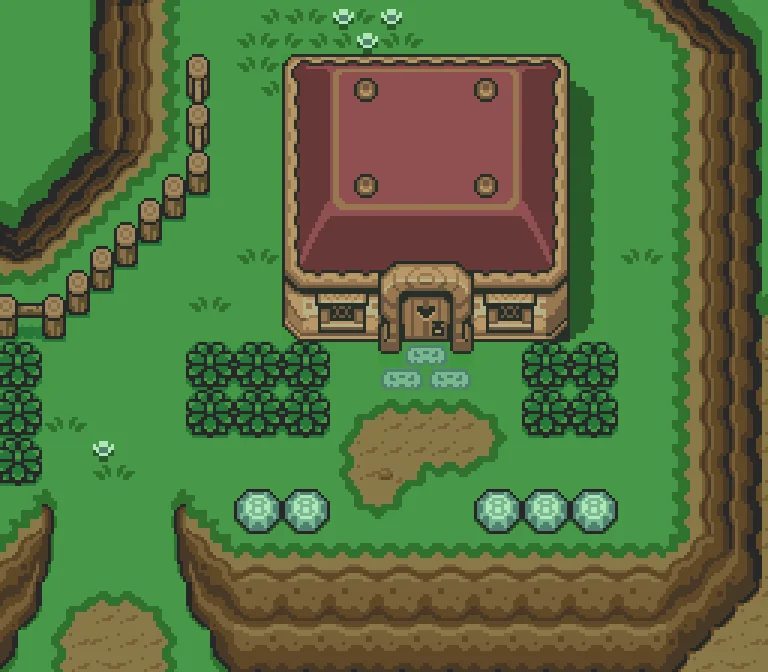
EG drops Link onto a layer underneath the room he is standing in, where walls do not exist. The reason that is catastrophic rather than merely funny is that most of the game's indoor screens live on a single shared map. Get under it and you can walk between rooms that share no door, no stairway and no connection of any kind.
There are three ways to arm it. Save and quit in the middle of an indoor ledge hop and the stored layer change survives the reload. Use the Magic Mirror on the exact frame Link hops a ledge. Or jump into a void, which normal play never lets you reach. Once armed, you cash it in by bonking or taking damage — and you lose it if you use any indoor ledge hop, or any northward ledge hop on the overworld, first. Rooms are graded strong or weak, and only strong ones will let stored EG activate.
Overworld EG behaves differently, because the overworld has only one layer. You cannot walk through terrain there. What you do get is separation from every sprite in the game, which turns the desert monuments and the Lumberjacks' tree into scenery — and Link goes mostly invisible, drawn behind the map's own graphics, surfacing only under transparent tiles like tree roots.
That is the machinery behind a 1:28 world record. The route positions Link in the corner northeast of his own house, feeds the game a string of single-frame diagonals until he clips, transitions a screen, enters a cave, clips into EG off the slope inside, then holds one direction until the Hyrule Castle music starts, another until Ganon's music starts, and up into the Triforce room. There is a beginner-friendly swim route that gives up about five seconds and asks for far less precision.
The same family of tricks powers the RMG categories through Kiki Skip, which clips out of a Death Mountain cave directly into the Palace of Darkness. Because the game never flips its world variable, you explore a Dark World dungeon without the Moon Pearl, and because of how the underworld map wraps, no sprites load at all — no enemies, no crystal switches, no Helmasaur King.
If you want the competitive scene without the frame counting, the randomizer has its own leaderboard and a much shorter learning curve. Everything else lives on the A Link to the Past hub.
Quick Action Checklist
- Learn the ruleset before the route: NMG, RMG and MG differ by exactly four glitches — EG, door glitches, wrong warp, misslotting.
- Most categories time file select to the Triforce room door, not to the credits — but read the category's own rules first, because Master Sword and Mirror Shield stop on the item pickup.
- Start on Master Sword NMG. Same ruleset as the main category, a quarter of the length, save and quit allowed.
- Expect your first Any% NMG run to take about two hours against a 1:22:56 record. That is normal.
- Bank 110 rupees for Kiki — 14 before the trees, plus 10, plus 80, plus 6 from the Circle of Pots.
- Do not route the Gold Sword or Silver Arrows; silverless Ganon is legal in NMG and has been the record route since 2010.
- Drill quickhops, hovering and sword buffering first — every NMG-legal technique carries over into RMG and MG, so none of that practice is wasted.
- Run Japanese 1.0 if you are chasing times: about a minute of text savings plus fake flippers, spindash and superspeed.
- ZSNES and SNES9x 1.43 or below will get your run rejected. Use a current emulator or real hardware.
- The GBA port is a separate leaderboard with a later timing start — never compare its times to the SNES board.
Frequently Asked Questions
What is the world record for A Link to the Past?
What is the difference between NMG, RMG and Major Glitches in ALttP?
Which A Link to the Past category should a beginner start with?
Why do A Link to the Past speedrunners use the Japanese 1.0 version?
What is the Exploration Glitch in A Link to the Past?
Is Low% slower than Any% in A Link to the Past?
Can you speedrun the GBA version of A Link to the Past?
Keep Reading
- speedrun.com — A Link to the Past (rulesets, category rules, current records)
- ALttP Speedrun Wiki — Categories (ruleset definitions and overall rules)
- ALttP Speedrun Wiki — Exploration Glitch (arming methods, EG strength, overworld EG)
- ALttP Speedrun Wiki — JP 1.0 (version-exclusive glitches and text timings)
- speedrun.com — A Link to the Past (GBA) (separate board, rules and timing start)
Related Guides
A Link to the Past Randomizer: The Beginner Guide to ALTTPR
The randomizer does not change the map, the enemies, or the music. It empties 216 item locations and refills them from a shuffled pool, and suddenly a 1991 game you have beaten nine times is a route-finding puzzle you have never played.
ALTTPR Entrance Shuffle: What Each Setting Moves
Entrance shuffle rewires the doors, caves and holes of the A Link to the Past Randomizer and leaves the screen edges alone. Here is what each of the five settings mixes, what never moves, why Ganon's Tower and the Pyramid are always in play, and how the hints change to help you find your way.
ALTTPR Boss Shuffle: Which Bosses Can Land Where
Boss shuffle moves thirteen fights around the A Link to the Past Randomizer and leaves three alone. Here is how Simple, Full and Random deal the bosses, which slots turn which bosses away, what each boss asks for in a sword seed, and how the compass tells you who is waiting.
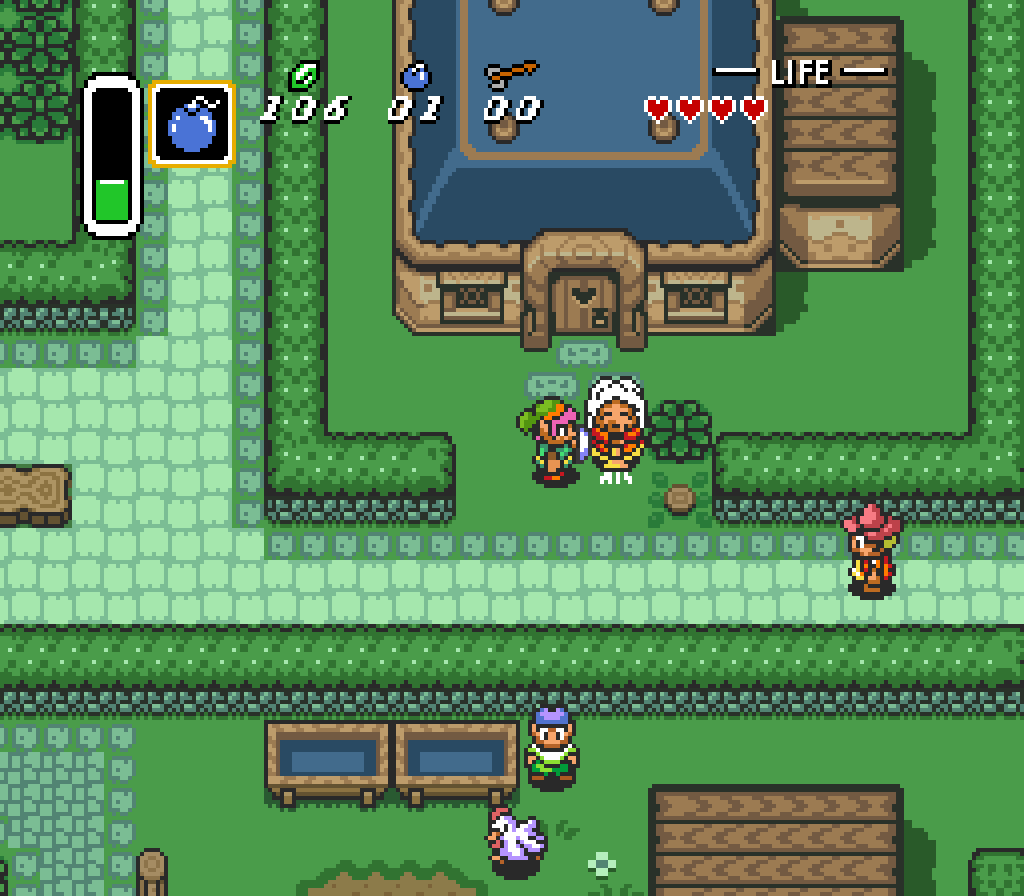
A Link to the Past Cuccos: 35 Hits Until the Flock Attacks
The number is 35, it is counted on one bird, and the flock never forms indoors. Here is the Cucco routine read out of the SNES code: what counts as a hit, how the attackers fly, what they cost you, how to switch them off, and the one Cucco in Kakariko that talks back.
A Link to the Past Beginner Guide: Your First Ten Hours
A Link to the Past hands you a sword and a rainstorm and then says almost nothing else. Here is the route, the combat, and the item order that turn a confusing first hour into a game you can actually finish.
ALTTPR Swordless Mode: Hammer, Medallion Pads and Ganon
Swordless takes every sword out of the A Link to the Past Randomizer and then rewires the game so a seed can still be finished. The Magic Hammer inherits three of the sword's jobs, medallions only fire on their emblem pads, and Ganon wants the Hammer and the silver arrows. Here is what changes, gate by gate and boss by boss.