A Link to the Past SNES vs GBA: Every Difference That Actually Matters
The Game Boy Advance port is not just A Link to the Past on a smaller screen. It has a bonus dungeon, a secret sword technique, a rewritten script, a shorter viewport, and a Link who yells every time he swings. Here is every difference worth knowing before you pick a version.
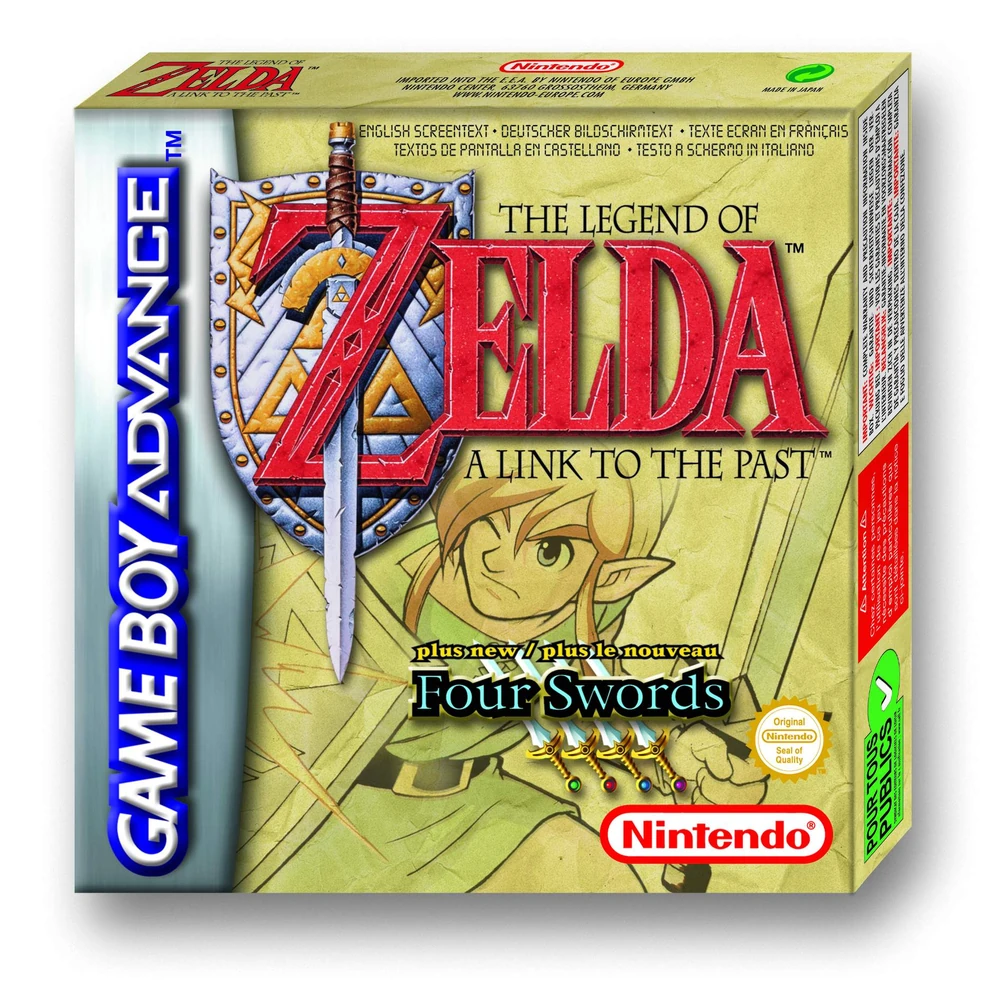
Nintendo has handed you A Link to the Past twice on the same console, and the two versions are not the same game. The Super Nintendo original has been sitting in the base Nintendo Switch Online library since September 5, 2019, one of the twenty SNES launch titles. The Game Boy Advance port — the one bundled with Four Swords — showed up on the Expansion Pack tier on June 18, 2024.
Same Hyrule, same eleven dungeons, same Ganon at the top of the tower. But the GBA cart has a bonus dungeon the SNES version does not, a secret sword technique the SNES version does not, a script that fixes a pile of 1991 translation weirdness, a third less screen to look at, and a Link who yells every single time he swings.
Here is what actually changed, and which one to load up.
Which version should you actually play
Short answer: GBA if you want the most content and the smoother moment-to-moment feel, SNES if you care about the soundtrack and want to see the whole room.
| SNES (1991) | GBA (2002) | |
|---|---|---|
| Resolution | 256 x 224 | 240 x 160 |
| Audio | Full SPC700 samples | Compressed, noticeably thinner |
| Link voice clips | None | Reused young Link clips from Ocarina of Time |
| Bonus dungeon | No | Palace of the Four Sword |
| Bonus technique | No | Hurricane Spin |
| Multiplayer | None | Four Swords, up to 4 players |
| On Switch | Base NSO, since Sept 2019 | NSO Expansion Pack, since June 2024 |
The GBA version is the more generous package by a wide margin. The catch is that its two headline extras are both gated behind Four Swords, which in 2002 meant handing your friends a cartridge each. That gate is a lot easier to walk through now — more on that below.
The screen shrank and the interface got rebuilt around it
This is the difference you notice in the first thirty seconds. The SNES runs at 256 x 224. The GBA screen is 240 x 160. That is roughly a third fewer pixels, and the vertical loss is the part that stings: 64 fewer lines of screen, which is a full quarter of the play area gone.
Nintendo did not squash the world to compensate. The camera is pulled in tighter and the view is cropped, so you are looking at less of every room than an SNES player is. In practice that means archers and Wizzrobes are already firing before they scroll on, and big rooms — Ice Palace, Ganon's Tower, anything with a long sightline — feel more claustrophobic than they were designed to.
The subscreen got a full rebuild to fit the narrower panel. The blocks are packed tighter, the three-font mess of the original was collapsed into one typeface, and your secondary item indicator moved from beside the Magic Meter to beside the Heart Meter.
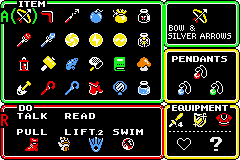
Two menu changes are genuine upgrades:
- Each bottle gets its own inventory slot. On SNES all four Magic Bottles share a single icon and you cycle a submenu to reach the one you want. On GBA they sit side by side and you just grab the fairy. If you keep a proper bottle loadout — and the bottles guide argues you should — this is the single best quality-of-life change in the port.
- The shovel and the flute coexist. On SNES, digging up the Flute replaces the Shovel outright. On GBA you keep both.
The translation finally got fixed
The 1991 English script is charming and frequently wrong. The GBA release quietly cleaned up a lot of it, and a few of the corrections are the ones people still argue about:
- Pegasus Shoes became Pegasus Boots, which is what every later game calls them.
- The Good Bee became the Golden Bee. The original name was a straight mistranslation.
- Faerie became fairy.
- Smithery became Smithy.
The port also puts the dungeon name on screen when you walk in, which the SNES version never did. Minor on paper, genuinely useful when you are eleven dungeons deep and trying to remember whether you already cleared Misery Mire. If you are working out that sequence, the dungeon order guide has the full route.
Quality-of-life changes you feel in the first hour
None of these change the shape of the game, but stacked together they make the GBA version noticeably less fussy:
- Swords pick up items. Slash a rupee and it comes to you instead of demanding a walk-over.
- Master Sword and above cut signs. Petty. Extremely satisfying.
- Arrows break pots. Silver Arrows punch through a whole row of them.
- The Lamp damages enemies. The flame is an actual weapon now, not just a light source.
- The Boomerang cuts signs, and the Magic Boomerang cuts grass and bushes too. That turns the red boomerang into a legitimate rupee-farming tool.
- The Shovel digs in all four directions. The SNES version only let you dig facing left or right.
- Zora's Flippers let you dive. Brief, but it exists.
- Save and quit puts you back at your last save point. On SNES, reloading a Light World file always dumped you in the mountain cave near the Sanctuary regardless of where you stopped. This one alone saves you a genuinely irritating amount of walking.
Two changes cut the other way. The Ice Palace puzzle layout was altered specifically to stop you grabbing the Cane of Somaria early, so a sequence break that worked on SNES is closed. And the Light World cave you reach by mirroring out of Turtle Rock is stocked with Eyegores instead of Goriyas, which is a meaningfully nastier room.
There is also a new Like Like lurking near the Dark World shield shop, and it will eat your shield — Mirror Shield included. The shop right there sells replacements, which is either thoughtful design or the most transparent upsell in Hyrule. Guard your Mirror Shield on the way to Turtle Rock; losing it is a long walk back.
Link has a voice now
The GBA port reuses young Link's voice clips from Ocarina of Time. He yells on every sword swing, grunts when he takes a hit, and screams on the way down a pit.
Reception was, charitably, split. Twenty-plus hours of the same three vocal samples on a fifteen-hertz sword-mashing loop wears on people, and it is the most common complaint about the port from anyone who played the SNES version first.
The bigger audio issue is not the voice, it is everything else. GBA audio hardware could not carry the SNES sound chip's sample quality, so Koji Kondo's soundtrack arrives thinner and grainier across the board. If the Dark World theme is a load-bearing part of why you love this game, that is the strongest single argument for staying on SNES.
The Riddle Quest and the Hurricane Spin
Here is the first piece of exclusive content, and it comes with a requirement that annoyed people in 2002.
Q. Bumpkin is a lumberjack who only exists in the GBA version, hanging around the lumberjacks' house near the Death Mountain entrance. Talk to him and he hands you a Basket — it takes over the question-mark slot in your inventory — and starts feeding you riddles. You solve each one by using the Bug-Catching Net to catch the object or creature the riddle describes and dropping it in the basket. There are ten riddles, and the last answer is a Cukeman.
Finish all ten and Bumpkin teaches you his family's secret sword technique: the Hurricane Spin. You charge your sword like a normal spin attack, then mash B while steering with the D-pad to chain multiple spins in a row. It eats magic while it runs, so the Half Magic upgrade from the Mad Batter matters more than usual — the items and upgrades guide covers where that lives.
The gate: you need 10 Medals of Courage from Four Swords on the same save, plus the Bug-Catching Net to solve the riddles. Medals come from the multiplayer half of the cartridge. No Four Swords, no Hurricane Spin.
The Palace of the Four Sword
The other exclusive is a whole extra dungeon, and it is the best reason to play the GBA version.
Unlock: beat Ganon in A Link to the Past and beat Vaati at least once in Four Swords, on the same file. Do both and a new hole opens on the east side of the Pyramid of Power, next to a statue. A gatekeeper takes 20 rupees and steps aside.
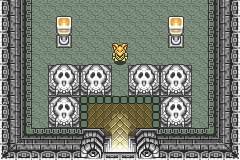
Inside is a hub room with four doorways and a fifth sealed behind a barrier the Master Sword cannot touch. Each of the four wings is a short puzzle run that ends in a boss and a sword in a pedestal. The bosses are palette-swapped, buffed versions of the first four Dark World bosses — Helmasaur King, Arrghus, Mothula, and Blind. If you have already handled them once, the boss guide patterns still apply; they just hit harder and take longer.
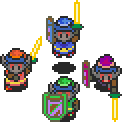
Collect all four swords and the barrier drops. Behind it: four Dark Links, fought one at a time, in the order green, red, blue, purple. Each one brings a new special attack and keeps every move the previous ones had, so the fourth fight is the first three stacked on top of each other. It is comfortably the hardest thing in either version of the game.
And the reward for all of that? A Quest Log on the ending credits. It shows how many times you used each item, how many times you saved, rupees found, enemies killed, total play time. No new item, no new heart container. Pure bragging rights and a stat sheet.
That is a genuinely funny payoff for the hardest content Nintendo ever bolted onto this game, and it is also completely in character for a 2002 GBA bonus mode.
Why almost nobody saw that content in 2002
Both extras route through Four Swords, and Four Swords on GBA was cartridge-per-player. Not one cart and a link cable — every single player needed their own copy of the game, their own Game Boy Advance, and a link cable to connect them. Two players meant two GBAs, two cartridges, and one cable. Four players meant four of everything plus extra cables.
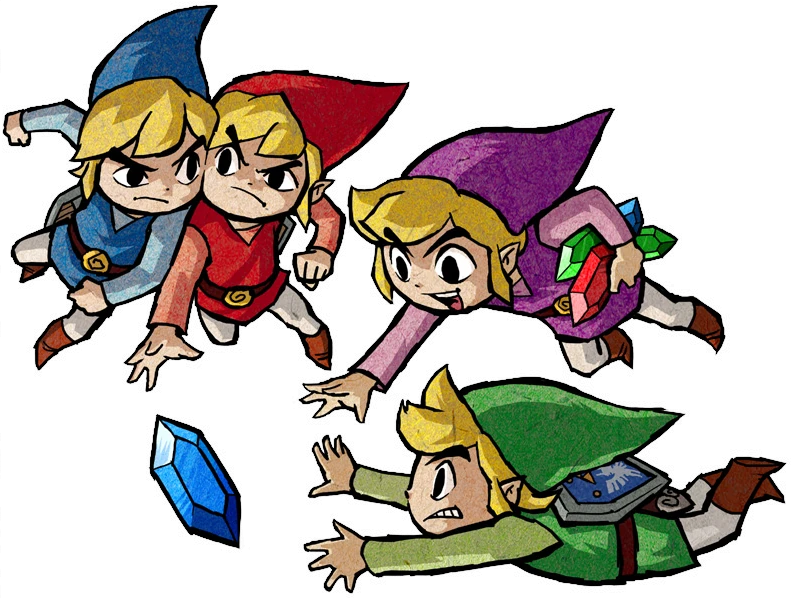
That is why an enormous number of people who owned this cartridge in 2002 never once saw the Palace of the Four Sword. The hardware barrier was absurd even by the standards of an era that thought link cables were normal.
The Nintendo Switch Online release is what changed the math. The Expansion Pack version supports online play for up to four players, so you can now clear Four Swords with people who are not sitting on your couch. The tradeoff: that version is online-only for multiplayer — there is no local co-op option. Which is a strange inversion of the original problem, but it does mean the exclusive content is genuinely reachable for the first time in over two decades.
The Chris Houlihan room got walled off
For completeness, because someone always asks: the Chris Houlihan room still exists in the GBA version's code, but every SNES method of reaching it fails, and nobody has found a legitimate way in. The telepathic tile carrying his message was removed outright, so even if you glitched your way inside you would find an empty blue-rupee room with no name on it.
If you want the famous version of that story, you want the SNES cart. New to the game entirely? Start with the beginner guide, and the A Link to the Past coverage hub has the rest of the routing.
Quick Action Checklist
- Playing for the content: take the GBA version. Bonus dungeon, Hurricane Spin, better menus, better script.
- Playing for the soundtrack and the framing: take the SNES version. Full-quality audio, and 224 lines of screen instead of 160.
- On Switch, SNES is base NSO and GBA is Expansion Pack only.
- Both GBA exclusives need Four Swords progress: 10 Medals of Courage for the Riddle Quest, one Vaati kill for the Palace of the Four Sword.
- The Palace entrance is a hole on the east side of the Pyramid of Power; the gatekeeper wants 20 rupees.
- Palace boss order: four recolored Dark World bosses, then Dark Links in green, red, blue, purple sequence.
- On GBA, guard your Mirror Shield near the Dark World shield shop — the new Like Like there eats it.
- Do not expect a prize for the Palace. The reward is a Quest Log on the credits and nothing else.
Frequently Asked Questions
Is the GBA version of A Link to the Past better than the SNES version?
How do you unlock the Palace of the Four Sword?
What do you get for beating the Palace of the Four Sword?
How do you get the Hurricane Spin in A Link to the Past?
Can you play Four Swords on Nintendo Switch Online?
Does Link talk in the GBA version of A Link to the Past?
Keep Reading
Related Guides
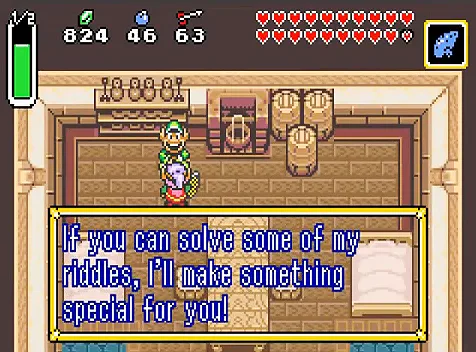
A Link to the Past GBA Riddle Quest: All 10 Answers
Ten one-line clues, ten things to scoop up with the Bug-Catching Net, and a sword technique at the end of it. The Riddle Quest only exists on the Game Boy Advance cartridge, and it will not start until you have won ten Medals of Courage in Four Swords.
A Link to the Past Light World Guide: The Half of Hyrule Everyone Underrates
Everyone remembers the Dark World. But the Light World is where the Flute fast-travel lives, where half your bottles and upgrades hide, and where a whole quest turns Kakariko into a warp hub most players never bother to unlock. Here is the map you thought you already knew.
A Link to the Past Dark World Guide: Crystals, Mirror Tricks, and the Stuff Nobody Tells You
Agahnim drops you on top of a golden pyramid with no map, no explanation, and seven crystals to find. Here is how the Dark World is actually laid out, what gates what, and which detours are worth taking before Ganon Tower.

A Link to the Past Crystal Switches: One Byte, Whole Dungeon
A Link to the Past does not track its orange and blue Switch Fence panels room by room. One RAM byte, shared by the entire dungeon, decides whether every crystal switch and every panel in it is up or down — including the ones in rooms you have not opened yet. Here is the exact byte, what it will and will not respond to, and why it resets the second you walk back through the door.
A Link to the Past Beginner Guide: Your First Ten Hours
A Link to the Past hands you a sword and a rainstorm and then says almost nothing else. Here is the route, the combat, and the item order that turn a confusing first hour into a game you can actually finish.
A Link to the Past Movement Speed: When Dashing Is Slower
A Link to the Past does not simulate movement. It looks it up. One byte picks your speed, the byte divided by sixteen is your pixels per frame, and every surface and every held item swaps the byte for a worse one. Here is the table, and the arithmetic that says the Pegasus Shoes are a loss under four and a half tiles.