Cookie Run: Braverse Color Pairs Guide: Which Two-Color Decks Actually Work
Two-color decks in Braverse aren't just 'jam your favorite cards together.' The generic-energy system decides which splashes hold up and which ones brick your Support Area. Here's what actually works.
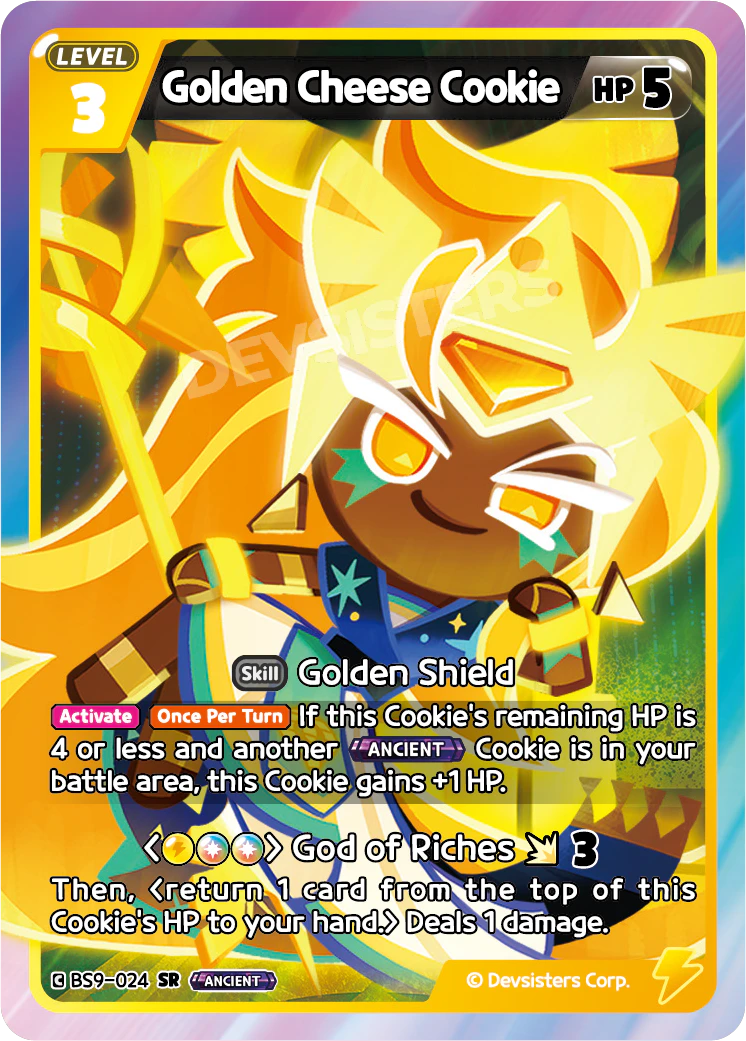
Here's the trap almost every new Braverse player walks into: you open a Yellow Golden Cheese Cookie and a Blue White Lily Cookie in the same booster, they both say "Ancient," they both look busted, and you shove them into one deck by Friday night. Then you spend six games staring at a Support Area that can never pay for the card you actually want to cast.
Two-color decks are real, they're strong, and some of the best decks in the game are pairs. But whether a splash holds up has almost nothing to do with how cool the cards look together and almost everything to do with one boring number: how much of each card's cost is generic. This guide walks the pairs that actually work, the ones that quietly don't, and the exact card examples that prove it. If you're still fuzzy on the resource system, read the energy guide first, because the whole argument below rides on it.
The real cost of a second color
In Braverse you don't tap lands or float mana. You pay for cards by resting cards in your Support Area, and you add exactly one Support card per turn. That single constraint is the entire reason two-color decks are a real decision instead of a free upgrade.
When you run one color, every Support card you place can pay for every card in your deck. Run two colors and you split that pool. Now some of your Support cards can only fuel one half of your deck, and on the turns the split goes wrong, you're holding a hand you can't cast. The cost of a second color isn't the cards. It's consistency. Every splash you add makes your resource base a little worse, and you only come out ahead if the second color pays you back with something your main color literally cannot do.
So the real question for any pair isn't "do these two colors have good cards?" Every color has good cards. It's "can this deck reliably produce the colored energy both halves demand, turn after turn?" That's where the card costs come in.
How multicolor actually works: generic energy
Look at any Braverse attack cost and you'll see two kinds of symbols. There's the colored pip, written like {R} or {B}, that demands energy of that specific color. And there's the generic pip, written {N}, that any color can pay. The ratio between those two is the whole ballgame for splashing.
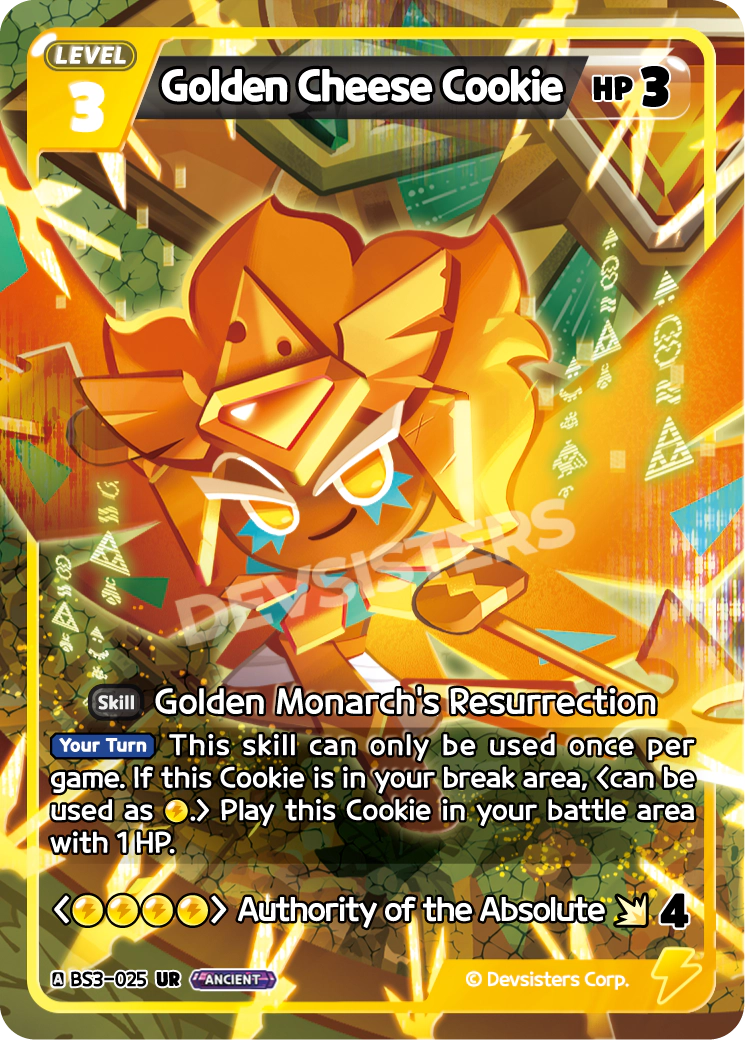
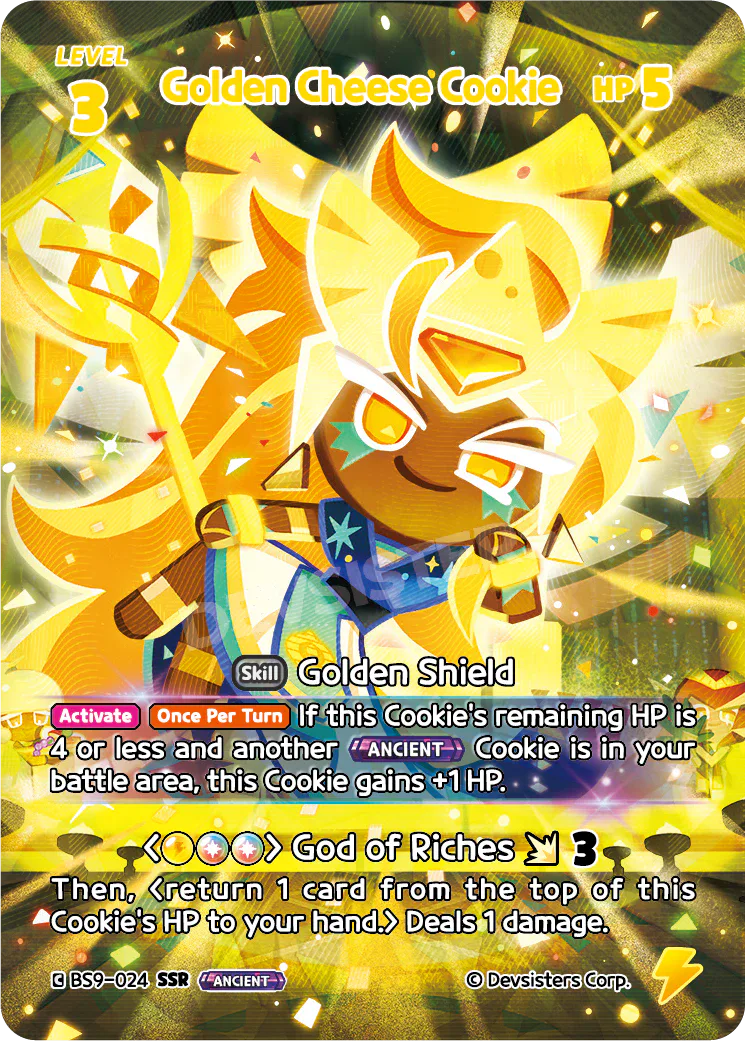
Take Golden Cheese Cookie, the Yellow Ancient in the hero image. Its God of Riches attack costs {Y}{N}{N} for 3 damage. Only one of those three pips actually cares that you're Yellow. The other two are generic, so a Blue or Purple splash can cover them without a single Yellow Support card. Compare that to Black Sapphire Cookie, whose Showtime! attack costs {P}{P}{P} - three colored pips, zero generic. That card fights you in a two-color deck because it wants your Support base to be almost entirely Purple.
That's the sorting rule, and it's falsifiable: I counted the enabled cardpool, and the single-colored-pip-plus-generic cost pattern (a card costing {X}{N}...) shows up on 68 Red Cookies, 53 Yellow, 51 Green, 49 Blue, and 44 Purple. Those roughly 265 Cookies are your splash-friendly toolbox. The triple-colored-pip cards are the ones that want a mono base. When you evaluate a pair, you're really asking how many of its payoff cards live in that generic-friendly column. For the deeper mechanics, the deck building basics guide covers how to count your energy sources properly.
The Ancient pairs: Yellow, Blue, Purple
If you want a two-color deck that was practically designed to be two colors, start with Ancient. The keyword spans all five colors, and the marquee Ancient Cookies conveniently carry that generic-heavy cost pattern. Better yet, several of them explicitly reward you for having another Ancient Cookie on the board - so mixing colors is upside, not tax.
Yellow and Blue: the value pair
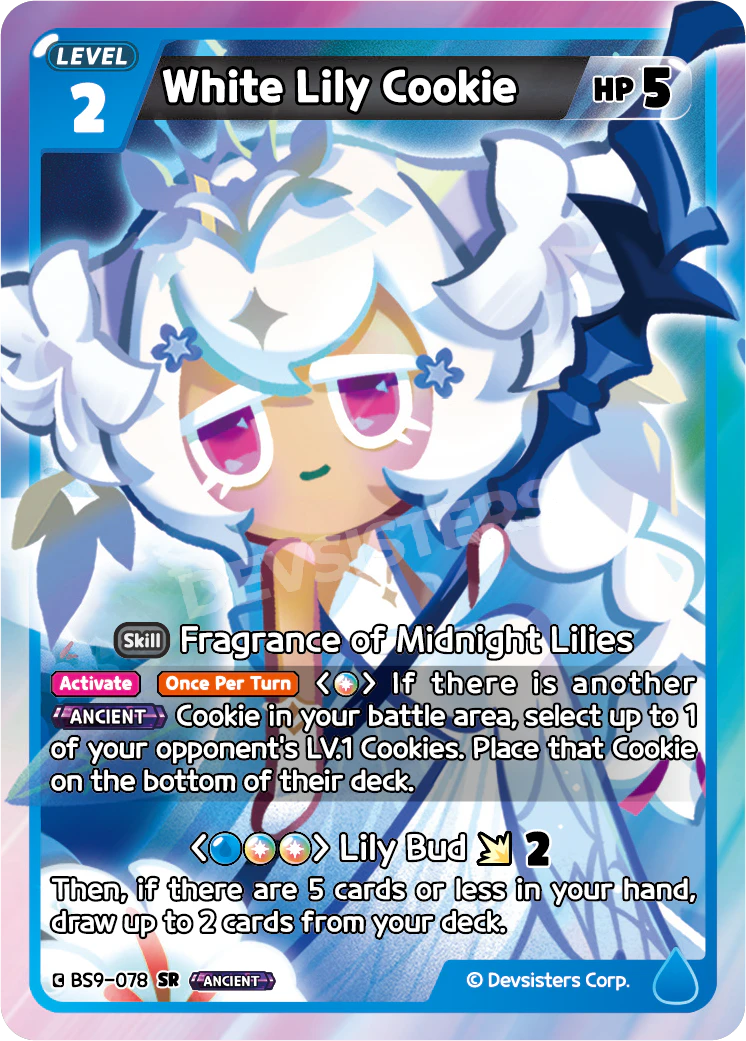
This is the pairing I'd hand a new player who wants to try multicolor without hating their life. White Lily Cookie is a Blue Ancient whose Lily Bud attack costs {B}{N}{N}, and its skill only lights up when there's another Ancient Cookie in your battle area: for a {N}, it can put an opponent's Level-1 Cookie on the bottom of their deck. Golden Cheese Cookie, the Yellow half, wants the exact same thing - it gains HP when another Ancient is around, and its attack is {Y}{N}{N}.
Notice what's happening: both payoffs are one colored pip and two generic. A deck running roughly half Yellow, half Blue Support can cast either one on curve, and each makes the other better. Blue brings the card draw - White Lily's attack refills your hand when you're low - and Yellow brings the grindy HP-gain and value engine. It's a control deck that draws its own gas. If you like the patient plan, cross-reference the control deck guide for the mono version and see what the splash buys you.
Yellow and Purple: the attrition pair
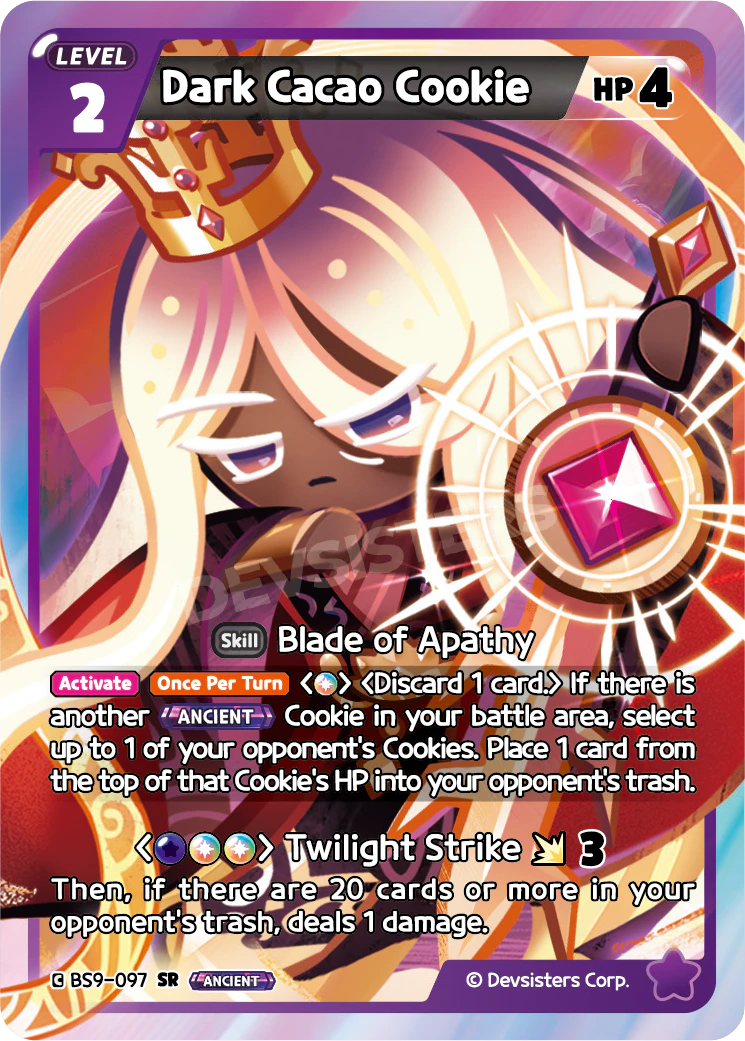
Swap the Blue for Purple and the deck gets meaner. Dark Cacao Cookie is a Purple Ancient with a {P}{N}{N} attack, and again its skill keys off having another Ancient Cookie present - for a {N} and a discard, it strips a card off the top of an opponent Cookie's HP. Its Twilight Strike also deals a bonus point of damage if there are 20 or more cards in the opponent's trash, which tells you where this deck wants the game to go: long, grindy, and full of the opponent's stuff in the bin.
Yellow's late-game math is the perfect partner. Where the Yellow-Blue build wants to out-draw you, Yellow-Purple wants to out-last you - peel HP, deny recovery, and win the attrition war. The catch is that Dark Cacao's trash payoff is conditional, so you either lean into a plan that fills the opponent's trash or you treat that clause as a bonus rather than the game plan. For a look at how Purple recurs its resources, the combos and synergies guide is the right next stop.
Green and Purple: the mill engine
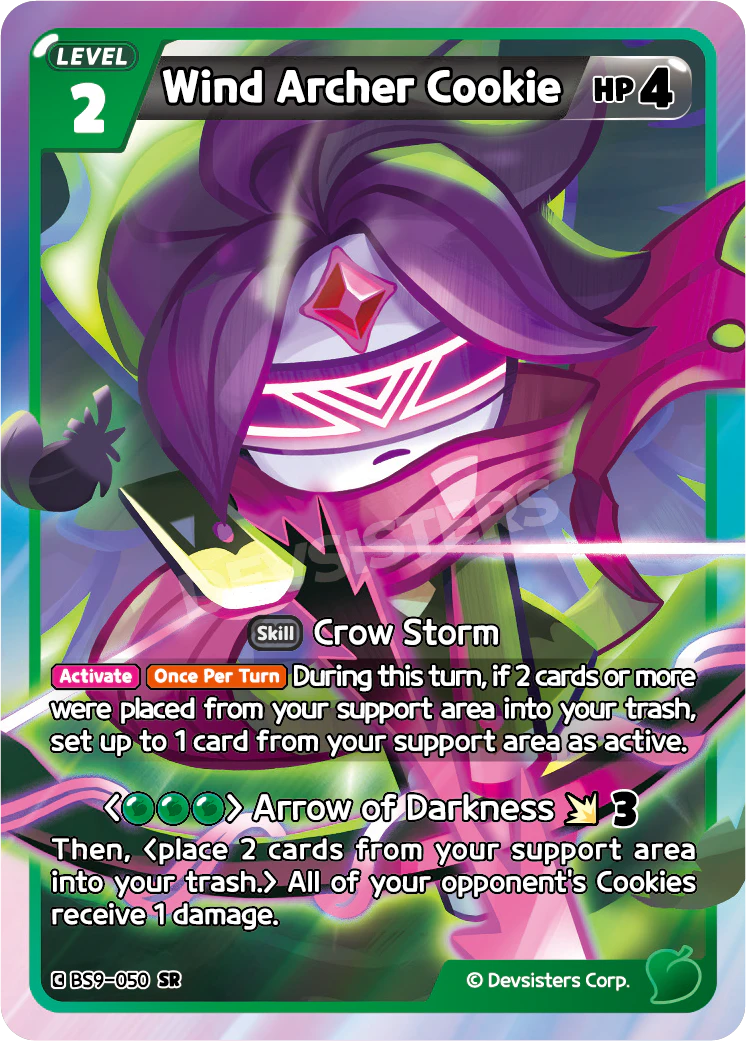
This one isn't held together by a keyword - it's held together by a shared verb: putting cards into the trash. Green in the current pool is loaded with Support-Area recursion. Wind Archer Cookie's Crow Storm skill sets a Support card active whenever two or more cards hit the trash from your Support Area that turn, and its Arrow of Darkness attack ({G}{G}{G}) can trash two more Support cards to ping every opposing Cookie for 1. Green is the engine that keeps the trash filling without running you out of resources.
Purple is the payoff. Black Sapphire Cookie's On Play effect mills five off both decks, and Dark Cacao (again) turns a fat opponent trash into extra reach. Put them together and you get a genuine mill-and-grind deck: Green keeps the Support Area churning, Purple converts that churn into damage and deck destruction.
The honest catch: Wind Archer's attack is {G}{G}{G} and Black Sapphire's is {P}{P}{P} - both triple-colored, zero generic. This is the least splash-friendly pair in the guide, and it shows. You cannot run a lazy 50/50 base here; you have to build your Support ratio deliberately around which color you cast first each game. If that sounds like your kind of puzzle, the mill deck guide goes deep on sequencing it.
Red and Yellow: aggro with a control top end
Most aggro-plus-control pairings are a contradiction, and Braverse is no exception - but there's a specific version that works. The trick is not trying to be both decks at once. You build a Red aggro shell and splash a small Yellow top end to close games that go long.
Red's early game is cheap and generic-heavy. Melted Choco Cookie and Candy Apple Cookie are both {R}{R} Level-1 aggressors that flood the board early. The problem every mono-Red deck eventually hits is the game it can't finish, and that's where a couple of Yellow finishers earn their slot. Something like Truthless Recluse, a Yellow Level-3 whose skill can stop the opponent from adding HP to their Cookies for a turn, is exactly the kind of "seal the deal" card Red lacks.
But be honest about the cost pattern. Recluse's attack is {Y}{Y}{Y} - triple-colored. That means this is a light Yellow splash, a handful of finishers, not a true 50/50. If you find yourself wanting more than three or four Yellow cards, you don't want a pair; you want to be a mono-Yellow control deck that plays a little faster. The aggro deck guide covers the mono-Red baseline you're deviating from.
Pairs that fight themselves
Not every combination is a hidden gem. Some pairs actively work against each other, and it's worth naming them so you don't waste a fortnight learning it the hard way.
The classic mistake is pairing two colors whose best cards are all triple-colored-pip. Two aggressive colors that both want {X}{X} costs on turn one give you the worst of the split-base problem: you need a specific color early, when your Support Area is smallest and least flexible, and a wrong-color draw just means you don't get to attack. Aggro is the archetype least able to afford inconsistency, which is exactly why most strong aggro decks stay mono.
The other trap is thematic, not mechanical: pairing a fast-clock color with a slow-payoff color and expecting them to add up. A hyper-aggressive Red plan and a grindy 20-cards-in-trash Purple plan don't reinforce each other - they compete for the same deck slots and pull the game length in opposite directions. When a pair feels bad, it's usually one of these two: the energy won't cooperate, or the two game plans want different games. The meta tier list is a good sanity check on which pairings are actually showing up in results versus which just look good on paper.
When to stay single-color
Here's the part nobody wants to hear: for most players, most of the time, mono is correct. A single-color deck casts everything it draws, mulligans cleaner, and never has the game where it draws the right cards in the wrong colors. If you're still learning the turn structure or you haven't nailed your mulligan decisions, a second color will punish you before it rewards you.
Go two-color when you can answer a specific question: what does the splash do that my main color can't? "White Lily draws me cards Yellow can't" is a real answer. "Purple has cool cards" is not. The Ancient pairs earn their splash because the keyword literally pays you for mixing, and because the payoff cards are generic-heavy. Everything else needs a deliberate Support-ratio plan and a reason. Splash for a hole in your deck, never for a highlight reel.
Quick Action Checklist
- Read the pip ratio first. Before you splash any card, check its cost. One colored pip plus generic ({X}{N}{N}) is splash-friendly; triple-colored ({X}{X}{X}) wants a mono base.
- Start with Ancient. Yellow-Blue (value) and Yellow-Purple (attrition) are the beginner-safe pairs because the keyword rewards mixing and the payoffs are generic-heavy.
- Splash for a hole, not a highlight. If the second color doesn't do something your main color can't, cut it.
- Keep aggro mono. Fast decks can't afford wrong-color early draws - Red-Yellow works only as a light finisher splash, not a 50/50.
- Build your Support ratio on purpose. For triple-pip pairs like Green-Purple, decide which color you cast first each game and skew your base accordingly.
- When in doubt, stay mono. It mulligans cleaner and never draws the wrong colors. Earn the splash after you've mastered one color.
Frequently Asked Questions
What is the best two-color pair in Cookie Run: Braverse?
How does multicolor energy work in Braverse?
Should beginners play single-color or two-color decks?
Why is Green-Purple hard to build as a two-color deck?
Which color pairs should I avoid in Braverse?
Keep Reading
Related Guides
The Break Area Is a Resource, Not a Graveyard (Braverse)
Most players treat the break area like a graveyard pile and forget it exists. It has a number attached to it, 81 cards read that number, and Yellow decks are quietly built to inflate it on purpose.
Cookie Run: Braverse Extra Deck Guide — All 17 Cards
The Extra Deck is six free cards that most Braverse players fill wrong. Here is how the zone actually works, all 17 EXTRA cards broken down by their printed conditions, and the build rule that decides whether your slots ever fire.
Cookie Run: Braverse Tech Cards Guide (Flex Slots That Win Games)
Tech cards are the flex slots that answer the deck your list has no plan for. Here's which Braverse answer traps, removal, bounce, and hate cards are worth running - all verified against the official database - plus how many slots to give them.
Cookie Run: Braverse Sideboard Guide — Tech Without One
Braverse locks your deck at registration - there's no sideboard to hide behind. This guide covers the tech binder system, flex-slot math, and database-verified swaps for aggro, control, mill, and midrange, so your 60 is already right before round one.

How to Play Cookie Run: Braverse - A Complete Beginner Guide
Cookie Run: Braverse is the rare TCG you can teach in a single match. This guide covers everything a first-time player needs: card types, setup, turn structure, how you pay for cards, the FLIP mechanic, and how to win.
Cookie Run: Braverse Meta Tier List — Best Decks & Archetypes Ranked
Which Cookie Run: Braverse decks are actually carrying right now? Here's a meta tier list of the strongest archetypes - the real cards that anchor each one, why they rank where they do, and what's overrated.