Minecraft Ruined Portals: Loot Table and How to Fix One
A ruined portal is a half-built Nether portal with a chest beside it. Here is what that chest actually rolls, where each variant generates, and how to finish the frame and light it, including what to do about crying obsidian.
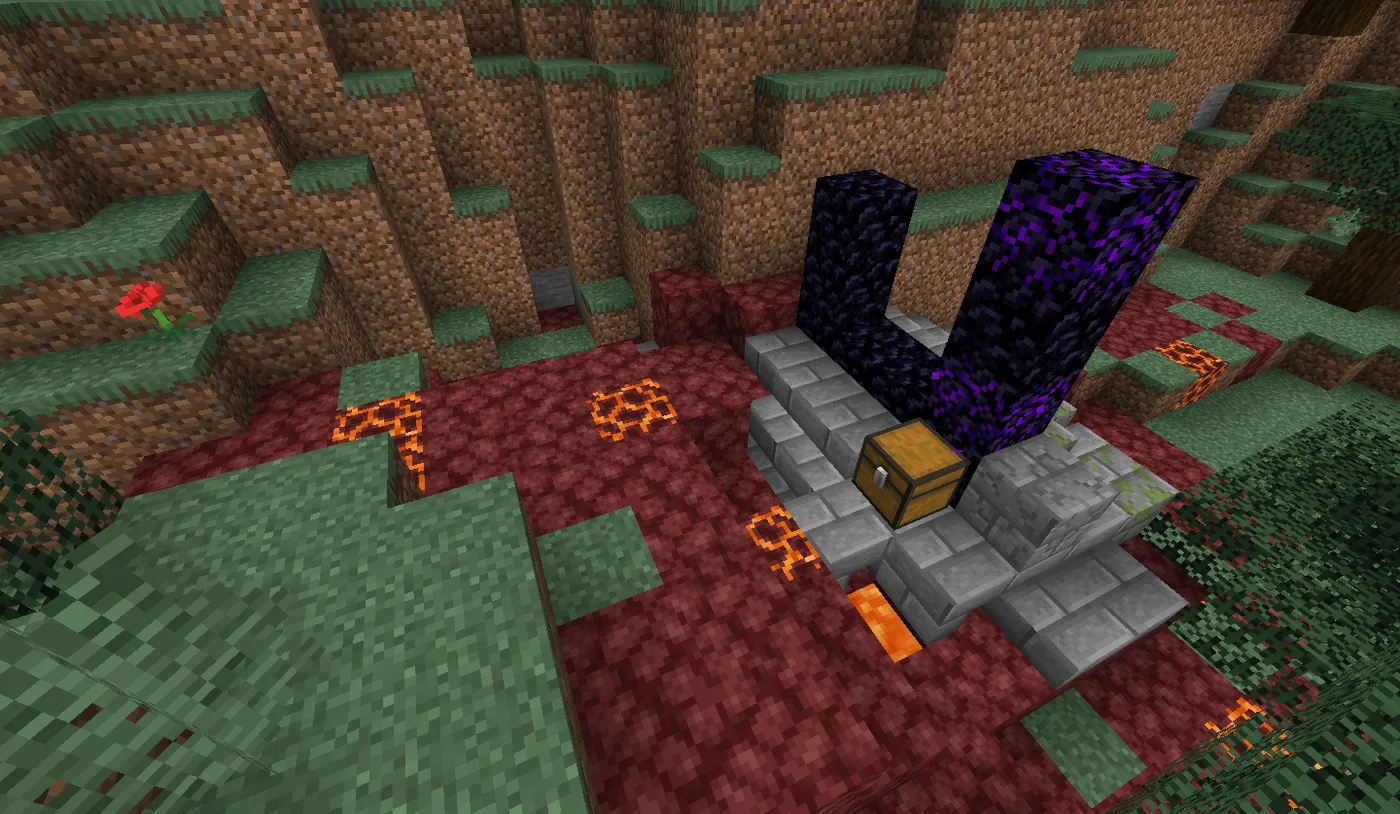
A ruined portal is the game leaving you a half-finished Nether portal and a chest of gold next to it, then swapping some of the frame for crying obsidian, which will not light. This guide covers where ruined portals generate, what the chest really rolls, and how to finish and light the frame without a diamond pickaxe.
The loot numbers come from the vanilla data for Java Edition 26.3, the current release, checked against the 26.4 Snapshot 8 data (the loot table is unchanged) and Mojang's published Bedrock behavior pack, which uses the same items, weights and stack sizes.
Ruined portals at a glance
| Ruined portal | |
|---|---|
| Dimensions | Overworld and the Nether |
| Biomes | Nearly every Overworld biome (the wiki names the deep dark as the exception) and every Nether biome |
| Designs | 10 normal (95% of portals) and 3 giant (5%) |
| Spacing (Java) | One attempt per 40 by 40 chunk region (640 by 640 blocks), at least 15 chunks apart |
| Loot | 1 chest: 4 to 8 rolls from the main pool, plus a 2 in 3 shot at 1 or 2 lodestones |
| Frame | Obsidian, with each block having a 15% chance (Java) or 20% (Bedrock) to generate as crying obsidian instead |
| Java locate | /locate structure #minecraft:ruined_portal finds any variant |
Two edition notes. On Bedrock the chest always generates; on Java, the Minecraft Wiki notes it can be replaced when terrain overrides it, usually lava. And Bedrock's higher crying obsidian rate means more frames that need patching.
Where they generate
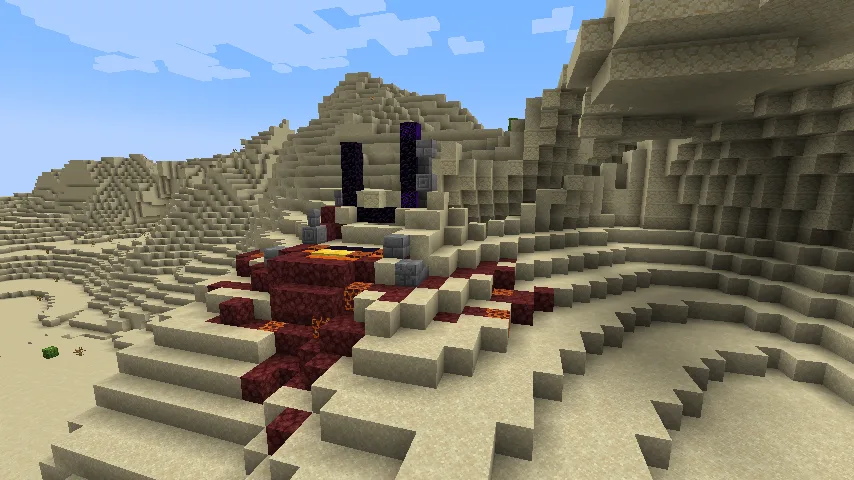
Java splits ruined portals into seven variants by biome. They all share the same loot table; what changes is how the structure sits in the world, which decides whether you will even see it.
| Variant | Biomes (Java data) | How it sits |
|---|---|---|
| Standard | Plains, forests, taigas, beaches, rivers, savanna, snowy plains, ice spikes, mushroom fields, and the dripstone, lush and sulfur cave biomes | 50% buried underground with an air pocket, 50% on the surface |
| Desert | Desert | Partly buried, 2 to 8 layers showing above the sand |
| Jungle | All jungle biomes | On the surface, overgrown with jungle leaves and vines |
| Swamp | Swamp and mangrove swamp | On the ground or the bottom of swamp water, with vines |
| Mountain | Badlands, windswept hills, windswept savanna, savanna plateau, stony shore, meadow, cherry grove, snowy slopes and the peaks | 50% inside the mountain, 50% on the surface |
| Ocean | All oceans | On the sea floor; lava becomes magma blocks, or netherrack in a cold ocean |
| Nether | All Nether biomes | Stone bricks swapped for blackstone, iron bars for chains |
What that means in practice:
- Look for the netherrack. Every ruined portal spreads netherrack into the ground around it, which is easy to pick out against grass, sand or snow. The standard and mountain variants hide best on land: half of them generate buried.
- Cold biomes are safer. Per the wiki, a ruined portal in a biome colder than 0.15 temperature swaps its lava for netherrack, so snowy portals have no lava to fall into.
- Jungle portals can start fires. They are overgrown with leaves, and the wiki's gallery shows leaves catching fire from the portal's own lava.
- The 26.4 snapshots add ice caves to the standard variant's biome list, so the ice caves biome from the upcoming drop can hold one too.
You will not have to look far. Unlike a desert or jungle temple, which only generates in its own biome type, almost every region of the Overworld qualifies, so the wiki describes one ruined portal per 640-block square.
Ruined portal loot table
Every ruined portal chest, in every variant and both dimensions, rolls the same table: 4 to 8 rolls from the main pool, then one roll with a 2 in 3 chance of lodestones. "Chance per chest" is the odds of at least one of that item in a single chest.
| Item | Stack | Chance per chest | Average per chest |
|---|---|---|---|
| Lodestone | 1-2 | 66.7% | 1.0 |
| Iron nugget | 9-18 | 46.4% | 8.1 |
| Flint | 1-4 | 46.4% | 1.5 |
| Obsidian | 1-2 | 46.4% | 0.9 |
| Flint and steel | 1 | 46.4% | 0.6 |
| Fire charge | 1 | 46.4% | 0.6 |
| Gold nugget | 4-24 | 20.5% | 3.2 |
| Golden apple | 1 | 20.5% | 0.23 |
| Enchanted golden sword, axe, pickaxe, shovel or hoe | 1 | 20.5% each | 0.23 each |
| Enchanted golden helmet, chestplate, leggings or boots | 1 | 20.5% each | 0.23 each |
| Glistering melon slice | 4-12 | 7.3% | 0.6 |
| Golden carrot | 4-12 | 7.3% | 0.6 |
| Gold ingot | 2-8 | 7.3% | 0.38 |
| Clock | 1 | 7.3% | 0.08 |
| Light weighted pressure plate | 1 | 7.3% | 0.08 |
| Golden horse armor | 1 | 7.3% | 0.08 |
| Block of gold | 1-2 | 1.5% | 0.02 |
| Bell | 1 | 1.5% | 0.02 |
| Enchanted golden apple | 1 | 1.5% | 0.02 |
The golden tools and armor always come enchanted, with a random enchantment from the game's random-loot list.
The lodestone is the newest line. It was added to ruined portal chests in Java 1.21.5 and Bedrock 1.21.70 (after a stint behind an experimental toggle in 1.21.60), alongside the recipe change that swapped the lodestone's netherite ingot for an iron ingot. A lodestone makes a compass point at it, so it is a free waypoint for your base or your portal.
The chest is a Nether starter kit
Read the table as a shopping list and it is obvious what the chest is for. Working the odds through all 4 to 8 rolls:
| What you need for the Nether | Chance a single chest has it |
|---|---|
| A ready lighter (flint and steel or a fire charge) | 72.7% |
| A lighter, or flint plus iron nuggets to craft flint and steel | 79.5% |
| At least one piece of enchanted golden armor | 61.5% |
| At least one golden armor or tool piece | 90.2% |
| Spare obsidian (1 or 2) | 46.4% |
Two of those matter more than the rest:
- The lighter. Iron nuggets come in stacks of 9 to 18, and 9 nuggets craft an iron ingot, so a chest with flint and nuggets is a flint and steel even if it rolled no lighter. Only about one chest in five leaves you with nothing to light the portal.
- The golden armor. Per the Minecraft Wiki, piglins are neutral to a player wearing at least one piece of golden armor. A ruined portal chest hands you a piece in about 61.5% of chests, which is exactly the protection the Nether guide tells you to pack.
The gold is a smaller prize. The average chest holds about 3 gold nuggets and 0.4 gold ingots, which is under one ingot's worth of piglin bartering. The golden carrots are the better find at 7.3%, since the Minecraft Wiki lists them as the highest-saturation stackable food (14.4); our food and hunger guide has the full ranking. The enchanted golden apple, at 1.5% per chest, is a lottery ticket, not a reason to come.
Do not forget the structure itself. Most designs have one or more blocks of gold in the stonework, though each one has a 30% chance to generate as air instead. Mined with an iron pickaxe or better, a block of gold drops itself, and it crafts back into 9 gold ingots.
How to finish and light a ruined portal
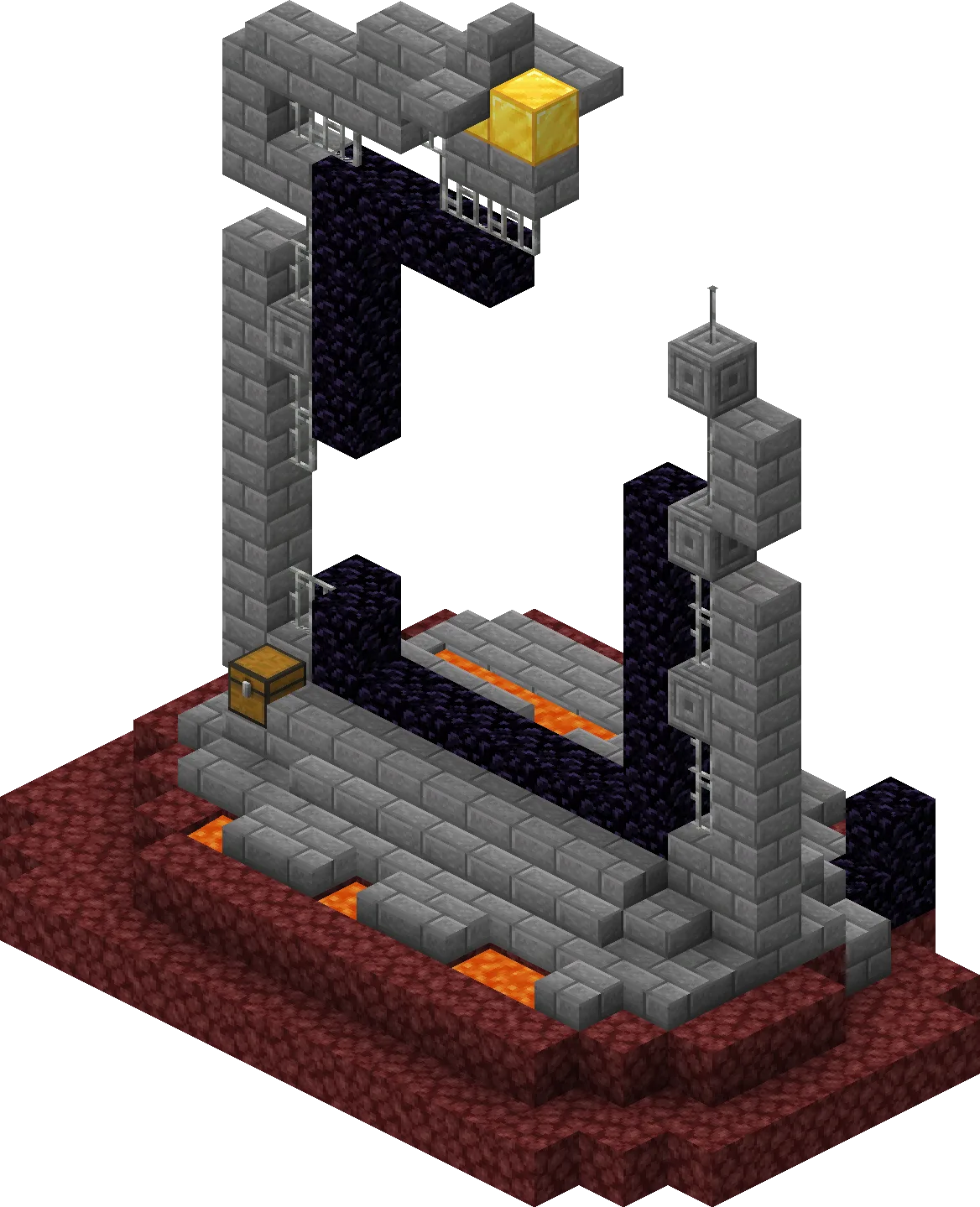
The frame rules are the normal Nether portal rules, per the Minecraft Wiki: a vertical rectangle of obsidian from 4 by 5 up to 23 by 23, and the four corners are not required. The two rules that trip people up at a ruined portal:
- Crying obsidian does not count. A frame with crying obsidian anywhere in its sides, top or bottom will not light. In a corner it does not matter, because corners are not part of the frame.
- The fire must go in last. The wiki notes that a fire set inside an unfinished frame does not activate the portal when you place the final obsidian. Finish the frame, then light it.
So the job is:
- Look at the frame and count the gaps, ignoring corners. Any crying obsidian in a non-corner position is a gap too.
- Clear the crying obsidian. You need a diamond or netherite pickaxe to mine it and keep it. Any other tool takes far longer and drops nothing, but the block still comes out, which is all you need here.
- Fill the gaps. You have three sources: the 1 or 2 obsidian the chest rolls 46.4% of the time, loose obsidian lying around the structure (diamond pickaxe needed to collect it), or cast it in place. Pour a lava source into the gap with a bucket, then pour water so it flows onto the lava and turns it to obsidian. Most ruined portal designs include lava (except in cold biomes and oceans, where it is replaced), so the lava is often right there.
- Light it with flint and steel or a fire charge, both of which the chest may have handed you.
How short you will be depends on the design. The normal portals hold 11 to 17 obsidian before the crying swap, and the giant ones 25 to 31. At Java's 15% swap rate, an 11-obsidian portal averages about 1.7 crying blocks. Per the wiki, most ruined portals contain enough obsidian in total for a complete portal, but the smaller ones may not once crying obsidian has taken its cut.
Once it is lit, a ruined portal links like any other portal, using the 1 to 8 coordinate math. If you already have a portal of your own nearby, read the portal linking guide first, because a second lit portal in range can steal your link.
Nether ruined portals and piglins
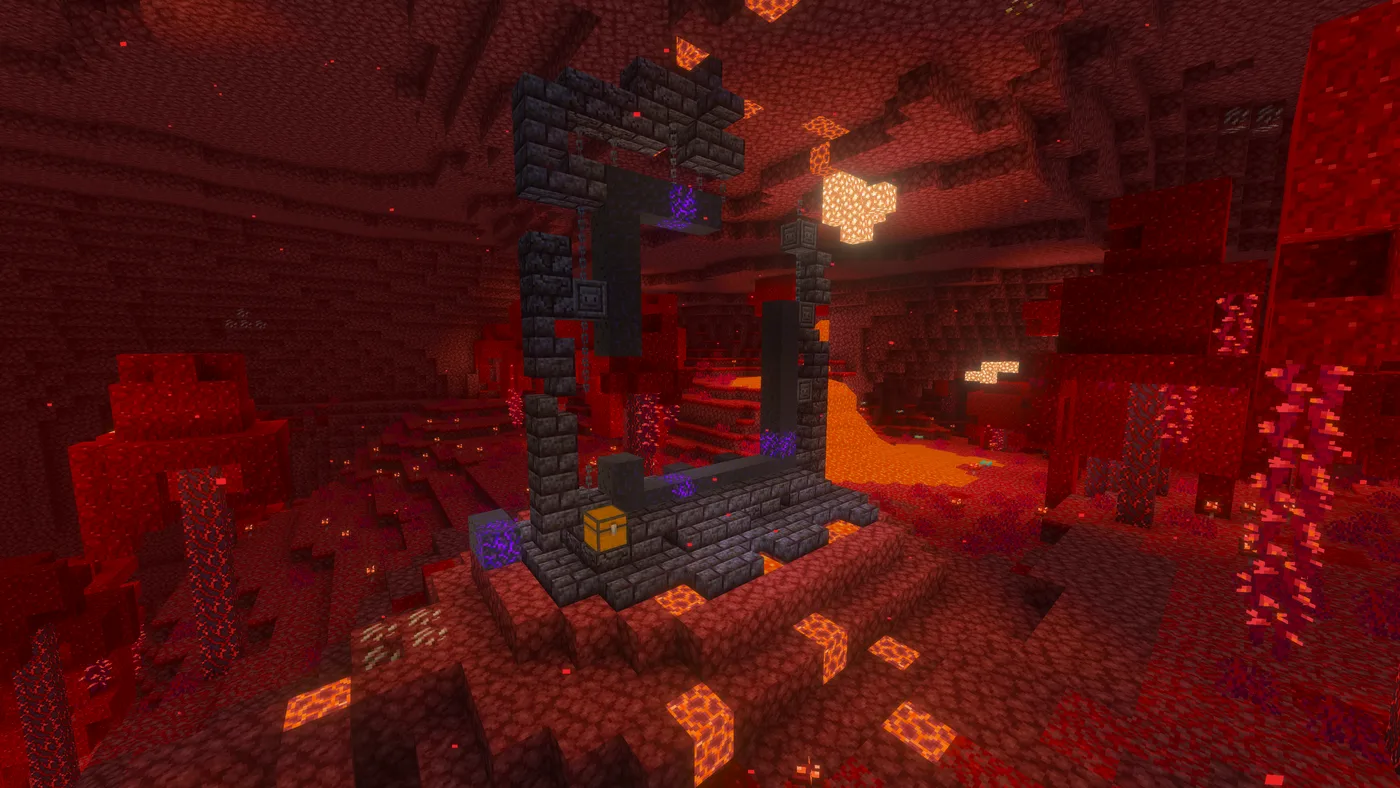
Nether ruined portals use the same chest and the same frame rules, with blackstone stonework and chains instead of stone bricks and iron bars. They are the more dangerous version, for a reason that has nothing to do with lava: piglins.
Per the Minecraft Wiki, piglins get angry when a player opens or breaks a chest near them, or breaks a block of gold, and golden armor does not stop either reaction. Opening a chest angers piglins within about 15 blocks that can see you; breaking a gold block reaches piglins up to 16 blocks away with no line of sight needed. Both are medium aggravation, and the wiki says piglins under medium aggravation can be distracted with gold.
So in a crimson forest or a Nether wastes biome, check for piglins before you loot. Your options, per the wiki:
- Drink an Invisibility potion. An invisible player can open chests and break gold blocks without angering piglins.
- Carry a spare gold ingot to distract any that turn on you.
- Wall off sight lines before you open the chest. Line of sight decides who reacts to the chest; it does not protect you from breaking the gold.
The Nether fortress and bastion guide covers the bigger version of the same problem.
Fix one or build your own?
My take: fix a ruined portal if you do not have a diamond pickaxe yet; build your own once you do. Without diamonds you cannot mine obsidian, so your choices are casting a whole frame with buckets or patching a ruined portal, which needs far fewer casts, and the chest throws in a lighter and a piece of golden armor most of the time. That is why the speedrun route uses them.
Once you have a diamond pickaxe, the math flips. You can put a portal exactly where your base is, sized however you like, and a giant ruined portal becomes an obsidian mine of 25 to 31 blocks, minus the crying ones. Keep the crying obsidian: six of it plus three glowstone crafts a respawn anchor.
Either way, open the chest. Lodestones in two chests out of three, flint and steel or a fire charge in about three in four, and golden armor in more than half is a good haul for walking up to a pile of netherrack.
Quick Action Checklist
- Spot one by its netherrack patch; with cheats on Java, use
/locate structure #minecraft:ruined_portal. - Open the chest first: a lighter 72.7% of the time, golden armor 61.5%, lodestones 66.7%, spare obsidian 46.4%.
- Mine the gold blocks in the stonework with an iron pickaxe; each crafts into 9 gold ingots.
- Treat crying obsidian as a gap unless it is in a corner; corners are optional.
- Fill gaps with chest obsidian or a lava-and-water cast, then light the portal last.
- In the Nether, drink Invisibility or carry gold before you open the chest near piglins.
Frequently Asked Questions
What loot is in a Minecraft ruined portal chest?
Why will my ruined portal not light in Minecraft?
How do you fix a ruined portal without a diamond pickaxe?
How common is crying obsidian in ruined portals?
Do ruined portals generate in the Nether?
How do you find a ruined portal in Minecraft?
Keep Reading
- Minecraft Wiki — Ruined Portal: generation by biome, 10 normal and 3 giant designs, crying obsidian and gold block replacement, loot
- Minecraft Wiki — Nether portal: 4x5 to 23x23 frames, corners optional, fire must be placed last
- Minecraft Wiki — Crying Obsidian: cannot form a portal frame, diamond pickaxe to mine, 15% chance per ruined portal obsidian
- Minecraft Wiki — Piglin: golden armor neutrality, anger from opening chests and breaking gold blocks, Invisibility exception
- Minecraft Wiki — Lodestone: added to ruined portal chests and recipe changed to an iron ingot in Java 1.21.5 and Bedrock 1.21.70 (experimental in 1.21.60)
- Java Edition 26.3 vanilla data (misode/mcmeta): ruined portal chest loot table
- Java Edition 26.3 vanilla data (misode/mcmeta): ruined portal placement, spacing 40, separation 15
- Java Edition 26.3 vanilla data (misode/mcmeta): biomes for the standard ruined portal variant
- Java Edition 26.4 Snapshot 8 data (misode/mcmeta): standard ruined portal biomes now include ice caves
- Java Edition 26.3 vanilla data (misode/mcmeta): the #minecraft:ruined_portal structure tag (all seven variants)
- Java Edition 26.3 vanilla data (misode/mcmeta): respawn anchor recipe, 6 crying obsidian and 3 glowstone
- Minecraft Wiki — Golden Carrot: 14.4 saturation, the most of any stackable food
- Mojang bedrock-samples: Bedrock ruined portal chest loot table
Related Guides
Minecraft Desert and Jungle Temples: Traps and Loot Odds
A desert temple has four chests sitting on nine TNT, and a jungle temple has two chests behind arrow traps and a lever puzzle. Here is how to find each one, get in without blowing up the loot, and what the chests actually hold, with the numbers from the game data.

Minecraft Realms Pro: Price, 50 Players, and Is It Worth It?
Mojang launched Realms Pro on November 9, 2026: a Bedrock-only Realms tier at $29.99 a month (US) that raises the player cap from 10 to 50, puts your world on a non-shared 4-core, 16 GB server and adds sliders, a performance dashboard and live Minecraft Editor access. Here is what it adds over Realms Core and Plus, what it costs per player slot, and who should skip it.
Minecraft Amethyst Geodes: Find, Farm and Use Amethyst
Amethyst geodes are the only renewable source of amethyst shards, and the block that makes them renewable cannot be moved. Here is where geodes generate, how long a cluster takes to grow, what a pickaxe and Fortune do to the drop, and what the shards are actually for.
Minecraft Spawn Point: Beds, Respawn Anchors and World Spawn
You died, clicked Respawn, and landed hundreds of blocks from your base. Here is how a bed, a respawn anchor and the spawnpoint command each set your respawn point, what quietly deletes it, and what to do in the five minutes your items last.
Minecraft Survival Guide for Beginners: Your First Days
You have about ten minutes of daylight before the sun sets and the world tries to kill you. Here is exactly what to do with them — punch a tree, build a tool chain, and get a roof over your head before the zombies arrive.
Best Minecraft Enchantments, Ranked — The Ones Worth Your XP
Mending is the enchantment that ends the grind — gear that repairs itself forever. Everything else is a fight over your XP and anvil uses. Here is what actually earns a slot, ranked, with the real max levels.