Minecraft TNT Guide: Blast Mechanics, Fuses, and Real Uses
Most players treat TNT like a party trick — light it, run, giggle. But the explosion is a precisely defined system with a power value, 1,352 rays, and a fuse that changes length depending on how you set it off. Learn the actual numbers and TNT stops being a gag and starts being a tool.
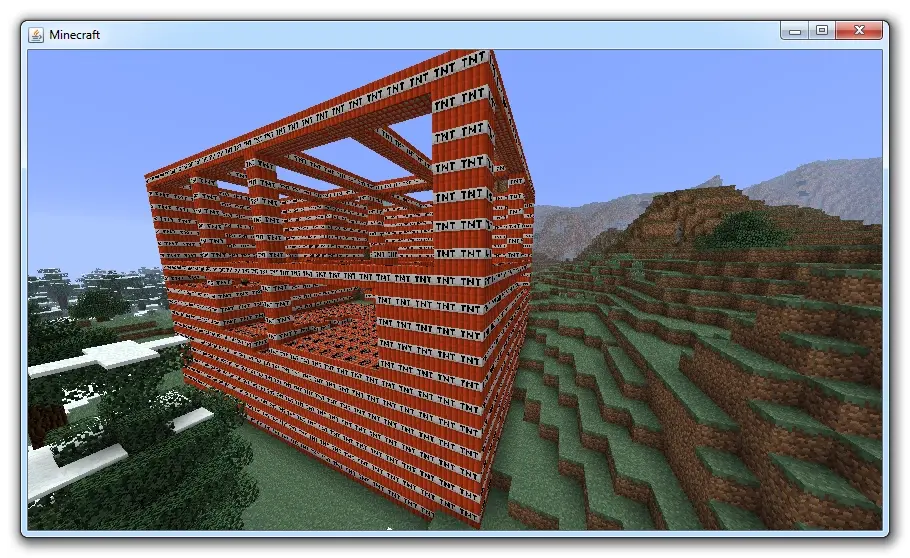
A TNT explosion has a power value of 4. A creeper also has a power of 4. That means the block-destroying half of the scariest sound in Minecraft is, mathematically, a creeper you asked for — and it's why a single TNT will never scratch obsidian no matter how many you stack on top of it. Explosion damage is evaluated per explosion, and blast resistance never gets "worn down" by the previous blast.
That one fact reframes the whole block. TNT isn't chaos. It's a system with defined inputs and outputs, and once you know them you can use it as a mining tool, a mob-farm component, and a delivery mechanism instead of a way to blow a hole in your own storage room. Here's everything that actually matters, with the real numbers.
Crafting TNT and where gunpowder comes from
The recipe is five gunpowder and four sand in a checkerboard: gunpowder in the four corners and the center, sand in the four edge slots. Red sand works exactly as well as regular sand — there's no difference in the output, so don't hoard one over the other.
Gunpowder is the bottleneck, and the drop rates are worth knowing before you plan a farm:
- Creepers drop 0–2 gunpowder. Looting adds up to 1 per level, capping at 5.
- Ghasts drop 0–2, same Looting scaling, same cap of 5.
- Witches drop 0–6 — by far the best per-kill rate. Looting adds 3 per level, capping at 15.
- Wandering traders have a 1-in-6 chance of offering gunpowder for a single emerald.
That witch number is the one people sleep on. A witch farm out-produces a creeper farm on gunpowder per kill by a wide margin, and witch huts generate in regular swamps. If you're building one dedicated farm to feed a TNT habit, build that one — our best Minecraft farms breakdown covers where it sits against the other big earners.
You can also just find TNT. Nine TNT blocks generate naturally in every desert pyramid, sitting under the floor as the classic pressure-plate trap. Two more flank a trapped chest in a secret woodland mansion room.
The fuse is 4 seconds, except when it isn't
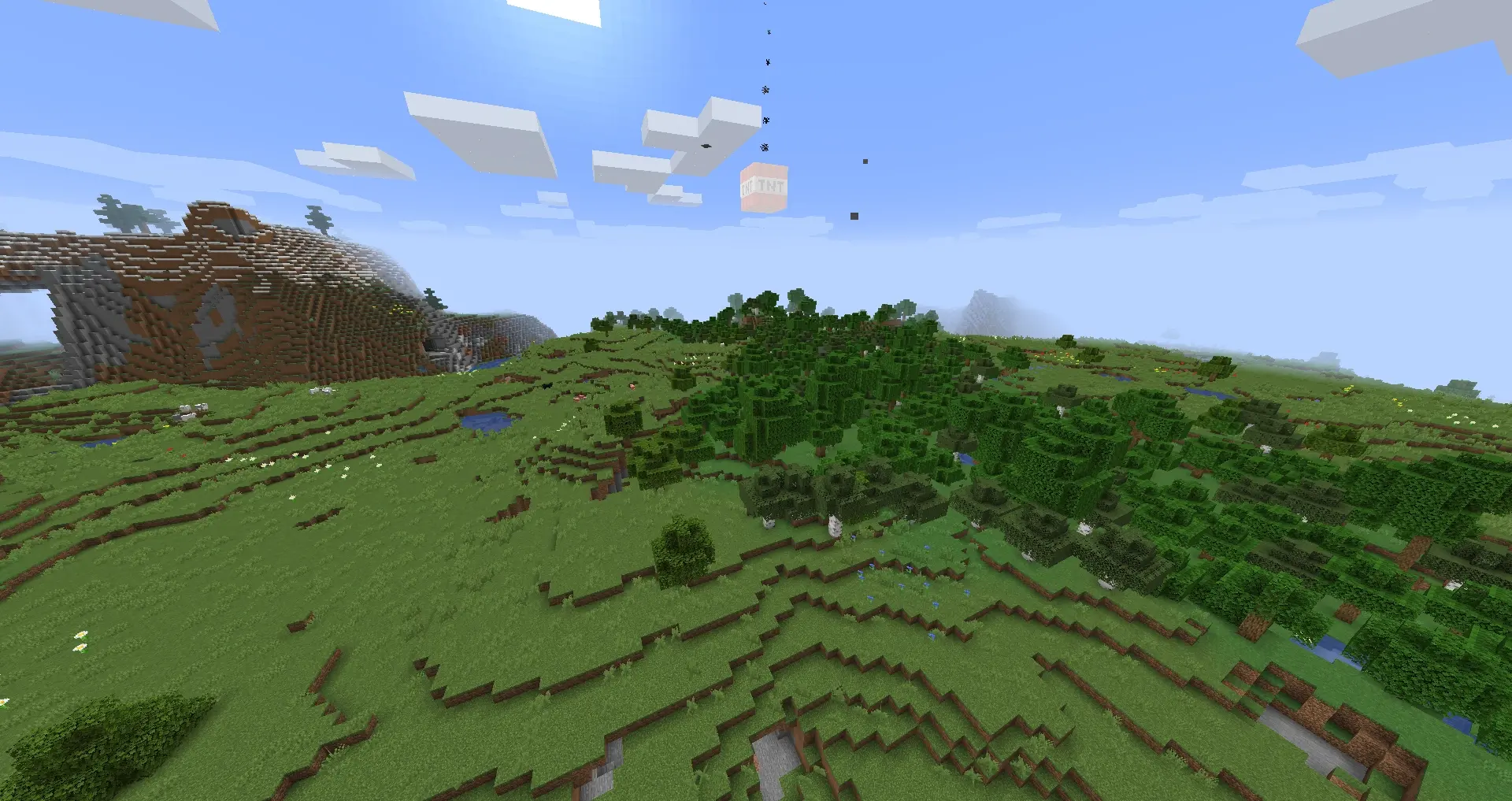
This is where most players get hurt. The fuse is 40 redstone ticks — 4 seconds, or 80 game ticks — when TNT is activated by a redstone signal or by fire. That's the number everyone memorizes.
But when TNT is primed by another explosion, the fuse becomes a random value between 10 and 30 game ticks — 0.5 to 1.5 seconds. That's the chain-reaction rule, and it's why a stack of TNT going off next to you doesn't give you the four seconds you were counting on. The first one gives you four. Everything it lights gives you half a second to a second and a half.
A few more fuse details that bite:
- Once primed, TNT becomes an entity affected by gravity — a cube 0.98 blocks on a side. You can't break it anymore. Only
/killremoves it. - It spawns with a small kick: 0.2 blocks per tick vertically and 0.02 horizontally in a random direction. It drifts about 0.166 blocks sideways before settling, which is roughly six pixels. Not enough to save you, enough to matter in tight redstone.
- If it's primed in the air, it falls roughly 77 blocks before detonating. Every 19.75 blocks of fall burns one second off the timer.
- In Java Edition, TNT summoned by command explodes immediately, because the fuse defaults to zero if you don't specify one. If you're scripting anything in a command block, set the fuse explicitly.
How the blast actually works
The explosion model is more interesting than "sphere of destruction." The game draws a cube around the explosion, splits it into a 16×16×16 grid, and fires a ray from the center to every point on that cube's outer surface — 1,352 rays total.
Each ray gets an intensity of (0.7 + a random value from 0 to 0.6) × power. Then it walks outward in 0.3-block steps. Every step drops the intensity by 0.225. If the step passes through anything other than air, it drops further by (blast resistance + 0.3) × 0.3. A block gets destroyed if the ray still has intensity left when it reaches it.
Two consequences fall straight out of that:
- Destruction is non-deterministic. That random 0-to-0.6 term means the same TNT in the same spot carves a slightly different crater every time. Anyone promising you an exact block count is guessing.
- Blast radius is capped by power. The maximum radius, assuming nothing absorbs the ray, works out to 6.9 blocks for TNT, 5.2 for a normal creeper, 10.4 for a charged creeper, and 1.7 for a ghast fireball. In practice, a TNT explosion can knock out a torch about 7 blocks away.
Also worth knowing: fireworks and wind charges deal entity damage but do not destroy terrain, so they don't count as conventional explosions at all. And stacking explosions gets you more knockback — multiple close blasts propel objects further — but zero extra digging power, for the per-explosion reason up top.
Every way to prime TNT
The ignition list is longer than most people realize, which is both a toolkit and a list of ways to lose a base:
- Flint and steel, or a fire charge
- Any item enchanted with Fire Aspect — including just a Fire Aspect enchanted book
- A powered redstone signal
- A flaming or explosive projectile, including a Flame-enchanted bow's arrow
- An arrow that has traveled through lava or fire
- A ghast or blaze fireball, or a fire charge from a dispenser
- An explosive skull from the Wither
- Spreading fire or lava touching it
- Any nearby explosion — TNT, creeper, bed, respawn anchor, or end crystal
- Being placed by a dispenser, or lit by a dispenser holding flint and steel
- A lightning bolt
Two odd ones for the collection: flint and steel can't start fires in Adventure Mode but can still ignite TNT, and primed TNT normally gets stuck in cobwebs — unless it's moving fast enough, in which case it passes through without slowing at all.
For redstone, the rule is simple: the signal has to either lead directly into the TNT or power a block adjacent to it. If you're fuzzy on how power travels through blocks, redstone basics is the prerequisite here.
Mining with TNT
TNT is a legitimate mining tool, particularly for clearing large volumes fast. It's not efficient for finding diamonds — the ore drops get destroyed by the same blast that exposes them often enough to hurt — but for hollowing out a room, clearing gravel, or opening a quarry, nothing beats it on time spent.
Water cancels block damage
Here's the rule that surprises people: when primed TNT detonates while in water or lava, it doesn't break any blocks at all. It still damages players, mobs, and entities — the shockwave is fine — but the terrain survives completely.
This cuts both ways. It means water is a perfect blast shield for your build. It also means you can't just drop TNT into the ocean and expect a hole. Note the asymmetry, though: TNT detonating outside water can still destroy submerged blocks. It's the TNT's own immersion that matters, not the target's.
The sand trick
Which leads to the workaround, and it's genuinely clever. Place sand or gravel on top of the TNT before you prime it. The moment you prime it, the TNT block becomes an entity and vacates its space — so the sand above falls one block and engulfs the primed TNT.
Now the TNT is no longer immersed in water. It's inside a sand block. The blast lands normally.
This is the standard technique for breaching an ocean monument from the roof, and it's the kind of mechanic that only exists because two systems — gravity blocks and entity conversion — happen to interact on exactly the same tick.
TNT minecarts hit harder
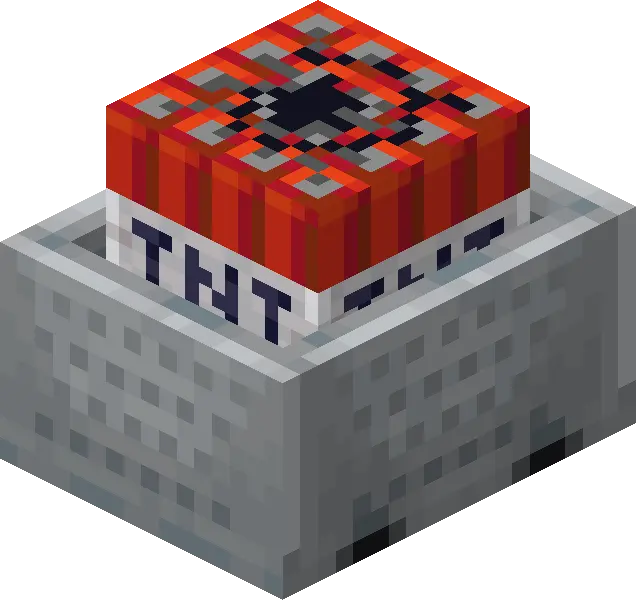
A minecart with TNT is not just TNT on wheels. Its explosion scales with speed, and that changes everything about how it's used.
The base power is 4, same as a TNT block. But the game adds a random bonus of up to 1.5 × velocity, capped at 7.5. At a speed of 5 or higher, the resulting power is a random value between 4 and 11.5 — meaning a fast TNT minecart can hit nearly three times as hard as a stationary TNT block.
Which velocity gets used depends on the trigger. An activator rail or damage trigger uses the cart's horizontal velocity. A flaming arrow uses the arrow's velocity. Fall damage uses fall distance divided by 10.
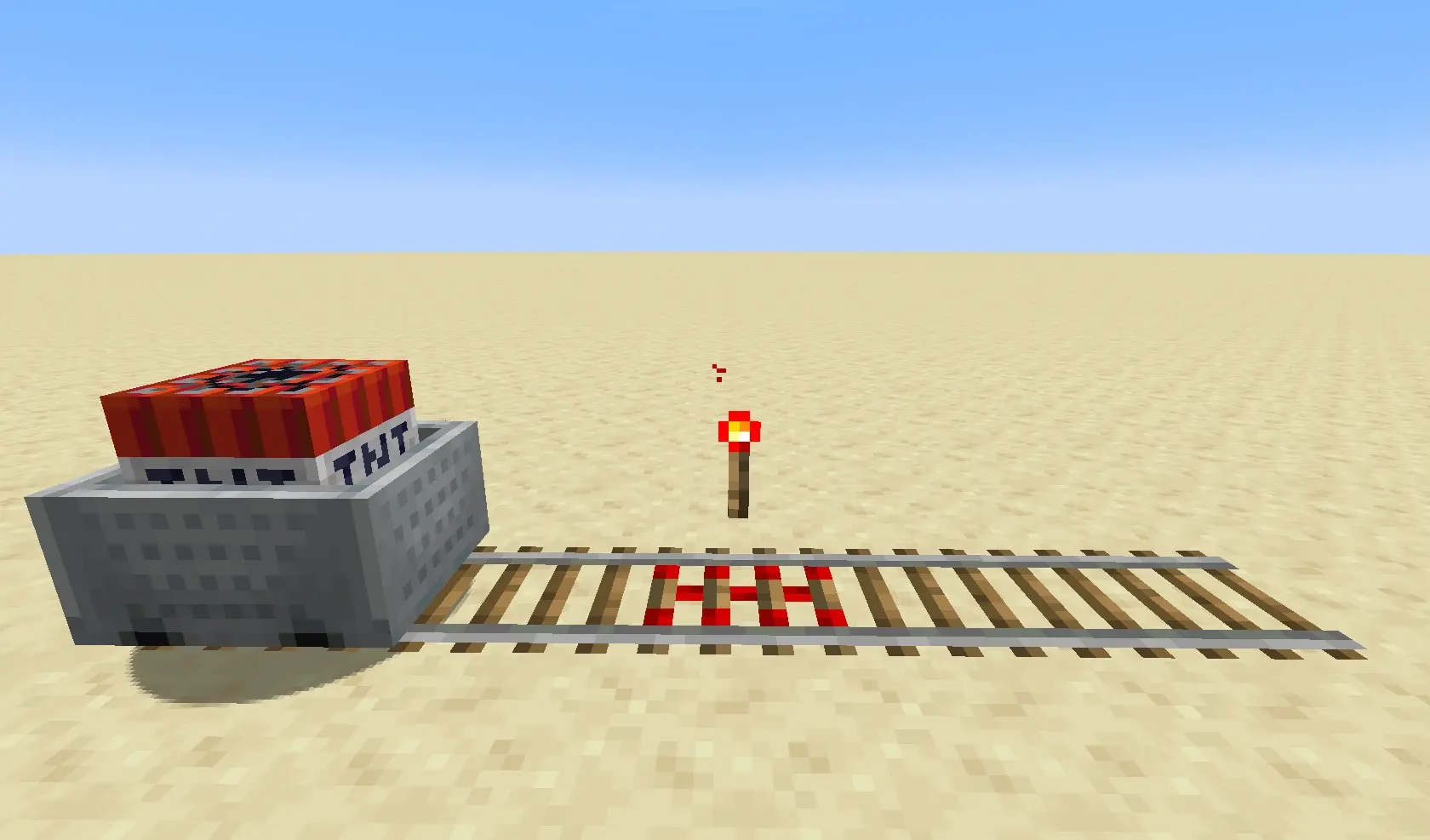
The trigger conditions split into delayed and instant. Delayed (4 seconds, exactly like a TNT block) happens when it rolls over a powered activator rail. Destroyed while in motion, or destroyed by fire, lava, or an explosion gives a random delay between 0 and 1.9 seconds, most likely landing near 1. Instant detonation happens when it hits the ground after falling more than three blocks (unless it lands on rail), takes a curved track too fast with a solid block or entity beside it, gets hit by a flaming arrow, or is pressed into a block or entity while it still has velocity.
Two exploitable quirks:
- Detonating via an activator rail does not destroy its own rails or the blocks under them — though other nearby carts still can. That's what makes repeatable rail-based demolition possible.
- Multiple minecarts fit on a single rail block. They stack. Merged TNT minecarts explode when touched and deal enormous damage — a direct hit from three merged carts can reduce a player in full diamond armor to half a heart.
TNT minecarts bounce off other minecarts and can't be linked to furnace minecarts, so any delivery system has to push them with rails, not chains. If you're building the track for one, the transportation guide has the powered-rail spacing.
TNT cannons, briefly
TNT cannons exploit the propulsion half of explosions rather than the destruction half. Since multiple close explosions propel objects further without adding destructive power, you can use a bank of "charge" TNT to fling a single "projectile" TNT a long distance.
The basic anatomy: a water trough holds the charge TNT so its blast doesn't destroy the cannon itself (water cancels block damage, remember), the projectile TNT sits outside the water at the muzzle, and the charges fire slightly before the projectile so the shockwave throws it. Range comes from charge count and firing timing, not from any special block.
The same propulsion trick shoots gravity-affected blocks, which is where a lot of the more creative contraptions live. If that's your thing, redstone contraptions goes deeper on the timing circuits that make it repeatable.
One caution: primed TNT is not teleported by a Nether portal — it passes straight through the portal blocks. End portals do teleport it correctly, preserving direction and speed.
The duping question
You'll see TNT duplicators in a lot of technical Minecraft builds. They rely on a piston-and-observer interaction with gravity blocks that produces more TNT than it consumes, and they are a Java Edition phenomenon — Bedrock's piston behavior doesn't support the same setups.
Be honest with yourself about what it is: it's an unintended interaction that Mojang has left in place because the technical community depends on it, not a documented feature. It can change in any update, and it's a fast way to get kicked from a server that bans exploits. Check the rules before you build one, and don't design a base that only functions if the dupe survives the next patch.
If you want TNT at scale without the asterisk, build the witch farm. It's slower to set up and it never breaks.
Quick Action Checklist
- Craft TNT with 5 gunpowder + 4 sand in a checkerboard. Red sand is identical to regular sand.
- Farm witches for gunpowder, not creepers — 0–6 per kill, up to 15 with Looting III.
- Loot the 9 free TNT in every desert pyramid, carefully.
- Remember two fuse lengths: 4 seconds from redstone or fire, 0.5–1.5 seconds from another explosion.
- Never expect TNT to break obsidian. Explosions don't stack destructively — power 4 is power 4.
- Assume a working blast radius near 6.9 blocks, and expect a different crater every time thanks to the random intensity term.
- Use water as a blast shield; TNT detonating in water does zero block damage.
- To blast underwater anyway, drop sand or gravel on top of the TNT before priming it.
- Get TNT minecarts moving before they blow — speed 5+ turns power 4 into a random 4 to 11.5.
- Stack multiple TNT minecarts on one rail block for burst damage; they detonate on touch.
- Don't route primed TNT through a Nether portal. It won't teleport.
- Specify the fuse explicitly when summoning TNT by command in Java, or it detonates instantly.
Frequently Asked Questions
How long is the TNT fuse in Minecraft?
What is the blast radius of TNT in Minecraft?
Why does TNT not break blocks underwater?
Are TNT minecarts stronger than regular TNT?
Can TNT destroy obsidian in Minecraft?
Keep Reading
Related Guides
Minecraft Music Discs: Every Disc and How to Get It
Twelve of the 22 music discs come from a creeper killed by a skeleton or one of its variants. The other ten come from ten different places, and eight of those are a structure. Here is every disc, its composer, its length, its odds, and the comparator value it puts out — including the seven signal levels that two different discs now share.
Minecraft Advancements List and How to Get the Hard Ones
Minecraft Java has 126 advancements, but only 23 pay XP, and one of them pays 1,000. Here is every advancement by tab for Java 26.3, the challenges ranked by reward, the full Adventuring Time, Monsters Hunted, A Balanced Diet and Two by Two checklists, the descriptions that mislead you, and what the 26.4 snapshots change.
Minecraft Wandering Trader Guide: Trades, Spawns and Llamas
Every wandering trader shows 9 offers drawn from a pool of 100 that is the same on Java 26.3 and Bedrock 26.50. Here is the full price list from the game's own trade files, the odds of seeing the offer you want, what the trader buys from you, how long one takes to spawn, and why a name tag will not keep it.
Minecraft on Switch 2: Free Upgrade, Price and Minecoins
Digital owners of Minecraft for Nintendo Switch get the native Switch 2 version free in most regions until January 31, 2027. Cartridge owners have been offered nothing so far. Here are the editions, the US prices, what the native version changes, and the Minecoins change that lands on the same day.
Minecraft Survival Guide for Beginners: Your First Days
You have about ten minutes of daylight before the sun sets and the world tries to kill you. Here is exactly what to do with them — punch a tree, build a tool chain, and get a roof over your head before the zombies arrive.

Best Minecraft Enchantments, Ranked — The Ones Worth Your XP
Mending is the enchantment that ends the grind — gear that repairs itself forever. Everything else is a fight over your XP and anvil uses. Here is what actually earns a slot, ranked, with the real max levels.