Tears of the Kingdom Rupee Farming: What to Sell and Keep
A Ruby sold for 210 rupees in Breath of the Wild. In Tears of the Kingdom it sells for 110. Six of the eight ores the two games share lost 42 to 71 percent of their value, which quietly broke the old money playbook. Here is what actually pays now, what the Great Fairies will want back, and the real math on feeding Luminous Stones to a Dondon.
A Ruby sold for 210 rupees in Breath of the Wild. In Tears of the Kingdom the same Ruby sells for 110.
That one number is why the old money playbook quietly stopped working. Of the eight ores the two games share, six lost between 42 and 71 percent of their sell price, and only the Diamond and humble Flint held still. At the same time the Great Fairies started charging rupees on top of materials — and the materials they want are exactly the things you would otherwise be selling.
So this guide covers both halves of the ledger: what pays, what the fairies will want back, what a cooking pot does to a sell price, and whether the gem-eating Dondons deserve your Luminous Stones. Prices come from Zelda Wiki's Tears of the Kingdom materials table, which agrees with its separate Sell Price list on every item used here. The totals are my arithmetic on the wiki's tables, and each one says so.
Every gem but the Diamond got cheaper
| Ore | Breath of the Wild | Tears of the Kingdom | Change |
|---|---|---|---|
| Diamond | 500 | 500 | 0% |
| Sapphire | 260 | 150 | -42% |
| Ruby | 210 | 110 | -48% |
| Topaz | 180 | 80 | -56% |
| Opal | 60 | 30 | -50% |
| Luminous Stone | 70 | 20 | -71% |
| Amber | 30 | 10 | -67% |
| Flint | 5 | 5 | 0% |
Star Fragments took a smaller cut, 300 down to 200. And the pouch itself changed shape: Zelda Wiki lists Tears of the Kingdom's rupee capacity as 999,999 from the start, with no wallet upgrades to buy.
If you remember farming Rare Taluses for roughly a thousand rupees a kill — our Breath of the Wild field boss guide ran that math on the last game's prices — do not carry the number forward. The Stone Talus (Rare) is back with 1,080 HP against Breath of the Wild's 900 and a spoils list of Flint, Amber, Opal, Topaz, Ruby, Sapphire, Diamond and a Rare Stone Talus Heart. Zelda Wiki does not publish its Tears of the Kingdom drop weights, so I am not putting a new per-kill figure on it. What is certain is that the Topaz, Ruby and Sapphire in that list are now worth roughly half.
The price list that matters
Here is every material in Zelda Wiki's 250-row Tears of the Kingdom table that sells for 110 rupees or more, with the four dragons' parts grouped since they share prices. The third column is the one no sell-price list shows you: how many of that item the Great Fairies ask for across every armor upgrade in the game, totalled from the wiki's enhancement table.
| Material | Sells for | Great Fairies want | Where it comes from |
|---|---|---|---|
| Diamond | 500 | 27 | Ore and Rare Ore Deposits, Rare Stone Taluses |
| Dragon horn (any of the four) | 300 | 18 | Dinraal, Naydra, Farosh, the Light Dragon |
| Dragon fang shard | 250 | 12 | The same four dragons |
| Star Fragment | 200 | 103 | Shooting stars, caught while skydiving at night |
| Lynel Guts | 200 | 30 | Any Lynel |
| Gleeok Guts | 200 | 18 | Flame, Frost, Thunder and King Gleeoks |
| Dragon claw / Light Dragon's Talon | 180 | 12 | The four dragons |
| Sapphire | 150 | 121 | Rare Stone Taluses, Dondons |
| Silver Lynel Saber Horn | 150 | 9 | Silver Lynels |
| Silver Lynel Mace Horn | 150 | 9 | Silver Lynels |
| Gleeok Thunder Horn | 150 | 15 | Thunder and King Gleeoks |
| Dragon scale | 150 | 14 | The four dragons |
| Ruby | 110 | 121 | Rare Ore Deposits, Dondons |
| Molduga Guts | 110 | 23 | Moldugas |
Read the two number columns together and the list splits cleanly in two.
High price, small demand — sell the surplus. The Diamond is the most valuable material in the game and the fairies want just 27 of them: 18 for the Diamond Circlet and 3 per piece for the Miner's set at four stars. Skip those two and you need none. Both Silver Lynel horns go to a single item, the Ancient Hero's Aspect, nine apiece at its last level. Lynel Guts go to the Soldier's set (15), the Radiant set (9) and the Fierce Deity set (6), so 30 covers all of it.
High price, big demand — keep them. Star Fragments are the trap. A 200-rupee sale is tempting, but the fairies ask for 103 of them across 26 pieces, including 10 for Sheik's Mask alone and 4 per piece for each of six legacy hero sets. Rubies, Sapphires and Topazes are the same story at 121 each.
Dragon parts sit in their own lane: the horns (300) and fang shards (250) are the priciest items after the Diamond, and our dragon parts guide already makes the case for not selling horns, since they are the timed part the armor tree wants most. Silver Lynel horns have one more buyer to weigh against the shop: at 55 Fuse attack power the Saber Horn tops the damage chart in our Fuse guide. One bolted to a weapon is 150 rupees you chose to swing instead.
The Great Fairy bill decides what you keep
Zelda Wiki's enhancement table lists 103 armor pieces that can be upgraded to four stars. Every piece costs 10, 50, 200 and 500 rupees for its four levels — 760 per piece — except the Ancient Hero's Aspect, which charges triple at 30, 150, 600 and 1,500. Run it across the whole table:
102 pieces at 760 plus one at 2,280 is 79,800 rupees in fees, before a single material changes hands.
That is my arithmetic on the wiki's fee schedule, and you do not need every piece at four stars — the armor guide makes the case for which sets deserve it. But the materials side of the same table is the more useful number, because it tells you what not to sell:
| Material | Total the fairies want | Sells for |
|---|---|---|
| Amber | 665 | 10 |
| Luminous Stone | 450 | 20 |
| Opal | 376 | 30 |
| Flint | 367 | 5 |
| Ruby | 121 | 110 |
| Sapphire | 121 | 150 |
| Topaz | 121 | 80 |
| Star Fragment | 103 | 200 |
| Diamond | 27 | 500 |
The colored gems break down the same way each time, which is what makes them plannable. Rubies go 15 to the Snowquill set, 21 to the Vah Rudania Divine Helm, 22 to the Ruby Circlet and 63 to the Hero set; Sapphires follow the identical 15/21/22/63 split across Desert Voe, Vah Medoh, the Sapphire Circlet and the Sky set; Topazes across Rubber, Vah Naboris, the Topaz Earrings and the Twilight set. If you will never upgrade that gem's Divine Helm, jewelry piece or legacy hero set, the fairies want just 15 of it.
The cheap stones are the opposite case. Selling Amber at 10 rupees apiece is pocket change against a 665-stone upgrade bill, so there is no real money in dumping it.
Priced at the wiki's sell values, everything the fairies ask for across all 103 pieces comes to 176,582 rupees by my arithmetic. That is the real size of the pile you are choosing between selling and wearing. For scale, the Wealthy medal in the Switch 2 Edition's Zelda Notes — one of the 24 medals in our Switch 2 Edition guide — sets its Master rank at 100,000 rupees collected, counted only from Ver. 1.4.0 onward.
Cooking adds up to 80 percent, except when it zeroes
Zelda Wiki gives the sell formula for meals and elixirs: add up the sell prices of the ingredients, multiply by a factor set by how many ingredients went in, and round down.
| Ingredients in the pot | Multiplier |
|---|---|
| 1 | 1.2x |
| 2 | 1.3x |
| 3 | 1.4x |
| 4 | 1.6x |
| 5 | 1.8x |
So five Raw Gourmet Meat, 35 rupees each, are 175 rupees sold raw and 315 sold as one dish. A Hot-Footed Frog (2) cooked with one Lynel Guts (200) into an elixir sells for 262 instead of 202. The wiki's formula lists no price ceiling, and I have not verified whether one exists, so the examples here stay well short of four digits.
Two rules take money away instead:
- Dragon parts and Star Fragments count as 1 rupee each once cooked. A Dinraal's Horn in a pot with four Raw Gourmet Meat sells for 253. Sold separately, the same five items fetch 440.
- Fairy Tonics, Dubious Food and Rock-Hard Food sell for 2 rupees, whatever went into them. Rock-Hard Food is what any gem, Flint, Luminous Stone, wood, pine cone or Zonaite produces in a pot, so a Diamond cooked by accident is a 498-rupee mistake.
The cooking guide covers what makes a dish or elixir valid in the first place; this is just what one is worth at the counter.
Dondons turn Luminous Stones into gems, slowly
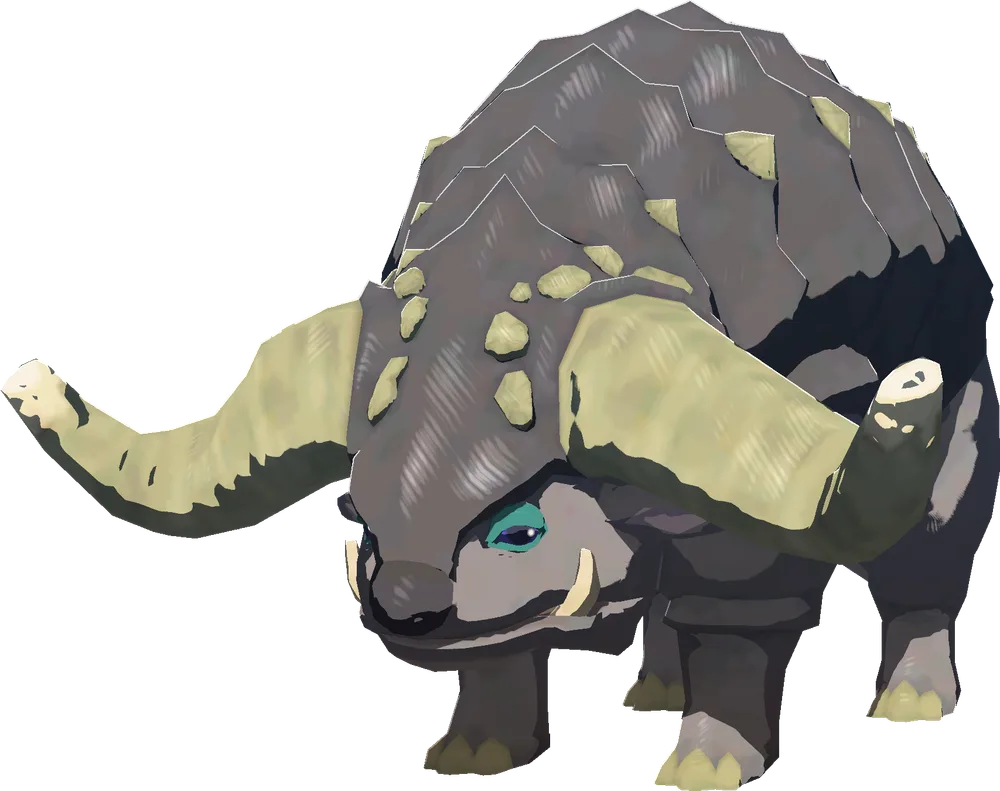
Dondons eat rocks and give back gems. Per Zelda Wiki, only five have been found in the wild, all now living in a sanctuary in Bronas Forest — Malanya places them near Lakeside Stable — and they process Luminous Stones into gemstones. The Side Adventure "The Beast and the Princess," from Penn at New Serenne Stable, is the one that sends you to the stable attendant Cima to learn about them.
The mechanics are specific. Each Dondon takes one to five Luminous Stones per batch. Processing takes 10 in-game hours, which is 10 real minutes, counted from the first stone; feeding it more during that window upgrades the drop table rather than starting a new batch. Zelda Wiki's outcome table, which it credits to a MiahTRT breakdown video, runs from 1% Diamond odds at one stone to 5% at five, with Flint, Amber, Opal and Zonaite making up most of the rest.
One stone or five
Multiply the wiki's odds by the wiki's sell prices and you get the expected value of each feeding. This is my arithmetic, not a stated game figure:
| Stones fed | Stones' own sell value | Expected output value | Per stone fed | Diamond chance |
|---|---|---|---|---|
| 1 | 20 | 30.1 | 30.1 | 1% |
| 2 | 40 | 51.9 | 25.9 | 2% |
| 3 | 60 | 73.9 | 24.6 | 3% |
| 4 | 80 | 95.7 | 23.9 | 4% |
| 5 | 100 | 118.7 | 23.7 | 5% |
Two conclusions, and they point in opposite directions.
If Luminous Stones are the limit, feed one at a time. A single stone comes back worth about 50% more than it sells for. Five stones come back worth about 19% more. Per stone, the one-stone feed wins at every step down the table.
If your time is the limit, feed five. Across all five Dondons, five stones apiece is 25 stones worth 500 rupees raw turning into roughly 593 in expected output every 10 minutes; one stone apiece nets about 150 from 100. Either way the gain lands between about 50 and 93 rupees a cycle. Dondons are a markup on a 20-rupee rock, not a money printer.
Where they do earn a visit is the fairy bill. A five-stone feed has a 30% chance of producing two Topazes, two Rubies or two Sapphires — the three gems the upgrade table wants 121 of apiece. Just remember that Luminous Stones are on that bill too, at 450. And one freebie: Zelda Wiki notes that the first time Link feeds a Dondon, the result is a 50/50 Ruby or Sapphire however many stones went in, so make that first feeding a single stone.
Luminous Stone Deposits, per Zelda Wiki, are now commonly found in caves, and the cave guide has the 147-cave sweep that walks you past them.
Rupees that arrive as rupees
Not every rupee has to be sold for. Some arrive as currency. Denominations run Green 1, Blue 5, Red 20, Purple 50, Silver 100 and Gold 300.
One quest chain pays enough to plan around: the Lucky Clover Gazette's "Potential Princess Sightings!", twelve stable investigations with Penn, paid by how many you have finished rather than which one.
| Investigation | Reward | Rupees |
|---|---|---|
| 1st | Purple Rupee | 50 |
| 2nd | Purple Rupee | 50 |
| 3rd | Red Rupee, Purple Rupee | 70 |
| 4th | Froggy Sleeve, Purple Rupee | 50 |
| 5th | Silver Rupee | 100 |
| 6th | Silver Rupee | 100 |
| 7th | Red Rupee, Silver Rupee | 120 |
| 8th | Red Rupee, Silver Rupee | 120 |
| 9th | Froggy Leggings, Silver Rupee | 100 |
| 10th | Purple Rupee, Silver Rupee | 150 |
| 11th | Two Silver Rupees | 200 |
| 12th | Gold Rupee | 300 |
| Total | 1,410 |
Traysi hands over the Froggy Hood when you report back. The chain overlaps other guides on this site — "Serenade to a Great Fairy" and "Zelda's Golden Horse" are two of the twelve — so you may be further along it than you think.
The smaller sources:
- Fera's "Where Are the Wells?" pays 10 rupees per well you locate for her, and there are 58 wells.
- Addison rewards Red Rupees, food and materials, per Zelda Wiki, when you prop up one of his 81 Hudson Construction signboards. Some boards hand over a Sleepover Ticket instead of a material, which covers one 20-rupee stable bed.
- Treasure Octoroks drop anything from a Green to a Silver Rupee; Yiga Footsoldiers drop Green through Purple.
- Blupees drop rupees when hit. Zelda Wiki places them near caves, after defeated Bubbulfrogs, and in the Blupee Burrow of the Hyrule Ridge Depths below Satori Mountain.
- Gold Rupee chests, worth 300, sit in the North Gerudo Ruins and in Hyrule Castle's Sanctum.
Nine shrines with a Diamond in the chest
Nine of the 51 Rauru's Blessing shrines covered in our shrines guide hold a Diamond, per Zelda Wiki's Shrine of Light table. That is 4,500 rupees if sold, or a third of the fairies' whole 27-Diamond bill if kept.
| Shrine | Location |
|---|---|
| Jinodok Shrine | South Hyrule Sky Archipelago |
| Joku-u Shrine | Dragonhead Island |
| Ganos Shrine | Tabantha Sky Archipelago |
| Sihajog Shrine | Valor Island |
| Jochi-ihiga Shrine | Akkala Falls |
| Sakunbomar Shrine | Lost Woods |
| Mayaotaki Shrine | North Lomei Labyrinth |
| Maoikes Shrine | Boné Pond East Cave |
| Yomizuk Shrine | Tarm Point Cave |
Where the money actually goes
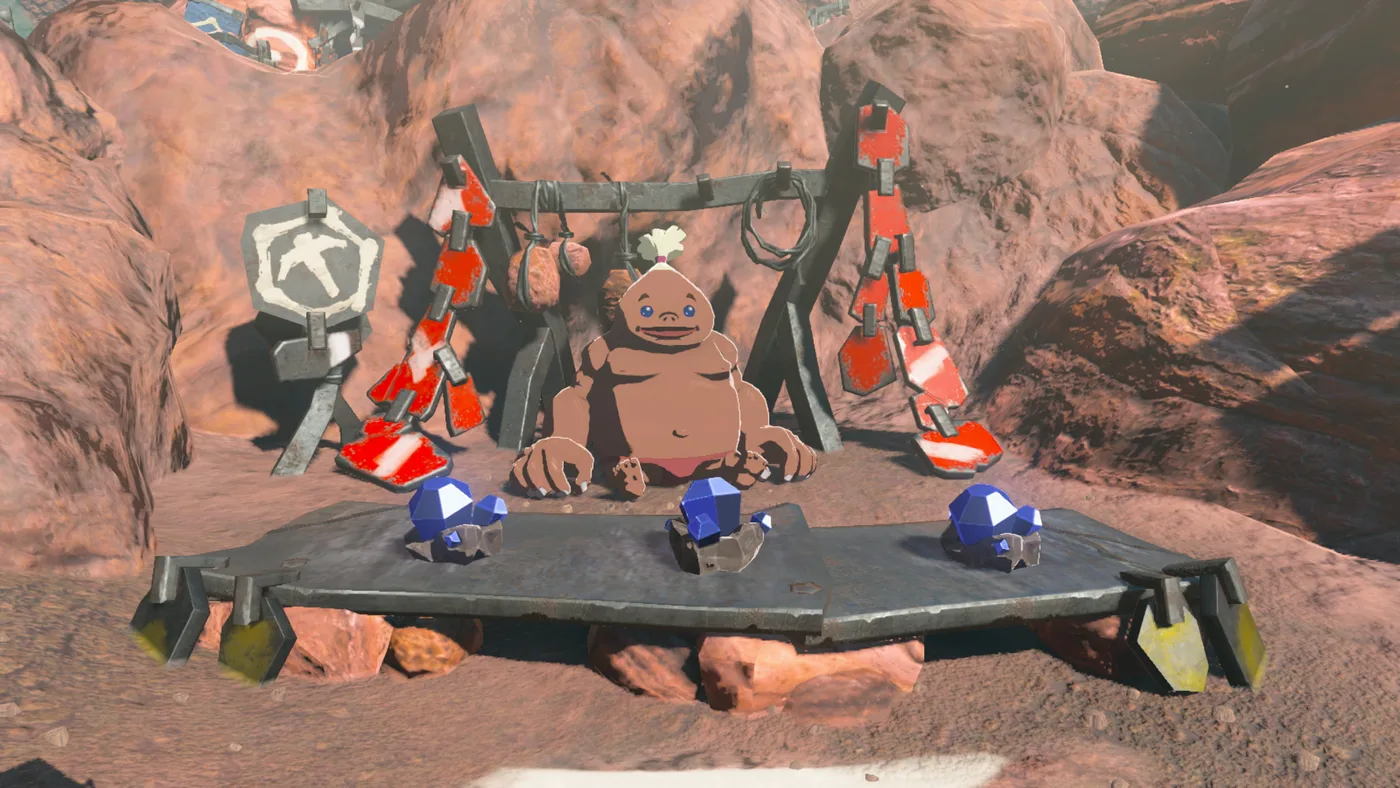
| Rupee sink | Cost |
|---|---|
| One armor piece, one star to four | 760 (10 / 50 / 200 / 500) |
| Ancient Hero's Aspect, one star to four | 2,280 (30 / 150 / 600 / 1,500) |
| Every upgradable armor piece to four stars | 79,800 |
| Replacement Hylian Shield from Cece | 3,000 |
| Replacement rare armor, masks or Divine Helm from Cece | 4,000 each |
| Diamond / Sapphire / Ruby / Flint at a YunoboCo Store | 1,000 / 300 / 220 / 10 |
| Separating a fusion at Pelison's Break-a-Part Shop | 20 |
| A stable bed for the night | 20 |
| Rupee Padding on the Mystic set | 10 per damage point absorbed |
Two rows deserve a second look.
YunoboCo's "half price" is double the sell price. The four YunoboCo Stores in Goron City and at the YunoboCo Mineral Market advertise ore at half the normal price, and each sells a single ore, three in stock. Line those four prices up against the sell column and each is exactly twice what the same ore sells for — Diamond 1,000 against 500, Sapphire 300 against 150, Ruby 220 against 110, Flint 10 against 5. Buying ore to resell is a guaranteed loss. Buy only to finish an upgrade you are one gem short of.
Cece's 4,000 is the real price of selling unique gear. Her private collection restocks lost or sold pieces — the Mystic set, the monster masks, the Divine Helms, the Zonaite, Froggy, Glide and Barbarian sets and more — at 4,000 rupees apiece, and she only stocks what Link has already owned. The Hylian Shield comes back at 3,000, and Zelda Wiki names her as the only way to replace one that breaks.
The Mystic set turns the sink into insurance: its Rupee Padding spends 10 rupees per damage point to spare your hearts, a trade the cave guide breaks down in full. A big bank keeps that padding funded.
More Hyrule lives on the Tears of the Kingdom hub, and everything else we are playing is on the Mythras blog.
Quick Action Checklist
- Diamond is the top seller at 500, and the fairies want only 27 — 18 for the Diamond Circlet, 9 for a four-star Miner's set. Sell past that.
- Keep Star Fragments. They sell for 200, but the upgrade table asks for 103.
- Rubies, Sapphires and Topazes: keep 15 of each for the elemental sets, and 121 if you plan to fully upgrade that gem's Divine Helm, jewelry and hero set.
- Silver Lynel horns only feed the Ancient Hero's Aspect. Sell them or fuse them unless you are maxing it.
- Do not dump Amber. At 10 rupees against a 665-piece bill, it is not money.
- Cook to sell, but leave out dragon parts and Star Fragments — they count as 1 rupee in a pot. Five ingredients multiply the rest by 1.8.
- Keep gems out of the pot. Rock-Hard Food sells for 2.
- Feed Dondons one stone at a time if stones are scarce, five if time is. The very first feeding is a 50/50 Ruby or Sapphire, so use one stone.
- Finish "Potential Princess Sightings!" for 1,410 rupees plus the Froggy set.
- Do not buy ore at YunoboCo to resell. Their price is exactly double the sell price.
- Keep rare armor. Cece charges 4,000 to replace a rare set piece, monster mask or Divine Helm.
Frequently Asked Questions
What sells for the most in Tears of the Kingdom?
How much do gems sell for in Tears of the Kingdom?
Should you sell Star Fragments in Tears of the Kingdom?
How do Dondons make gems in Tears of the Kingdom?
Does cooking increase sell price in Tears of the Kingdom?
How many rupees does it cost to upgrade all armor in Tears of the Kingdom?
Is it worth buying gems at the YunoboCo Store in Tears of the Kingdom?
Keep Reading
- Zelda Wiki — Materials in Tears of the Kingdom: the 250-row in-game-order table with every material's sell value, including Diamond 500, dragon horns 300, Star Fragment 200 and Lynel and Gleeok Guts 200
- Zelda Wiki — Sell Price: the separate Tears of the Kingdom sell price list, cross-checked against the materials table
- Zelda Wiki — Enhancing: the 10/50/200/500 rupee fees (tripled for the Ancient Hero's Aspect) and the full 103-piece Tears of the Kingdom upgrade table the material totals here are summed from
- Zelda Wiki — Cooking in Tears of the Kingdom: the 1.2x to 1.8x meal sell multiplier, dragon parts and Star Fragments counting as 1 rupee, the 2-rupee failed dishes, and the Rock-Hard Food materials
- Zelda Wiki — Dondon: five in the Bronas Forest sanctuary, Luminous Stone gem processing, the 10-minute batch, the first-feeding Ruby or Sapphire, and the one-to-five-stone outcome table
- Zelda Wiki — Ruby: 210 rupees in Breath of the Wild, 110 in Tears of the Kingdom
- Zelda Wiki — Sapphire: 260 rupees in Breath of the Wild, 150 in Tears of the Kingdom
- Zelda Wiki — Topaz: 180 rupees in Breath of the Wild, 80 in Tears of the Kingdom
- Zelda Wiki — Luminous Stone: 70 rupees in Breath of the Wild, 20 in Tears of the Kingdom
- Zelda Wiki — Diamond: 500 rupees in both games, found in Ore and Rare Ore Deposits, sold at the YunoboCo Store for 1,000
- Zelda Wiki — Stone Talus (Rare): 1,080 HP in Tears of the Kingdom and its gem and Talus Heart spoils
- Zelda Wiki — YunoboCo Store: four stores, the half-price pitch, and the Diamond 1,000 / Sapphire 300 / Ruby 220 / Flint 10 prices
- Zelda Wiki — Cece: 4,000-rupee replacement armor and masks, and the 3,000-rupee Hylian Shield
- Zelda Wiki — Potential Princess Sightings!: the twelve stable investigations and their order-based rupee rewards
- Zelda Wiki — Well: Fera paying 10 rupees per well during "Where Are the Wells?"
- Zelda Wiki — Addison: 81 signboard locations, rewarding Red Rupees, food and materials (some boards give a Sleepover Ticket)
- Zelda Wiki — Rupee: Tears of the Kingdom denominations, the 999,999 capacity, and Treasure Octorok, Yiga Footsoldier and Blupee drops
- Zelda Wiki — Gold Rupee: the North Gerudo Ruins and Hyrule Castle Sanctum chests
- Zelda Wiki — Shrine of Light: the per-region shrine tables listing the nine Rauru's Blessing shrines with a Diamond
- Zelda Wiki — My Play Data: the Wealthy medal thresholds and Rupees Collected tracking from Ver. 1.4.0
- Zelda Wiki — Gleeok Thunder Horn: dropped by Thunder Gleeoks and King Gleeoks
- Zelda Wiki — Shooting Star: in Tears of the Kingdom they can appear near Link while skydiving at night and be caught
- Zelda Wiki — Treasure Octorok: Tears of the Kingdom spoils including Green through Silver Rupees
- Zelda Wiki — Yiga Footsoldier: Tears of the Kingdom spoils including Green through Purple Rupees
- Zelda Wiki — Blupee: found near caves, after defeated Bubbulfrogs, and in the Depths only at the Blupee Burrow
- Zelda Wiki — Blupee Burrow: in the Hyrule Ridge Depths, corresponding to Satori Mountain on the Surface
- Zelda Wiki — Break-a-Part Shop: Pelison separates fused materials for 20 rupees in Tarrey Town
- Zelda Wiki — Sleepover Ticket: covers the 20-rupee stable bed fee; earned via Pony Points or Addison
- Zelda Wiki — Rupee Padding: the Mystic set effect that costs 10 rupees per damage point negated
Related Guides
Tears of the Kingdom Dragon Parts: The 101-Part Armor Bill
Four dragons, twenty parts, and a full armor tree that wants 101 of them. Here is what each part does when you fuse it, what it sells for, exactly how many the Great Fairies take, and why 45 of the 101 cost you nothing but a landing.
Tears of the Kingdom Cooking Guide: The Buff Math the Game Hides
One Dragon's Horn turns any dish into a 30-minute buff. A 2-rupee Gibdo Guts guarantees a critical bonus. And two effects in the game cannot be cooked past level one no matter what you do. Here is the arithmetic behind Tears of the Kingdom's cooking pot.
Tears of the Kingdom Purah Pad Upgrades and the Compendium
The Purah Pad you take off a Steward Construct is missing half its features. The Camera and Hyrule Compendium wait on a Main Quest in the Depths, and the Sensor, Sensor +, Hero's Path Mode and three Travel Medallions come one Side Adventure at a time from Robbie. Here is what unlocks each one, what Robbie charges for Compendium pictures, and which boss entries have no rematch, so they are best photographed mid-fight.
Tears of the Kingdom Master Kohga: All Four Mine Fights
The two researchers who watch you get Autobuild are Yiga, and their boss wants it back. That fight at the Great Abandoned Central Mine is only the first of four. Here is how to reach each Abandoned Mine Master Kohga runs to, how to knock him off each of his four vehicles, and what the whole chase pays.
Tears of the Kingdom Beginner Guide: Great Sky Island and Your First 10 Hours
Tears of the Kingdom hands you four abilities in two hours and then refuses to explain how they interact. Here is what the Great Sky Island is actually teaching, what it skips, and the systems that decide whether hour ten feels powerful or exhausting.
Tears of the Kingdom Paraglider Fabrics: All 57 Sources
Mineru's Construct amiibo went on sale September 17, 2026, and its one exclusive drop is a paraglider skin. That makes 29 fabrics you can only get from a figure, against 28 you earn by playing. Here is where every one comes from, which figure drops which, and the per-scan odds from Zelda Wiki's datamined tables.