Palworld TCG Rarities - All 13 Codes and 89 Parallels
Bushiroad prints thirteen different rarity codes on Palworld TCG cards and publishes a legend for exactly two of them. Pulling the whole card database and running the official parallel filter over it turns the letters into a structure: 167 base cards, 89 parallel printings, and a chase tier that is nested rather than stacked. No card in the launch pool exists in more than three printings, and 97 of them exist in only one.
Bushiroad prints thirteen different rarity codes on Palworld TCG cards and publishes a plain-English legend for exactly two of them. The rest are letters in the corner of a card you either pulled or did not.
So I pulled the whole thing. All 256 rows of Bushiroad's card database, read on 23 August 2026, then run back through the database's own parallel filter — the one the card search exposes as All / Parallel Only / Exclude — to get an official split rather than one I guessed from card numbers. The answer is 167 base cards and 89 parallel printings, and once you sort by that line the codes stop being decoration and start being a structure.
The short version: the chase tier is nested, not stacked. The three scarcest parallel codes - OSR, SP and SSP - are 31 printings spread across just sixteen cards, and twelve of those sixteen are the same twelve RR cards.
What the card database actually holds
Four products are in the database right now: Booster Pack "Dawn of Palpagos" (EBP01), the two launch trial decks (ETD01 and ETD02), and the 2026 promo set (PR2026). Sleeve & Card Set Vol.1 is dated 16 October 2026 (pushed back from 2 October in a delay notice Bushiroad posted on 28 August), Booster Pack "Legends Awaken" 30 October 2026 and Trial Decks "Eternal Ascent" 18 December 2026; none of the three has a card list yet, so nothing below covers them.
Ask the database for everything and you get 256 rows. Ask it to exclude parallels and you get 167. That 167 counts the Soul card twice, once under each trial deck, so the honest figure for distinct cards is 166 — which is the same 166 the Pal cost breakdown and the gear guide work from.
Two numbers set up everything else:
- 97 of the 167 base entries have no parallel printing at all. One artwork, one rarity, done.
- No card in the pool exists in more than three printings. 51 base cards have two, 19 have three, and nothing has four.
All 13 rarity codes
Every code that appears in the database, what it is, and how many entries carry it. Counts are entries in Bushiroad's card list on 23 August 2026.
| Code | Official name | Parallel? | Entries | Where it comes from |
|---|---|---|---|---|
| C | not published | No | 34 | Booster Pack "Dawn of Palpagos" |
| U | not published | No | 30 | Booster Pack "Dawn of Palpagos" |
| R | not published | No | 24 | Booster Pack "Dawn of Palpagos" |
| RR | not published | No | 12 | Booster Pack "Dawn of Palpagos" |
| SR | not published | Yes | 30 | Booster Pack "Dawn of Palpagos" |
| OSR | not published | Yes | 15 | Booster Pack "Dawn of Palpagos" |
| SP | not published | Yes | 12 | Booster Pack "Dawn of Palpagos" |
| SSP | not published | Yes | 4 | Booster Pack "Dawn of Palpagos" |
| SSS | not published | No | 1 | Booster Pack "Dawn of Palpagos" |
| TD | not published | No | 50 | Both launch trial decks |
| TSR | Trial Deck Super Rare | Yes | 24 | Both launch trial decks |
| TSP | Trial Deck Super Parallel | Yes | 4 | Both launch trial decks |
| PR | not published | No | 16 | PR2026 promo set |
TSR and TSP are spelled out on the trial deck product pages. For the other eleven, Bushiroad's English site prints the abbreviation and no expansion, so this guide does not invent one. The code itself is on the card — bottom-left corner, immediately before the card number, so a card reading <RR> EBP01-001 tells you its rarity without a database lookup.
The TD row is 50 entries but 49 distinct cards, because the Soul card is filed under both trial decks. PR covers nine Pals and seven Souls, which the promo card breakdown goes through card by card.
The booster is four rarities and 61 parallels
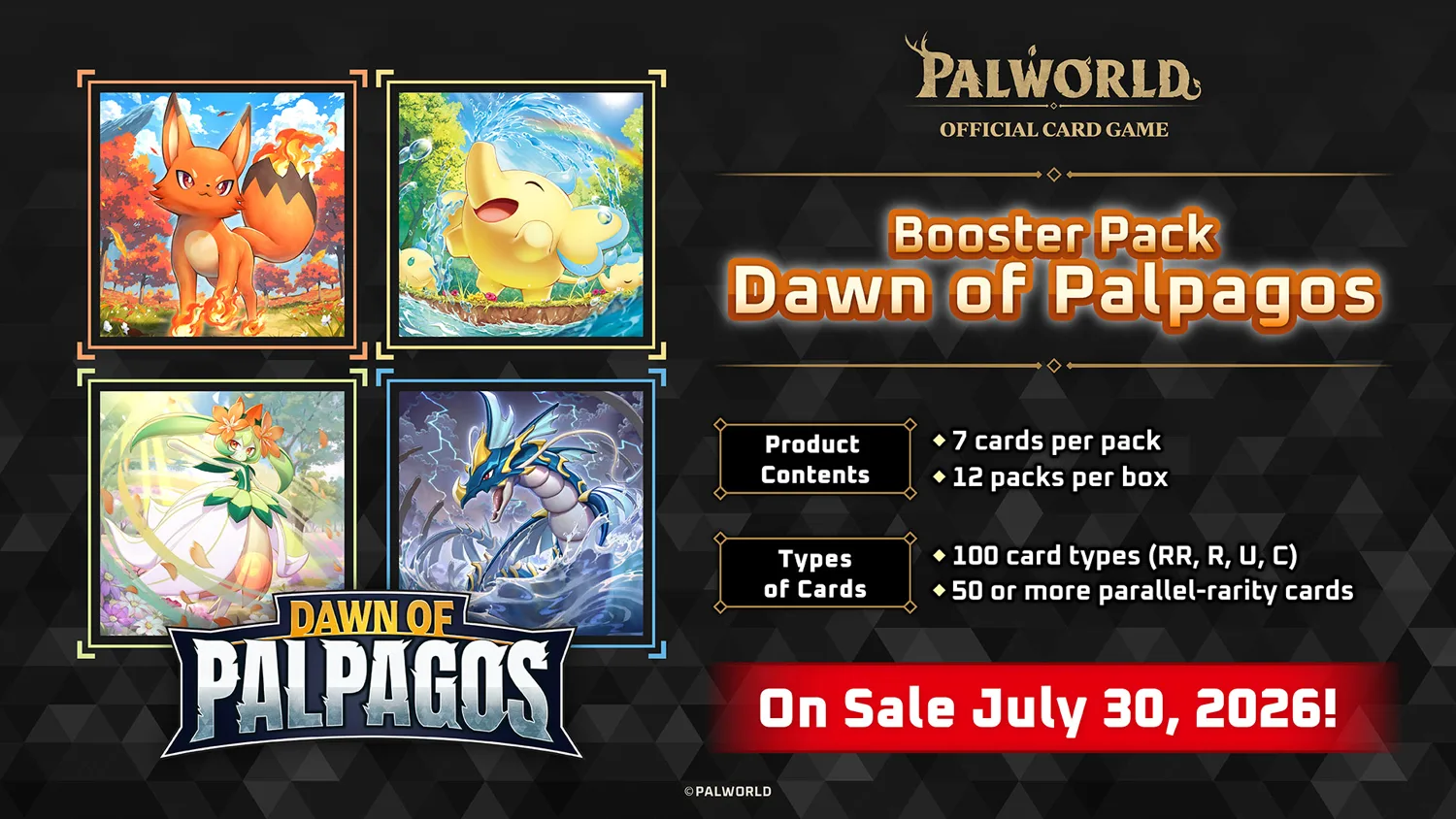
Bushiroad's spec for Booster Pack "Dawn of Palpagos" reads "Card types: 100 types (RR, R, U, C) + Parallel: 61 types". The database agrees exactly, which is worth saying out loud because the set's own key visual — the one at the top of this page — gives a floor rather than a figure: "50 or more parallel-rarity cards". 61 is the number.
Here is the whole booster, base rarity by base rarity, with what each tier gets as a parallel.
| Base rarity | Cards | With no parallel | Gets SR | Gets OSR + SP | Gets OSR + SSP | Gets SP only |
|---|---|---|---|---|---|---|
| C | 34 | 31 | 3 | 0 | 0 | 0 |
| U | 30 | 23 | 7 | 0 | 0 | 0 |
| R | 24 | 0 | 20 | 3 | 0 | 1 |
| RR | 12 | 0 | 0 | 8 | 4 | 0 |
| Total | 100 | 54 | 30 | 11 | 4 | 1 |
Add the parallel columns: 30 SR, 15 OSR, 12 SP, 4 SSP. Sixty-one.
Two things fall straight out of that table. Every R and RR card in the booster has at least one parallel printing — all 36 of them, no exceptions in the grid above. And 54 of the 100 booster card types have none, which is more than half the set living at exactly one printing.
Every RR card exists in exactly three printings
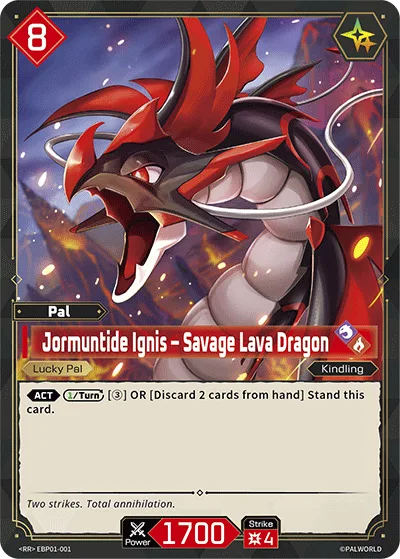
RR is the top base rarity, and the twelve cards there behave identically: base, plus an OSR, plus either an SP or an SSP. Three printings each, no more, no less.
| Card | Colour | Type | Cost | Power / Strike | Third printing |
|---|---|---|---|---|---|
| Jormuntide Ignis – Savage Lava Dragon | Red | Lucky Pal | 8 | 1700 / 4 | SSP |
| Suzaku – Hellfire Wings | Red | Lucky Pal | 7 | 1200 / 3 | SP |
| Axel's Strategy | Red | Event | 4 | — | SP |
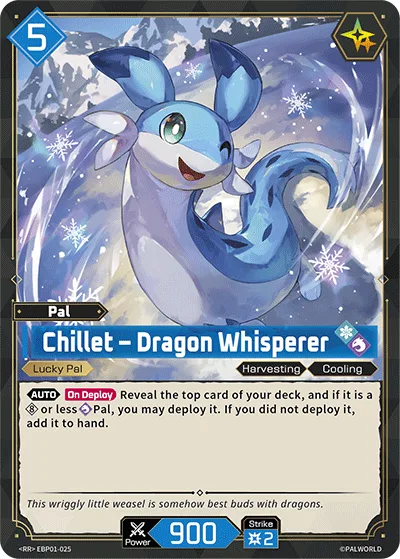
| Chillet – Dragon Whisperer | Blue | Lucky Pal | 5 | 900 / 2 | SSP |
| Relaxaurus – Hungry Gunner | Blue | Normal Pal | 7 | 1200 / 3 | SP |
| Victor's Strategy | Blue | Event | 3 | — | SP |
| Lyleen – Blessing of the Goddess | Green | Lucky Pal | 7 | 900 / 3 | SSP |
| Digtoise – Seismic Drillback | Green | Lucky Pal | 6 | 900 / 2 | SP |
| Lily's Strategy | Green | Event | 3 | — | SP |
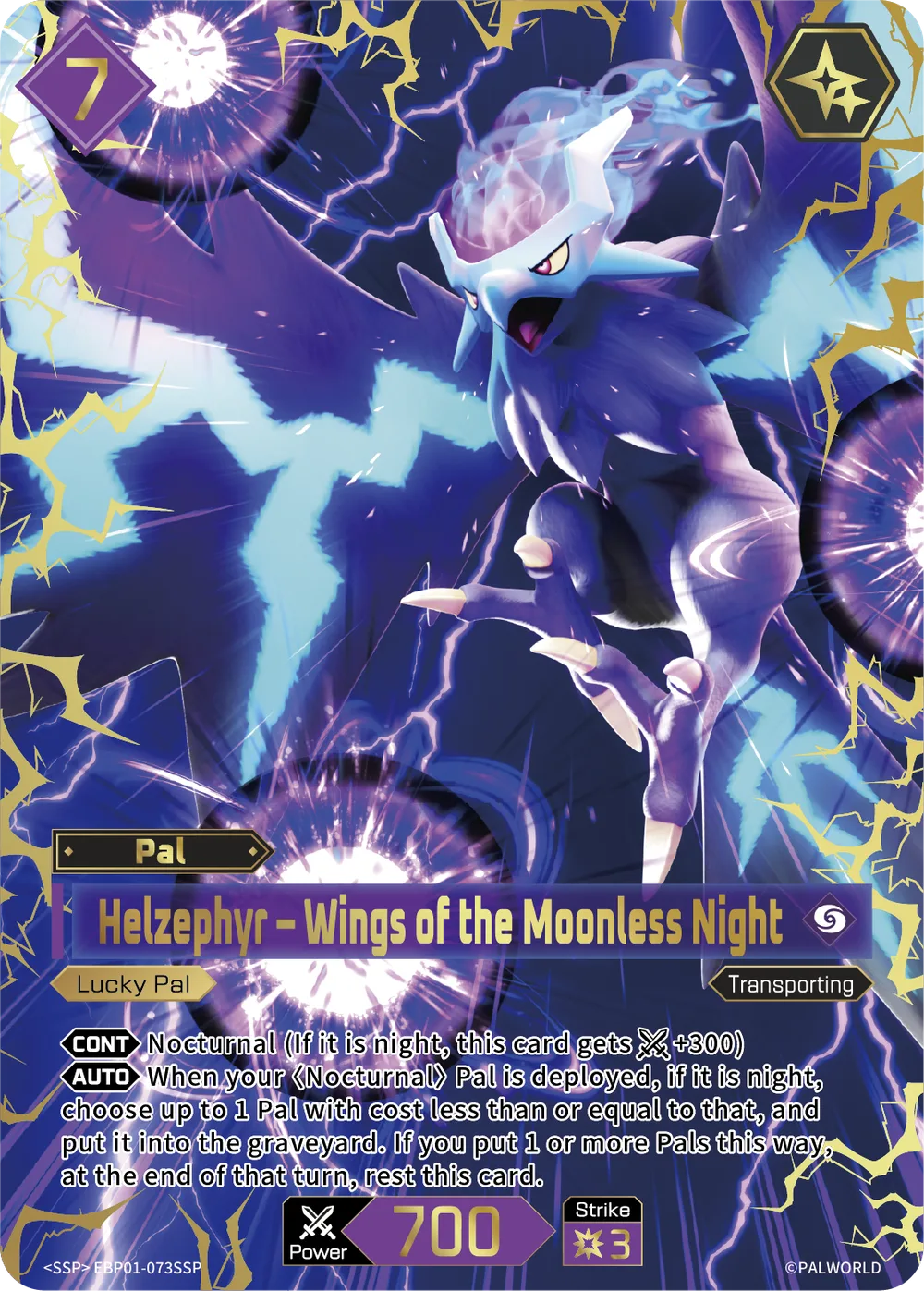
| Helzephyr – Wings of the Moonless Night | Purple | Lucky Pal | 7 | 700 / 3 | SSP |
| Shadowbeak – Seed of Despair | Purple | Lucky Pal | 8 | 1300 / 3 | SP |
| Zoe's Strategy | Purple | Event | 3 | — | SP |
Every one of the twelve also carries an OSR printing, so the table above is the third slot only.
The shape is deliberate and it is identical in all four colours: one Event and two Pals per colour, and the Event in each case is that colour's Strategy card. The event card guide already flagged the four Strategy cards as the only RR events; the full rarity sort adds that they are also the only non-Pal cards anywhere in the RR tier.
Seven of the eight RR Pals carry the Lucky icon. Relaxaurus – Hungry Gunner is the one that does not, which is the same split the Lucky Pal guide reports from the other direction.
One thing rarity does not track is size. Helzephyr sits at RR with 700 Power at cost 7, the bottom of a cost-7 band that runs to 1600 — 900 Power below the top of its own bracket, and below several Commons. Rarity in this set marks which card got the extra printing, not which card wins the game.
Four SSP cards, one per colour
SSP is the smallest tier in the game outside the single SSS card, and it is perfectly symmetrical: four cards, one in each colour, all four of them Lucky Pals, all four of them RR at base.
| Card | Colour | Cost | Power / Strike |
|---|---|---|---|
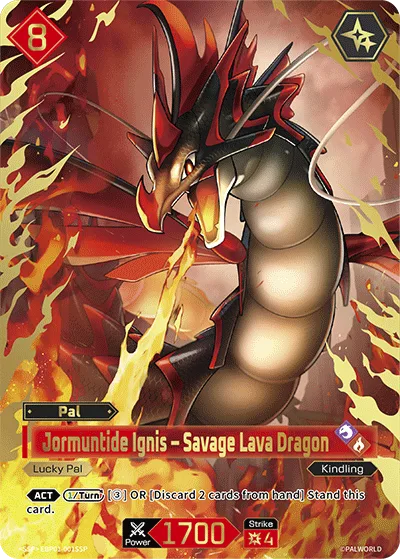
| Jormuntide Ignis – Savage Lava Dragon | Red | 8 | 1700 / 4 |
| Chillet – Dragon Whisperer | Blue | 5 | 900 / 2 |
| Lyleen – Blessing of the Goddess | Green | 7 | 900 / 3 |
| Helzephyr – Wings of the Moonless Night | Purple | 7 | 700 / 3 |
Put the base and the SSP of the same card side by side and the difference is layout, not content. The RR printing has a bordered illustration with a flavour line under the ability box; the SSP is full-bleed art with the frame stripped back and the flavour line gone. Cost, Power, Strike, subtype and ability text are identical.
SR is a parallel, not a tier
This is the code that repays a second look, because in the database SR is not a rarity a card is printed at — it is a treatment applied to a card printed at something else. All 30 SR entries are parallels, and they attach to three different base rarities: 20 R cards, 7 U cards and 3 C cards.
The R half is regimented. Five R cards per colour get an SR, and in every colour that is three Pals plus two non-Pals — Red gets Foxparks' Harness and Pump-Action Shotgun, Blue gets Antique Curtain and Pengullet Rocket Launcher, Green gets Breeding Farm and Cola Vending Machine, Purple gets Lamp and Meat Cleaver. Twenty cards, four colours, same recipe. That accounts for all four SR gear, matching the count in the gear card guide.
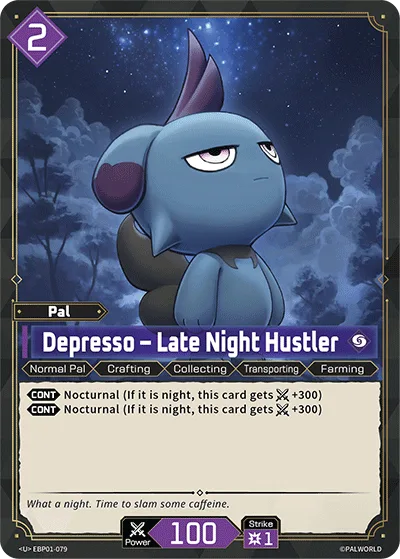
The other ten are scattered. Seven Uncommons and three Commons picked up an SR, including two Events (Pal Sphere and The Adventure Begins) and a 100-Power 2-drop in Depresso – Late Night Hustler. A Common with an SR parallel outranks, on the card, plenty of cards printed at R.
The one card that breaks the pattern
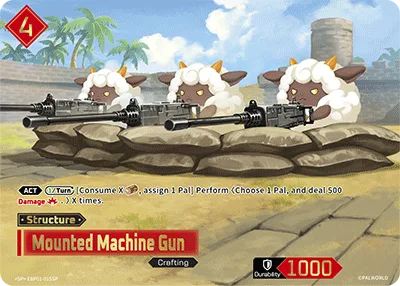
Sixteen cards in the booster have an SP or an SSP. Fifteen of them also have an OSR. The sixteenth is Mounted Machine Gun (EBP01-015), a 4-cost Red structure with 1000 Durability, and it is the only card in the set with an SP printing and no OSR to go with it.
It is also the only structure anywhere in the SP or SSP tiers — every other card in those sixteen is a Pal or an Event.
There is a second, quieter symmetry underneath it. Four R-rarity cards get pulled up into the SP tier alongside the eight RR ones, and there is exactly one per colour: Mounted Machine Gun in Red, Jormuntide – Surging Sea Serpent in Blue, Petallia – Sweet Blessings in Green, Katress – Abyssal Sorcerer in Purple. Red's slot is the structure, and Red's slot is the one that missed the OSR.
The gold Soul nobody put in the spec sheet
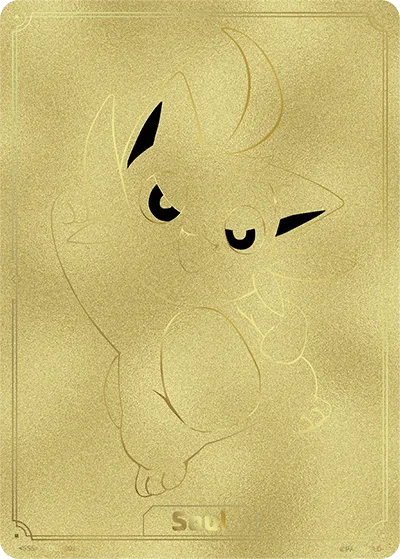
SSS has exactly one member: ESOUL-002, a Soul card filed under Booster Pack "Dawn of Palpagos". It is a solid gold card with the Pal artwork embossed into the foil rather than printed on it, and the word Soul along the bottom edge.
It is not one of the 100 card types. Bushiroad's published spec for the booster is 100 types across RR, R, U and C plus 61 parallels, and the database does not classify the SSS Soul as a parallel either — the parallel filter excludes it. So it is a 101st entry sitting outside the advertised structure, and how it is distributed has not been published.
Trial deck parallels: 14 possible, 1 in the box
The trial decks work on a completely separate scheme. Each of Trial Deck "Dawn of Palpagos Red・Blue" and "Green・Purple" is a 60-card product - a 50-card main deck plus a 10-card soul deck - built from 24 numbered card types plus the Soul card, all at TD rarity. Bushiroad's product pages say one parallel-rarity card — a Trial Deck Super Rare (TSR) or Trial Deck Super Parallel (TSP) — is included in place of a card from the 50-card main deck.
The database says which cards those can be. In each deck, 12 of the 24 numbered types have a TSR version, and 2 of those 12 also have a TSP version. Fourteen possible parallels per deck, and you open one of them.
| Deck | Cards | TSR available | TSP available | Cards with no parallel |
|---|---|---|---|---|
| Red・Blue (ETD01) | 24 | 12 | 2 | 12 |
| Green・Purple (ETD02) | 24 | 12 | 2 | 12 |
The two TSP cards in Red・Blue are Grizzbolt – Rumbling Tank and Elphidran Aqua – Gentle Ripples; in Green・Purple they are Mossanda – Guard Captain and Astegon – Aegis Wyvern of Death. Those four are the only trial deck cards with three printings.
What rarity changes at the table
Nothing about the numbers, and everything about your deck list arithmetic.
Different rarities are the same card for the four-copy limit. Official Q&A #2 is explicit: "Even if the cards have different card number/artwork/rarity, you may only include up to 4 pieces of cards with the same card name in total in a deck." An RR Chillet, an OSR Chillet and an SSP Chillet are three of your four, not one each.
A parallel can be missing text and still do the same thing. Official Q&A #20 covers cards that share a name across rarities where one printing lacks the text inside parentheses: "No, the effect is the same. The text written in parentheses ( ) is explanatory text, so its presence or absence does not change the card's effect." The Soul cards are where this is most visible — the trial deck Soul carries the parenthetical reminder that you may rest 3 souls once per main phase to draw a card, and the SSS and PR Soul printings leave that line off the card.
A parallel can also just be wrong and stay legal. Trial Deck "Dawn of Palpagos Red・Blue" carries an errata for ETD01-024TSR, the TSR printing of Ribbuny – Little Princess, where the Strike text was omitted. Bushiroad's notice keeps the card fully legal and treats it as if the correct text were present. The trial deck comparison has the full notice.
What Bushiroad has not published
Worth being blunt about, because none of the four exists in any official document I can find:
- No pull rates. Nothing on the frequency of SR, OSR, SP, SSP or SSS in a booster, and nothing on which of the 14 possible parallels turns up in a trial deck.
- No legend for eleven of the thirteen codes. Only TSR and TSP are spelled out, on the trial deck product pages.
- No distribution method for the SSS Soul.
- No MSRP. Prices vary by region and retailer, so any price table here would be a guess.
Quick reference
| Question | Answer |
|---|---|
| Rarity codes in the game | 13 |
| Base cards in the pool | 167 database entries, 166 distinct |
| Parallel printings | 89 |
| Booster base types | 100 — 34 C, 30 U, 24 R, 12 RR |
| Booster parallels | 61 — 30 SR, 15 OSR, 12 SP, 4 SSP |
| Trial deck parallels | 14 per deck — 12 TSR, 2 TSP |
| Top base rarity | RR, 12 cards |
| Rarest tier by count | SSS, 1 card (ESOUL-002) |
| Cards with no parallel | 97 of 167 |
| Most printings of any one card | 3 |
| Does rarity change the card | No — Q&A #2 and Q&A #20 |
Current as of Bushiroad's official card database and product pages on 23 August 2026, and re-verified against both on 30 August — every count above was unchanged. Sleeve & Card Set Vol.1 arrives first, now on 16 October after a delay Bushiroad announced on 28 August, with five card types unique to the set that may also come in parallel versions; Booster Pack "Legends Awaken" follows on 30 October with another 100 types plus parallels. The pool counts above have a two-month shelf life.
Frequently Asked Questions
How many rarities does the Palworld TCG have?
What does SSP mean in the Palworld TCG?
How many parallel cards are in Dawn of Palpagos?
Do different rarities count as different cards in a Palworld TCG deck?
Which Palworld TCG cards have three different printings?
What is the rarest card in the Palworld TCG?
Are parallel cards legal in Palworld TCG tournaments?
How many trial deck cards have a parallel version?
Keep Reading
- Palworld Official Card Game - Official Card List and Parallel Filter
- Booster Pack "Dawn of Palpagos" - Official Product Page
- Trial Deck "Dawn of Palpagos Red・Blue" - Official Product Page
- Trial Deck "Dawn of Palpagos Green・Purple" - Official Product Page
- Palworld Official Card Game - Rules Q&A
- Booster Pack "Legends Awaken" - Official Product Page (30 October 2026)
- Trial Decks Eternal Ascent Preorders (Bushiroad, 19 August 2026)
Related Guides
Palworld TCG Recommended Decks: All 4, and Which One Wins
Bushiroad recommends four decks to build from Dawn of Palpagos: Material, Dragon, Ingredient and Nocturnal. Its English site posted all four on 1 October, and on 7 October it posted the first tournament lists played with English cards, from the Grand Challengers Cup at Bushiroad EXPO 2026 in Kuala Lumpur. Here are all four recommended lists, card for card, and what happened when I checked each one against the 49 tournament lists in Bushiroad's own databases.
Palworld TCG Meta: What Won the Kyoto Masters League
Bushiroad has published the decks that finished first, second and third in all four blocks of Japan's first Masters League 26-27 qualifier, held in Kyoto on 22 September 2026. Every card in them has an English printing, so this is the first Masters League data for the Dawn of Palpagos format English players are about to take into October's Grand Challengers Cups. Eight of the 12 are Blue-Purple, ten run four Chillet, all 12 run exactly eight Lucky Pals, and not one contains a Green card.
Palworld TCG AUTO, CONT and ACT Abilities Explained
Every ability on a Palworld TCG card opens with one of three tags - AUTO, CONT or ACT - and Comprehensive Rules 10.1 makes that tag the most important word in the text box. It decides whether the ability works on your opponent's turn, whether you are allowed to decline it, and whether a [Once Per Turn] clock applies. I counted all 153 printed abilities across the 157 distinct cards in the launch pool and sorted them by category, trigger and cost.
Palworld TCG Keyword Abilities - 10 Counted, 14 in the Rules
Comprehensive Rules ver. 1.00 defines fourteen keywords in one section, and How to Play the Palworld TCG tables all of them - what Brave does, what Taunt does - and stops there. Nobody has counted how many cards actually carry each one. I pulled every card tagged with one of the ten keyword abilities Bushiroad's official database filters on and cross-referenced all 97 rulings: Interrupt covers nine Pals, Retaliate covers exactly one, and Depresso - Late Night Hustler prints Nocturnal twice on the same card, which the official Q&A confirms stacks to +600 Power.
How to Play the Palworld TCG - Souls, Power vs Strike, and How You Actually Win
Bushiroad's Palworld card game launched 30 July 2026, and its comprehensive rules landed the same day. Here is the full walkthrough - the four colours plus colourless, the soul deck, the Power and Strike split that decides every attack, structures and Pal labour, and the Damage Check that turns your own deck into your life total. Everything here is sourced from the official rules, and I flag what Bushiroad has not published.
Palworld TCG Elements - All 9, and Why Only 2 Cards Care
Every Pal card in the Palworld TCG carries an element icon, and the video game trained you to expect that icon to decide fights. It does not. Comprehensive Rules ver. 1.00 spends three sub-rules on elements and never mentions them again, and exactly two of the 166 cards in the launch pool have text that reads an element. Here is the full census of all nine across the 100 Pal cards, and the one element that already has support.