BotW Temperature and Lightning: What Stops What
Wearing a resistance and still taking damage usually means you brought the wrong one. Breath of the Wild has four separate temperature hazards and two separate lightning protections, and each fix works on exactly one of them. Here is the map, with the thresholds Zelda Wiki publishes.
Equip the Flamebreaker set, walk into the southern Gerudo Desert at noon, and the heat will still hurt. Zelda Wiki's Flame Guard page says the effect "does not affect damage taken from Extremely Hot Zones", and its Heat Resistance page says that effect does not touch a Scorching Climate either. Breath of the Wild does not have one temperature system. It has four hazards that each want a different answer, and two lightning protections that are not the same thing.
The armor guide tells you which sets to buy for which region, and the cooking guide tells you how to build the dishes. This post sits between them. It answers the question you ask when the hearts are draining anyway: what exactly is hurting me, and what does stop it?
Four hazards that look like one
The figures below come from Zelda Wiki's Temperature, Freezing Climate, Scorching Climate, Extremely Hot Zone, Heat, Cold Water and Lightning pages.
| Hazard | Where | What starts it | What stops it | What does not |
|---|---|---|---|---|
| Freezing Climate | Mount Hylia, the Hebra Mountains, Mount Lanayru, the Gerudo Highlands, and the tops of Akkala Tower, Wasteland Tower and Hyrule Castle | Air below 0°C (32°F) is slow damage; below -10°C (14°F) is faster | Cold Resistance | Ice attacks, and Cold Water |
| Extreme heat | The Gerudo Desert in daylight | Air above 40°C (104°F) is slow damage; above 50°C (122°F) is faster | Heat Resistance, shade, or water | Scorching Climates, fire, lava |
| Scorching Climate | Eldin Canyon and Death Mountain | Standing in it: Link catches fire and takes damage | Flame Guard (the Temperature page also lists entering water) | Heat Resistance, Extremely Hot Zones, fire, lava |
| Cold Water | Water in cold regions, including four spots Zelda Wiki names | Swimming in it | Nothing | Food, elixirs, armor |
| Lightning | Thunderstorms in five regions | Metal gear that sparks, then a strike | Lightning Proof | Shock Resistance alone |
You can read the live number on the dial in the lower right of the screen, or on the Map in the Sheikah Slate, which shows measurements. Zelda Wiki adds that near flowing lava the Slate stops giving a number and reads "ERROR", and that wooden equipment starts to burn.
Freezing Climates, and the water nothing stops
Zelda Wiki lists the Freezing Climates as the snowy regions plus high perches: Mount Hylia, the Hebra Mountains, Mount Lanayru, the Gerudo Highlands, and the tops of Akkala Tower, the Wasteland Tower and Hyrule Castle. In one, Link shivers and loses health until he warms up.
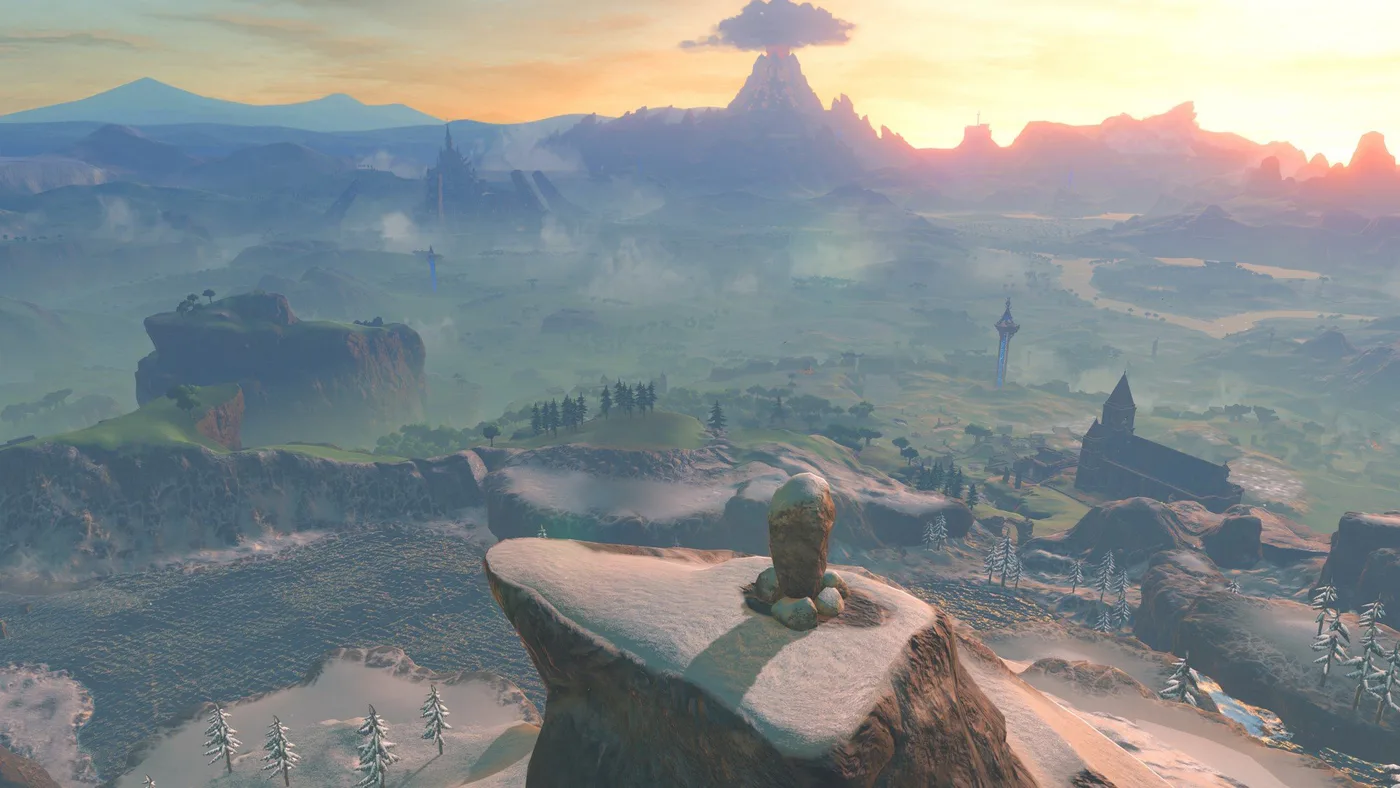
Three things cover it, and all of them grant the same Cold Resistance effect:
- Gear. The Warm Doublet, the Snowquill Headdress, Tunic and Trousers, the Vah Medoh Divine Helm and the Ruby Circlet. Zelda Wiki says the Warm Doublet and a single Snowquill piece each give one level. The doublet comes from the Old Man (or Ventest Clothing Boutique in Hateno), and the whole Snowquill set costs 2,150 rupees in Rito Village.
- Food. Spicy Pepper, Sunshroom, Warm Safflina, Sizzlefin Trout, Summerwing Butterfly and Warm Darner. Spicy Elixirs are the same effect in a bottle.
- Moving. The Temperature page says you can also just go somewhere more temperate.
The pages I read give no per-area table of how many cold levels each region needs. They also disagree on the ceiling: the Cold Resistance page caps the effect at level two, while the Snowquill Set page counts the full set as level 3. Wear the whole set, or a strong spicy dish, anywhere you plan to stay.
Unfreezable is not Cold Resistance
Cold Resistance stops the shivering. It does not stop being frozen solid by ice attacks, and that is a separate effect called Unfreezable. Zelda Wiki says upgrading all three Snowquill pieces twice at a Great Fairy gives complete immunity to freezing. Zant's Helmet, the Champions' Ballad reward from Tobio's Hollow, also gives Unfreezable, and its page is blunt that Link still takes damage from frigid environments and freezing water while wearing it.
That split matters around Naydra, whose aura freezes you; the dragon farming guide covers it, and the field bosses guide covers the fights where you will want that gear.
Cold Water is the exception to everything. Zelda Wiki's Cold Water page says swimming in it takes half a heart every 0.5 seconds, and the game's own tip says cooked food and special garb will not help. It lists four spots: Hebra Falls, Hebra Headspring and Hebra Plunge in the Tabantha Frontier, and the River of the Dead on the Great Plateau. Stay out of the water, or paraglide over it.
Desert heat and Heat Resistance
Zelda Wiki's Heat page says desert heat happens in the daytime in the Gerudo Desert. Above 104°F, Link slowly takes damage. Above 122°F it is faster. The Extremely Hot Zone page says the southern and western desert are the places where daytime air frequently goes past 122°F, and that they need two levels of Heat Resistance to be safe. The Heat page lists the other ways out: shade, jumping in water, certain armor, Chilly food or a Chilly Elixir.
Gerudo Town and Kara Kara Bazaar are always safe from the heat. A Rito traveler named Guy waits at the Bazaar for the daytime heat to pass, which is where the side quest "An Ice Guy" comes from: he needs a Chilly Elixir to cross.
Where to get Heat Resistance, per Zelda Wiki:
- Desert Voe set. 2,400 rupees for all three pieces, from the Gerudo Secret Club in Gerudo Town or the Rhondson Armor Boutique in Tarrey Town. The Spaulder at the Secret Club needs "The Secret Club's Secret" side quest first. The pieces combine to a maximum of mid-level resistance, and upgrading each one twice adds a Shock Damage Resist set bonus.
- Sapphire Circlet. 800 rupees and three sapphires at Starlight Memories in Gerudo Town, one level.
- Island Lobster Shirt. The Champions' Ballad DLC reward, one level.
- Food. Hydromelon, Chillshroom, Cool Safflina, Chillfin Trout, Winterwing Butterfly and Cold Darner.
Death Mountain and Flame Guard
A Scorching Climate is not a hot desert. Zelda Wiki says it is the result of Vah Rudania's rampage and covers Eldin Canyon and Death Mountain; inside it Link catches fire. The cure is Flame Guard. Heat Resistance does not touch it.
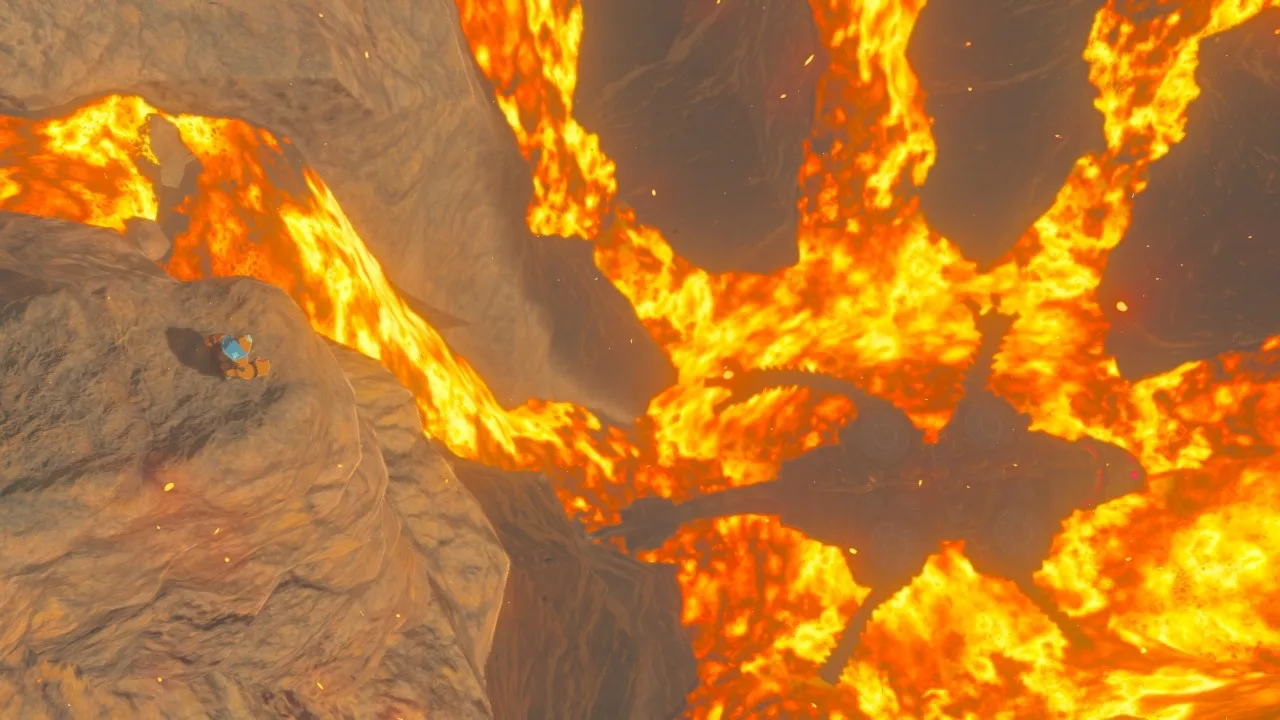
Flame Guard comes from the Flamebreaker set (3,300 rupees for all three from Ripped and Shredded in Goron City, and each piece gives one level), the Vah Rudania Divine Helm, and a Fireproof Elixir made from a Smotherwing Butterfly or a Fireproof Lizard plus a monster part. Zelda Wiki's Flame Guard page caps the effect at level two. Two Flamebreaker pieces is the whole job.
The markers count the levels for you
The Death Mountain Markers along the Mountain Road print a heat rating, and Zelda Wiki's Marker page records them:
| Marker | Place | Heat level |
|---|---|---|
| #2 | East of Medingo Pool | One star |
| #6 | Abandoned North Mine | Two stars |
| #8 | Bridge of Eldin | Two stars |
The Scorching Climate page says the same thing in words. It starts near Medingo Pool and needs one level of Flame Guard, then intensifies at the Abandoned North Mine and past the Bridge of Eldin, where two levels are needed. If you are crossing the Bridge of Eldin in one piece of Flamebreaker, that is why you are burning. The Divine Beasts guide covers Vah Rudania, and the Champions' Ballad guide covers Darb Pond.
The set bonus is a different thing with a confusingly similar name. The Flame-Resistant Equipment page says the trait that stops Scorching Climates is called Flame Guard, while the bonus for wearing all three pieces upgraded twice is called Fireproof, which stops Link catching fire. Per the Fireproof page, it does not stop a Scorching Climate, an Extremely Hot Zone or lava. You need both, and they are two different things in the armor menu.
What a Scorching Climate does to your kit
- Wooden weapons, bows and shields burn to ash, per Zelda Wiki. Carry stone or metal.
- Arrows ignite when drawn, and a Bomb Arrow explodes the moment you draw it.
- Dropped materials roast into Roasted Food on the ground. Meat dropped in a Freezing Climate hardens into frozen food instead.
Thunderstorms and the lightning rules
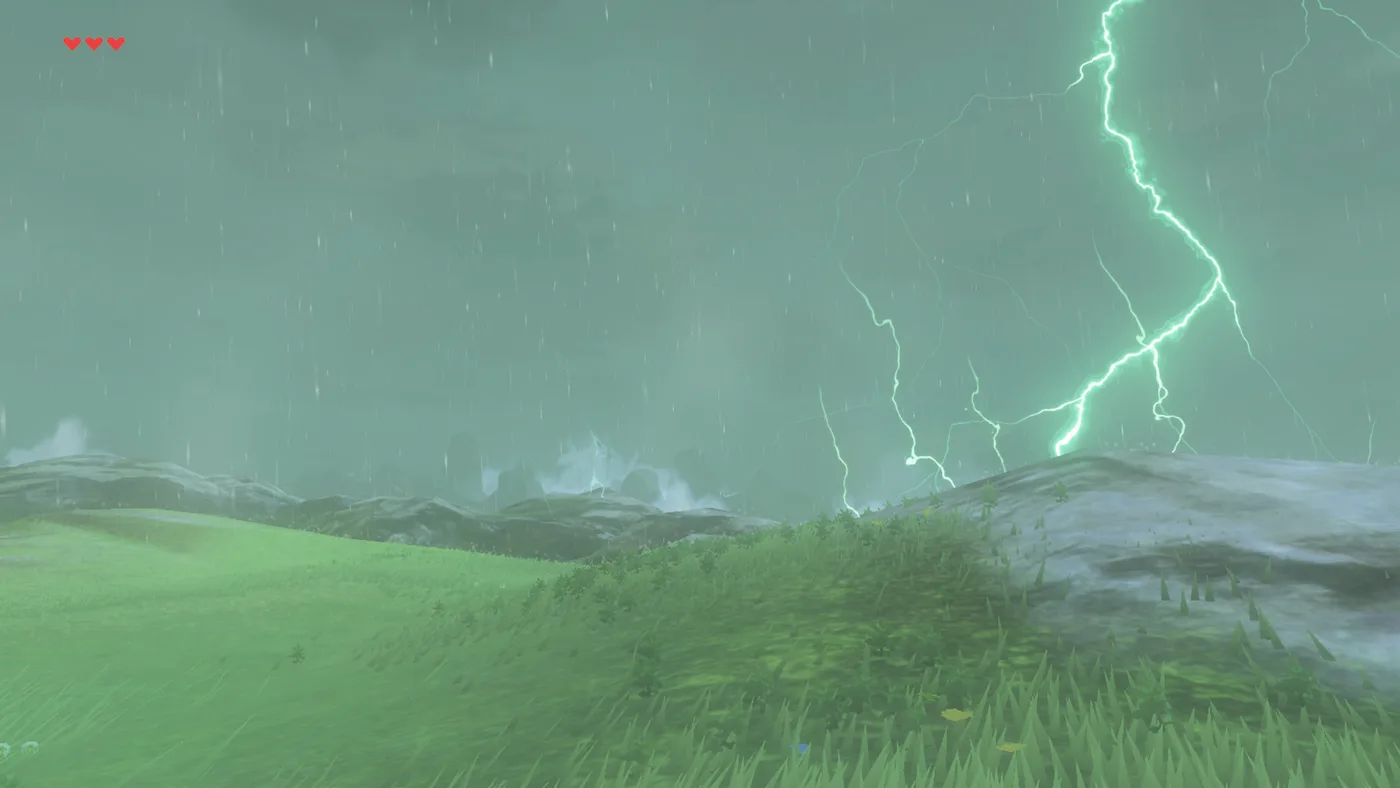
Zelda Wiki says thunderstorms occur in Akkala, Central Hyrule, Faron, Lanayru and Necluda, and can happen as snow-storms on Mount Hylia. The mechanic is the same everywhere: metallic weapons, shields and bows, including the ones in an enemy's hands, spark, and the spark eventually draws a strike that deals extreme damage. Metal objects such as the blocks in Cube Patterns attract strikes too, so keep your distance.
That makes the fix cheap. Put metal away, or, as the Lightning page puts it, equip the Thunder Helm. Thundra Plateau and Calora Lake start out in permanent thunderstorms, which stop only when you finish the "Trial of Thunder" and "A Song of Storms" shrine quests. Those are the same two shrines whose chests hold the Rubber Armor and Rubber Tights.
Shock Resistance versus Lightning Proof
These are two separate effects, and the difference is the whole story.
| Effect | What it does | Where it comes from |
|---|---|---|
| Shock Resistance | Cuts electricity damage by 33%, 66% or 100% at levels one, two and three; level three also stops you dropping what you hold. Zelda Wiki says it does not affect the explosion damage from a lightning strike | Voltfruit, Zapshroom, Electric Safflina, Voltfin Trout, Thunderwing Butterfly, Electric Darner; the Rubber pieces, Vah Naboris Divine Helm, Topaz Earrings |
| Lightning Proof | No damage from electricity or lightning, and no knockback or disarming | The Thunder Helm; the Rubber Set bonus (called Unshockable) with all three pieces upgraded twice |
So an Electro Elixir will blunt electric attacks, but it is not the answer to a thunderstorm. Each Rubber piece adds a level of Shock Resistance, and the Rubber Helm comes from the "Thunder Magnet" side quest at Lakeside Stable. If you have the full set at two stars, you are Lightning Proof, and the dragon guide uses exactly that to stand in Farosh's electric aura.
Getting the Thunder Helm without losing it
The Thunder Helm belongs to Riju. Zelda Wiki says she lends it after you have cleared Vah Naboris and finished four Gerudo Town side quests: "Tools of the Trade", "The Mystery Polluter", "Medicinal Molduga" and "The Search for Barta". It has 3 defense and cannot be upgraded at a Great Fairy, which is why the Great Fairy guide tells you not to bring it.
One trivia note on that page is worth heeding. Zelda Wiki says that because of an oversight, if your armor inventory is full when Riju hands it over, the helm can be permanently lost. It will not appear and she will not give it again. Free a slot first. The Yiga Clan Hideout guide covers recovering it in the first place.
The name traps in food and gear
The names are chosen to confuse. Use this as a cheat sheet.
| You want | Effect name | Food name | Elixir | Gem on the gear |
|---|---|---|---|---|
| Warm in the snow | Cold Resistance | Spicy | Spicy Elixir | Ruby Circlet |
| Cool in the desert | Heat Resistance | Chilly | Chilly Elixir | Sapphire Circlet |
| Not on fire on Death Mountain | Flame Guard | Only two critters listed, so an elixir job | Fireproof Elixir | Flamebreaker |
| Not electrocuted | Shock Resistance | Electro | Electro Elixir | Rubber |
Three traps are in there. "Warm" Safflina and Warm Darner give Cold Resistance, while "Cool" Safflina and Cold Darner give Heat Resistance. A ruby, the fire gem, warms you, and a sapphire cools you. And the Ruby Circlet is the 500-rupee, three-ruby one, while the Sapphire is 800 rupees and three sapphires, both at Starlight Memories in Gerudo Town.
The cooking guide has the recipes, the pot rules and the Fireproof Elixir prices from Gaile and Offrak.
How the weather itself works
Zelda Wiki says the weather in a given area changes every four in-game hours, and the forecast sits beside the mini-map and on the Slate's Map. Hyrule is divided into 94 map areas linked to 20 predefined climates, and each climate carries its own odds for blue sky, cloud, rain, heavy rain and thunderstorm plus its own day and night temperature by altitude. At low enough temperatures, rain falls as snow.
Two desert extras. Sandstorms occur only in the Gerudo Desert, and while you are inside one the Slate's Map fills with static, so you cannot warp out. And the Raging Winds north and west of the Hebra Mountains are not part of the dynamic weather system.
Quick Action Checklist
- Read the hazard before the gear. Cold, desert heat, Death Mountain fire and lightning each need a different effect.
- Desert in daylight: Heat Resistance. Two levels for the southern and western Extremely Hot Zones. Gerudo Town and Kara Kara Bazaar are safe.
- Death Mountain: Flame Guard, two levels past the Bridge of Eldin. Heat Resistance does nothing there.
- Wear all three Flamebreaker pieces at two stars to get the Fireproof set bonus that stops catching fire.
- Cold peaks: Cold Resistance, plus Unfreezable (upgraded Snowquill or Zant's Helmet) against ice attacks.
- Do not swim in Cold Water. Half a heart every 0.5 seconds, and nothing blocks it.
- In a thunderstorm, put the metal away, or wear the Thunder Helm or the upgraded Rubber set.
- Free an armor slot before Riju lends you the Thunder Helm.
- Check the name, Spicy and Warm are cold, Chilly and Cool are heat.
Frequently Asked Questions
Does Heat Resistance protect you on Death Mountain in Breath of the Wild?
What protects you from desert heat in Breath of the Wild?
How do you stop Cold Water damage in Breath of the Wild?
What is the difference between Shock Resistance and Lightning Proof in Breath of the Wild?
How do you stop lightning from hitting you in Breath of the Wild?
Is Zant's Helmet enough for the cold in Breath of the Wild?
How often does the weather change in Breath of the Wild?
Keep Reading
- Zelda Wiki — Temperature: 0°C and -10°C cold thresholds, 40°C and 50°C heat thresholds, the dial and Slate readout, lava reads ERROR
- Zelda Wiki — Freezing Climate: Mount Hylia, Hebra, Lanayru, Gerudo Highlands and tower tops, Warm Doublet, Snowquill, Spicy Elixir, Cold Water
- Zelda Wiki — Scorching Climate: Eldin Canyon and Death Mountain, one level near Medingo Pool and two at the Abandoned North Mine and Bridge of Eldin, burning wooden gear, Bomb Arrows
- Zelda Wiki — Extremely Hot Zone: southern and western Gerudo Desert, two levels of Heat Resistance
- Zelda Wiki — Heat: 104°F and 122°F thresholds, shade and water, Gerudo Town and Kara Kara Bazaar protected, An Ice Guy
- Zelda Wiki — Cold Resistance (Chill-Proof): does not stop ice, ice attacks or Cold Water, maximum level two, materials and armor that grant it
- Zelda Wiki — Heat Resistance: stops Extremely Hot Zones but not Scorching Climates, fire or lava, materials and armor that grant it
- Zelda Wiki — Flame Guard: stops Scorching Climates but not Extremely Hot Zones, fire or lava, maximum level two, Flamebreaker and Vah Rudania Divine Helm
- Zelda Wiki — Cold Water: half a heart every 0.5 seconds, nothing protects, Hebra Falls, Hebra Headspring, Hebra Plunge, River of the Dead
- Zelda Wiki — Death Mountain Marker: heat level stars on markers 2, 6 and 8 along the Mountain Road
- Zelda Wiki — Flame-Resistant Equipment: Flamebreaker set, 3,300 rupees, Flame Guard trait versus the Fireproof set bonus at two stars
- Zelda Wiki — Flamebreaker Helm: one level of Flame Guard, sold in Ripped and Shredded, Goron City
- Zelda Wiki — Fire-Proof: the set bonus stops fire damage but not Scorching Climates, Extremely Hot Zones or lava
- Zelda Wiki — Snowquill Set: 2,150 rupees in Rito Village, Unfreezable when all three pieces are upgraded twice
- Zelda Wiki — Snowquill Headdress: one level of Cold Resistance on its own, Brazen Beak in Rito Village
- Zelda Wiki — Warm Doublet: one level of Cold Resistance, from the Old Man or Ventest Clothing Boutique
- Zelda Wiki — Ruby Circlet: 500 rupees and three rubies at Starlight Memories, one level of Cold Resistance
- Zelda Wiki — Sapphire Circlet: 800 rupees and three sapphires at Starlight Memories, one level of Heat Resistance
- Zelda Wiki — Desert Voe Set: 2,400 rupees, Gerudo Secret Club or Rhondson Armor Boutique, mid-level Heat Resistance, Shock Damage Resist set bonus
- Zelda Wiki — Desert Voe Spaulder: sold at the Gerudo Secret Club once The Secret Club's Secret is complete
- Zelda Wiki — Island Lobster Shirt: Champions' Ballad armor, one level of Heat Resistance
- Zelda Wiki — Zant's Helmet: Tobio's Hollow, Unfreezable bonus, still takes damage from frigid environments and freezing water
- Zelda Wiki — Spicy Elixir: Cold Resistance, made from Summerwing Butterflies or Warm Darners with monster parts
- Zelda Wiki — Chilly Elixir: Heat Resistance, made from Cold Darners or Winterwing Butterflies with monster parts
- Zelda Wiki — Fireproof Elixir: Flame Guard, made from Smotherwing Butterflies or Fireproof Lizards with monster parts
- Zelda Wiki — Electro Elixir: Shock Resistance, made from Electric Darners or Thunderwing Butterflies with monster parts
- Zelda Wiki — Lightning: metal weapons spark and attract strikes in thunderstorms, extreme damage unless the Thunder Helm is worn
- Zelda Wiki — Thunderstorm: Akkala, Central Hyrule, Faron, Lanayru and Necluda, permanent storms over Thundra Plateau and Calora Lake until their shrine quests
- Zelda Wiki — Shock Resistance: 33, 66 and 100 percent at levels one to three, does not affect lightning strike explosions
- Zelda Wiki — Lightning-Proof (Unshockable): no damage, knockback or disarming from electricity or lightning, Thunder Helm and Rubber Set bonus
- Zelda Wiki — Rubber Set: Thunder Magnet at Lakeside Stable, Toh Yahsa Shrine, Qukah Nata Shrine, one Shock Resistance level per piece
- Zelda Wiki — Thunder Helm: lent by Riju after Vah Naboris and four Gerudo Town side quests, 3 defense, cannot be enhanced, can be lost with a full armor inventory
- Zelda Wiki — Weather: four-hour weather changes, 94 map areas, 20 climates, rain turning to snow
- Zelda Wiki — Sandstorm: exclusive to the Gerudo Desert, the Sheikah Slate map turns to static and teleporting is blocked
- Zelda Wiki — Raging Wind: forceful gusts north and west of the Hebra Mountains
Related Guides
Breath of the Wild Runes: Damage, Cooldowns and Upgrades
A Remote Bomb hits for 12 and recharges in six seconds; three Ancient Shafts make that 24 and three. Here is what each Sheikah Slate rune does, with the numbers where the wikis publish them, where each one stops working, and which of Purah's three upgrades to buy first.
Breath of the Wild Mini-Games: All 16, Costs and Prizes
Breath of the Wild has 16 mini-games, from Snowball Bowling to Gut Check Rock. Four of them stand between you and a shrine, and their prizes run from a refunded fee to a 300-rupee Gold Rupee. Here is every location, fee and prize tier, and which ones repay a second run.
Breath of the Wild Hateno House: Every Upgrade and Cost
Buying Link's house in Hateno Village is only the first half of Hylian Homeowner. Bolson then sells 14 additions at 100 rupees each, and nine of them do something. Here is the full 4,400-rupee bill, the conversation that unlocks the renovation menu, and what is worth hanging on the walls.
Breath of the Wild Best Shields: All 33, Stats and Locations
The Ancient Shield and the Royal Guard's Shield both block at 70 guard, but surf them down a rocky slope and the Royal Guard's loses durability fifteen times as fast. Here are all 33 shields with guard, durability, material and source, plus the surfing friction, surfing wear and Guardian-beam values from the game's data.
Breath of the Wild Beginner's Guide: Your First 10 Hours
Breath of the Wild does not tell you that armor matters more than hearts, that your weapons are ammunition, or that the Blood Moon is a restock button. Here is the stuff the game leaves you to discover the hard way.
Breath of the Wild Kilton: Shop Locations, Mon and Masks
Kilton pays 3 Mon for a Bokoblin Horn, exactly what a shop pays in rupees, and 100 Mon for a Lynel Guts a shop buys for 200. Here is where the Fang and Bone opens, the full Mon exchange table, all twelve wares and their Divine Beast unlocks, and what the masks, the Dark set and Monster Extract actually do.