Minecraft Dye Guide: How to Make All 16 Colors
Fifteen of Minecraft's sixteen dyes come from a single item you can pick up, smelt or squid. Purple is the only one that does not exist outside a crafting grid, and green is the only one with no crafting recipe at all. Here is the whole palette in one table, which biome hands you eight of the sixteen for free, and the sheep trick that turns one dye into unlimited coloured wool.
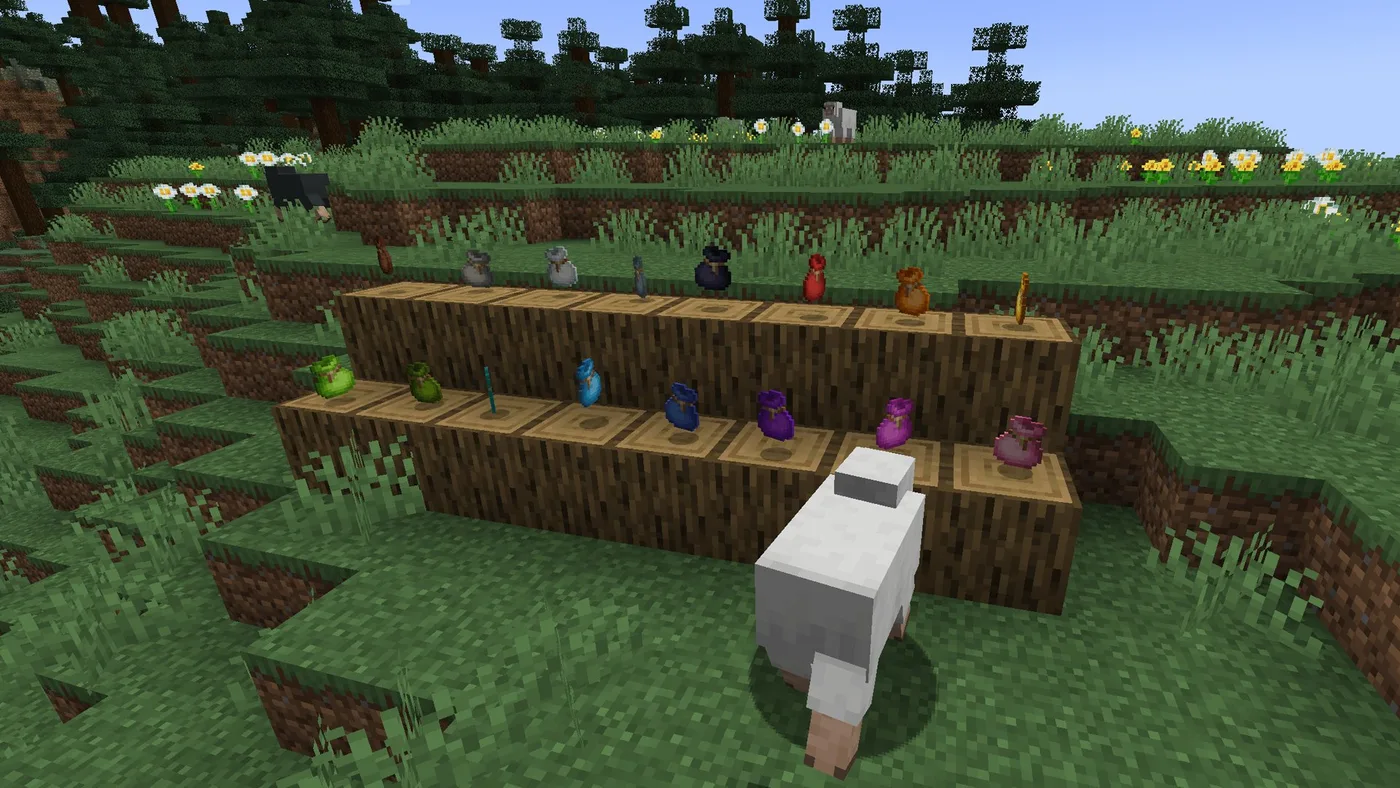
Sixteen dyes, and the game will cheerfully let you spend an evening crafting the expensive version of every one of them. It does not need to be that complicated. Fifteen of the sixteen dyes come from a single item you can pick off the ground, smelt in a furnace, or take off a squid — no mixing, no second dye, no chart. Purple is the only colour that cannot exist outside a crafting grid.
That one fact reorganises the whole system. You are not learning a colour wheel; you are learning a short shopping list of flowers, plus two furnace recipes and one squid.
Here is the complete palette, the biome that hands you half of it in a single afternoon, and the sheep trick that turns one dye into wool forever.
All 16 dyes and what each one is made from
The Direct source column is every item that crafts or smelts straight into that dye with no other dye involved. The number in brackets is how many dye you get per item — everything is 1 unless stated.
| Dye | Direct source (no other dye needed) | From other dyes |
|---|---|---|
| White | Bone meal, lily of the valley | — |
| Light gray | Azure bluet, oxeye daisy, white tulip | Gray + white (2), black + white + white (3) |
| Gray | Closed eyeblossom | Black + white (2) |
| Black | Ink sac, wither rose | — |
| Brown | Cocoa beans | — |
| Red | Poppy, red tulip, beetroot, rose bush (2) | — |
| Orange | Orange tulip, torchflower, open eyeblossom | Red + yellow (2) |
| Yellow | Dandelion, wildflowers, sunflower (2), golden dandelion | — |
| Lime | Smelt a sea pickle | Green + white (2) |
| Green | Smelt a cactus | — |
| Cyan | Pitcher plant (2) | Blue + green (2) |
| Light blue | Blue orchid | Blue + white (2) |
| Blue | Lapis lazuli, cornflower | — |
| Purple | none | Blue + red (2) |
| Magenta | Allium, lilac (2) | Purple + pink (2), pink + red + blue (3), red + red + blue + white (4) |
| Pink | Pink tulip, pink petals, cactus flower, peony (2) | Red + white (2) |
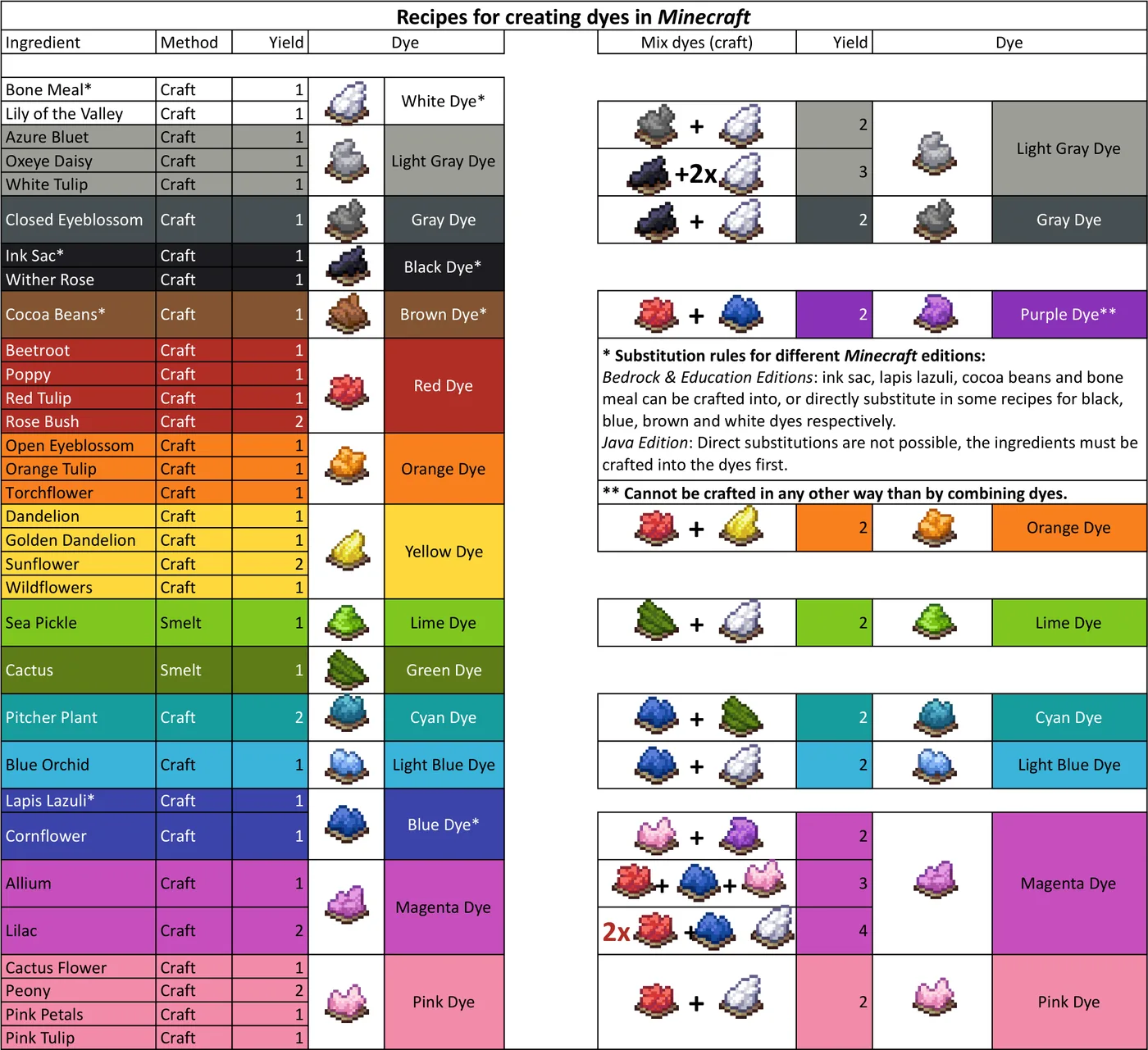
Six of the sixteen — white, light blue, blue, green, orange and yellow — also turn up loose in generated chest loot, so you may already own dyes you never made.
One entry in that table is a trap. Golden dandelion does craft into yellow dye, but a golden dandelion is itself crafted from eight gold nuggets and a dandelion. It exists to pause a baby mob's growth, not to colour anything. Never feed one to a crafting grid.
Fifteen dyes need no other dye. Purple always does
Run down the Direct source column and count the blanks: there is exactly one. Purple dye has no source in the game other than combining blue dye and red dye, two at a time. Every other colour, including the ones whose names sound like a mixing instruction, has a plant or an item that skips the mixing entirely:
- Magenta looks like a three-dye recipe. An allium is one dye, and a lilac is two.
- Light blue looks like blue plus white. A blue orchid is one dye, and blue orchids grow in swamps.
- Cyan looks like blue plus green. A pitcher plant gives two cyan dye from one plant.
- Gray looks like black plus white. A closed eyeblossom is one gray dye.
That last one is the odd one, because an eyeblossom is not one flower. Eyeblossoms generate only in the pale garden, and they close during the day and open at night. Break one and it drops in whatever state it was in at that moment. A closed eyeblossom crafts into gray dye and an open one crafts into orange — the same plant, two different dyes, decided by the clock.
Torchflowers and pitcher plants do not generate anywhere in the world, and wandering traders will not sell either one. Both come out of a sniffer. And a wither rose only drops when the wither kills something, so if black dye is the goal, go find a squid.
Green is the only dye with no crafting recipe
Green is the mirror image of purple. Purple is the only dye you must craft; green is the only dye you cannot craft at all. There is no flower, no combination, nothing on a crafting grid — you smelt a cactus, and that is the entire recipe.
Lime is the other furnace dye, from a smelted sea pickle, but lime at least has the green-plus-white crafting route as a backup. Green does not.
That matters more than it sounds, because green is upstream of two other colours. Cyan is blue plus green. Lime is green plus white. Unless you have a sniffer for pitcher plants or an ocean full of sea pickles, green, cyan and lime all trace back to a furnace and a cactus — which makes a cactus farm a dye supply line, not a decorative project.
There is a side benefit. Smelting cactus is worth 1 XP per item in Java Edition and 0.2 in Bedrock, which the wiki itself flags as a long-standing Java bug (MC-210211, "smelting cactus gives too much experience since 1.13"). An automatic cactus farm feeding a furnace is a slow but genuinely free XP trickle on top of the dye, and the XP guide covers where that ranks against the fast options.
Tall flowers pay double, and bone meal copies them
There are exactly five two-block flowers in the game, and every one of them crafts into two dye instead of one: sunflower (yellow), lilac (magenta), rose bush (red), peony (pink) and pitcher plant (cyan).
Four of the five also duplicate. Bone meal used on a double flower — every one except the pitcher plant — makes it drop a copy of itself, which the wiki notes is the only renewable way to obtain double flowers. Bone meal a rose bush and it drops a second rose bush worth 2 red dye, with the original still planted. Wildflowers behave the same way, dropping a copy per bone meal, at one yellow dye each.
So you do not really need a dye farm. One rose bush, one lilac, one sunflower, one peony, a patch of dirt and a composter feeding you bone meal will do it: red, magenta, yellow and pink all come out of those four plants at two dye a pick, and orange is red plus yellow.
That is why the pitcher plant is the odd one out of the five: it pays two cyan dye like the rest, but bone meal will not copy it, so cyan stays sniffer-gated or blue-plus-green.
One flower forest covers half the palette
Flower biomes are not evenly stocked, and one of them is stocked absurdly well. In Java Edition a flower forest generates dandelions, poppies, alliums, azure bluets, all four tulips, oxeye daisies, cornflowers and lily of the valley, and lilac, rose bush and peony generate there as well.
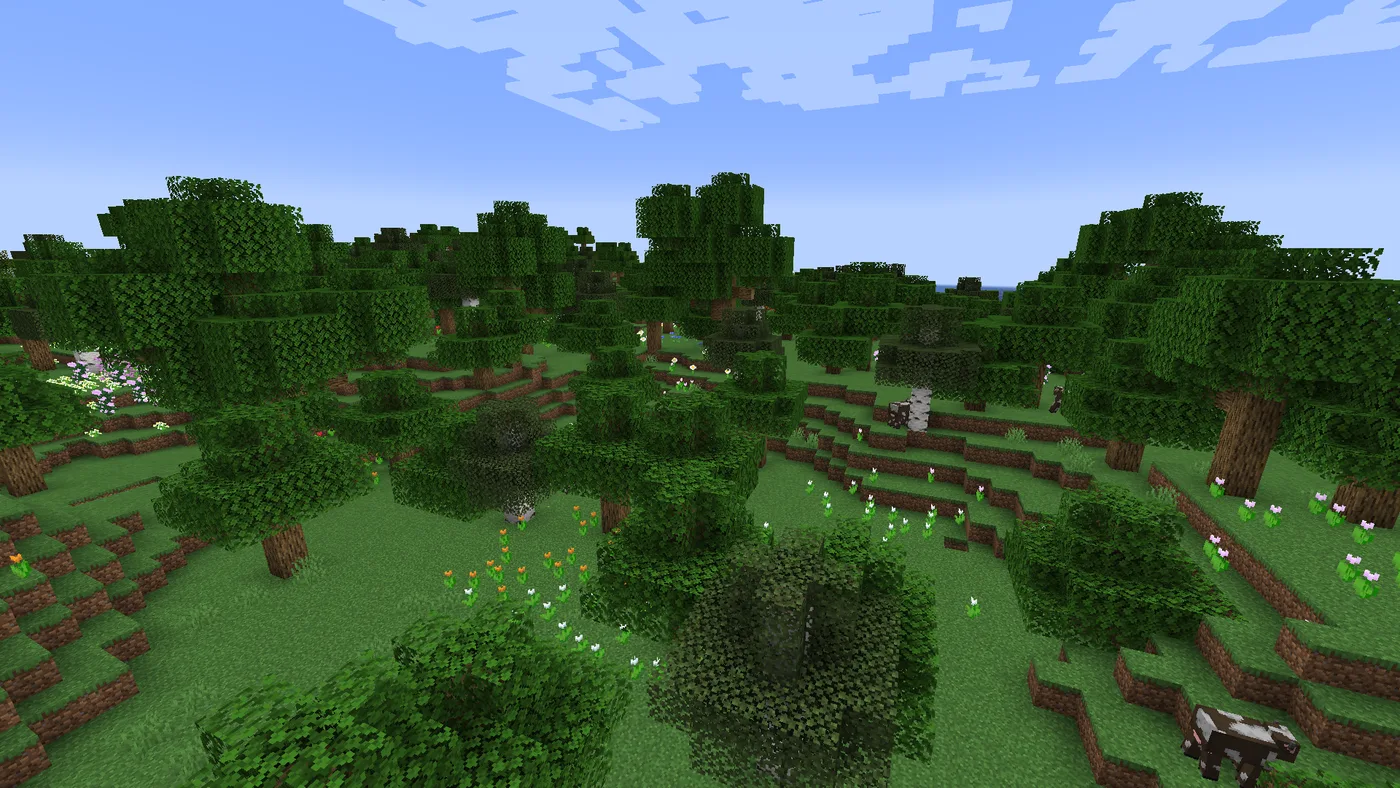
Count what that single biome hands you: white, light gray, red, orange, yellow, pink, magenta and blue — eight of the sixteen dyes, direct, no mixing. Blue and red then make purple, and blue and white make light blue, so ten of the sixteen come out of one biome.
The six it cannot give you, and where they actually live:
| Missing dye | Where to get it |
|---|---|
| Black | Ink sac from a squid, or a wither rose from a wither kill |
| Brown | Cocoa beans, on jungle tree trunks |
| Green | Smelt a cactus (desert or badlands) |
| Lime | Smelt a sea pickle, or green + white |
| Cyan | Pitcher plant from a sniffer, or blue + green |
| Gray | Closed eyeblossom from a pale garden, or black + white |
Two more placement notes worth knowing: blue orchids generate in swamps, and wildflowers generate only in birch forests, old growth birch forests and meadows. Neither shows up in a flower forest.
Dye a sheep, not a stack of wool
Dye applied to wool is consumed permanently: one dye, one block of wool, gone. Dye applied to a sheep is not, and the difference compounds.
Use a dye on a sheep and its wool changes colour for good. Shear it and you get 1 to 3 wool of that colour, unaffected by Fortune or Looting. The sheep regrows its wool by grazing grass — and only by grazing grass, so a sheep standing on stone stays bald. Then you shear it again. One dye, indefinite coloured wool.
Breeding compounds it, and the colour rules are the odd bit. A lamb takes one parent's colour, or the mix of both parents if those two colours mix as dyes do. Red and yellow sheep make an orange lamb, because red dye plus yellow dye makes orange dye. Blue and yellow sheep cannot make a green lamb, because blue dye plus yellow dye is not a green dye recipe — so the lamb is randomly one parent's colour instead.
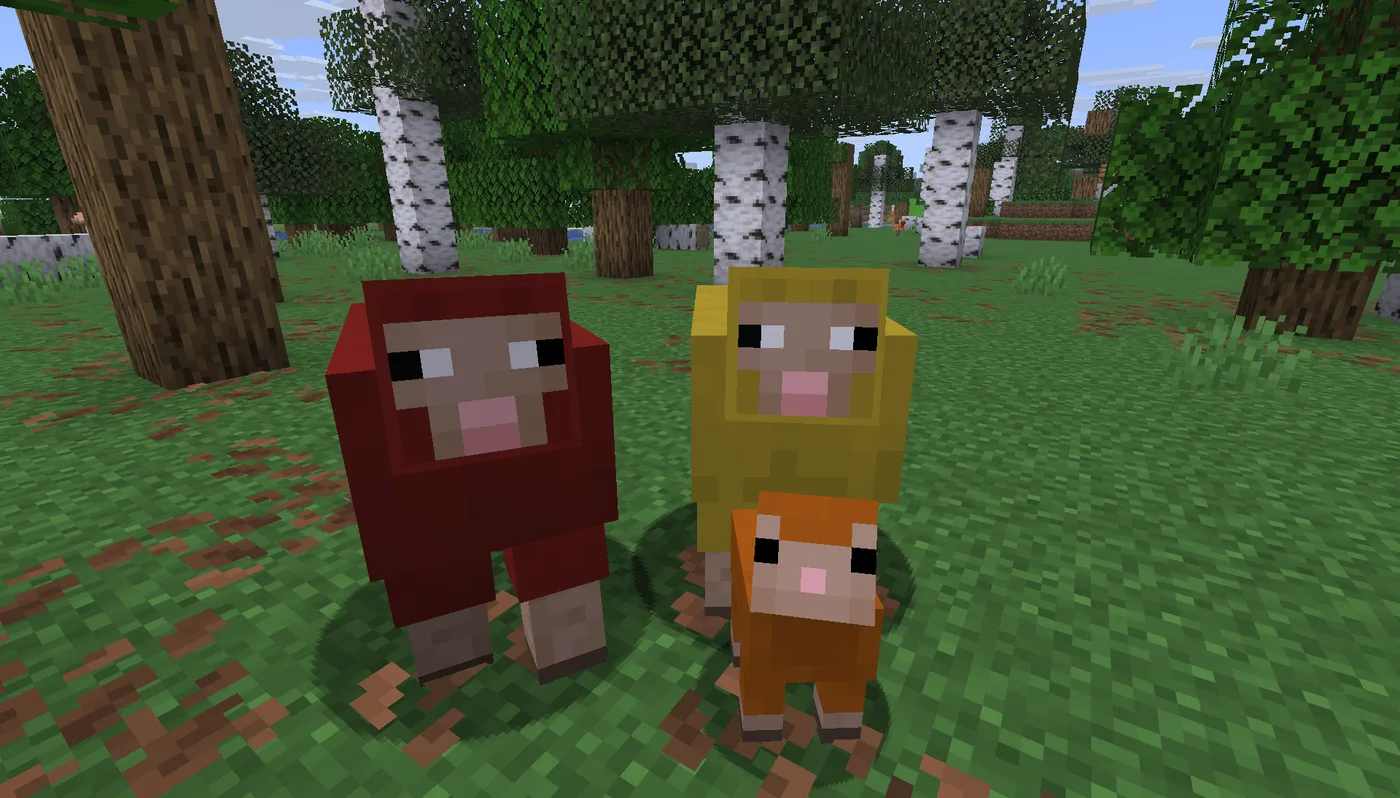
If you want a specific colour in bulk, dye two sheep that colour and breed them. If you want orange, red and yellow parents will get you there without spending an orange dye at all.
One dye colours eight blocks, or one. Know which
The other half of dye economy is output ratio, and it is not consistent. Some recipes stretch a single dye across eight blocks; others burn one dye per item.
| What you are dyeing | Dye per craft | You get | Re-dyeable later |
|---|---|---|---|
| Stained glass (+ 8 glass) | 1 | 8 | No |
| Stained glass panes (+ 8 panes) | 1 | 8 | No |
| Stained terracotta (+ 8 terracotta) | 1 | 8 | No |
| Concrete powder (+ 4 sand, 4 gravel) | 1 | 8 | No |
| Wool | 1 | 1 | Yes |
| Carpet | 1 | 1 | Yes |
| Bed | 1 | 1 | Yes |
| Shulker box | 1 | 1 | Yes |
| Bundle | 1 | 1 | Yes |
| Harness | 1 | 1 | Yes |
| Candle | 1 | 1 | No — undyed candles only |
| Firework star | 1–8 | 1 | Adds a fade layer |
| Sheep | 1 | wool forever | Yes |
| Wolf or cat collar | 1 | 1 | Yes |
| Sign or hanging sign text | 1 | 1 | Yes |
The four 8-for-1 recipes are where a big build should spend its dye. A full stack of stained glass costs 8 dye; a full stack of coloured wool costs 64 unless it came off a sheep.
The "No" column matters too. Stained terracotta cannot be re-stained and concrete cannot be re-dyed — pick the colour before you craft 512 of them. Wool, carpet, beds, bundles, harnesses and shulker boxes can all be recoloured any number of times.
Banner patterns are their own system: the loom consumes one dye per pattern layer, and that dye sets the layer's colour rather than the banner's. That is a separate rabbit hole, and the banner guide has it.
Buy at three for one, sell at twelve for one
Every dye in the game is purchasable. A wandering trader sells 3 of any dye for 1 emerald, up to 12 uses of that offer, which makes the wandering trader the universal backstop for a colour your world has no biome for.
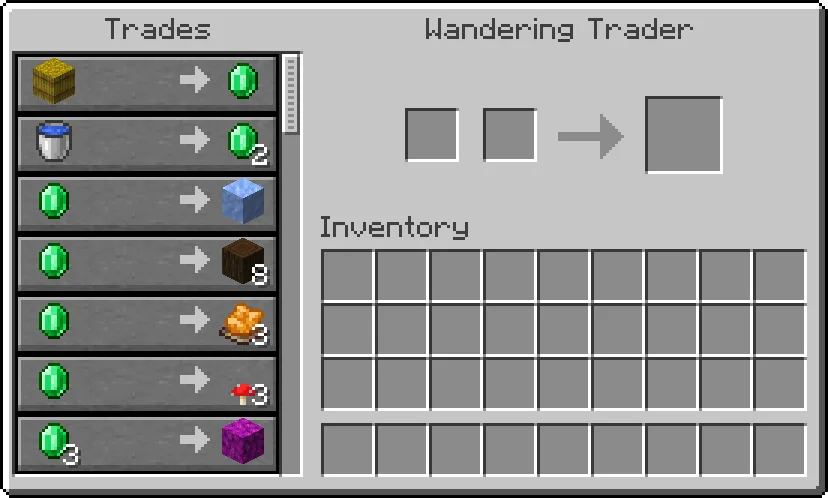
Dye also runs the other way, into emeralds. An apprentice-level shepherd buys 12 of any dye for 1 emerald, and a novice shepherd buys 18 white, brown, black or gray wool for 1 emerald. So a flower farm plus a shepherd is a real, if unglamorous, emerald income — see the villager trading guide for how to lock those offers in.
Do not run both sides. Buying 12 dye from a wandering trader costs 4 emeralds and selling those same 12 to a shepherd returns 1. That is a 4-to-1 loss, every time.
Wandering traders will also sell you the flowers themselves, one per emerald for most small flowers — but not wither roses, torchflowers, closed eyeblossoms, or any of the tall flowers. Open eyeblossoms are on the list; closed ones never are, so the closed eyeblossom stays a pale garden errand.
Java and Bedrock do not dye the same way
Four differences, and the first one changes what a recipe will accept.
- Bedrock lets four items stand in for dyes; Java does not. In Bedrock and Education editions, bone meal, ink sacs, lapis lazuli and cocoa beans substitute directly for white, black, blue and brown dye in recipes. In Java you must craft them into the dye first. The Bedrock substitution also has to be total — you cannot put lapis lazuli and blue dye into the same recipe and expect it to work.
- Leather armour is dyed differently. In Java you craft dye onto leather armour, wolf armour or leather horse armour directly, several dyes at a time, and previous colours affect the result. In Bedrock and console you dye a cauldron of water first, then dip the armour, which spends one layer of water. Enchantments and custom names survive either way.
- Bedrock cauldron water only remembers its current colour. Adding a dye averages the dye into whatever colour the water already is. The order therefore changes the outcome: blue, pink, blue, pink does not land on the same colour as pink, blue, pink, blue.
- Sign text is fussier in Bedrock. An ink sac will not set sign text to black there; it has to be actual black dye. Signs default to black text, and using the colour a sign already has just opens the edit screen instead of spending the dye.
One cosmetic difference worth knowing: in Java, a sheep renders its wool with its own, darker colour values than the dye itself, while Bedrock sheep use the plain dye colours. A dyed Java sheep looks darker than the dye you used on it — the wool it drops is the normal block either way.
What you can undo
Dye is usually permanent, and the exceptions are worth memorising because two of them are genuinely useful:
- Dyed leather armour, wolf armour and leather horse armour revert to their original colour when used on a cauldron of plain water, in both editions.
- A dyed shulker box can be stripped back to undyed in a cauldron. Re-dyeing it purple does not undo it — that just makes a purple shulker box.
- Terracotta, concrete powder and concrete are one-way. There is no cauldron trick.
- A dyed candle stays that colour; only undyed candles take dye.
Everything else — wool, carpet, beds, bundles, harnesses, sheep, collars, sign text — can be recoloured as often as you like, for one dye a go.
Quick Action Checklist
- Find a flower forest. It supplies eight of the sixteen dyes directly, and purple and light blue immediately after that.
- Plant one rose bush, one lilac, one sunflower and one peony, then bone meal them. Two dye per pick, infinite copies, no farm needed.
- Build a cactus farm. Green has no crafting recipe, and cyan and lime both depend on green.
- Kill squid for black, not withers. Cocoa pods in jungles for brown.
- Dye sheep, not wool. One dye, 1 to 3 wool per shear, forever, and the lambs inherit the colour.
- Spend dye on the 8-for-1 recipes — glass, panes, terracotta, concrete powder — and let sheep cover the wool.
- Choose terracotta and concrete colours once. Neither can ever be re-dyed.
- Keep a shepherd if the flower supply outruns the build, at 12 dye per emerald.
Frequently Asked Questions
How do you make all 16 dyes in Minecraft?
Which Minecraft dye can only be made by combining other dyes?
How do you make green dye in Minecraft?
Is it better to dye wool or dye a sheep in Minecraft?
Can you remove dye from things in Minecraft?
What is the difference between dyeing in Java and Bedrock Minecraft?
Keep Reading
- Mythras blog
- Minecraft coverage hub
- Banner guide (how the loom spends dye)
- Pale garden guide (eyeblossoms)
- Sniffer guide (torchflower and pitcher plant)
- Villager trading guide (shepherd dye trades)
- XP guide (cactus smelting XP)
- Shulker box guide
- Bundle guide
- Happy ghast guide (harnesses)
- Firework guide (firework star colours)
- How to beat the wither (wither roses)
- Minecraft Wiki — Dye: the full list of dyeable items, trading prices, cauldron rules and edition differences
- Minecraft Wiki — Crafting/Dye: every dye crafting recipe and yield
- Minecraft Wiki — Green Dye: smelting a cactus is the only production method, 1 XP in Java and 0.2 in Bedrock
- Minecraft Wiki — Purple Dye: blue plus red is the only recipe
- Minecraft Wiki — Yellow Dye: dandelion, wildflowers, golden dandelion and sunflower
- Minecraft Wiki — Magenta Dye: allium, lilac and the three dye-combination recipes
- Minecraft Wiki — Flower: per-biome generation tables, bone meal duplication of double flowers, wandering trader flower sales
- Minecraft Wiki — Eyeblossom: opens at night and closes by day, dropping in whichever state it was in
- Minecraft Wiki — Sheep: shearing yields 1-3 wool, wool regrows only by grazing, breeding colour rules
- Minecraft Wiki — Wither Rose: dropped by any mob the wither kills
- Minecraft Wiki — Wandering Trader: 3 of any dye per emerald, up to 12 uses
- Minecraft Wiki — Trading: shepherd buys 12 dye or 18 wool per emerald
Related Guides
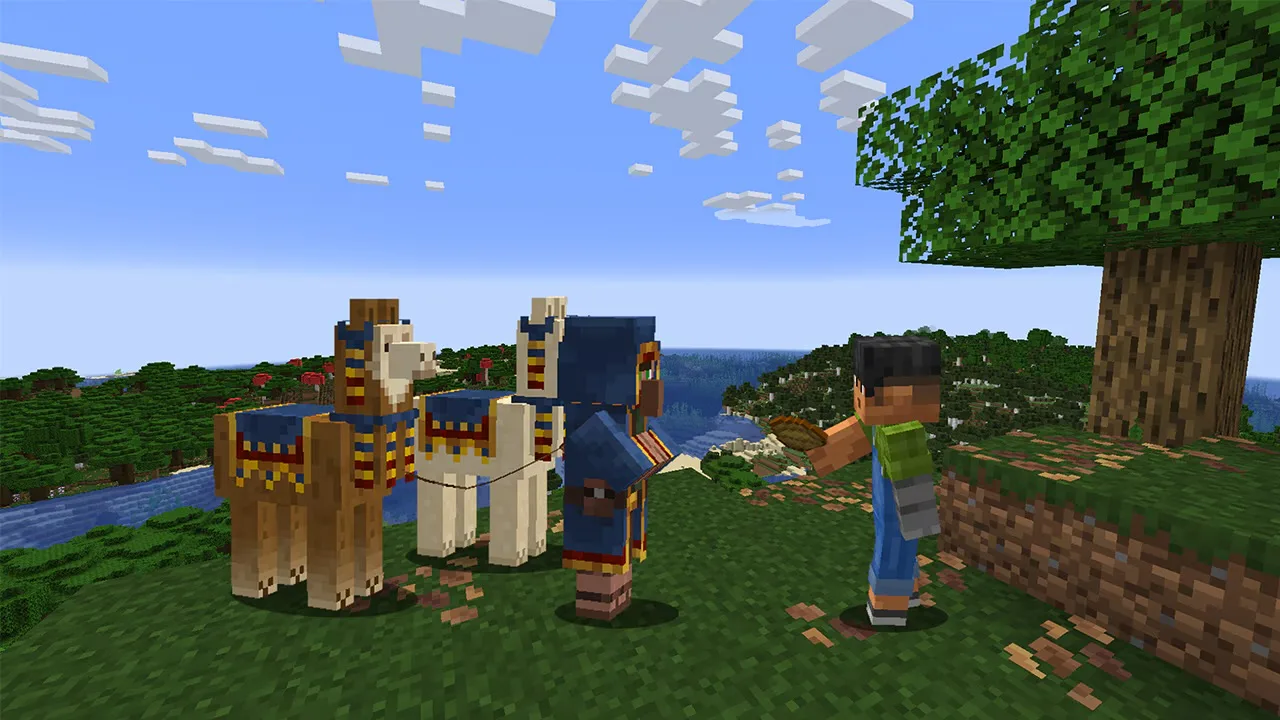
Minecraft Wandering Trader Guide: Trades, Spawns and Llamas
Every wandering trader shows 9 offers drawn from a pool of 100 that is the same on Java 26.3 and Bedrock 26.50. Here is the full price list from the game's own trade files, the odds of seeing the offer you want, what the trader buys from you, how long one takes to spawn, and why a name tag will not keep it.
Minecraft Name Tags Guide: How to Get, Use & Secret Names
A name tag is the cheapest insurance policy in Minecraft: name almost any mob and it will never despawn, no matter how far you roam. The exceptions are wandering traders, which still leave, and most hostile mobs on Peaceful. Since Java 26.1 and Bedrock 26.10 you can craft one from a scrap of paper and a metal nugget, so there's no excuse for losing a zombie villager before you can cure it anymore. This guide covers every way to get one, the anvil step you can't skip, and the hidden names that flip mobs upside down.
Minecraft on Switch 2: Free Upgrade, Price and Minecoins
Digital owners of Minecraft for Nintendo Switch get the native Switch 2 version free in most regions until January 31, 2027. Cartridge owners have been offered nothing so far. Here are the editions, the US prices, what the native version changes, and the Minecoins change that lands on the same day.
Minecraft Spear Guide: Jab, Charge Damage, and Lunge
A diamond spear jabs for 4 damage. Held low on an elytra at rocket speed, the same spear charges for 37. The spear's charge takes its damage from how fast you are moving, and the weapon breaks several rules the rest of Minecraft combat runs on. Here are the real numbers for every tier, both attacks, and Lunge.
Minecraft Survival Guide for Beginners: Your First Days
You have about ten minutes of daylight before the sun sets and the world tries to kill you. Here is exactly what to do with them — punch a tree, build a tool chain, and get a roof over your head before the zombies arrive.
Best Minecraft Enchantments, Ranked — The Ones Worth Your XP
Mending is the enchantment that ends the grind — gear that repairs itself forever. Everything else is a fight over your XP and anvil uses. Here is what actually earns a slot, ranked, with the real max levels.